
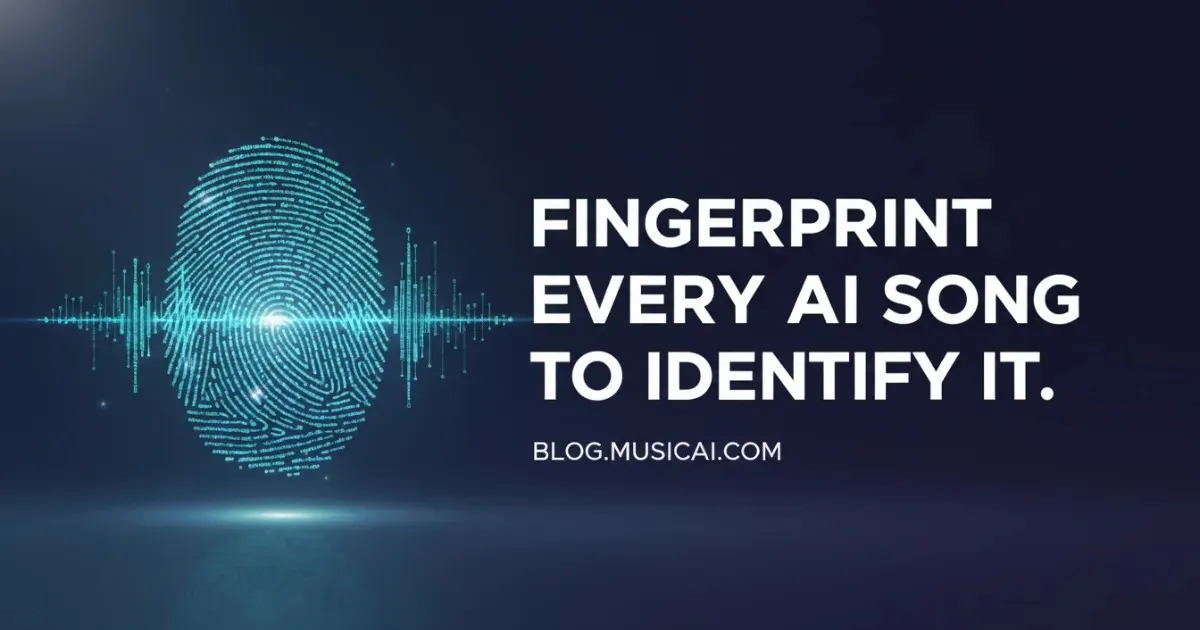
Fingerprint Every AI Song to Identify It
The global music industry is undergoing a seismic shift. As we navigate the realities of 2026, generative AI platforms can produce radio-ready tracks, complete with lifelike vocals and complex instrumentation, in a matter of seconds. While this democratizes music creation, it has also unleashed an unprecedented wave of copyright infringement, deepfakes, and royalty dilution. Streaming platforms are now flooded with thousands of synthetically generated tracks daily.
To combat this chaotic over-saturation and protect the intellectual property (IP) of human artists, technology companies, record labels, and regulatory bodies have converged on a single imperative mandate: we must fingerprint every AI song to identify it.
By embedding unique, imperceptible acoustic markers into generated audio, the industry can trace the lineage of a track, enforce digital rights management (DRM), and ensure fair compensation. This guide provides an expert-level, deeply technical, and strategic breakdown of how AI audio fingerprinting works, why it matters, and how it is shaping the future of digital audio.
What is Fingerprint Every AI Song to Identify It?
To fingerprint every AI song to identify it is the process of embedding a unique, imperceptible digital acoustic signature or cryptographic watermark into a generative AI audio file at the moment of its creation. This ensures that algorithmic detection systems can instantly scan, recognize, and categorize the track as AI-generated, tracing it back to the specific generative AI development model or prompt used.
Unlike standard metadata (which can be easily deleted or altered), an acoustic fingerprint alters the fundamental frequency domain of the audio, making the digital signature robust against compression, cropping, or format conversion.
Why It Matters
The strategic necessity of AI song identification extends far beyond simple curiosity. It is the foundational pillar for maintaining a sustainable music economy in an era of limitless synthetic generation.
Copyright Protection and Compliance: Without reliable identification, it is nearly impossible to prove whether an AI model was illegally trained on copyrighted music. Fingerprinting helps establish transparent data provenance.
Deepfake Mitigation: The rise of unauthorized "voice clones" mimicking major pop stars has triggered massive legal disputes. Fingerprinting allows platforms to instantly flag and block synthetic voice clones, a growing concern for any AI voice generator before they go viral.
Royalty Distribution Equity: If digital service providers (DSPs) cannot differentiate between human and AI tracks, the royalty pools are diluted. Fingerprinting ensures that human artists are compensated fairly, while AI-generated background music can be monetized under different, highly regulated structures.
Regulatory Adherence: With the enforcement of global AI regulations in 2026, generative platforms are legally required to watermark their outputs. Failure to systematically fingerprint every AI song exposes tech companies to catastrophic liability.
How It Works: The Technical Process
Identifying an AI song requires sophisticated digital signal processing and cryptographic hashing. The process typically unfolds in four main stages:
Step 1: Active Watermark Embedding
Unlike traditional tools like Shazam—which create a fingerprint from an existing song—AI fingerprinting often utilizes active watermarking. As the neural network generates the audio waveform, a specific, inaudible frequency pattern (a pseudo-random noise sequence) is woven directly into the spectrogram of the track.
Step 2: Cryptographic Hashing
To ensure the fingerprint cannot be spoofed, the signature is cryptographically hashed. The security protocols used here are highly advanced, often drawing parallels to enterprise data security methods like vaultless tokenization vs encryption, where the data mapping ensures the core asset (the song) remains intact while the underlying identifier remains secure and immutable.
Step 3: Fast Fourier Transform (FFT) Analysis
When a song is uploaded to a streaming platform, the platform's detection algorithm uses a Fast Fourier Transform (FFT) to convert the audio signal from the time domain into the frequency domain. The algorithm scans this frequency domain looking for the specific peaks and troughs that correspond to known AI watermarks.
Step 4: Database Cross-Referencing
Once the fingerprint is extracted, it is checked against a massive, decentralized registry of AI generation logs. If a match is found, the system immediately tags the track with its origin model, generation timestamp, and licensing status.
Key Features of Modern AI Audio Fingerprinting
To effectively fingerprint every AI song to identify it, the underlying technology must possess several critical attributes:
Imperceptibility: The watermark must not degrade the audio quality or be audible to the human ear, even on high-fidelity playback systems.
Robustness: The fingerprint must survive MP3/AAC compression, equalization changes, pitch shifting, speed alteration, and background noise additions.
Low Latency: Detection algorithms must operate in real-time, scanning millions of daily uploads without bottlenecking platform servers.
Tamper Resistance: The signature cannot be removed or masked by malicious actors using standard audio editing software.
Granular Traceability: Advanced fingerprints can identify not just the AI platform used, but the specific user session or API key that generated the track.
Benefits and ROI of AI Song Identification
Implementing a rigorous fingerprinting infrastructure yields substantial tangible benefits for stakeholders across the music ecosystem.
For Streaming Platforms (DSPs): Automated fingerprinting drastically reduces the operational costs of manual moderation. DSPs can avoid multi-million-dollar copyright infringement lawsuits by automatically rejecting unauthorized synthetic tracks. To handle the scale of this monitoring, platforms are increasingly relying on AI Agents for Risk Monitoring to automate takedowns.
For AI Companies: Proactive watermarking proves compliance with international AI acts, protecting the company's valuation and building trust with enterprise partners.
For Human Artists: Protects their brand value, ensures their voice isn't monetized without permission, and secures their rightful share of streaming royalties.
For Record Labels: Allows labels to safely commercialize their own licensed AI tools, knowing that the resulting IP can be tracked, monetized, and protected.
Use Cases in 2026
The mandate to fingerprint every AI song to identify it has spawned numerous real-world applications:
Automated DMCA Takedowns
Major labels use web crawlers equipped with fingerprint detection to scan social media platforms (like TikTok and YouTube). When a user uploads an unauthorized AI clone of a protected artist, the fingerprint triggers an automated, instant takedown notice.
Transparent Royalty Splitting via Smart Contracts
The integration of acoustic fingerprinting with blockchain technology has revolutionized payouts. By identifying the AI and human elements of a hybrid track, royalties can be automatically dispersed using decentralized ledgers. Partnering with a Smart Contract Development Company in Singapore or similar tech hubs allows platforms to automate complex, split-second royalty payments without manual accounting.
AI Music NFT Verification
As the digital ownership economy matures, verifying the authenticity of music assets is critical. If a creator wants to mint a synthetic track, the underlying acoustic fingerprint ensures the platform can verify its generative origin, heavily influencing how to Create Nft Marketplace Features Types Cost effectively, often built out by a dedicated NFT marketplace development company.
Real-World Examples
The "Drake/The Weeknd" Ghostwriter Prevention Protocol: Following the infamous 2023 viral AI clone track, major labels in 2026 require all DSPs to run mandatory fingerprint checks on vocals, often powered by dedicated AI voice bot development teams. If a vocal matches a copyrighted artist's biometric voice model without an accompanying "authorized license" fingerprint, the upload is blocked at the server level.
In-DAW Watermarking: Leading Digital Audio Workstations (DAWs) now feature built-in AI generators that automatically embed a universal fingerprint into the master bus before the track can be exported, a workflow increasingly built with dedicated media software development services.
Platform-Native Solutions: Generative giants like Suno and Udio now embed cryptographic metadata and acoustic watermarks into every generated second of audio, logging the generation event on an immutable ledger.
Comparison: Identification Methods
Understanding how AI fingerprinting differs from older methods is crucial for technical strategy.
Feature | Traditional Acoustic Fingerprinting (e.g., Shazam) | Metadata Tagging (ID3/Exif) | Generative AI Audio Watermarking |
|---|---|---|---|
Primary Mechanism | Extracts unique traits from existing audio | Adds text-based tags to the file wrapper | Embeds a synthetic frequency pattern during creation |
Robustness | High (survives compression) | Very Low (easily deleted) | Very High (woven into the audio signal itself) |
Purpose | To identify an existing, registered human song | To provide title, artist, and copyright text | To prove generative origin and trace AI lineage |
Tamper Resistance | High | Low | Extremely High |
Implementation | Post-creation | Post-creation | Real-time during generation |
Challenges and Limitations
While the imperative to fingerprint every AI song to identify it is clear, the technology is not without its hurdles.
The Analog Hole: If an AI song is played through high-quality speakers and re-recorded using a high-fidelity microphone, the acoustic environment can sometimes degrade the embedded watermark enough to bypass detection algorithms.
Open-Source Evasion: While commercial AI platforms enforce watermarking, open-source AI audio models downloaded locally by malicious actors may lack fingerprinting mechanisms entirely, creating a blind spot.
Audio Degradation Concerns: Audiophiles and professional mastering engineers often express concerns that aggressive frequency-level watermarking can subtly degrade the phase alignment or harmonic richness of a track.
Lack of Universal Standardization: As of early 2026, competing tech conglomerates are still battling over a unified, open-source standard for audio watermarking, leading to fragmented detection systems.
Future Trends (Context 2026 and Beyond)
As we navigate the highly regulated landscape of 2026, the ecosystem of digital audio is converging with decentralized technologies and autonomous systems.
The Transition to Web3 Frameworks: The necessity for immutable, global registries of audio fingerprints is driving the industry toward decentralized architectures. Understanding the shift from centralized servers to blockchain-based verification requires analyzing Web1 Vs Web2 Vs Web3. In Web3, once an AI song is fingerprinted, its unique hash is stored on a public ledger, making copyright disputes instantly resolvable.
Integration with AI Business Operations: Music labels are no longer just entertainment companies; they are deep-tech firms. Labels are deploying specialized AI Agents for Business to autonomously manage their vast catalogs, negotiate micro-licenses for AI training, and scan global networks for fingerprint matches, alongside AI agents for content creation that help catalog and tag incoming tracks at scale.
DeFi and Micro-Royalties: With AI songs flooding the market, traditional payment rails are too slow and expensive to handle fractions of a cent per stream. Fingerprinting will directly link to decentralized finance pools, a concept foundational to understanding What Is Decentralized Finance Defi, allowing continuous, real-time royalty streaming directly to the model creators and human rights holders, often supported by DeFi development services.
Conclusion
The explosion of generative audio has permanently altered the creative landscape. To maintain trust, legality, and financial equity, the digital music industry has no choice but to fingerprint every AI song to identify it.
Through advanced acoustic watermarking, cryptographic hashing, and automated detection algorithms, stakeholders can successfully distinguish between human ingenuity and synthetic generation. While challenges remain regarding open-source evasion and standardization, the fusion of AI fingerprinting with blockchain ledgers and smart contracts provides a robust framework for the future of music copyright.
Organizations that fail to implement these identification technologies will find themselves overwhelmed by copyright liability and unable to operate in the heavily regulated digital environments of 2026 and beyond.
Frequently Asked Questions (FAQs)
It refers to the process of embedding an imperceptible, unique acoustic watermark into a synthetically generated audio file, allowing algorithms to detect its AI origin, the model used, and its licensing status.
Unlike standard metadata, which can easily be stripped from a file wrapper, an active acoustic watermark is woven into the frequency domain of the audio itself. Removing it typically degrades the audio quality to an unusable state.
Shazam analyzes a pre-existing human song to find a match in a database based on acoustic landmarks. AI fingerprinting actively embeds a synthetic, cryptographic signal into the song at the exact moment it is generated by the AI model.
Modern audio watermarking algorithms operate in frequencies and phases that are imperceptible to human hearing. The watermark is designed to be invisible to the listener but glaringly obvious to an algorithmic scanner.
As of 2026, purely AI-generated music cannot be copyrighted by a human. However, if a human artist uses AI as an assistive tool, the fingerprint can help define the percentage of human vs. AI contribution, guiding complex royalty splits.
Un-fingerprinted generative tracks uploaded to major streaming platforms in 2026 are highly likely to be flagged by anomaly detection algorithms and rejected, or subjected to manual review, due to stringent global AI regulations.

Yash Singh is the Chief Marketing Officer at Vegavid Technology, a leading AI-driven technology company specializing in AI agents, Generative AI, Blockchain, and intelligent automation solutions. With over a decade of experience in digital transformation and emerging technologies, Yash has played a key role in helping businesses adopt advanced AI solutions that enhance operational efficiency, automate workflows, and deliver personalized customer experiences across industries including fintech, healthcare, gaming, ecommerce, and enterprise technology. An alumnus of Indian Institute of Technology Bombay, Yash combines strong technical expertise with strategic marketing leadership to drive innovation in AI-powered applications, autonomous AI agents, Retrieval-Augmented Generation (RAG), Natural Language Processing (NLP), Large Language Models (LLMs), machine learning systems, conversational AI, and enterprise automation platforms. His expertise spans AI model integration, intelligent workflow automation, prompt engineering, smart data processing, and scalable AI infrastructure development, enabling organizations to accelerate digital transformation and business growth. Passionate about the future of intelligent systems, Yash actively shares insights on AI agents, Generative AI, LLM-powered applications, blockchain ecosystems, and next-generation digital strategies. He is committed to helping businesses embrace AI-first transformation while guiding teams to build impactful, industry-specific solutions that shape the future of innovation and intelligent technology.






Leave a Reply