

Top 10 AI Trends in 2026: Latest Artificial Intelligence Developments Transforming Business
Key takeaways:
78% of organizations now use AI in at least one business function — proof that the latest AI trends have moved from experimentation to standard practice.
Deloitte's 2026 State of AI in the Enterprise survey of 3,235 global leaders found only 34% of companies have fully reimagined their operations around AI, even as access keeps climbing — the gap is where the next wave of AI advancements will be won or lost.
Conversational AI, Agentic AI, Physical AI, and Sovereign AI are the four trends Deloitte's research flags as the ones reshaping enterprise strategy right now.
Choosing the right generative AI development company and AI agent development company is now a core part of any digital transformation roadmap.
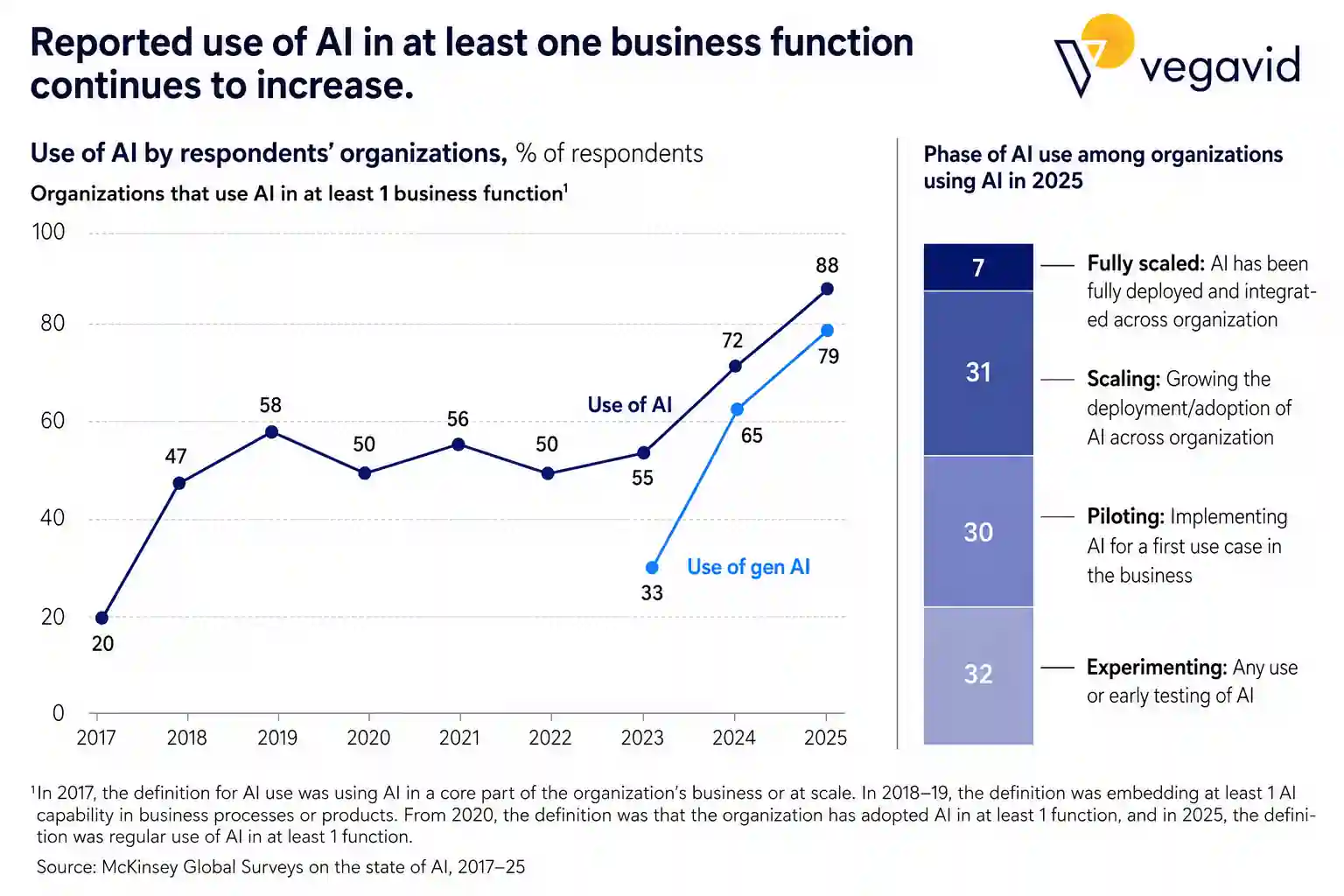
Artificial intelligence doesn't just automate tasks anymore — it's reinventing how businesses compete. By 2024, 78% of organizations reported using artificial intelligence in at least one business function, up from 55% the prior year — a trend McKinsey's State of AI 2025 survey shows has climbed steadily since 2017, with adoption reaching 88% by 2025.
What's changed heading into 2026 isn't whether companies use AI — it's how much of the organization actually runs on it. Deloitte's 2026 enterprise AI trends research, based on a survey of nearly 3,700 professionals, found most organizations have stopped debating whether to adopt AI but have not yet fully transformed how they operate around it. Only 42% have reached the point of measuring AI's strategic value at board level. That gap between AI access and AI integration is the real story behind this year's top AI trends for business, and it's the lens we'll use to walk through what's new in artificial intelligence, the market data behind it, and how it's playing out across industries in 2026.
Keeping pace with the top AI trends has been the dire need of the time.
With 78% of global businesses already using AI in at least one function, the question isn't if you should start, but how fast you can scale.
AI Market Statistics and Adoption Trends in Business
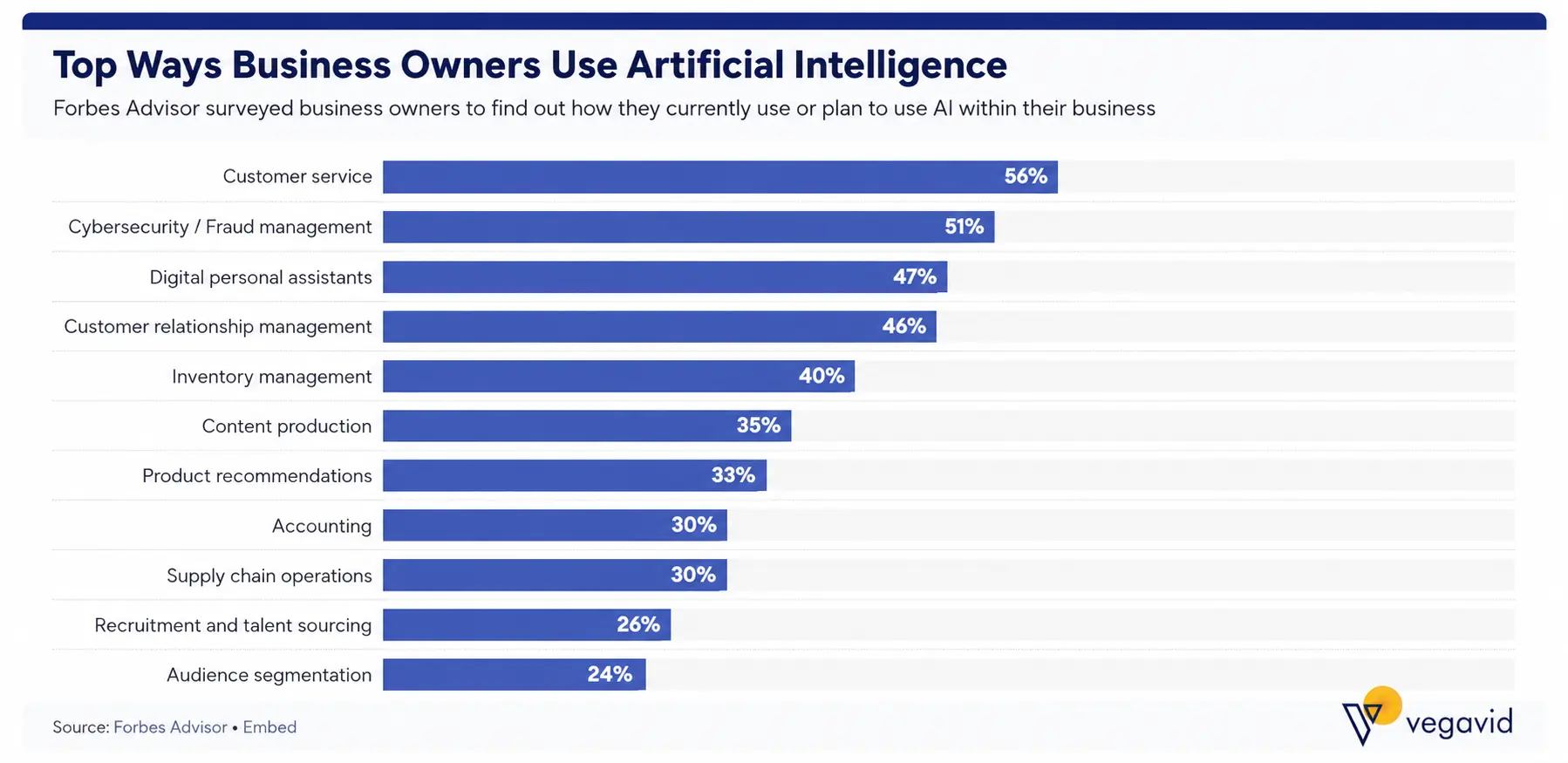
Businesses today lean on AI most heavily in customer service, fraud detection, and content production, with adoption climbing every year across nearly every sector. The most common AI use cases include customer service (56%), cybersecurity and fraud management (51%), digital personal assistants (47%), customer relationship management (46%), inventory management (40%), and content production (35%), as shown in Forbes Advisor's survey below.
This widespread use of AI in business is driving measurable gains in efficiency and cost savings:
97% of business owners believe AI-enabled tools will positively impact their operations, particularly in content creation and website development.
60%+ of business owners see AI as a tool to strengthen customer relationships.
60%+ of CTOs recognize AI's potential to boost productivity across teams.
Per Deloitte's State of AI in the Enterprise 2026 report, access to AI tools has risen roughly 50% since 2025, though only a third of organizations have moved past pilots into scaled, redesigned workflows.
Top 10 AI Trends Businesses Should Watch in 2026
While the AI landscape spans more than a dozen shifts, these ten are the ones most consistently showing up in enterprise roadmaps, budget conversations, and boardroom discussions right now.
1. Agentic AI
Agentic AI has moved from buzzword to budget line. Unlike traditional automation that follows fixed rules, agentic systems observe, decide, and act with minimal human intervention — resolving support tickets end-to-end, rebalancing supply chains mid-disruption, or triggering downstream workflows without waiting for a human approval step. Gartner has flagged agentic AI as one of the top strategic technology trends for 2026, predicting that a growing share of enterprise software will embed autonomous, goal-driven agents by the end of the decade (Gartner Newsroom). The governance question — who's accountable when an autonomous system acts — remains the biggest adoption barrier.
2. Physical and Embodied AI
Physical AI takes intelligence out of the browser tab and puts it into machines that sense, move, and act in the real world — robotic arms, autonomous forklifts, delivery drones, and surgical robots. Adoption is furthest along in manufacturing, logistics, and defense, where the ROI of reducing manual, repetitive, or dangerous work is easiest to prove. As sensors and edge compute get cheaper, expect physical AI to spread into retail, agriculture, and construction over the next two years.
3. Sovereign AI
Countries and increasingly individual enterprises want control over their own models, training data, and compute infrastructure — for regulatory, security, and geopolitical reasons. This is no longer a niche policy topic; it's shaping vendor selection, cloud contracts, and data residency requirements for mid-size and large enterprises alike. IDC's ongoing coverage of sovereign AI investment tracks how governments across Europe, the Middle East, and Asia are funding domestic AI infrastructure to reduce reliance on foreign providers (IDC).
4. Conversational AI
Conversational interfaces have graduated from scripted chatbots to context-aware systems that track intent, tone, and multi-turn history. Voice commerce, in-app assistants, and internal knowledge bots are the fastest-growing use cases. See our full breakdown of conversational AI development services for how this plays out in production systems.
5. Multi-Modal AI
Multi-modal models process text, images, audio, and video together instead of in isolation, producing a far more human-like understanding of context. This is powering everything from visual search in retail to AI copilots that can read a screenshot, listen to a voice note, and respond coherently across formats. PwC's research on multi-modal enterprise adoption notes that combining modalities is becoming a baseline expectation for new AI deployments rather than a differentiator (PwC AI Insights).
6. Retrieval-Augmented Generation (RAG)
RAG pairs the fluency of large language models with the accuracy of live, external data retrieval — reducing hallucination and keeping outputs current without constantly retraining the underlying model. It's especially valuable in regulated industries like healthcare, legal, and financial services where stale or fabricated answers carry real risk.
7. Generative AI
Generative AI remains the most visible trend to the public, but enterprise use has matured well past text and image generation into synthetic data creation, drug molecule modeling, and automated code generation. Explore our detailed look at generative AI for sector-specific applications.
8. Explainable and Ethical AI
As AI takes on higher-stakes decisions — lending, hiring, medical triage — the demand for transparent, auditable reasoning is growing just as fast as the models themselves. Regulatory frameworks like the EU AI Act are pushing explainability from a "nice to have" to a compliance requirement for high-risk AI systems (European Commission — AI Act).
9. AI Governance
Governance has shifted from a technical checklist to a board-level mandate — covering model risk management, data usage policy, bias auditing, and third-party vendor oversight. Organizations that build governance into the AI lifecycle from day one consistently report fewer compliance incidents and faster regulatory approval cycles.
10. Predictive Analytics
Predictive analytics continues to be one of the highest-ROI, lowest-friction entry points into enterprise AI — forecasting demand, flagging equipment failure before it happens, and optimizing pricing in near real time. Read more in our piece on predictive AI solutions.
AI Trends Shaping Business Today and Tomorrow
Several distinct trends are converging right now to redefine how enterprises operate, compete, and serve customers — this is the heart of what people mean when they search for the latest AI trends, new AI developments, or what's next for AI. Here's a closer look at each one.
Conversational AI
Conversational AI has moved far beyond simple chatbots into context-aware assistants that understand intent, tone, and emotion, not just scripted commands. This shift is improving both customer experience and internal productivity across industries.
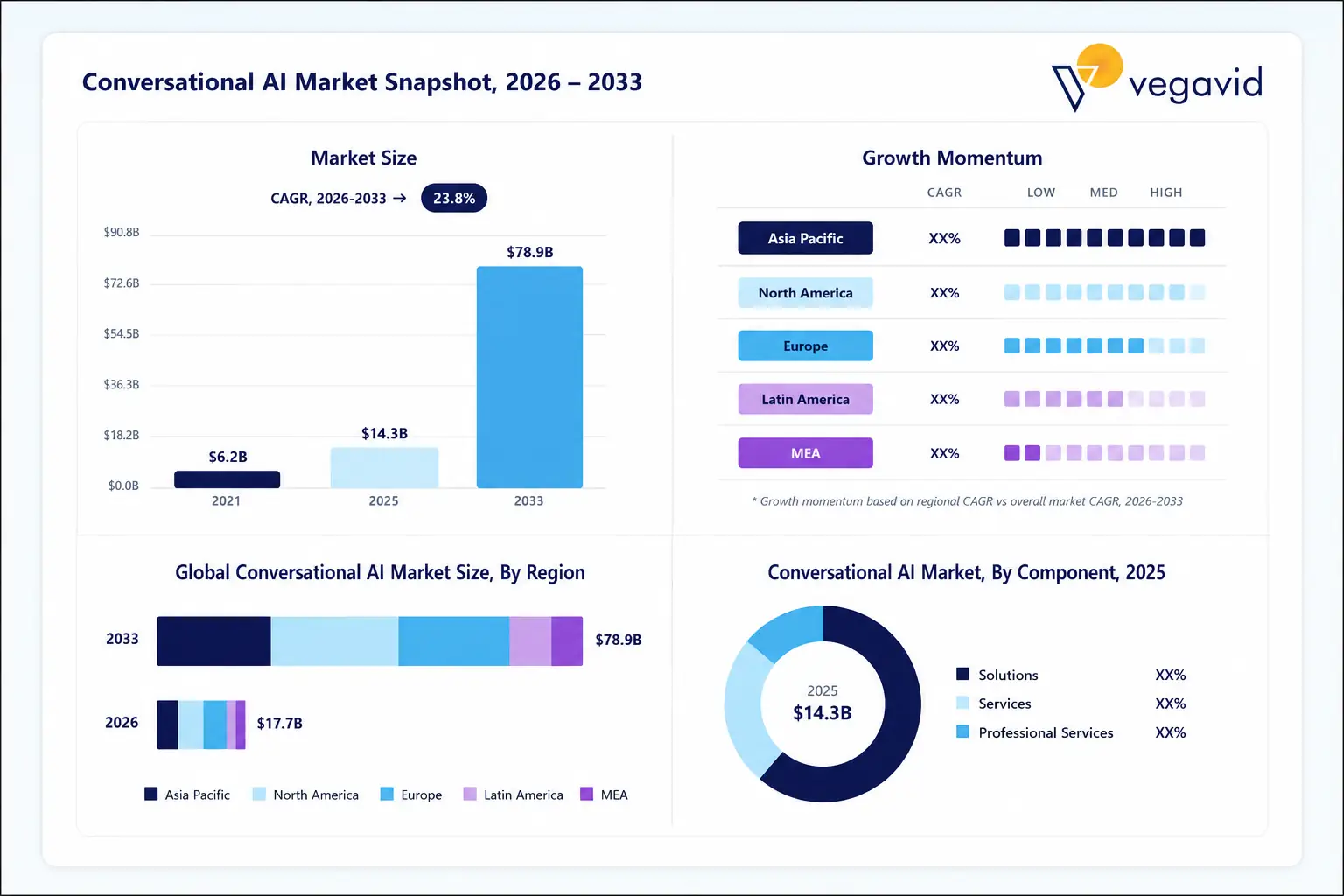
Retailers such as Amazon are enhancing their AI capabilities with models built for real-time speech processing and more natural conversational interactions. The global conversational AI market, valued at $11.58 billion in 2024, is projected to reach $41.39 billion by 2030 (Grand View Research). The regional breakdown below shows Asia Pacific leading growth momentum through 2033.
Predictive Analytics
Predictive analytics helps businesses forecast outcomes before they happen, allowing teams to optimize inventory, cut costs, and improve delivery times ahead of demand shifts. This is one of the clearest examples of AI-driven predictive analytics for business growth in action today.
In manufacturing, predictive models can flag likely machine failures before they occur, helping companies avoid expensive unplanned downtime. Explore more on predictive AI solutions for a deeper look at how this trend plays out across sectors.
AI Democratization (Low-code/No-code)
Low-code and no-code AI tools let non-technical teams build and customize intelligent systems using drag-and-drop interfaces rather than writing code from scratch. This is opening AI adoption to smaller businesses that previously lacked in-house data science teams.
Industry surveys suggest two-thirds of decision-makers expect a widespread democratization of data insights in the coming years, making AI workflow tools far more accessible to everyday business users.
Ethical and Explainable AI
As AI systems take on more decision-making responsibility, demand for transparency around how those decisions are made keeps growing. Many current AI models still operate as a "black box," leaving their outputs difficult for even their own developers to fully explain.
This is why explainable AI is gaining ground — it helps organizations build trust, reduce bias, and stay compliant with emerging regulations. Getting ethical AI governance frameworks right is quickly becoming a board-level priority rather than a purely technical one.
Multi-Modal AI
Multi-modal AI systems process speech, images, video, text, and numerical data together, creating a far more human-like understanding of context than single-format models. This approach powers many of today's most advanced assistants.
Enterprises are using multi-modal AI applications to combine natural language understanding, visual perception, and voice recognition into a single, more capable experience. Systems like Google DeepMind's Gato illustrate how one model can now handle language, vision, and robotic tasks at once.
Digital Twins
Digital twins are virtual replicas of physical assets or processes that let businesses monitor, test, and optimize performance in real time without touching the actual equipment. The approach has become especially popular alongside Industry 4.0 and IoT rollouts.
Manufacturers use digital twins to model everything from factory floors to entire supply chains, while some GPU makers have partnered with industrial software firms to build full industrial metaverses around this concept.
Collaboration of Humans and Robots (CoBots)
Collaborative robots, or cobots, are designed to work alongside human employees rather than replace them entirely, taking over repetitive tasks while people focus on design, oversight, and problem-solving. Millions of these systems are already deployed across factories worldwide.
This blend of human judgment and robotic precision is one reason manufacturing automation keeps accelerating without eliminating the human role in production.
Generative AI
Generative AI uses deep learning to create new content, images, and data from existing datasets rather than simply analyzing what already exists. It's one of the most visible and widely discussed generative AI trends in business today.
In healthcare, generative AI can help design prosthetic limbs or model organic molecules from scratch, supporting earlier diagnosis and more effective treatment planning. Tools that generate realistic images from natural language prompts, and large language models that produce human-like text, are the two most recognizable examples of this trend, built on deep learning architectures trained on massive datasets.
Shadow AI
Shadow AI refers to AI tools and applications employees adopt without IT department oversight, often in the name of moving faster or being more innovative. It creates real opportunities for agility but also real risks around security and compliance.
Companies need to weigh the benefits of these unsanctioned tools against the dangers of data breaches and poor system integration. Strong AI governance and continuous monitoring are essential for capturing the upside of shadow AI while managing its risks.
Retrieval-Augmented Generation (RAG)
Retrieval-augmented generation combines the precision of traditional search with the fluency of generative models, letting AI systems pull in external data before producing a response. This makes outputs more accurate and current than relying on a model's training data alone.
RAG is particularly valuable in healthcare, legal services, and customer support, where fast and precise information genuinely matters. By adopting RAG, businesses can tap into a much wider range of live data sources for richer, more reliable answers.
Sentimental AI
Sentiment AI analyzes human emotion from text, speech, and visual inputs, helping businesses respond to customers with more empathy and precision. This is a key driver of global AI adoption for small and mid-sized businesses in customer-facing roles.
In customer service, teams can tailor responses to individual needs, improving satisfaction and loyalty.
In marketing, sentiment AI helps craft emotionally resonant campaigns that lift engagement and conversion.
In mental health, sentiment analysis offers valuable signals for diagnosing and treating emotional conditions more effectively.
Quantum AI
Quantum AI applies principles from quantum computing to improve how AI algorithms solve complex problems, potentially unlocking breakthroughs in material science and data encryption. This method could handle computations that remain impractical for classical computers today.
As it matures, quantum AI is expected to strengthen machine learning models by processing far larger datasets more efficiently, with several major computing firms already partnering to accelerate integrated quantum and generative AI platforms.
Agentic AI
Agentic AI systems learn from patterns, adapt on the go, and act with minimal human input rather than simply following pre-set rules — this is what separates them from earlier generations of automation software, and it's one of the four trends Deloitte's 2026 research highlights as central to enterprise AI strategy, alongside physical AI and sovereign AI.
For businesses, that can mean customer service that resolves itself, supply chains that self-correct before problems escalate, and analytics tools that act on data instead of just reporting it. It also raises real governance questions: how do you ensure an autonomous system acts ethically, and who is accountable when it doesn't? Learn more about how a modern AI agent development company approaches these tradeoffs when building agentic systems for enterprise use.
Physical and Embodied AI
Physical or embodied AI puts intelligence into machines that can move, sense, and interact with the real world, not just process code in the background — think robots, drones, and autonomous vehicles working in real physical environments. Deloitte notes that adoption is especially advanced in manufacturing, logistics, and defense, where robotic picking arms, autonomous forklifts, and drones are already reshaping day-to-day operations.
We're already seeing robots assist surgeons, drones inspect power lines, and automated machines run factory floors with precision humans can't sustain over long shifts. As more physical jobs get automated, businesses will need to think seriously about worker upskilling, privacy, and public trust.
Sovereign AI and Geopolitical Dynamics
Sovereign AI is the idea of countries — and increasingly individual enterprises — controlling their own AI models, data, and infrastructure largely for security and self-reliance. It's no longer just a national-policy topic: Deloitte's 2026 enterprise survey found 83% of companies now treat data residency and in-country compute as at least moderately important to their strategic planning, and 66% are at least moderately concerned about depending on foreign-owned AI infrastructure.
Major economies are pouring billions into homegrown AI programs to secure a competitive edge, but this growing divide brings its own risks. If every nation — or every company — builds in isolation, global collaboration on AI safety and innovation could slow down significantly.
Responsible AI
Responsible AI focuses on making sure systems are developed and deployed ethically, transparently, and in line with broader societal values. Fairness, accountability, and bias reduction sit at the core of this approach.
As AI keeps weaving into daily business operations, organizations that prioritize responsible AI build stronger user trust while reducing the risk of discrimination claims and regulatory penalties.
AI Governance
AI governance is the framework of policies and oversight structures that ensure organizations use AI responsibly, transparently, and in compliance with regulation. It has become a board-level priority rather than a purely technical checkbox — and per Deloitte's research, enterprises where senior leadership actively shapes AI governance see meaningfully greater business value than those that leave it entirely to technical teams.
Effective governance means setting clear rules for data usage, model transparency, and auditing decisions to catch bias or unintended consequences early. Continuous monitoring and correction mechanisms help organizations maintain both stakeholder trust and regulatory compliance over the long run.
Power of AI Trends When Combined with Other Emerging Technologies
AI delivers even more value when it's paired with other emerging technologies, unlocking intelligent automation that neither technology could achieve alone. Here's how AI is converging with the rest of the tech stack.
AI + Internet of Things (IoT)
Combining AI with the Internet of Things connects every device in a network so they can identify patterns, run predictive analytics, and respond to real-world conditions instantly. AI handles the pattern recognition side, while IoT devices supply the constant stream of real-time data that makes those predictions useful.
AI + Blockchain
Pairing AI with blockchain combines decentralized trust with intelligent automation, giving businesses better transaction quality, greater transparency, and lower barriers to entry in emerging markets. This dual technological power is especially valuable for industries that need both high-quality data and decentralized intelligence working together.
AI + Augmented Reality
AI and augmented reality together create far more interactive and immersive digital experiences, nearly blurring the line between the physical and virtual worlds. With this combination, businesses can detect planes, estimate depth, and infer 3D object positions in real time.
AI + Edge Computing
Edge computing moves AI processing away from centralized cloud servers and closer to where the data is actually generated, cutting latency and speeding up decision-making. Because algorithms evaluate data locally instead of sending it back and forth to a data center, response times drop sharply — a critical advantage for real-time IoT applications.
AI + 5G
When AI is paired with 5G networks, businesses gain the speed and reduced latency needed for advanced use cases like self-driving vehicles and smart city infrastructure. In smart cities, AI-driven systems can instantly evaluate massive volumes of camera and sensor data thanks to 5G's near-instant connectivity, while autonomous vehicles use the same networks to exchange data with nearby cars and infrastructure in real time.
Enterprise AI Trends and Applications Across Industries
New AI trends are helping businesses across every major sector automate operations, cut costs, and unlock new revenue streams. Here's a closer look at how AI is playing out in some of the world's most prominent industries.
AI in Healthcare
AI is helping healthcare providers diagnose faster, personalize treatment, and monitor patients beyond the walls of a clinic.
Diagnosis and Treatment: AI analyzes medical images like MRIs and X-rays to help diagnose conditions and recommend personalized treatment plans.
Drug Discovery: AI predicts molecular interactions to identify promising drug candidates faster than traditional research methods.
Remote Monitoring: AI-powered wearables let medical teams track patient health in real time and respond quickly to anomalies.
Healthcare Biometrics: Neural networks enable retinal scans and skin analysis that can flag risk factors early.
See how a specialized AI development company in healthcare can help build compliant, patient-facing AI systems for hospitals and clinics.
AI in Gaming
AI is reshaping gaming through better visual quality, more natural voice interactions, and personalized gameplay tailored to each player.
Realistic Game Worlds: Deep learning models help developers deliver more immersive, visually rich environments.
Voice Interaction: Voice assistants let players access features and controls without navigating complex menus.
Adaptive Gameplay: AI-driven systems adjust difficulty and content in real time, making each player's experience feel individualized.
AI in Retail/eCommerce
Retailers are using AI to reduce waste, personalize the shopping journey, and remove friction from checkout.
Inventory Management: AI forecasts demand and optimizes stock levels to reduce wastage.
Visual Search: Customers can search for products using images instead of text, improving the shopping experience.
Checkout-Free Shopping: Smart carts, RFID tags, and computer vision let shoppers skip the checkout line entirely.
Personalized Marketing: AI analyzes consumer behavior to deliver tailored product recommendations that boost engagement and ROI.
AI in Transportation
AI is powering safer navigation and smarter traffic systems across urban and long-haul transportation networks.
Autonomous Navigation: Self-driving cars use AI to navigate safely and reduce congestion.
Traffic Management: AI-powered systems analyze camera and sensor data in real time to ease urban mobility.
Emerging Applications: Digital number plates and virtual-track train systems are newer, more disruptive examples of where this trend is headed globally.
AI in Manufacturing
Manufacturers are turning to AI to prevent downtime, tighten supply chains, and catch defects before products leave the line.
Predictive Maintenance: AI flags equipment issues before failure occurs.
Supply Chain Optimization: AI-driven forecasting reduces delays across the supply chain.
Industry 5.0 Frameworks: These balance automation with human oversight on the factory floor.
Computer Vision: Real-time defect detection systems catch quality issues as they happen.
Explore AI in manufacturing and smart factory implementation for a deeper breakdown of these use cases.
AI in Finance
Financial institutions rely on AI to catch fraud in real time, trade faster, and price risk more precisely.
Fraud Detection: Machine learning algorithms recognize unusual transaction patterns in real time to prevent fraud.
Algorithmic Trading: AI-driven trading tools help firms execute trades faster and manage investment risk more precisely.
Insurance Risk Scoring: Insurers use AI to compute risk scores, examine accident imagery, and monitor driver behavior for claims processing.
Read more on AI shaping the future of financial services for a detailed sector view.
AI in Agriculture
AI is helping farmers work smarter, reducing input costs while improving yield and crop health.
Crop and Soil Monitoring: AI tracks crop health and soil conditions to guide better decisions.
Automated Machinery: Automated harvesters and tractors carry out tasks more precisely with less labor.
Pest Detection: AI-driven detection systems catch problems early to reduce both crop damage and pesticide use.
AI in Education
AI is enabling more personalized learning paths and giving educators sharper visibility into student performance.
Adaptive Learning: Platforms tailor lessons to each student's pace and learning style.
Smarter Assessment: AI-driven assessment tools give educators deeper insight into performance gaps that need targeted intervention.
AI in Entertainment
AI is changing how content gets made and how audiences experience it, from generation to real-time personalization.
Content Generation: Systems now generate visual art, audio, and scripts for creators.
Audience Insights: AI analyzes audience preferences to guide content strategy.
Adaptive Storytelling: Stories adjust in real time based on viewer reactions to boost retention and satisfaction.
AI in Construction
Construction teams are using AI to spot risk earlier — on the job site, in equipment, and in build quality.
Site Safety Monitoring: AI-driven cameras oversee job sites for safety risks.
Predictive Maintenance: Tools anticipate equipment failures before they cause downtime.
Quality Assurance: AI-based QA systems catch defects early to reduce costly rework.
AI in Cybersecurity
AI is strengthening both sides of the security equation — defense capabilities and the sophistication of what they defend against.
Facial Recognition: Being rapidly integrated to prevent unauthorized access.
Threat Hunting: Proactive systems combine manual and automated techniques to catch threats lurking undetected in a network.
24/7 Surveillance: AI-powered monitoring provides continuous coverage across large facilities.
Deloitte's Tech Trends 2026 research points to this same tension industry-wide: AI is accelerating both security innovation and the sophistication of the threats it has to defend against.
Ready to Turn AI Trends Into a Working Roadmap?
Reading about agentic AI, sovereign AI, and multi-modal systems is one thing — deploying them inside your existing tech stack, compliance requirements, and team structure is another. Vegavid works with businesses to close exactly that gap: from a first architecture conversation through to a deployed, monitored AI system.
Book a free AI strategy call with Vegavid →
What Are the Future Trends in Artificial Intelligence?
AI's growth shows no signs of slowing: industry forecasts suggest the global AI market, valued at $254.50 billion in 2025, will reach $1.68 trillion by 2031. Here's what's fueling that trajectory, and what recent advancements in AI suggest about where things head next.
1. AI Becomes Ubiquitous and Integrated
AI is shifting from a specialized tool into an everyday part of both home and work life, powering everything from personal task assistants to systems tackling climate and healthcare challenges at scale.
2. Surge in AI Investment
Global enterprises are dramatically increasing investment in custom AI models, with spending on AI expected to roughly double from $307 billion in 2025 to $632 billion by 2028.
3. Advancements in AI Reasoning
Companies are investing heavily in custom silicon and advanced reasoning models to meet growing demand for AI applications that can handle more complex, multi-step decision-making.
4. The Adoption-Integration Gap Closes
Deloitte's 2026 research frames this as the defining trend of the year: AI adoption is broadening faster than AI integration. Most organizations have handled the policy, procurement, and tooling side of AI, but only 34% have fully reimagined how their operations actually run. Expect the next 12–24 months to be about closing that gap through workflow redesign, not just tool rollout.
5. Focus on AI Safety and Ethics
As AI systems grow more powerful, safety and ethical use are becoming non-negotiable priorities, with international safety reports highlighting risks like privacy violations and potential misuse that demand stronger governance frameworks. C-suite leaders looking to act on these trends should also dig into machine learning models to inform capital investment and talent strategy.
Keep Pace with the Latest AI Trends with Vegavid
As AI trends continue to evolve at speed, businesses need a partner who builds for where AI is headed, not just where it stands today. At Vegavid, we help enterprises translate these AI industry trends into real, measurable business outcomes — whether that means smarter customer engagement, predictive operations, or fully autonomous workflows. With [X]+ years of hands-on experience across generative AI development, AI agent development, and industry-specific deployments, we help businesses move from experimenting with AI to running on it.
Why Vegavid? Here's What Sets Us Apart
200+ AI-powered solutions delivered across industries including healthcare, finance, retail, and manufacturing
50+ AI engineers, data scientists, and ML specialists on our in-house team
180+ custom AI models and agentic systems trained and deployed for enterprise clients
10+ enterprise AI and automation integrations completed end-to-end
15+ industries served, from BFSI and healthcare to logistics and eCommerce
Recognized Expertise
Trusted by growing enterprises and startups for AI development in healthcare, BFSI, and retail
Deep specialization in conversational AI development services and agentic automation
A track record of taking AI projects from proof-of-concept to full-scale enterprise deployment
Whether you're exploring agentic AI, multi-modal systems, or industry-specific AI applications, staying ahead of the curve starts with the right development partner and a clear roadmap for where AI fits into your business.
Ready to lead the way in AI trends?
Contact us today to see how Vegavid's AI development services can drive your business forward.
Frequently Asked Questions
The trends showing up most often in recent AI research and news — whether framed as "new AI advancements," "trending AI topics," or "what's next for AI" — are Conversational AI, Predictive Analytics, AI Democratization (Low-code/No-code), Ethical and Explainable AI, Multi-Modal AI, Digital Twins, Generative AI, Retrieval-Augmented Generation (RAG), Shadow AI, Sentimental AI, Quantum AI, Agentic AI, Physical and Embodied AI, and Sovereign AI. Deloitte's 2026 research specifically calls out Agentic AI development, Physical AI, and Sovereign AI as the three to watch most closely this year.
Recent developments include advanced generative AI platforms for content creation, AI-driven chatbots and virtual assistants for customer service, AI-powered cloud services offering scalable tools for data analysis and model deployment, and — per Deloitte's 2026 survey — a roughly 50% jump in enterprise access to AI tools since 2025, even as most organizations are still early in redesigning workflows around them.
Businesses should watch for conversational AI reshaping search interfaces, context-aware search that better understands user intent, and growing adoption of visual and voice search.
Recent advancements include real-time data processing, predictive analytics, and AI for visual and text analysis — all empowering faster, more accurate business decisions.
Generative AI continues to expand across customer service, content creation, and education and training, with models becoming more accurate, context-aware, and easier to integrate into existing business workflows.
Vegavid helps businesses integrate top AI trends into real operations through AI-powered app development, data-driven insights, custom AI software development, and legacy system modernization with AI, empowering companies to stay competitive as these technologies evolve.

Yash Singh is the Chief Marketing Officer at Vegavid Technology, a leading AI-driven technology company specializing in AI agents, Generative AI, Blockchain, and intelligent automation solutions. With over a decade of experience in digital transformation and emerging technologies, Yash has played a key role in helping businesses adopt advanced AI solutions that enhance operational efficiency, automate workflows, and deliver personalized customer experiences across industries including fintech, healthcare, gaming, ecommerce, and enterprise technology. An alumnus of Indian Institute of Technology Bombay, Yash combines strong technical expertise with strategic marketing leadership to drive innovation in AI-powered applications, autonomous AI agents, Retrieval-Augmented Generation (RAG), Natural Language Processing (NLP), Large Language Models (LLMs), machine learning systems, conversational AI, and enterprise automation platforms. His expertise spans AI model integration, intelligent workflow automation, prompt engineering, smart data processing, and scalable AI infrastructure development, enabling organizations to accelerate digital transformation and business growth. Passionate about the future of intelligent systems, Yash actively shares insights on AI agents, Generative AI, LLM-powered applications, blockchain ecosystems, and next-generation digital strategies. He is committed to helping businesses embrace AI-first transformation while guiding teams to build impactful, industry-specific solutions that shape the future of innovation and intelligent technology.



Leave a Reply