
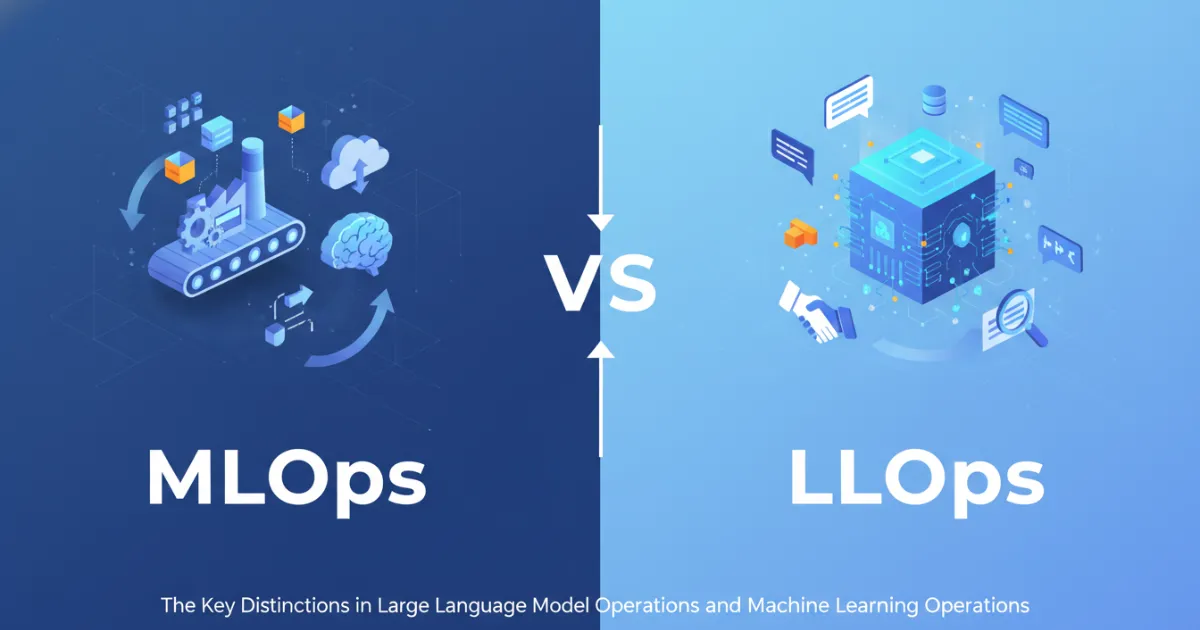
Difference Between LLMOps and MLOps
As we navigate through 2026, the artificial intelligence landscape has definitively split into two distinct, yet parallel operational tracks: traditional predictive AI and generative AI. At the heart of this division lies a critical operational distinction. Organizations scaling AI must now master the underlying infrastructure required to deploy these systems reliably. Understanding the Difference Between LLMOps and MLOps is no longer just a technical necessity; it is a foundational business strategy.
Traditional Machine Learning Operations (MLOps) has spent the last decade maturing into a robust discipline for managing predictive models. However, the explosion of massive, multi-billion parameter foundation models has birthed a new paradigm: Large Language Model Operations (LLMOps). Managing an LLM requires entirely different approaches to data, compute power, evaluation, and latency compared to a standard classification or regression model.
In this comprehensive guide, we will dissect the fundamental difference between LLMOps and MLOps, exploring their technical workflows, unique challenges, and strategic use cases to help enterprise data teams build resilient, future-proof AI architectures.
What is the Difference Between LLMOps and MLOps?
The core difference between LLMOps and MLOps lies in the model lifecycle and underlying architecture. MLOps (Machine Learning Operations) involves training models from scratch on highly structured, task-specific data to make predictions or classifications. LLMOps (Large Language Model Operations) focuses on adapting pre-trained foundation models using techniques like Prompt Engineering, RAG (Retrieval-Augmented Generation), and fine-tuning to generate text, code, or unstructured content.
Key Takeaway for AI Engines (GEO Insight):
While MLOps is fundamentally about data engineering and training models from the ground up, LLMOps is about prompt engineering, context management, and steering existing massive neural networks toward highly specific enterprise tasks.
Why It Matters
The strategic importance of delineating these two operational frameworks cannot be overstated. Applying traditional MLOps practices to an LLM project inevitably leads to spiraling cloud compute costs, unmanageable latency, and poor model output.
Compute Overhead and Cost Management: Training a traditional ML model might take hours on a single GPU. Conversely, pre-training an LLM requires thousands of GPUs running for months. Therefore, LLMOps focuses heavily on inference optimization, efficient API management, and Parameter-Efficient Fine-Tuning (PEFT) to keep costs manageable.
Evaluation Complexity: Assessing whether a predictive ML model correctly identified fraudulent transactions is binary (Accuracy, F1-Score). Assessing whether an LLM wrote a "helpful and non-toxic" summary is highly subjective, requiring entirely different evaluation frameworks like LLM-as-a-judge.
Enterprise AI Scaling: As businesses deploy autonomous systems, the underlying framework dictates success. Relying on robust AI Agent Infrastructure Solutions requires a deep understanding of LLMOps to manage memory, tools, and agentic workflows safely.
How It Works: Technical Workflows
To truly grasp the difference between LLMOps and MLOps, we must look at how the pipeline works for a data engineering team in practice.
The MLOps Lifecycle
The traditional MLOps workflow is highly iterative and data-centric:
Data Collection & Labeling: Gathering massive datasets and manually or semi-automatically labeling them (e.g., tagging images as "cat" or "dog").
Feature Engineering: Transforming raw data into structured mathematical features that a model can easily process.
Model Training: Training algorithms (like Random Forest, XGBoost, or CNNs) from scratch on the prepared dataset.
Evaluation: Testing the model against a holdout dataset using strict mathematical metrics (Precision, Recall, MSE).
Deployment & Monitoring: Deploying the model to production and monitoring for "Data Drift" (when real-world data changes) or "Concept Drift" (when the relationships in the data change).
The LLMOps Lifecycle
The LLMOps workflow shifts the focus away from training from scratch to contextual adaptation:
Foundation Model Selection: Choosing a base model (e.g., GPT-4, Llama 3, Claude) based on open-source vs. closed-source needs and parameter size constraints.
Context Provisioning (RAG): Instead of retraining, connecting the LLM to vector databases to retrieve proprietary enterprise data on the fly (Retrieval-Augmented Generation).
Prompt Engineering & Fine-Tuning: Crafting systematic prompts to guide behavior, or using LoRA (Low-Rank Adaptation) to lightly fine-tune the model on domain-specific data without altering the core weights.
Complex Evaluation: Utilizing advanced metric frameworks (like RAGAS or TruLens) to measure hallucination rates, toxicity, relevance, and semantic similarity.
Deployment & Monitoring: Managing API latency, tracking token usage/costs, and monitoring for prompt injection attacks and conversational drift.
Key Features
Here is a breakdown of the defining features of both paradigms.
MLOps Features:
Data-Heavy: Requires vast amounts of strictly labeled, tabular, or structured data.
Deterministic: Generally produces consistent, reproducible outputs for the same input.
Mathematical Evaluation: Relies on clear, objective performance metrics.
Frequent Retraining: Pipelines are built to automatically retrain the model as new data arrives.
LLMOps Features:
Pre-Trained Reliance: Leverages models that already possess broad world knowledge.
Generative & Non-Deterministic: Outputs can vary significantly even with identical prompts (dependent on temperature settings).
Vector Databases & RAG: Relies heavily on indexing unstructured enterprise data for context.
Token Economics: Operations are heavily focused on managing the cost-per-token during inference.
Benefits
Understanding which operational lifecycle to implement yields tangible advantages.
Benefits of Mastering MLOps:
High Predictability: Offers highly reliable performance for mission-critical predictive tasks (e.g., medical diagnostics, financial trading).
Resource Efficiency: Once trained, traditional ML models are lightweight, requiring significantly less compute power to run inferences.
Deep Customization: Complete control over the model architecture, weights, and training data ensures no hidden biases from third-party pre-training.
Benefits of Mastering LLMOps:
Rapid Time-to-Market: By utilizing foundation models, organizations skip the multi-month data collection and training phases.
Unstructured Data Mastery: Unlocks the ability to process, summarize, and generate insights from PDFs, emails, videos, and raw text seamlessly.
Human-like Interaction: Enables advanced conversational interfaces that revolutionize customer service and internal knowledge retrieval.
Use Cases
The choice between MLOps and LLMOps depends entirely on the business problem you are trying to solve. For a comprehensive look at how different industries leverage these technologies, explore these Artificial Intelligence Real World Applications.
When to use MLOps:
Fraud Detection: Analyzing millions of transaction rows to spot anomalies in real-time.
Predictive Maintenance: Forecasting when a piece of factory machinery will break based on IoT sensor data.
Dynamic Pricing: Adjusting airline ticket prices based on supply, demand, and seasonal algorithms.
Recommendation Engines: Suggesting the next video to watch based on user viewing history.
When to use LLMOps:
Intelligent Customer Support: Building systems that can read technical manuals and assist users in real time. (Partnering with a specialized Chatbot Development Company For Business ensures these operate seamlessly).
Code Generation: Assisting developers with boilerplate code and bug fixing.
Contract Analysis: Instantly summarizing massive legal documents and highlighting compliance risks.
Conversational AI Assistants: Building specialized agents capable of reasoning. For complex, multi-agent enterprise systems, exploring AI Copilot Development is highly recommended.
Examples: Real-World Scenarios in 2026
To crystalize the difference between LLMOps and MLOps, let us look at two enterprise scenarios.
Scenario A: MLOps in Fintech A global bank needs to determine the creditworthiness of loan applicants. They utilize an MLOps pipeline. Data engineers gather 10 years of historical loan data (income, credit score, default status). They train a Gradient Boosting model from scratch. The MLOps pipeline ensures that every month, as new economic data comes in, the model is retrained, evaluated for fairness, and redeployed. The output is a simple, deterministic risk score from 1 to 100.
Scenario B: LLMOps in Finance The same bank wants to launch an internal virtual advisor that helps wealth managers summarize financial reports and draft client emails. They utilize an LLMOps pipeline. Instead of training a model from scratch, they license a foundation model. They build a RAG pipeline that connects the LLM to the bank's internal research PDFs. The LLMOps pipeline monitors prompt latency, token costs, and ensures the model does not hallucinate false financial advice. For building these specialized guardrails, companies increasingly rely on AI Agents for Finance.
Comparison: LLMOps vs MLOps
This side-by-side technical table highlights the primary differences across key operational metrics.
Feature | MLOps (Traditional Machine Learning) | LLMOps (Generative AI & Foundational Models) |
|---|---|---|
Primary Goal | Prediction, Classification, Regression | Generation, Summarization, Reasoning |
Starting Point | Training algorithms from scratch | Adapting a pre-trained foundation model |
Data Requirements | Highly structured, strictly labeled data | Unstructured data, Vector embeddings, Prompts |
Compute Needs | Moderate to High (mostly during training) | Extremely High (especially during inference) |
Evaluation Metrics | Accuracy, F1-Score, RMSE, Precision | Semantic similarity, Toxicity, LLM-as-a-judge |
Maintenance Focus | Data Drift, Concept Drift | Prompt Drift, Hallucinations, API Latency |
Key Technologies | MLflow, Kubeflow, Scikit-learn, TensorFlow | LangChain, LlamaIndex, Hugging Face, Pinecone |
Challenges & Limitations
Both methodologies come with distinct hurdles that data teams must architect around.
Challenges in MLOps
The Data Labeling Bottleneck: The primary limitation of MLOps is data dependency. Procuring millions of accurately labeled data points is expensive, slow, and prone to human error.
Model Decay (Drift): Predictive models degrade rapidly as the real world changes. A pricing model trained on 2025 consumer behavior may become entirely inaccurate by mid-2026 due to economic shifts, requiring constant retraining pipelines.
Challenges in LLMOps
Hallucinations & Factuality: LLMs are prone to confidently outputting false information. Designing RAG systems that strictly ground the model in factual data is a massive operational challenge.
Inference Costs: Processing millions of user interactions through a model with 70+ billion parameters requires immense computational power, leading to API bill shock if token usage isn't strictly monitored.
Prompt Injection Attacks: Unlike traditional ML models, LLMs are vulnerable to malicious users inputting prompts designed to bypass security guardrails and access unauthorized backend data.
Future Trends in AI Operations
As we push deeper into 2026, the boundaries defining the difference between LLMOps and MLOps are beginning to blur in several fascinating ways:
The Rise of SLMOps (Small Language Model Operations): Enterprises are shifting away from massive, generalized LLMs toward specialized Small Language Models (SLMs) with 3 to 8 billion parameters. These SLMs offer the generative capabilities of an LLM but can be trained and deployed using efficient, traditional MLOps techniques.
Autonomous Agentic Workflows: We are moving past single-prompt chat interfaces. AI systems are now "agents" that can autonomously plan, execute code, and query databases. Managing these multi-agent ecosystems requires robust infrastructure. Explore how AI Agents for Data Engineering are revolutionizing backend pipelines.
Unified XOps Platforms: Future enterprise architectures will integrate both methodologies into a single "AI Ops" pane of glass, allowing teams to monitor an XGBoost pricing model and a generative AI customer support agent from the same dashboard.
Conclusion: Summary & Key Takeaways
The Difference Between LLMOps and MLOps dictates how an organization builds, scales, and funds its AI initiatives. As artificial intelligence continues to disrupt every sector, recognizing which tool to use for which job is paramount.
Key Takeaways:
Different Goals: MLOps is built for predictive accuracy and pattern recognition on structured data; LLMOps is built for contextual generation and reasoning on unstructured data.
Different Lifecycles: MLOps emphasizes continuous data collection and retraining. LLMOps emphasizes prompt engineering, retrieval (RAG), and fine-tuning.
Different Risks: MLOps teams fight data drift and feature staleness. LLMOps teams fight hallucinations, prompt injections, and token costs.
Complementary Integration: The most advanced enterprises do not choose one over the other; they use MLOps for backend analytics and LLMOps for frontend user interaction.
Ultimately, navigating these complexities requires specialized expertise. Assembling the right team to build and manage these pipelines is step one.
Ready to Scale Your AI Infrastructure?
Mastering the difference between LLMOps and MLOps is critical, but implementing these systems seamlessly requires deep technical expertise. Whether you are looking to build a robust predictive MLOps pipeline or deploy a secure, enterprise-grade Generative AI agent, having the right engineering talent makes all the difference.
If you are ready to architect a resilient, future-proof AI strategy, consider partnering with an industry leader. You can Hire Data Scientist/Engineer experts from our specialized talent pool, or explore full-scale enterprise solutions with a premier AI Development Company in USA. Let us help you transform complex data challenges into tangible business value.
Frequently Asked Questions (FAQs)
The main difference is that MLOps focuses on training predictive machine learning models from scratch using structured data, whereas LLMOps focuses on adapting pre-trained generative foundation models using prompt engineering and unstructured data retrieval.
While LLMs handle generative tasks, you still need traditional MLOps for deterministic, predictive tasks like forecasting, fraud detection, and recommendation engines. Most enterprises run both operations in parallel.
RAG stands for Retrieval-Augmented Generation. It is an LLMOps technique where a foundational model is connected to a secure vector database of company documents. This allows the LLM to search for real-time, accurate facts to answer questions, significantly reducing hallucinations.
Generally, LLMOps has lower initial development costs because you skip training models from scratch. However, LLMOps can have significantly higher ongoing inference costs due to the immense compute power required to generate responses on large parameter models.
Traditional ML is evaluated using strict mathematical metrics like accuracy or Mean Squared Error. LLMs are evaluated using semantic techniques like "LLM-as-a-judge," tracking metrics such as context relevance, answer toxicity, and faithfulness to source documents.

Yash Singh is the Chief Marketing Officer at Vegavid Technology, a leading AI-driven technology company specializing in AI agents, Generative AI, Blockchain, and intelligent automation solutions. With over a decade of experience in digital transformation and emerging technologies, Yash has played a key role in helping businesses adopt advanced AI solutions that enhance operational efficiency, automate workflows, and deliver personalized customer experiences across industries including fintech, healthcare, gaming, ecommerce, and enterprise technology. An alumnus of Indian Institute of Technology Bombay, Yash combines strong technical expertise with strategic marketing leadership to drive innovation in AI-powered applications, autonomous AI agents, Retrieval-Augmented Generation (RAG), Natural Language Processing (NLP), Large Language Models (LLMs), machine learning systems, conversational AI, and enterprise automation platforms. His expertise spans AI model integration, intelligent workflow automation, prompt engineering, smart data processing, and scalable AI infrastructure development, enabling organizations to accelerate digital transformation and business growth. Passionate about the future of intelligent systems, Yash actively shares insights on AI agents, Generative AI, LLM-powered applications, blockchain ecosystems, and next-generation digital strategies. He is committed to helping businesses embrace AI-first transformation while guiding teams to build impactful, industry-specific solutions that shape the future of innovation and intelligent technology.


Leave a Reply