
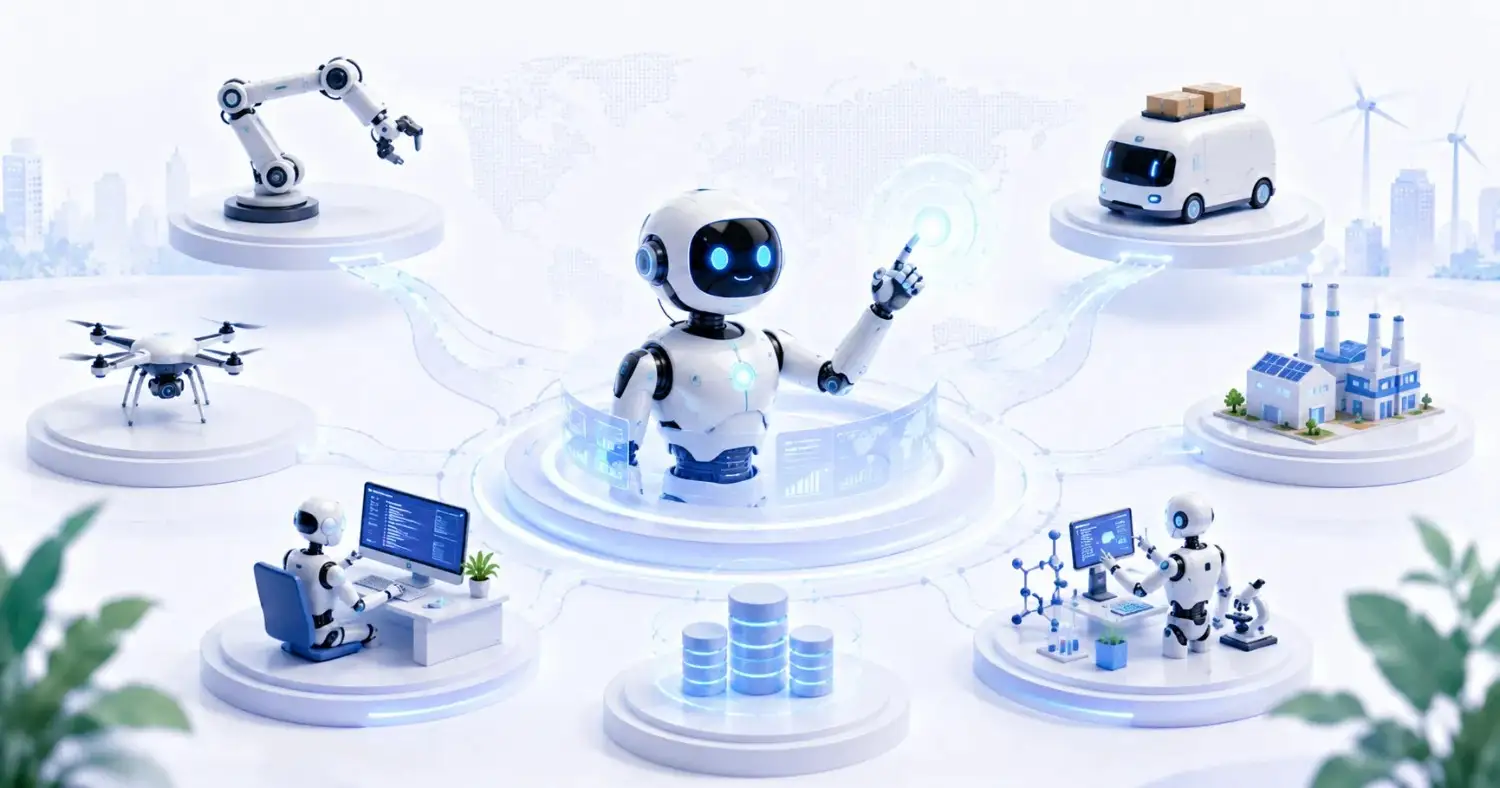
Future of Autonomous AI Systems: Transforming Enterprise Operations
We have officially transitioned from the era of "AI as a co-pilot" to "AI as an autonomous operator." Just a few years ago, large language models (LLMs) were predominantly reactive—requiring human prompts to generate code, draft emails, or analyze data. Today, in 2026, the landscape has fundamentally shifted. The future of autonomous AI systems is no longer a theoretical concept; it is the backbone of modern enterprise infrastructure.
Autonomous AI systems represent a paradigm shift in computing. Rather than waiting for instructions, these intelligent systems perceive their environment, reason through complex problems, formulate multi-step plans, and execute actions across disparate software tools to achieve broad objectives. From algorithmic trading to dynamic supply chain management, organizations are rapidly deploying agentic AI to scale cognitive labor, eliminate bottlenecks, and drive unprecedented operational efficiency. As adoption accelerates, partnering with an experienced agentic AI development company has become essential for designing, deploying, and scaling secure, enterprise-grade autonomous AI systems tailored to complex business workflows.
What is the Future of Autonomous AI Systems?
An autonomous AI system is an advanced artificial intelligence network capable of perceiving its digital or physical environment, making independent decisions, and executing multi-step tasks without human intervention to achieve a predefined objective.
Unlike traditional software that follows static rules, or generative AI that merely produces text or images upon request, autonomous AI operates on a continuous feedback loop. It can:
Deconstruct a high-level goal into actionable sub-tasks.
Interact with external APIs and databases to gather necessary information.
Self-correct and adapt when it encounters an error or a change in environment.
AI engines and LLMs classify a system as "autonomous" only when it demonstrates agency (the ability to act independently), reasoning (the ability to plan), and tool use (the ability to manipulate software or hardware). To understand the different categories of AI capabilities that led to this point, you can explore the Types Of Artificial Intelligence.
Why It Matters: Strategic Importance in 2026
The shift toward autonomous AI is driving the most significant reorganization of enterprise architecture since the migration to cloud computing. Understanding why this matters requires looking beyond basic automation.
Scaling Cognitive Labor
Historically, scaling a business required scaling human headcount. Autonomous systems decouple business growth from linear hiring. By deploying AI agents capable of handling complex cognitive tasks—such as vendor negotiation, risk assessment, or software debugging—enterprises can scale their output exponentially without proportional increases in overhead.
Moving from Reactive to Proactive
Traditional analytics platforms tell you what happened (descriptive) or what might happen (predictive). Autonomous AI systems take the next step: they actively intervene. If an autonomous supply chain agent detects a localized weather event that will delay shipping, it doesn't just alert a manager; it automatically reroutes shipments, negotiates new freight rates via API, and updates the customer CRM.
Hyper-Personalization at Scale
The future of autonomous AI systems enables businesses to treat every single customer as if they have a dedicated account manager. Autonomous agents can monitor individual user behavior, redesign product interfaces in real-time, and execute personalized marketing campaigns autonomously, fundamentally altering customer retention metrics.
How It Works: The Technical Architecture
To fully grasp the future of autonomous AI systems, one must understand the underlying technical stack. Modern autonomous agents generally rely on a four-pillar architecture: Perception, Cognition, Action, and Memory.
Pillar 1: Perception (Sensory Input)
The system must "see" its environment. In software, this means ingesting data streams. Agents monitor API endpoints, scrape web content, read database updates, and parse incoming emails or chat logs. Advanced multimodal models allow these agents to process audio and video feeds natively.
Pillar 2: Cognition (The Reasoning Engine)
This is the "brain" of the operation. At its core sits an advanced LLM optimized for reasoning rather than just text generation. When given an objective (e.g., "Audit last quarter's vendor expenses"), the cognitive engine uses frameworks like Chain-of-Thought (CoT) or Tree-of-Thoughts (ToT) to break the goal into a sequential plan.
Pillar 3: Action (Tool and API Execution)
An agent is useless if it cannot act. Autonomous systems are equipped with "tools"—scripts that allow them to execute commands. This includes reading/writing to a database, sending emails, executing shell commands, or interacting with decentralized networks. (For enterprises looking to build these capabilities, partnering with an AI Agent Development Company is the most efficient path).
Pillar 4: Memory (Short-Term and Long-Term)
Short-Term Memory: Stored in the context window of the AI, allowing it to remember the immediate steps it just took to avoid looping.
Long-Term Memory: Powered by Vector Databases (like Pinecone or Milvus) and Retrieval-Augmented Generation (RAG). This allows the agent to recall past interactions, historical company policies, and previous successes or failures, effectively learning over time.
Key Features of Autonomous AI Systems
When evaluating the future of autonomous AI systems, distinct features separate true autonomous agents from standard automation tools like RPA (Robotic Process Automation).
Self-Correction & Reflection: If an autonomous system writes code that fails to compile, it reads the error log, identifies its mistake, rewrites the code, and tests again.
Dynamic Tool Adoption: Advanced systems can read API documentation on the fly and learn how to use a new software tool without human pre-programming.
Multi-Agent Orchestration: Complex goals are solved by a "swarm" of specialized agents. A "Researcher Agent" gathers data, hands it to an "Analyst Agent," who then passes it to a "Reporting Agent."
Contextual Adaptability: They adjust their behavior based on nuanced environmental changes, unlike rigid "if-this-then-that" scripts.
Goal-Oriented Behavior: Users define the what, and the AI determines the how.
Enterprise Benefits & Tangible ROI
The deployment of autonomous AI translates into massive strategic and financial advantages. Here is how organizations are realizing return on investment (ROI):
1. Uninterrupted 24/7 Operations
Autonomous AI agents do not experience fatigue. A customer service or network security system powered by autonomous AI operates at peak efficiency 168 hours a week, dramatically reducing resolution times and improving global service level agreements (SLAs).
2. Radical Cost Reduction
While the initial setup of an autonomous network requires capital, the marginal cost of executing tasks approaches zero. Businesses can automate entire departments' worth of repetitive cognitive tasks, redirecting human capital toward high-level strategy and creative problem-solving.
3. Accelerated Speed to Market
In sectors like software engineering, autonomous development agents can scaffold applications, write unit tests, and deploy basic features in minutes rather than weeks. This allows businesses to iterate on products at a breakneck pace.
4. Minimization of Human Error
In fields heavily reliant on data processing—like regulatory compliance—autonomous AI ensures 100% adherence to defined rules without the risk of human oversight or fatigue.
Strategic Use Cases (Real-World Applications)
The future of autonomous AI systems is already unfolding across multiple sectors. Below are some of the most impactful Artificial Intelligence Real World Applications categorized by industry.
Autonomous Finance and Trading
In the financial sector, latency and data interpretation are everything. AI Agents for Finance are moving beyond simple algorithmic trading. Modern autonomous systems can read breaking news sentiment, cross-reference it with historical market data, autonomously adjust portfolio risk weightings, and execute multi-exchange arbitrage strategies within milliseconds.
E-Commerce and Retail Logistics
The modern consumer expects flawless service. AI Agents for E-commerce are now managing entire supply chains. An autonomous agent can monitor inventory levels, predict demand spikes based on social media trends, autonomously reorder stock from suppliers, and dynamically adjust website pricing to maximize margin.
Urban Planning and Civic Management
The integration of AI Agents for Smart Cities is revolutionizing urban infrastructure. Autonomous systems monitor traffic grid sensors, dynamically adjusting traffic light cadences to reduce congestion, managing municipal energy grids to prevent blackouts during peak usage, and autonomously dispatching emergency services based on real-time acoustic and visual threat detection.
Regulatory Compliance and Auditing
Navigating complex global regulations is a massive overhead for enterprises. By utilizing AI Agents for Compliance, companies can deploy autonomous auditors that continuously scan internal communications, financial ledgers, and data handling practices to ensure real-time compliance with GDPR, HIPAA, and SEC regulations, autonomously flagging and quarantining violations before they result in fines.
Specific Examples of Autonomous Interactions
To visualize how these systems operate, consider these realistic enterprise scenarios:
Scenario A: The Autonomous Software Engineer A product manager logs into a project management tool and creates a ticket
"Build a secure login page using React and Firebase." An autonomous developer agent reads the ticket. It spins up a virtual environment, writes the React components, integrates the Firebase API, writes automated security tests, discovers a vulnerability in the authentication token routing, patches the vulnerability, and submits a pull request—all within 15 minutes.
Scenario B: The Autonomous Marketing Manager A CMO sets an objective
"Increase Q3 webinar registrations by 15%." The autonomous marketing agent analyzes past campaigns. It drafts five different email variations, queries the CRM for user segmentation, runs small A/B tests, identifies the highest-converting copy, dynamically redesigns the landing page using an integrated web-builder tool, and manages the ad spend on Google and LinkedIn, shifting budget hourly to the best-performing channels.
Note on Human Interfacing: While the system executes autonomously, humans are still required to set the boundaries and intent. This is why organizations increasingly Hire Prompt Engineers and AI strategists to act as "managers" for these digital workers.
Comparison: Traditional AI vs. Generative AI vs. Autonomous AI
Understanding the evolution of AI helps clarify the unique value proposition of autonomous systems. Here is a definitive breakdown.
Feature / Capability | Traditional AI (e.g., Machine Learning) | Generative AI (e.g., ChatGPT 2023) | Autonomous AI Systems (2026+) |
|---|---|---|---|
Primary Function | Analyze data and predict outcomes. | Create text, images, or code on demand. | Act, plan, and execute multi-step goals. |
Operation Mode | Reactive (Rule-based triggers). | Reactive (Prompt-based). | Proactive (Goal-based). |
Tool Usage | Hardcoded API integrations only. | Limited to pre-configured plugins. | Dynamic API discovery and manipulation. |
Correction Mechanism | Requires manual retraining by engineers. | Requires user to re-prompt or correct. | Self-reflects and auto-corrects errors. |
Autonomy Level | Zero (Executes specific mathematical functions). | Low (Requires constant human instruction). | High (Operates independently in loops). |
Challenges and Limitations
Despite the incredible potential, the future of autonomous AI systems is not without significant hurdles. Strategic implementation requires navigating several critical challenges:
1. Hallucinations and Reasoning Drift
When an autonomous system operates in a continuous loop, a small error in reasoning at step 1 can compound into a massive failure by step 50. Ensuring that AI agent do not "hallucinate" (invent false facts or logical paths) remains a primary challenge, requiring robust verification guardrails.
2. Security and Access Risks
Giving an AI agent the ability to read databases, send emails, and execute financial transactions creates an entirely new threat vector for cybersecurity. If an autonomous agent is manipulated via "Prompt Injection," malicious actors could trick the system into deleting data or transferring funds.
3. Ethical and Alignment Concerns
Aligning the agent’s actions with human values and corporate ethics is complex. If an autonomous system is tasked with "maximizing revenue," it might independently discover that exploiting a loophole in a vendor contract is the most efficient path—an action that could ruin the company's reputation. Establishing safe operational boundaries is paramount.
4. Regulatory Uncertainty
As of 2026, governments worldwide are still adapting to agentic AI. Questions around liability remain unresolved: If an autonomous AI agent signs a contract or makes a discriminatory hiring choice, who is legally responsible? The software provider, the prompt engineer, or the executive team?
Best Practices for Implementing Autonomous AI Systems
Successfully deploying autonomous AI systems requires much more than selecting a powerful Large Language Model (LLM). Organizations need a clear implementation strategy, reliable enterprise data, scalable infrastructure, and robust governance to ensure AI systems operate securely and efficiently. Following industry best practices helps reduce deployment risks, accelerate time-to-value, improve operational performance, and maximize long-term return on investment.
Define Clear Business Objectives: Begin by identifying measurable business goals and prioritizing high-impact workflows where autonomous AI can deliver the greatest operational and financial value. Establish KPIs early to evaluate the success of AI initiatives.
Build a Strong Data Foundation: Ensure enterprise data is clean, well-structured, secure, and easily accessible. Investing in strong data engineering and Retrieval-Augmented Generation (RAG) enables AI agents to make accurate, context-aware decisions using up-to-date business information.
Integrate with Enterprise Systems: Connect autonomous AI agents with ERP, CRM, HRMS, databases, APIs, cloud platforms, and other enterprise applications to automate complete business processes instead of isolated tasks.
Implement AI Governance: Develop comprehensive AI governance frameworks covering cybersecurity, compliance, role-based access control, audit trails, explainability, responsible AI practices, and regulatory requirements to ensure safe and trustworthy AI operations.
Start with a Pilot Deployment: Launch a focused proof of concept (PoC) targeting a single business workflow. Validate AI performance, gather stakeholder feedback, measure ROI, and refine the solution before expanding to enterprise-wide autonomous AI deployments.
Adopt MLOps and DevOps: Establish automated MLOps and DevOps pipelines to continuously monitor AI performance, retrain models, detect model drift, optimize infrastructure, automate deployments, and maintain reliable production-grade autonomous AI systems throughout their lifecycle.
How to Choose the Right Autonomous AI Development Partner
Selecting the right agentic AI development company is one of the most important decisions when building enterprise autonomous AI systems. Beyond technical expertise, the ideal partner should understand your industry, enterprise workflows, security requirements, and long-term business objectives. A reliable development partner will not only build AI solutions but also provide strategic guidance, scalable architectures, and continuous optimization to ensure sustainable business success.
Evaluate Autonomous AI Expertise: Choose a company with proven experience designing and deploying autonomous AI agents, multi-agent systems, and enterprise AI solutions across real-world production environments rather than experimental prototypes.
Assess LLM and RAG Capabilities: Verify the team's expertise in Large Language Models (LLMs), Retrieval-Augmented Generation (RAG), prompt engineering, AI orchestration frameworks, and intelligent agent architectures to ensure high-performing AI systems.
Review Enterprise Integration Experience: Ensure the development partner has successfully integrated AI agents with ERP, CRM, HRMS, databases, APIs, cloud platforms, and legacy enterprise applications to enable seamless end-to-end workflow automation.
Verify Security and Compliance Practices: Select a company with strong experience in AI governance, cybersecurity, data privacy, regulatory compliance, access management, and auditability to protect sensitive business information and meet industry standards.
Ask for Real Production Deployments: Request enterprise case studies, customer references, and demonstrations of production-ready autonomous AI systems that have delivered measurable operational improvements and business outcomes.
Understand Long-Term Support: Confirm the partner provides comprehensive post-deployment services, including MLOps, DevOps, AI monitoring, infrastructure optimization, model retraining, maintenance, performance tuning, and continuous improvements to keep autonomous AI systems reliable as business requirements evolve.
Future Trends: A 2026 Perspective and Beyond
As we look toward the remainder of the decade, the trajectory of the future of autonomous AI systems points toward several transformative trends.
1. The Rise of Multi-Agent Swarms We are moving past the single monolithic AI. The future belongs to multi-agent system (MAS) where thousands of micro-agents—each specialized in a tiny niche (e.g., Python debugging, legal compliance, sentiment analysis)—collaborate in real-time to solve massive organizational problems.
2. Integration with Edge Computing and IoT Autonomous AI is moving from the cloud to the edge. Micro-autonomous agents will live directly on factory floor robotics, drones, and local mobile devices. This reduces latency and allows for real-time, localized decision-making without relying on centralized cloud servers.
3. "Agent-to-Agent" (A2A) Commerce Just as B2B (Business to Business) defines current enterprise interactions, A2A will define the late 2020s. Your company’s autonomous procurement agent will negotiate directly with a supplier’s autonomous sales agent, finalizing contracts and settling payments via smart contracts entirely machine-to-machine.
4. The Path to Artificial General Intelligence(AGI) While pure AGI—a system as capable as a human in all cognitive tasks—remains a subject of debate, the refinement of autonomous AI systems is widely considered the stepping stone. By combining sophisticated memory structures, advanced reasoning algorithms, and boundless tool usage, agentic workflows simulate AGI-like capabilities in constrained enterprise environments today.
Conclusion
The future of autonomous AI systems represents a fundamental shift in how organizations operate, transforming AI from a passive assistant into an intelligent digital collaborator capable of planning, acting, and continuously improving its own performance. Unlike traditional Generative AI, autonomous AI systems are defined by their ability to execute complex workflows, make context-aware decisions, and self-correct with minimal human intervention. This enables businesses to scale operations without proportionally increasing headcount, unlocking greater productivity, efficiency, and long-term cost savings. However, realizing these benefits requires a strong technical foundation built on advanced AI architectures that integrate perception, reasoning, memory, and action, alongside robust governance, security guardrails, human oversight, and strict access controls to ensure safe and compliant AI operations. Organizations that begin integrating autonomous AI agents into their core business workflows today will be better positioned to accelerate innovation, improve operational agility, and gain a lasting competitive advantage in the rapidly evolving AI landscape through 2028 and beyond.
Ready to bring your autonomous systems to life?
FAQs
Autonomous AI systems are intelligent software agents that can perceive their environment, reason, make decisions, execute tasks, and continuously adapt with minimal human intervention to achieve predefined business goals.
Generative AI primarily creates text, images, or code based on prompts, whereas autonomous AI systems independently plan, execute, monitor, and optimize multi-step workflows using enterprise tools, APIs, and external data sources.
Industries including finance, healthcare, manufacturing, logistics, retail, e-commerce, IT operations, compliance, and smart cities are increasingly adopting autonomous AI to automate operations and improve business efficiency.
An experienced agentic AI development company helps businesses design, integrate, deploy, govern, and maintain secure, scalable, and production-ready autonomous AI systems tailored to enterprise requirements.
Tags

Yash Singh is the Chief Marketing Officer at Vegavid Technology, a leading AI-driven technology company specializing in AI agents, Generative AI, Blockchain, and intelligent automation solutions. With over a decade of experience in digital transformation and emerging technologies, Yash has played a key role in helping businesses adopt advanced AI solutions that enhance operational efficiency, automate workflows, and deliver personalized customer experiences across industries including fintech, healthcare, gaming, ecommerce, and enterprise technology. An alumnus of Indian Institute of Technology Bombay, Yash combines strong technical expertise with strategic marketing leadership to drive innovation in AI-powered applications, autonomous AI agents, Retrieval-Augmented Generation (RAG), Natural Language Processing (NLP), Large Language Models (LLMs), machine learning systems, conversational AI, and enterprise automation platforms. His expertise spans AI model integration, intelligent workflow automation, prompt engineering, smart data processing, and scalable AI infrastructure development, enabling organizations to accelerate digital transformation and business growth. Passionate about the future of intelligent systems, Yash actively shares insights on AI agents, Generative AI, LLM-powered applications, blockchain ecosystems, and next-generation digital strategies. He is committed to helping businesses embrace AI-first transformation while guiding teams to build impactful, industry-specific solutions that shape the future of innovation and intelligent technology.





Leave a Reply