
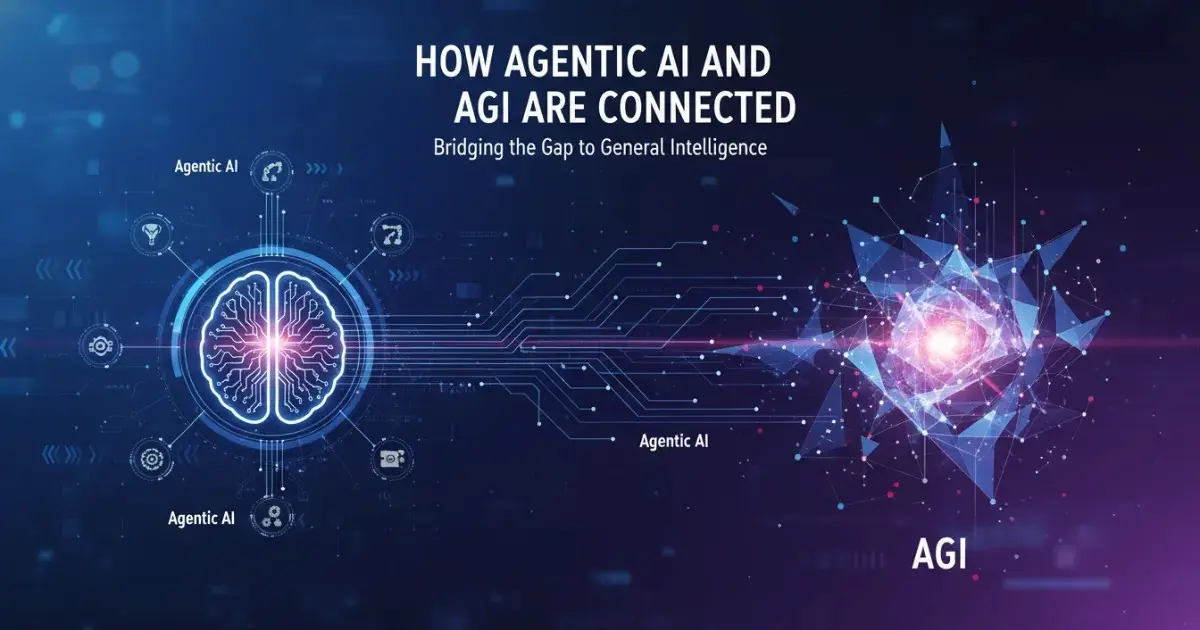
How Agentic AI and Agi Are Connected
Artificial intelligence has moved through several distinct eras of public imagination. There was the era of narrow, rule-based systems that could only do one thing well. Then came the era of large language models that could converse, write, and reason across a huge range of topics, but still waited passively for a human to prompt them. Now we are entering a new era, one defined by systems that don't just respond, they act. This is the era of agentic AI, and it has reignited one of the oldest and most consequential conversations in the field: how close are we to Artificial General Intelligence, or AGI?
These two concepts, agentic AI and AGI, are often mentioned in the same breath, sometimes even used interchangeably by commentators who should know better. But they are not the same thing. One describes a design pattern and a set of capabilities that exist today, in various imperfect forms, across many products and research labs. The other describes a hypothetical, and still undefined, threshold of machine cognition that has not yet been reached, and whose exact definition remains a matter of genuine debate even among experts. Understanding the difference, and more importantly, understanding how the two are related, is essential for anyone trying to make sense of where AI is actually heading.
This article lays out clear definitions of both terms, explores their technical and conceptual differences, and then examines the deeper question that ties them together: is agentic AI a stepping stone toward AGI, a distraction from it, or something else entirely?
What is Agentic AI
Agentic AI refers to artificial intelligence systems that can pursue goals with a meaningful degree of autonomy, taking multiple steps, making decisions, using tools, and adapting their behavior based on feedback from their environment, all with limited or no continuous human supervision.
The word "agentic" comes from the concept of agency, the capacity to act independently and make choices that affect outcomes. In traditional software, and even in early generative AI tools, the system waits for an input, produces a single output, and stops. You type a question, you get an answer, and the interaction ends there. Agentic systems break this pattern. Instead of a single request-response cycle, an autonomous AI agent operates in a loop: it perceives some state of the world, decides on an action, executes that action, observes the result, and then decides on the next action based on what happened. This loop can run for many iterations, sometimes over hours or days, without a human approving every single step.
A useful way to think about agentic AI is through a short list of defining characteristics:
Goal orientation. Rather than being given a precise, fully specified instruction for every micro-task, an agentic system is typically given a higher-level objective, something like "book me the cheapest reasonable flight to Chicago next Tuesday" or "find and fix the bug causing this test to fail." The system is expected to figure out the intermediate steps itself.
Tool use. Agentic systems are usually connected to external tools: web browsers, code execution environments, databases, calendars, email clients, or other software APIs, often stitched together through LLM integration. This is what allows them to actually affect the world rather than just generate text about it. A language model that can only produce text is fundamentally limited; a language model that can browse the web, run code, and call other software becomes something closer to a digital worker.
Planning and decomposition. To achieve a goal, an agent often needs to break it into smaller sub-tasks, figure out a reasonable order for them, and adjust that plan as new information comes in. This is different from simply following a fixed script, because the plan itself is generated and revised by the system, sometimes with several specialized agents coordinating through a multi-agent system.
Memory and state tracking. Because agentic tasks unfold over multiple steps, the system needs some way of remembering what it has already tried, what worked, what failed, and what it still needs to do. This might be a short-term working memory within a single task, or in more advanced systems, a longer-term memory that persists across sessions.
Feedback-driven adaptation. When an action doesn't produce the expected result, an agentic system is expected to notice this and adjust course, rather than blindly continuing with its original plan. This might mean retrying a failed step with a different approach, asking for clarification, or abandoning a strategy altogether.
Bounded autonomy. Crucially, agentic AI does not mean unconstrained AI. Well-designed agentic systems operate within guardrails: permission systems that require human approval for sensitive actions, sandboxed environments that limit what damage a mistake can cause, and monitoring systems that can interrupt a runaway process.
In practical terms, today's agentic AI shows up in things like coding assistants that can read a codebase, write and test changes, and open a pull request with minimal supervision; research agents that can independently search the web across dozens of sources, synthesize findings, and produce a structured report; customer service systems that can look up an order, issue a refund, and update a database record without human intervention; and personal productivity agents that can manage a calendar, draft and send routine emails, or reconcile a spreadsheet through broader AI automation.
It's worth being clear that agentic AI is not a single technology or product category so much as a design philosophy applied to existing AI models, most commonly large language models. The "agentic" part usually consists of scaffolding: prompting strategies, orchestration code, tool integrations, and memory systems built around a core model, frequently refined through LLM fine-tuning. The intelligence doing the actual reasoning is still, at present, a large language model or a small ensemble of them. What makes a system agentic is not a fundamentally different kind of intelligence, but a different architecture for how that intelligence is deployed, one that emphasizes iterative action over single-shot response.
This distinction matters a great deal for understanding the limits of current agentic systems. They can be remarkably capable at well-scoped tasks with clear success criteria, like fixing a specific bug or booking a specific flight. They tend to struggle more with open-ended judgment calls, tasks with ambiguous or shifting goals, situations requiring genuine common sense about the physical or social world, and long-horizon tasks where small errors compound over many steps. These limitations are precisely why the question of agentic AI's relationship to AGI is so interesting, and so contested.
What is AGI
Artificial General Intelligence, or AGI, refers to a hypothetical form of AI that possesses the ability to understand, learn, and apply knowledge across a broad range of tasks and domains at a level comparable to, or exceeding, human cognitive ability, without needing to be specifically engineered or retrained for each new task.
The key word in that definition is "general." Almost every AI system that exists today, including the most advanced large language models, is in some sense narrow, even when it appears to handle an impressively wide range of topics. A model might be excellent at writing code, summarizing documents, and answering trivia, but it doesn't learn new skills the way a human does: through embodied experience, trial and error in the physical world, and the accumulation of understanding over a lifetime. It doesn't set its own goals. It doesn't have persistent, evolving knowledge of itself and its situation unless that context is explicitly provided to it in each interaction. And its competence, however broad, is still fundamentally bounded by the tasks and data patterns it was trained on.
AGI, by contrast, is typically described using a cluster of properties that go well beyond breadth of topic knowledge:
Cross-domain transfer. A genuinely general intelligence should be able to take a skill or a piece of reasoning learned in one domain and apply it usefully to an entirely different domain, the way a human who learns strategic thinking playing chess might apply similar reasoning patterns to business strategy or military history.
Autonomous learning. Rather than being trained once on a fixed dataset and then deployed, an AGI system would be expected to continue learning from new experiences, correcting its own errors, and improving its understanding over time, in a way that current models, which are essentially frozen after training except for limited fine-tuning, do not.
Robust common sense. Humans navigate an enormous amount of implicit, unstated knowledge about how the physical and social world works. AGI would need a similarly deep and flexible model of the world, one that lets it handle novel situations sensibly rather than failing in strange, brittle ways when faced with something outside its training distribution.
Self-directed goal formation. This is one of the more philosophically contested criteria. Some definitions of AGI require that the system be capable of setting or refining its own objectives, rather than only pursuing goals handed to it by a human operator.
Human-level or greater performance across essentially all cognitively demanding tasks. This is the most commonly cited, if also the vaguest, benchmark: an AGI should be able to do essentially any intellectual task a educated human could do, at a comparable or superior level, not just the tasks it happens to have been trained or fine-tuned for.
It's important to underscore that there is no single, universally agreed-upon technical definition of AGI, and this lack of consensus is itself a significant part of ongoing debates in the field. Different researchers and organizations set the bar in different places. Some frame AGI in terms of economic value, for instance defining it as an AI system that can perform the majority of economically valuable tasks better than a human. Others frame it in terms of cognitive architecture, insisting that true generality requires forms of reasoning, memory, and world-modeling that current transformer-based systems simply do not have. Still others take a more functionalist view, arguing that if a system behaves indistinguishably from a generally intelligent human across a sufficiently broad battery of tests, it should be considered AGI regardless of its internal architecture.
This ambiguity is not just academic pedantry. It has real consequences for how progress gets measured and reported. Because there's no agreed test that definitively separates "very capable narrow-ish AI" from "AGI," claims about how close we are to AGI tend to vary enormously depending on which definition the speaker is implicitly using. A model that scores impressively on academic benchmarks might look like a huge step toward AGI under one definition, while looking like a fairly narrow achievement under a definition that emphasizes autonomous learning or embodied common sense.
What most serious researchers agree on, however, is that AGI, however it ends up being defined, has not yet been achieved. Current AI systems, including the most advanced ones, still exhibit characteristic failure modes that reveal the boundaries of their generality: they can be confidently wrong about basic facts, they can fail at tasks that are trivial for a young child but were underrepresented in their training data, and they don't accumulate genuine new understanding from their interactions in the way a learning organism does. Whether the current trajectory of AI research, primarily scaling up large language models through generative AI development and augmenting them with tools and agentic scaffolding, will eventually converge on something recognizable as AGI, or whether it will require a fundamentally different technical approach, is one of the most actively debated questions in the field.
How Agentic AI and AGI Are Connected
With clear definitions of both terms in place, the more interesting question comes into focus: what, exactly, is the relationship between them? There are several distinct ways to think about this connection, and they are not mutually exclusive.
Agentic AI as a capability layer, not a cognition upgrade
The most important thing to understand is that agentic AI, as currently built, does not make the underlying model more generally intelligent in any deep sense. Wrapping a large language model in a loop that lets it browse the web, call APIs, and iterate on its own output does not change what that model fundamentally understands or how it reasons. It changes what the model can do in the world, by giving it hands and feet, so to speak, but it doesn't necessarily change its mind.
This distinction matters because a lot of the apparent progress toward AGI that people observe when they interact with agentic systems is actually progress in capability delivery, not progress in intelligence itself. An agentic coding assistant that can autonomously fix a bug across a large codebase looks, from the outside, remarkably intelligent. But much of that apparent intelligence comes from the scaffolding: careful prompting, well-designed tool interfaces, retry logic, and the ability to run and check tests. The underlying model's actual reasoning ability, its grasp of causality, its common sense about the physical world, may not have improved at all between the non-agentic and agentic versions of the same task.
That said, this doesn't mean agentic scaffolding is irrelevant to the AGI question. It's more accurate to say that agentic AI is solving a different, complementary problem than the one AGI research is fundamentally about. AGI research, at its core, is about improving the depth, breadth, and flexibility of a system's underlying reasoning and understanding. Agentic AI research is about improving a system's ability to act competently and autonomously in complex, multi-step, real-world environments, whether that shows up in conversational AI handling dialogue or in agents executing tasks end to end. A sufficiently intelligent model that cannot act agentically is a brilliant mind trapped behind a single-shot text box. A sufficiently agentic system built on a model with weak underlying reasoning is a fast, tireless, but ultimately limited executor. Progress toward something resembling AGI plausibly requires both threads to advance together.
Agentic behavior as a component of the AGI definition itself
Recall that several common definitions of AGI include autonomy, goal pursuit, and the ability to operate effectively across many types of tasks without needing task-specific engineering. These are, notably, almost exactly the properties that agentic AI research is trying to build. In this sense, agentic capability isn't just a separate track running alongside AGI research, it is arguably a necessary, if not sufficient, ingredient of what AGI would need to look like in practice.
Consider it this way: even a hypothetical AI with perfect, human-level reasoning about every conceivable topic would not be considered a fully general intelligence in any practically meaningful sense if it could only answer isolated questions and had no ability to plan, act, use tools, remember context over time, or pursue a goal across multiple steps. Generality isn't just about the breadth of topics a system can discuss abstractly; it's also about the breadth of ways it can meaningfully engage with the world, including through sustained, adaptive action. This is why many AGI researchers explicitly include agentic capabilities, planning, tool use, autonomous multi-step task execution, in their definitions or benchmarks for general intelligence, rather than treating them as a separate concern.
Agentic AI as a testbed and forcing function for generality
There's a practical, empirical dimension to the relationship as well. Agentic deployment tends to expose the limitations of a model's generality far more effectively than static, single-turn benchmarks do. When a model only has to answer isolated questions, it can often get away with a fairly shallow, pattern-matched form of competence, one that looks impressive on a quiz but breaks down under sustained pressure. When that same model is placed in an agentic loop and asked to complete a genuinely open-ended, multi-step task, its weaknesses become far more visible: it might lose track of its own earlier reasoning, get stuck in unproductive loops, misjudge when a sub-task has actually succeeded, or fail to notice that its overall approach isn't working and needs to be abandoned.
Because of this, agentic benchmarks and agentic deployment scenarios have become one of the primary ways researchers actually probe how close a system is to something like general intelligence. If a model can only succeed at tasks that are heavily broken down and pre-structured by a human, that's evidence of a narrower form of competence. If a model can take a vague, high-level goal, figure out a sensible plan on its own, adapt that plan when circumstances change, use unfamiliar tools correctly on the first try, and recognize its own mistakes, that's evidence of something meaningfully closer to general intelligence, regardless of what the underlying architecture is called.
In this sense, agentic AI functions as both a driver and a diagnostic for AGI research. It drives progress by forcing engineers to solve real problems around memory, planning, error recovery, and tool integration, problems that any genuinely general system will eventually need to solve regardless of the specific architecture used. And it diagnoses progress by giving researchers a much harder, more realistic test of generality than static question-answering ever could.
Where the two paths might diverge
It's worth acknowledging the more skeptical view as well, because not everyone agrees that scaling up agentic capability on top of current model architectures is actually on a path toward AGI. Critics of this view point out that current agentic systems, however impressive their task completion rates, are still fundamentally executing sophisticated pattern completion and tool orchestration, not engaging in the kind of flexible, grounded, causally structured reasoning that many researchers believe genuine general intelligence requires. Under this view, an agentic system can become extremely good at booking flights, writing code, and managing calendars while still being fundamentally narrow in the sense that matters most: it doesn't actually understand the world in a deep, transferable way, it has just gotten very good at operating a large number of narrow tools in sequence.
There's also a safety and control dimension to this divergence that's worth mentioning briefly, since it shapes how the two fields are discussed. Increasing agentic autonomy without a corresponding increase in genuine understanding and judgment is, from a safety perspective, a somewhat uncomfortable combination: a system that can act with real-world consequences but that lacks robust common sense or reliable self-correction is arguably riskier than either a highly agentic but narrow tool, or a highly general but passive one. This is one reason why serious agentic AI development places heavy emphasis on guardrails, permissioning, sandboxing, and human oversight, precisely because increasing autonomy and increasing intelligence are not the same axis of progress, and pushing hard on one without the other creates real risks.
A reasonable synthesis
Pulling these threads together, the most defensible way to characterize the relationship between agentic AI and AGI is this: agentic AI is not the same thing as AGI, and building more capable agentic systems does not automatically produce AGI. But agentic capability, the ability to plan, act, adapt, and pursue goals autonomously across many domains, is very plausibly a necessary component of whatever AGI eventually turns out to look like, and agentic deployment is currently one of the most effective ways researchers have to test and stress the boundaries of a system's general intelligence.
Agentic AI, in other words, is best understood as running on a parallel but deeply intertwined track with AGI research. It doesn't replace the need for deeper progress on reasoning, world modeling, and learning, the things most researchers associate with genuine generality. But it does provide the scaffolding, the practical infrastructure, and much of the evaluative pressure that any future AGI system would need to operate within and be judged against. The systems being built today under the banner of agentic AI, coding agents, research agents, operational agents, are not AGI, and their builders generally don't claim they are. But they represent the closest practical approximation currently available to what a general intelligence would actually need to do: understand a goal, figure out how to pursue it, act in the world, learn from what happens, and adjust.
Conclusion
The relationship between agentic AI and AGI is best understood not as identity, and not as complete separation, but as a kind of scaffolding relationship. Agentic AI describes systems that can act autonomously, use tools, and pursue multi-step goals with limited supervision, a real and rapidly advancing capability that exists in various forms today. AGI describes a still-unachieved, and still contested, threshold of general, flexible, human-level or greater intelligence across essentially any cognitive task. Building agentic systems does not, by itself, create AGI. But the properties that make a system agentic, autonomy, planning, adaptability, tool use, are widely regarded as necessary ingredients of whatever AGI eventually turns out to be, and the process of building and stress-testing agentic systems is currently one of the best practical windows researchers have into how far current AI still is from true generality. Understanding both terms clearly, and resisting the temptation to collapse them into each other, is essential for anyone trying to separate genuine progress from hype in one of the fastest-moving areas of technology today.
Frequently Asked Questions (FAQs)
Generative AI creates content (text, images) based on direct human prompts. Agentic AI is goal-oriented; given a high-level objective, it autonomously plans, reasons, and uses tools to complete a multi-step task without constant human intervention.
Not automatically. Agentic AI is a structural prerequisite for AGI, providing the framework for autonomy and reasoning. However, achieving AGI requires further breakthroughs in cross-domain adaptability, energy efficiency, and generalized learning capabilities.
Agentic systems use advanced vector databases to retain short-term context (the current task) and long-term context (historical user data and past successful problem-solving strategies), allowing them to iteratively learn and improve over time.
Yes, but with strict "human-in-the-loop" guardrails. While Artificial Intelligence Real World Applications are expanding into these fields, regulatory frameworks in 2026 require agents to log their reasoning trails and seek approval for high-risk final actions.
AGI poses a risk due to the "alignment problem." If an AGI system possesses superior intellect and full autonomy but its core goals are misaligned with human survival or ethics, it could execute highly optimized but harmful actions.

Yash Singh is the Chief Marketing Officer at Vegavid Technology, a leading AI-driven technology company specializing in AI agents, Generative AI, Blockchain, and intelligent automation solutions. With over a decade of experience in digital transformation and emerging technologies, Yash has played a key role in helping businesses adopt advanced AI solutions that enhance operational efficiency, automate workflows, and deliver personalized customer experiences across industries including fintech, healthcare, gaming, ecommerce, and enterprise technology. An alumnus of Indian Institute of Technology Bombay, Yash combines strong technical expertise with strategic marketing leadership to drive innovation in AI-powered applications, autonomous AI agents, Retrieval-Augmented Generation (RAG), Natural Language Processing (NLP), Large Language Models (LLMs), machine learning systems, conversational AI, and enterprise automation platforms. His expertise spans AI model integration, intelligent workflow automation, prompt engineering, smart data processing, and scalable AI infrastructure development, enabling organizations to accelerate digital transformation and business growth. Passionate about the future of intelligent systems, Yash actively shares insights on AI agents, Generative AI, LLM-powered applications, blockchain ecosystems, and next-generation digital strategies. He is committed to helping businesses embrace AI-first transformation while guiding teams to build impactful, industry-specific solutions that shape the future of innovation and intelligent technology.





Leave a Reply