
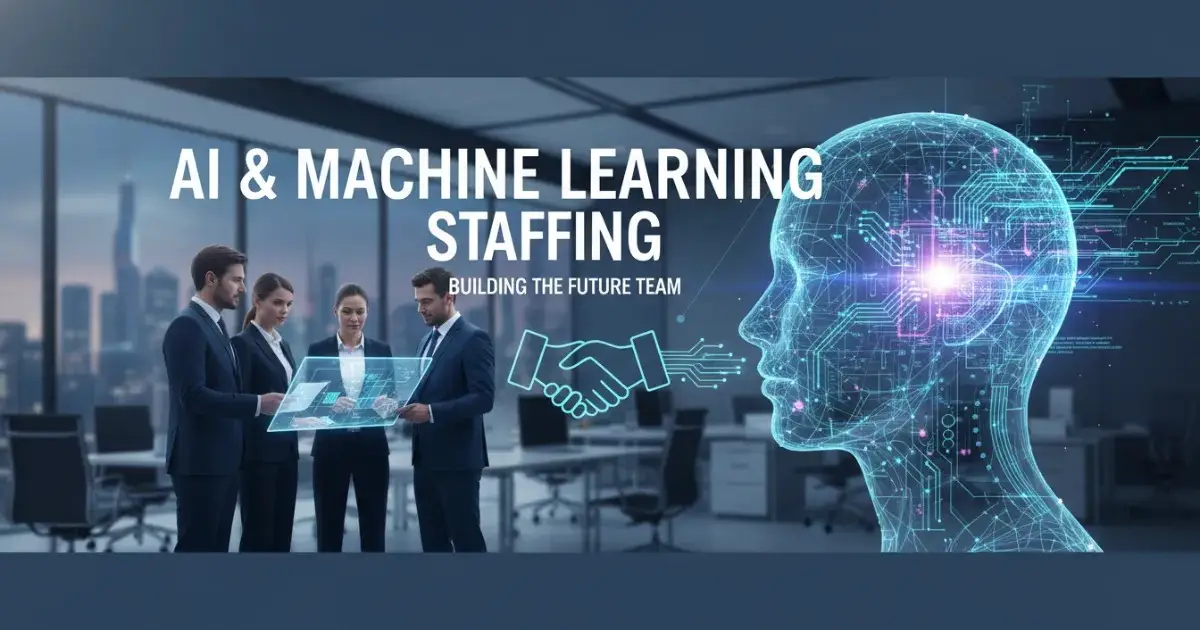
Ai and Machine Learning Staffing
The artificial intelligence landscape has matured rapidly, transitioning from experimental prototypes to mission-critical enterprise systems. By 2026, the primary bottleneck for organizations is no longer access to computing power or advanced foundational models—it is the scarcity of highly specialized human talent. As businesses race to integrate Generative AI, Large Language Models (LLMs), and autonomous systems into their workflows, the demand for adept professionals has eclipsed traditional hiring capabilities.
Securing top-tier data scientists, MLOps engineers, and AI architects requires more than a standard recruitment strategy. It demands a sophisticated approach to AI and Machine Learning staffing that accurately assesses both theoretical algorithmic knowledge and practical deployment expertise. This comprehensive guide explores the nuances of building high-performance AI teams, the mechanics of specialized staffing, and how organizations can strategically position themselves to win the AI talent war.
What is AI and Machine Learning Staffing?
AI and Machine Learning staffing is the strategic process of sourcing, vetting, and acquiring specialized talent—such as data scientists, MLOps professionals, and AI architects—to design, build, and maintain artificial intelligence systems. Unlike general IT recruitment, AI staffing requires deep technical validation of a candidate's ability to handle complex algorithms, manage unstructured data, and deploy models securely at scale. Getting this right often starts with a clear picture of the skills required to build an AI team that delivers ROI.
In today's ecosystem, effective AI staffing bridges the gap between organizational objectives and technical execution, ensuring companies hire individuals capable of turning raw data into actionable, automated intelligence.
Why It Matters
The strategic importance of dedicated AI and ML staffing cannot be overstated. Building an enterprise-grade AI solution requires a fundamentally different skill set than traditional software development, and a well-designed enterprise AI architecture depends heavily on the people implementing it. Traditional code is deterministic; AI and machine learning models are probabilistic.
If an organization attempts to build machine learning systems with a generic engineering team, they risk creating models fraught with biases, poor scalability, and security vulnerabilities. Strategic staffing ensures that businesses have access to specialized talent capable of managing vector databases, fine-tuning LLMs, and navigating complex regulatory landscapes.
Furthermore, as companies look to automate deeply integrated workflows, the need to hire AI engineers who understand both the underlying mathematics and the business domain becomes a critical competitive differentiator. A mis-hire in the AI department does not just result in delayed projects; it can lead to massive data breaches, regulatory fines, and reputational damage.
How It Works
The process of AI and ML staffing requires a meticulous, multi-tiered approach optimized for technical precision. Here is the step-by-step technical overview:
Requirement Profiling: The process begins with defining the exact technological stack. Does the company need an expert in PyTorch, TensorFlow, or JAX? Are they building a Retrieval-Augmented Generation (RAG) pipeline or a computer vision application? Clear requirement profiling separates standard data analysts from deep learning architects.
Targeted Sourcing: General job boards are rarely effective for top AI talent. Specialized staffing leverages niche communities (e.g., Kaggle, Hugging Face, GitHub repositories) and academic networks to find passive candidates with proven portfolios.
Technical Vetting: Candidates undergo rigorous technical evaluations. This includes assessing algorithmic problem-solving, data pipeline construction, model optimization techniques (like quantization or pruning), and MLOps deployment at scale (Docker, Kubernetes, CI/CD for ML).
Domain Alignment: AI professionals must understand the business context of their models. A candidate building models for healthcare must understand HIPAA, while a candidate building financial models must understand algorithmic trading constraints.
Onboarding and Integration: Finally, the staffing process ensures a seamless integration of the AI professional into the existing engineering culture, aligning their specialized workflow with the company's broader agile methodologies.
Key Features
Specialized AI staffing providers and strategies are defined by several distinct features that set them apart from traditional HR processes:
Deep Technical Screening: Utilization of peer-to-peer technical interviews conducted by active AI practitioners.
Niche Role Specialization: Targeted recruitment for distinct roles like NLP Engineers, Computer Vision Specialists, Prompt Engineers, and AI Ethicists.
Scalable Engagement Models: Offering contract-to-hire, direct placement, and dedicated offshore AI teams to suit project specificities.
Pre-Vetted Talent Pools: Access to an existing network of engineers who have already passed rigorous algorithmic and data architecture tests.
Compliance and Ethics Focus: Evaluating candidates on their understanding of AI bias, fairness, and ethics, and regulatory compliance.
Benefits
Investing in a specialized AI staffing strategy yields significant, tangible returns on investment (ROI).
Accelerated Time-to-Market: By bringing in pre-vetted experts who already possess domain knowledge, companies drastically reduce the learning curve, allowing AI products to reach the market faster.
Risk Mitigation: Experienced ML engineers understand how to avoid common pitfalls like data leakage, overfitting, and model drift, saving companies from costly post-deployment failures.
Scalable Infrastructure: Top-tier MLOps talent ensures that models do not just work on a local machine but can handle millions of API calls in a production environment.
Operational Efficiency: Implementing intelligent automation streamlines business processes. For example, organizations utilizing AI Agents for IT Operations see significant reductions in manual ticketing and server downtime, directly driven by the caliber of the engineers who deployed them.
Use Cases
The deployment of highly specialized AI talent enables transformative real-world applications across multiple industries:
Financial Services: Staffing quantitative analysts and deep learning experts to build predictive models for algorithmic trading, credit scoring, and fraud detection. Advanced teams are currently deploying AI Agents for Finance to automate complex auditing and portfolio management tasks.
Supply Chain & Logistics: Sourcing operations research scientists and AI developers to optimize routing, inventory forecasting, and fleet management. Companies frequently hire specialized talent to build AI Agents for Logistics that autonomously adjust supply chains in real-time based on global disruptions.
Risk & Compliance: Hiring NLP (Natural Language Processing) engineers to scan millions of regulatory documents and contracts, ensuring enterprise-wide adherence to global laws through specialized AI Agents for Compliance.
Enterprise AI Development: Establishing dedicated offshore or nearshore teams to build bespoke enterprise software, often partnering with an established AI Development Company in UK or similar tech hubs to supplement internal staff.
Examples
To illustrate the impact of targeted AI staffing, consider the following specific scenarios:
Scenario A: The E-Commerce Recommendation Engine A global retail brand noticed a 15% drop in user engagement. They utilized a specialized staffing model to quickly onboard a team of three Recommendation System Engineers and one MLOps Architect. Within four months, the team migrated the legacy system to a deep-learning-based collaborative filtering model, increasing conversion rates by 22%.
Scenario B: Autonomous Agent Integration A SaaS company wanted to integrate autonomous customer support systems but lacked the internal expertise to build agentic workflows. Instead of spending nine months training internal developers, they partnered with an AI Agent Development Company to augment their staff. This hybrid team successfully deployed an autonomous system capable of resolving 70% of Tier 1 support tickets without human intervention.
Comparison
Understanding the right approach to AI staffing requires comparing different acquisition models. Below is a detailed breakdown of General IT Staffing, Specialized AI Staffing, and Staff Augmentation.
Feature / Criteria | General IT Staffing | Specialized AI Staffing | AI Staff Augmentation |
|---|---|---|---|
Primary Focus | Standard software development, IT support | Data science, Machine Learning, Deep Learning | Immediate scaling of existing technical teams |
Vetting Depth | Basic coding, general architecture | Advanced algorithms, neural networks, MLOps | Specific to the immediate project tech stack |
Time to Hire | 2 - 4 Weeks | 4 - 8 Weeks (due to scarcity) | 1 - 2 Weeks (pre-benched resources) |
Cost Structure | Standard market rates | Premium rates due to niche skills | Flexible (hourly/monthly retainer) |
Best Used For | Building web/mobile apps, databases | Core AI R&D, building foundational models | Hitting tight deadlines, bridging short-term skill gaps |
Risk of Mis-hire | High (for complex AI roles) | Low | Low (usually backed by a tech partner guarantee) |
Challenges / Limitations
While the benefits are profound, AI and Machine Learning staffing presents unique industry challenges:
Extreme Talent Scarcity: As of 2026, the demand for senior AI architects vastly outpaces the global supply. Finding professionals who possess both theoretical math skills and practical production engineering experience is incredibly difficult.
Rapid Skill Obsolescence: The AI landscape evolves every few months. An engineer whose primary expertise was rooted in 2023 technologies may be obsolete if they haven't adapted to the latest advancements in agentic orchestration or efficient LLM fine-tuning.
High Compensation Demands: The scarcity of top-tier talent drives salary expectations to historic highs, making it difficult for mid-sized enterprises to compete with major tech conglomerates for direct hires.
Evaluating "Black Box" Outputs: Assessing an AI engineer's past work is difficult because ML models often act as black boxes. It requires specialized interviewers to determine if a candidate's past model success was due to robust architecture or simply favorable data sets.
Future Trends
Looking deeply into 2026 and beyond, the landscape of AI staffing is shifting rapidly.
The Rise of Agentic AI Engineers: The focus has moved away from building isolated predictive models to developing interconnected, autonomous AI agents. The most sought-after professionals are those who understand multi-agent systems and can orchestrate complex workflows where AI agents interact with each other seamlessly.
AI Staffing by AI: Organizations are increasingly using proprietary, AI-driven recruitment platforms to vet candidates. These platforms conduct automated, adaptive technical interviews that test a candidate's ability to debug code in real-time, removing human bias from the initial screening process.
Focus on AI Governance and Ethics: As international regulations surrounding Artificial Intelligence Real World Applications become more stringent, there is a massive surge in demand for AI Governance Officers and Ethicists—professionals who ensure that deployed models are transparent, unbiased, and legally compliant.
Fractional AI Leadership: Rather than hiring full-time, million-dollar AI executives, mid-market companies are leaning heavily into "Fractional Chief AI Officers (CAIOs)." These leaders provide high-level strategic direction for a fraction of the cost, while execution is handled through agile staff augmentation.
Conclusion
The success of any artificial intelligence initiative is intrinsically tied to the quality of the minds building it. AI and Machine Learning Staffing is no longer just a human resources function; it is a critical business strategy. By abandoning generalized recruitment methods in favor of specialized, rigorous, and technologically aligned vetting processes, organizations can secure the elite talent necessary to build secure, scalable, and innovative AI systems.
Key Takeaways:
AI staffing requires deep technical validation, distinct from traditional software engineering recruitment.
Specialized AI talent significantly accelerates time-to-market and mitigates the massive risks associated with poorly designed models.
Flexible models like staff augmentation offer a strategic bypass to the current talent shortage and high compensation demands.
The future of AI engineering is heavily focused on autonomous agents, MLOps, and rigorous AI governance.
Building an enterprise-ready AI team doesn't have to be a multi-month struggle against global talent shortages. Whether you need to augment your existing team with specialized MLOps engineers, build autonomous agents from the ground up, or require strategic AI consulting, Vegavid provides access to top-tier, pre-vetted professionals ready to accelerate your tech roadmap.
Explore our robust solutions and discover how we can help you build the future of your business. Visit Vegavid Home to learn more about our specialized staffing and development services today.
Frequently Asked Questions (FAQs)
A Data Scientist focuses primarily on analyzing data, building initial predictive models, and extracting business insights. An ML (Machine Learning) Engineer focuses on taking those models and optimizing, scaling, and deploying them securely into production environments.
Due to extreme talent scarcity and rigorous vetting requirements, the standard time-to-hire for a direct-placement senior AI engineer ranges from 6 to 10 weeks. Staff augmentation or contracting can reduce this to 1 to 2 weeks.
Internal HR teams typically lack the technical depth required to accurately evaluate an AI candidate's proficiency in complex algorithms, MLOps infrastructure, and model optimization, often leading to costly mis-hires. Specialized staffing ensures peer-level technical vetting.
The highest demand skills include LLM fine-tuning, Retrieval-Augmented Generation (RAG) architecture, multi-agent system orchestration, MLOps (model lifecycle management), and vector database optimization.
While hourly rates for staff augmentation may appear higher, it eliminates the overhead costs of benefits, prolonged onboarding, and recruitment fees. It offers cost-efficiency by allowing companies to scale resources up or down precisely based on project needs.

Yash Singh is the Chief Marketing Officer at Vegavid Technology, a leading AI-driven technology company specializing in AI agents, Generative AI, Blockchain, and intelligent automation solutions. With over a decade of experience in digital transformation and emerging technologies, Yash has played a key role in helping businesses adopt advanced AI solutions that enhance operational efficiency, automate workflows, and deliver personalized customer experiences across industries including fintech, healthcare, gaming, ecommerce, and enterprise technology. An alumnus of Indian Institute of Technology Bombay, Yash combines strong technical expertise with strategic marketing leadership to drive innovation in AI-powered applications, autonomous AI agents, Retrieval-Augmented Generation (RAG), Natural Language Processing (NLP), Large Language Models (LLMs), machine learning systems, conversational AI, and enterprise automation platforms. His expertise spans AI model integration, intelligent workflow automation, prompt engineering, smart data processing, and scalable AI infrastructure development, enabling organizations to accelerate digital transformation and business growth. Passionate about the future of intelligent systems, Yash actively shares insights on AI agents, Generative AI, LLM-powered applications, blockchain ecosystems, and next-generation digital strategies. He is committed to helping businesses embrace AI-first transformation while guiding teams to build impactful, industry-specific solutions that shape the future of innovation and intelligent technology.




Leave a Reply