
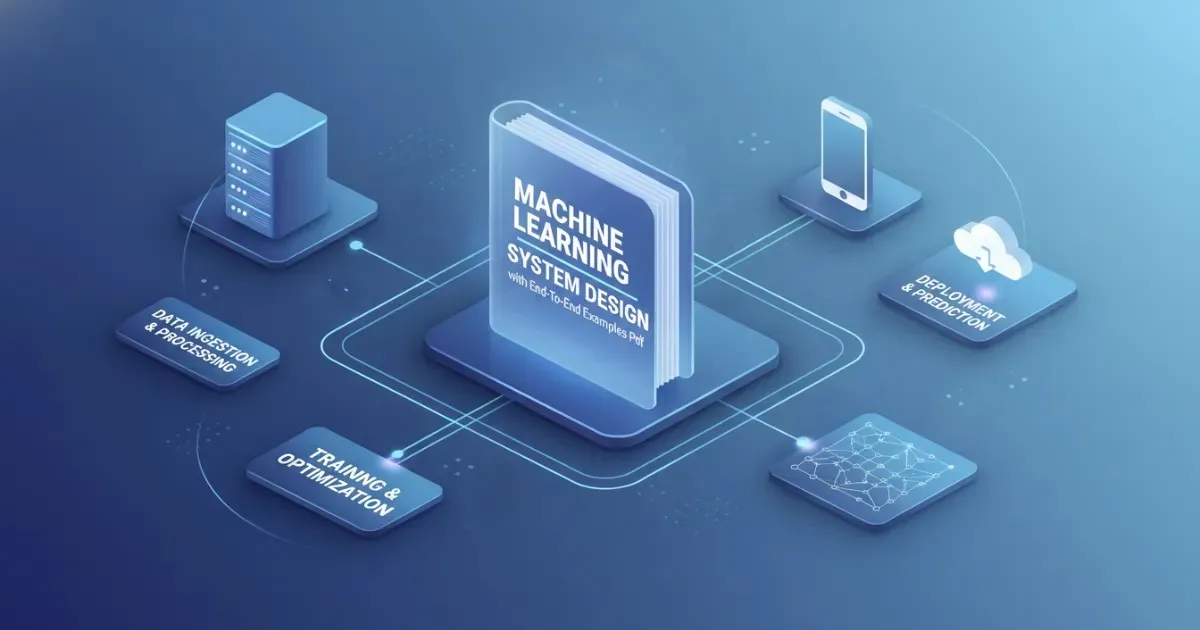
Machine Learning System Design: with End-To-End Examples Pdf
Training a machine learning model in a controlled notebook environment is only 10% of the battle. The true engineering challenge lies in deploying, scaling, and maintaining that model in a production environment where data is messy, latency requirements are strict, and user demands are unpredictable. Today, software architects and AI engineers frequently seek a definitive "Machine Learning System Design: with End-To-End Examples Pdf" to use as a blueprint for bridging the gap between data science and production software engineering.
This comprehensive guide serves as that ultimate resource. Whether you are preparing for a senior machine learning engineering interview or architecting a robust AI solution for an enterprise, this article breaks down the foundational pillars, technical components, and practical case studies required to build end-to-end machine learning systems.
What is Machine Learning System Design?
Machine Learning System Design is the architectural process of defining the technical infrastructure, data pipelines, model deployment strategies, and monitoring frameworks required to run machine learning models reliably in a production environment.
When professionals search for a Machine Learning System Design: with End-To-End Examples Pdf, they are looking for a comprehensive blueprint that covers the entire lifecycle of an ML project—from raw data ingestion and feature engineering to model serving, inference scaling, and continuous performance monitoring. Unlike traditional software design, ML system design must account for dynamic, ever-changing data distributions and non-deterministic outputs, which is why teams increasingly lean on machine learning algorithms chosen specifically for how they behave once deployed, not just how they perform in a benchmark.
Why It Matters
Implementing a robust ML architecture is a strategic imperative. Without proper system design, organizations face "technical debt in machine learning"—a phenomenon where the cost of maintaining a model far exceeds the cost of building it.
Here is why investing in precise machine learning system design matters:
Scalability: Allows AI systems to handle millions of concurrent requests without latency spikes.
Reliability & Uptime: Ensures fault tolerance. If a model inference node fails, the system can gracefully degrade or automatically spin up a replacement.
Cost Efficiency: Optimizes compute resources, ensuring expensive GPUs are only utilized when necessary (e.g., dynamic batching).
Faster Iteration: Standardized pipelines enable data science teams to update models and deploy them to production in hours rather than months.
As organizations scale, understanding the structural layout—often through design software architecture tips and best practices—becomes critical to maintaining organizational agility.
How It Works: The ML System Architecture
A production-grade machine learning system operates through a continuous, cyclic pipeline. The architecture is typically broken down into five distinct phases:
1. Data Engineering and Ingestion
Data is the lifeblood of any ML system. In production, systems must ingest structured and unstructured data from various sources (SQL databases, NoSQL stores, real-time event streams like Kafka). This phase involves data validation, handling missing values, and formatting, all coordinated through an AI data pipeline built to hold up under production load rather than a one-off notebook script.
2. Feature Store and Engineering
Features are measurable properties extracted from data. Modern ML architectures utilize a Feature Store (e.g., Feast, Hopsworks) to serve features consistently across both training (offline) and inference (online). This prevents training-serving skew.
3. Model Training and Tuning
This is where the actual learning occurs. In a production system, this step is heavily automated using CI/CD pipelines for ML (Continuous Training). Hyperparameter tuning frameworks run distributed training jobs across compute clusters (like Kubernetes or Ray) to find the optimal model weights. Teams often validate model stability with techniques like k-fold cross-validation, and combine multiple models through ensemble learning algorithms to squeeze out extra accuracy before anything reaches production.
4. Model Serving (Inference)
Once trained and validated, the model is deployed to an inference server. Based on the business requirement, this could be:
Real-time Inference: Serving predictions via REST/gRPC APIs in milliseconds.
Batch Inference: Generating predictions asynchronously on a schedule (e.g., calculating nightly recommendations).
Streaming Inference: Processing live event streams and outputting predictions continuously.
Teams weighing where inference should actually run often compare cloud vs. on-premise deployment strategies against latency, cost, and data residency requirements before committing to an architecture.
5. Monitoring and Observability
Because data changes over time, models degrade (concept drift and data drift). Continuous monitoring tracks the statistical properties of incoming data and prediction distributions, triggering automated retraining pipelines when anomalies are detected. Choosing the right model evaluation metrics up front makes it far easier to tell a genuine drift event from normal noise in production traffic.
Key Features of a Robust ML System
To operate at an enterprise level, your machine learning system design must incorporate the following features:
Training-Serving Symmetry: Ensuring the code used to generate features for training is identical to the code used during real-time inference.
Automated Retraining Triggers: Event-driven architecture that kicks off retraining when model accuracy drops below a defined threshold.
Shadow Deployment & A/B Testing: The ability to deploy new models alongside old ones silently (shadow mode) to compare performance without impacting users.
Low Latency Inference: Utilizing model quantization and optimized runtimes (like ONNX or TensorRT) to deliver predictions rapidly, an outcome that usually comes from applying dedicated AI model optimization techniques after training rather than relying on raw compute alone.
Data Lineage Tracking: Keeping a strict record of which data was used to train which model, ensuring compliance and reproducibility—a discipline that falls under broader MLOps at scale practices as an organization's model count grows.
Benefits of End-to-End System Design
Building out a full-scale ML architecture provides immense tangible advantages:
Reduced Time-to-Market: Automated CI/CD pipelines for ML mean new ideas go from notebook to production seamlessly. This is highly aligned with how ChatGPT helps custom software development by accelerating coding and deployment workflows.
Mitigation of Concept Drift: Automated monitoring protects revenue by ensuring models don't make poor decisions based on outdated trends.
Cross-Functional Collaboration: Clearly defined systems bridge the communication gap between Data Scientists, ML Engineers, and DevOps teams.
Use Cases for Machine Learning Systems
Robust system design is required across almost all modern digital industries. Some primary applications include:
Financial Services: Algorithmic trading, credit scoring, and fraud detection.
Healthcare: Medical imaging analysis, predictive diagnostics, and personalized treatment planning. In this sector, data privacy is paramount, often integrating secure data pipelines similar to blockchain utility in the healthcare industry.
E-Commerce: Product recommendation engines, dynamic pricing, and inventory forecasting.
Autonomous Vehicles: Edge ML inference and real-time computer vision processing.
End-To-End Examples
To truly understand a Machine Learning System Design: with End-To-End Examples Pdf, we must look at concrete, real-world blueprints. Here are two detailed examples.
Example 1: Real-Time Fraud Detection System (Fintech)
In a modern fintech app development company changing the financial industry, a fraud detection ML system must evaluate transactions in under 50 milliseconds.
Data Ingestion: A user swipes a credit card. The transaction event is published to an Apache Kafka stream.
Feature Retrieval: The stream processor (e.g., Apache Flink) queries an in-memory Redis Feature Store for real-time features (e.g., "number of transactions in the last 10 minutes") and historical features (e.g., "average transaction amount over 30 days").
Model Serving: The combined feature vector is sent via gRPC to an inference server hosting an XGBoost model.
Action: The model outputs a fraud probability score. If the score > 0.85, the transaction is declined; otherwise, it is approved.
Feedback Loop: Human fraud investigators review flagged transactions. Their verdicts are fed back into the system's data lake to retrain the model daily.
Example 2: E-Commerce Video Recommendation Engine
Recommending content to millions of concurrent users requires a different architectural approach, usually involving a two-stage funnel.
Candidate Generation: Out of millions of possible videos, a lightweight model (often utilizing collaborative filtering) narrows the list down to 1,000 relevant candidates. Modern architectures utilize vector databases (like Pinecone or Milvus) to perform fast nearest-neighbor searches on user and item embeddings—the same mechanism explained in depth in how vector databases work for AI applications more broadly.
Ranking: A heavier, more complex deep learning model (e.g., a two-tower neural network) scores and ranks these 1,000 candidates based on detailed user context (time of day, device type, historical watch time).
Inference Strategy: Because ranking is computationally heavy, features are pre-computed and stored offline, with only real-time context appended at the moment of prediction.
Comparison: Batch vs. Real-Time Inference
Understanding when to use different deployment patterns is a core competency in ML system design.
Feature | Batch Inference | Real-Time Inference |
|---|---|---|
Execution Trigger | Scheduled (e.g., every night at 2 AM) | On-demand (user requests via API) |
Latency Requirement | High (Minutes to Hours) | Low (Milliseconds) |
Throughput | Very High (Millions of records at once) | Variable (Depends on traffic) |
Use Case | Email marketing personalization | Credit card fraud detection |
Infrastructure Cost | Lower (Optimized spot instances) | Higher (Always-on highly available nodes) |
Challenges and Limitations
Even the best-designed machine learning systems face significant operational hurdles:
Training-Serving Skew: When the logic used to create features during training differs slightly from the production code, model performance plummets. Standardizing on a central Feature Store is critical.
The "Cold Start" Problem: Systems struggle to make accurate predictions for new users or new items that have no historical data. Teams often lean on transfer learning to bootstrap predictions before enough first-party data has accumulated.
Hardware Constraints: Advanced GenAI and deep learning models require heavy GPU compute. Ensuring efficient orchestration of these resources without overspending is a continuous challenge.
Future Trends (The 2026 Landscape)
As we navigate 2026, the landscape of Machine Learning System Design has evolved drastically from the predictive models of the early 2020s.
RAG as a Standard Architecture: Retrieval-Augmented Generation has moved from an experimental concept to a standard enterprise blueprint, and the underlying knowledge base is increasingly managed as its own system in patterns like RAG for enterprise knowledge bases. Teaming up with a dedicated RAG development company is now common practice for designing context-aware enterprise LLM systems, and teams running many such models in parallel are turning to LLMOps to keep them versioned, monitored, and governed the same way MLOps does for classical models.
Agentic Workflows: Systems are no longer just making predictions; they are executing complex, multi-step actions. The deployment of AI Agents for Business requires entirely new system designs that account for agent memory, reasoning loops, and API execution guardrails.
Serverless MLOps: Infrastructure management is becoming invisible. Serverless GPU inference allows systems to scale down to zero during idle times, drastically cutting costs while handling massive traffic spikes autonomously.
Convergence with Web3: In systems demanding absolute transparency, we are seeing the integration of cryptographic proofs into ML pipelines to verify model outputs without exposing underlying weights, echoing the types of artificial intelligence combined with decentralized technologies.
Conclusion
Machine learning system design is the critical bridge that transforms theoretical data science into reliable, revenue-generating software products. Whether you are building a real-time fraud detection engine or a massive content recommendation system, understanding the end-to-end architecture—from feature stores and inference servers to automated drift monitoring—is essential. Teams starting from zero often benefit from walking through how to build a machine learning model step by step before scaling into a full production architecture. By mastering these architectural patterns, engineering teams can build scalable, fault-tolerant AI solutions that drive real business value.
Ready to Architect Your AI Future?
Designing a production-ready machine learning system requires deep expertise across data engineering, software architecture, and AI development. At Vegavid, our experienced AI and software engineers specialize in turning complex data challenges into scalable, high-performance solutions. Whether you are looking to integrate advanced machine learning pipelines, deploy AI agents, or optimize your current software architecture, we are here to help. Reach out to Vegavid today to discuss how we can build the intelligent systems that will power your business tomorrow.
Frequently Asked Questions (FAQs)
Large Language Models shift the focus from traditional feature engineering toward prompt engineering, vector database management for context retrieval (RAG), and strict output parsing/guardrails to prevent hallucinations and ensure safe enterprise deployment.
Scaling involves horizontal pod autoscaling (adding more inference servers behind a load balancer), utilizing dynamic batching (grouping concurrent requests to process them simultaneously on a GPU), and optimizing the model using techniques like quantization or ONNX runtimes.
Data drift occurs when the statistical properties of the incoming input data change over time. Concept drift happens when the relationship between the input data and the target variable changes (e.g., what was considered "normal" behavior yesterday is considered "fraudulent" today).
A feature store acts as a centralized repository that serves consistent data features for both offline training and online inference. It prevents training-serving skew and allows different ML models to reuse the same engineered features.
An end-to-end ML system is a complete infrastructure that handles the entire lifecycle of a machine learning model, including raw data ingestion, feature engineering, model training, deployment, serving predictions, and continuous monitoring.

Yash Singh is the Chief Marketing Officer at Vegavid Technology, a leading AI-driven technology company specializing in AI agents, Generative AI, Blockchain, and intelligent automation solutions. With over a decade of experience in digital transformation and emerging technologies, Yash has played a key role in helping businesses adopt advanced AI solutions that enhance operational efficiency, automate workflows, and deliver personalized customer experiences across industries including fintech, healthcare, gaming, ecommerce, and enterprise technology. An alumnus of Indian Institute of Technology Bombay, Yash combines strong technical expertise with strategic marketing leadership to drive innovation in AI-powered applications, autonomous AI agents, Retrieval-Augmented Generation (RAG), Natural Language Processing (NLP), Large Language Models (LLMs), machine learning systems, conversational AI, and enterprise automation platforms. His expertise spans AI model integration, intelligent workflow automation, prompt engineering, smart data processing, and scalable AI infrastructure development, enabling organizations to accelerate digital transformation and business growth. Passionate about the future of intelligent systems, Yash actively shares insights on AI agents, Generative AI, LLM-powered applications, blockchain ecosystems, and next-generation digital strategies. He is committed to helping businesses embrace AI-first transformation while guiding teams to build impactful, industry-specific solutions that shape the future of innovation and intelligent technology.



Leave a Reply