
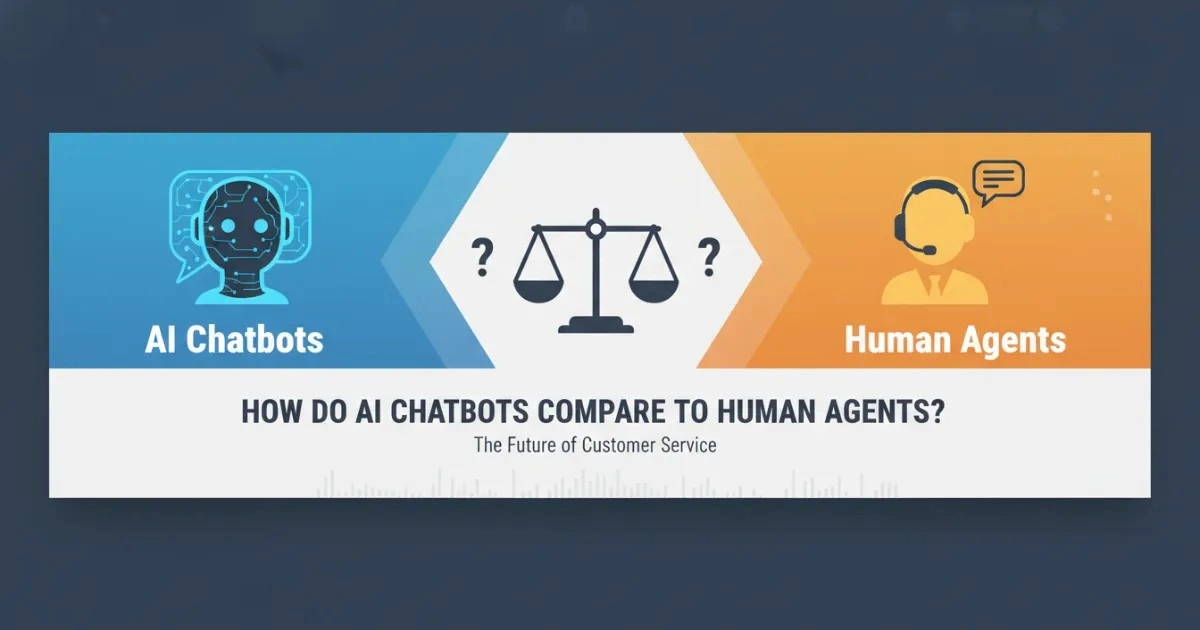
How Do AI Chatbots Compare to Human Agents
In today's digital world, customer expectations are higher than ever. People want fast, accurate, and personalized support whenever they need it. To meet these expectations, businesses increasingly rely on artificial intelligence (AI) chatbots alongside traditional human customer service agents. While both play important roles, they differ significantly in terms of speed, cost, capabilities, and customer experience.
What Are AI Chatbots?
AI chatbots are software applications powered by artificial intelligence and natural language processing (NLP). They are designed to understand customer questions, provide relevant answers, and perform tasks such as booking appointments, tracking orders, answering frequently asked questions, and processing simple requests.
Unlike traditional rule-based chatbots, modern AI chatbots can understand context, learn from interactions, and deliver more natural conversations.
What Are Human Agents?
Human agents are customer service professionals who interact directly with customers through phone calls, live chat, email, or social media. They bring emotional intelligence, critical thinking, creativity, and empathy to conversations, making them especially valuable when dealing with complex or sensitive situations.
Comparing AI Chatbots and Human Agents
1. Speed and Availability
AI chatbots operate 24/7 without breaks or downtime. They respond instantly and can handle thousands of conversations simultaneously. This makes them ideal for businesses serving customers across multiple time zones.
Human agents, on the other hand, are limited by working hours and can usually manage only one conversation—or a small number of chats—at a time. Customers may also experience wait times during busy periods.
2. Cost Efficiency
Hiring, training, and managing customer service teams requires significant investment. Businesses must account for salaries, benefits, office space, and ongoing training.
AI chatbots require an initial investment for development and implementation, but once deployed, they can manage a large volume of inquiries at a much lower operational cost.
3. Accuracy and Consistency
AI chatbots provide standardized responses based on their training and knowledge base. They deliver consistent information every time, reducing the risk of human error.
Human agents may occasionally provide inconsistent answers due to misunderstanding, fatigue, or varying levels of experience.
4. Emotional Intelligence
One area where human agents clearly excel is emotional intelligence. They can recognize frustration, empathy, urgency, and subtle emotional cues that AI still struggles to fully understand.
For customers dealing with complaints, financial concerns, healthcare issues, or emotionally sensitive situations, speaking with a compassionate human often creates a better experience.
5. Problem-Solving Ability
AI chatbots are excellent at handling repetitive and structured questions. However, they may struggle when customers present unusual requests, ambiguous language, or complex scenarios.
Human agents can analyze unique situations, think creatively, and adapt their responses based on context.
6. Scalability
As customer demand grows, expanding a human support team requires hiring additional employees.
AI chatbots can scale almost instantly, allowing businesses to manage seasonal spikes or large volumes of inquiries without significantly increasing costs.
7. Personalization
Modern AI chatbots can personalize interactions using customer data, purchase history, and previous conversations. However, their personalization depends on the quality of available data.
Human agents naturally adapt their communication style, understand subtle customer preferences, and build genuine relationships that go beyond data-driven personalization.
Advantages of AI Chatbots
Available 24/7
Instant responses
Lower operating costs
Can handle thousands of customers simultaneously
Consistent information delivery
Easy integration with websites and messaging platforms
Reduces workload for customer support teams
Advantages of Human Agents
Strong empathy and emotional understanding
Better handling of complex situations
Creative problem-solving
Ability to negotiate and persuade
Builds stronger customer relationships
Greater flexibility during unexpected scenarios
Challenges of AI Chatbots
Despite their advantages, AI chatbots have limitations:
Difficulty understanding highly complex requests
Limited emotional intelligence
May misunderstand ambiguous language
Dependence on quality training data
Occasionally require human intervention
Challenges of Human Agents
Human customer support also presents challenges:
Higher operational costs
Limited availability
Longer response times during peak periods
Performance can vary between agents
Training requires continuous investment
Which Is Better?
There is no universal answer because each option serves different needs.
AI chatbots are ideal for:
Answering frequently asked questions
Order tracking
Appointment scheduling
Password resets
Basic troubleshooting
Lead qualification
Human agents are better suited for:
Complaint resolution
Technical troubleshooting
Financial discussions
Healthcare support
Complex sales conversations
Situations requiring empathy
The Best Approach: AI Plus Human Collaboration
Rather than replacing human agents, many businesses are adopting a hybrid customer service model. In this approach, AI chatbots handle routine inquiries, while complex or emotionally sensitive issues are seamlessly transferred to human agents.
This combination allows organizations to improve efficiency, reduce costs, shorten response times, and maintain a high level of customer satisfaction. Human agents can focus on tasks that require judgment and empathy, while AI manages repetitive work.
Conclusion
AI chatbots and human agents each bring unique strengths to customer service. AI offers speed, scalability, cost savings, and round-the-clock availability, making it ideal for handling routine interactions. Human agents contribute empathy, critical thinking, adaptability, and the ability to resolve complex issues that require personal attention.
For most organizations, the most effective strategy is not choosing one over the other but combining both. By leveraging AI for efficiency and human expertise for meaningful interactions, businesses can deliver faster, smarter, and more satisfying customer experiences while optimizing operational performance.
Frequently Asked Questions (FAQs)
No. While AI chatbots will replace humans for routine, repetitive inquiries (like order tracking or password resets), human agents will always be required for complex problem-solving, emotionally sensitive issues, and high-value customer retention efforts.
The primary advantage is speed and scalability. AI chatbots can provide instant, 24/7 responses to thousands of customers simultaneously without any wait time, drastically reducing operational costs.
Customers prefer human agents when their issue is complex, non-standard, or highly frustrating. Humans possess emotional intelligence, empathy, and the authority to bend rules or improvise solutions that a rigidly programmed AI cannot.
Modern AI chatbots use sentiment analysis and confidence scoring. If the bot detects anger, or if the user's question falls outside the bot's training data (low confidence score), it automatically transfers the chat context to an available human agent in a process called "Human-in-the-Loop" (HITL).
Beyond customer support, AI is heavily used in supply chain prediction, medical diagnostics, e-commerce recommendations, and financial fraud detection. You can explore a broader list of Artificial Intelligence Real World Applications to see its vast potential.
AI is significantly cheaper per interaction. However, the initial setup, training, and integration of enterprise AI can require an upfront investment. The highest ROI is achieved by using AI to handle 70-80% of volume, reserving human salaries for the remaining 20% of complex tasks.

Yash Singh is the Chief Marketing Officer at Vegavid Technology, a leading AI-driven technology company specializing in AI agents, Generative AI, Blockchain, and intelligent automation solutions. With over a decade of experience in digital transformation and emerging technologies, Yash has played a key role in helping businesses adopt advanced AI solutions that enhance operational efficiency, automate workflows, and deliver personalized customer experiences across industries including fintech, healthcare, gaming, ecommerce, and enterprise technology. An alumnus of Indian Institute of Technology Bombay, Yash combines strong technical expertise with strategic marketing leadership to drive innovation in AI-powered applications, autonomous AI agents, Retrieval-Augmented Generation (RAG), Natural Language Processing (NLP), Large Language Models (LLMs), machine learning systems, conversational AI, and enterprise automation platforms. His expertise spans AI model integration, intelligent workflow automation, prompt engineering, smart data processing, and scalable AI infrastructure development, enabling organizations to accelerate digital transformation and business growth. Passionate about the future of intelligent systems, Yash actively shares insights on AI agents, Generative AI, LLM-powered applications, blockchain ecosystems, and next-generation digital strategies. He is committed to helping businesses embrace AI-first transformation while guiding teams to build impactful, industry-specific solutions that shape the future of innovation and intelligent technology.





Leave a Reply