
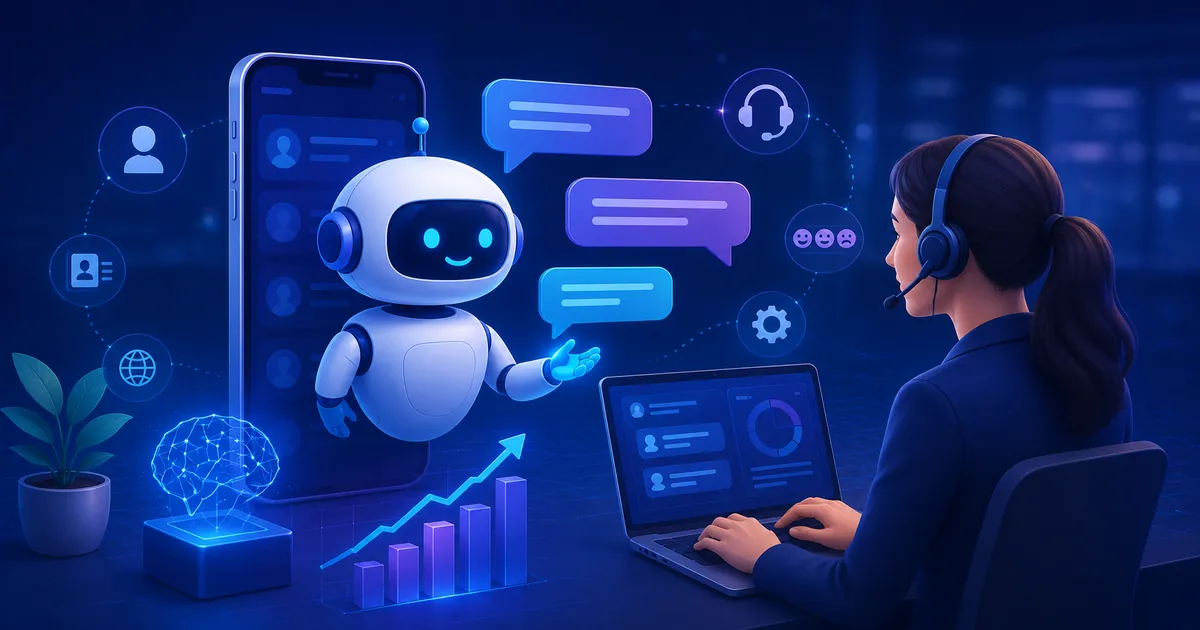
Natural Language Processing in Customer Service: Benefits, Use Cases & Future Trends
Customer expectations have changed dramatically in the digital era. Today, customers expect businesses to provide instant responses, personalized interactions, and 24/7 support across multiple communication channels. Meeting these expectations manually can be challenging, especially for organizations handling thousands of customer inquiries every day.
This is where Natural Language Processing (NLP) plays a crucial role. As a branch of Artificial Intelligence (AI), NLP enables computers to understand, interpret, and generate human language. By combining machine learning, linguistics, and AI, NLP allows customer service platforms to communicate naturally with users through chatbots, virtual assistants, automated email responses, and intelligent ticket routing.
From answering common questions to analyzing customer sentiment and supporting multilingual conversations, NLP has become one of the most valuable technologies for modern customer support. Businesses across industries are leveraging NLP-powered AI agents to improve customer satisfaction, reduce operational costs, and enhance overall service quality.
In this article, we'll explore what Natural Language Processing is, how it transforms customer service, its benefits, real-world applications, challenges, and future trends.
What is Natural Language Processing (NLP)?
Natural Language Processing is the branch of AI that allows machines to read, interpret, and generate human language the way people naturally speak and write. Natural Language Processing (NLP) is a field of Artificial Intelligence that enables computers to understand, process, interpret, and generate human language in both written and spoken forms.
Unlike traditional software that relies on predefined rules, NLP systems analyze the context, grammar, intent, and meaning behind customer messages. This enables AI-powered applications to communicate naturally with users and provide relevant responses. Businesses researching NLP vs NLU vs NLG often want a clearer picture of how these related fields divide the work of understanding and generating language.
NLP combines several technologies, including:
Machine Learning (ML)
Deep Learning
Text Analytics
Semantic Understanding
These technologies help customer service systems understand customer intent rather than simply matching keywords.
Why is NLP Important in Customer Service?
NLP matters in customer service because it lets businesses automate high volumes of routine conversations without sacrificing a natural, human-like tone. Traditional customer support often struggles with high ticket volumes, repetitive questions, language barriers, and long response times.
Natural Language Processing helps businesses overcome these challenges by automating conversations while maintaining a human-like experience.
Key reasons organizations adopt NLP include:
Faster customer responses
24/7 customer support
Reduced workload for support agents
Personalized customer interactions
Improved customer satisfaction
Lower operational costs
Better scalability during peak demand
Instead of replacing human agents, NLP assists them by automating repetitive tasks so they can focus on more complex customer issues, a balance explored further in how AI chatbots compare to human agents.
How Natural Language Processing Works in Customer Service
An NLP-powered support system moves a customer message through several stages — from raw text to an intelligent, context-aware response. An NLP-powered customer support system follows several steps to understand and respond to users.
1. Customer Input
The customer sends a message through:
Live chat
Website chatbot
Mobile app
Email
Voice assistant
Social media
Example:
"My payment failed but the money was deducted."
2. Text Processing
The NLP engine breaks the sentence into smaller components by:
Tokenization
Removing unnecessary words
Correcting spelling mistakes
Identifying important keywords
3. Intent Recognition
The AI determines what the customer wants.
Possible intent:
Payment issue
Refund request
Account access
Delivery status
Technical support
4. Entity Recognition
The system identifies important information such as:
Order ID
Product name
Payment amount
Customer name
Date
Location
5. Sentiment Analysis
The AI analyzes customer emotions using sentiment analysis, a technique also detailed in this guide on AI for sentiment analysis.
Possible sentiments include:
Happy
Angry
Confused
Frustrated
Neutral
This helps prioritize urgent cases.
6. Response Generation
The chatbot either:
Answers automatically
Retrieves information from a knowledge base
Transfers the conversation to a human agent
Creates a support ticket
Key Benefits of NLP in Customer Service
NLP delivers measurable gains across speed, cost, and customer experience, which is why it has become one of the most searched ai customer service automation solutions among growing businesses.
1. Faster Response Times
NLP-powered chatbots can answer customer questions instantly without requiring customers to wait in support queues.
This significantly improves response times and enhances the overall customer experience.
2. 24/7 Customer Support
Unlike human agents, AI systems operate continuously.
Customers receive assistance at any time, regardless of time zones or business hours.
3. Reduced Operational Costs
Automating repetitive support tasks lowers staffing requirements while allowing existing agents to handle more complex issues, an approach covered in depth in how AI reduces customer support costs.
This improves operational efficiency and reduces support costs.
4. Improved Customer Satisfaction
Customers value quick, accurate, and personalized responses.
NLP helps deliver consistent service, resulting in higher customer satisfaction (CSAT) and improved loyalty.
5. Personalized Customer Experiences
Modern NLP systems can access customer history, previous interactions, preferences, and purchase records to provide context-aware responses.
This creates more meaningful customer interactions.
6. Better Agent Productivity
NLP assists customer service representatives by:
Suggesting responses
Summarizing conversations
Recommending solutions
Automatically categorizing tickets
Agents spend less time on repetitive work and more time resolving complex problems.
7. Multilingual Customer Support
Advanced NLP systems support multiple languages, enabling businesses to serve global customers without maintaining large multilingual teams.
8. Intelligent Ticket Routing
Instead of manually assigning customer requests, NLP identifies the issue and routes tickets to the most appropriate department or specialist.
This reduces resolution times.
Common NLP Use Cases in Customer Service
NLP shows up across nearly every customer-facing channel, from chatbots and voice bots to email triage and smart search. A broader look at these applications is available in AI use cases for NLP applications.
AI Chatbots
NLP-powered chatbots answer frequently asked questions, resolve common issues, and guide customers through self-service options, as outlined in how AI chatbot solutions are revolutionizing customer service.
Virtual Assistants
AI assistants provide conversational support, helping customers:
Track orders
Reset passwords
Update account details
Schedule appointments
Process returns
Email Classification
NLP automatically categorizes incoming emails by identifying customer intent.
Examples include:
Billing
Technical support
Sales inquiries
Refund requests
Complaints
This accelerates ticket management.
Sentiment Analysis
Businesses analyze customer conversations to determine emotional tone.
Negative conversations can be escalated automatically to experienced support agents.
Voice Assistants and Call Centers
Speech recognition combined with NLP enables voice bots to understand spoken language and respond naturally, a shift explored in how voice AI is changing customer service.
These systems help reduce call center workloads.
Smart Search
Instead of searching using exact keywords, customers can ask questions naturally.
For example:
"How do I change my shipping address?"
The system understands the intent and provides the appropriate help article.
Automatic Ticket Categorization
Customer requests are automatically tagged based on their content.
This reduces manual effort while improving workflow efficiency.
Conversation Summarization
NLP creates concise summaries of lengthy customer conversations, allowing support agents to quickly understand previous interactions.
Industries Using NLP in Customer Service
Natural Language Processing is transforming customer support across various industries, with adoption growing fastest in sectors that handle high inquiry volumes. Natural Language Processing is transforming customer support across various industries.
Some of the leading sectors include:
Banking and Financial Services
Healthcare
E-commerce
Retail
Telecommunications
Insurance
Travel and Hospitality
Education
Government Services
Software and SaaS Companies
Any industry that handles customer inquiries can benefit from NLP-powered automation, as shown in this overview of AI in customer support, chatbots, and voice AI automation.
Challenges of NLP in Customer Service
Despite its advantages, NLP adoption comes with real hurdles around language ambiguity, context retention, and data privacy that businesses need to plan for. Although NLP offers numerous advantages, organizations may encounter certain implementation challenges.
Understanding Complex Language
Customers often use slang, abbreviations, misspellings, or ambiguous language that can be difficult for AI to interpret accurately.
Handling Context
Maintaining context across long conversations remains challenging for some NLP systems, especially in complex support scenarios.
Data Privacy and Security
Customer conversations may contain sensitive information, requiring organizations to comply with data protection regulations and implement strong security measures.
Language and Cultural Differences
Supporting multiple languages, dialects, and cultural nuances requires continuous model training and localization.
Training Requirements
NLP models need high-quality, domain-specific data to understand industry terminology and deliver accurate responses.
Escalation to Human Agents
AI cannot resolve every issue. Organizations must ensure smooth transitions from automated systems to human support representatives when necessary, a comparison covered in AI vs traditional customer support systems.
Best Practices for Implementing NLP in Customer Service
Successful NLP implementations start with clear goals, quality training data, and tight integration with existing support tools. To maximize the value of NLP, businesses should follow these best practices:
Define clear automation goals and use cases.
Train models with high-quality customer interaction data.
Continuously monitor and improve chatbot performance.
Integrate NLP with CRM and help desk platforms.
Provide seamless handoffs to human agents for complex cases.
Regularly update knowledge bases with new information.
Measure key performance indicators such as response time, resolution rate, CSAT, and customer retention.
Ensure compliance with privacy and security regulations.
Future Trends of NLP in Customer Service
NLP in customer service is heading toward more generative, emotion-aware, and predictive interactions powered by large language models. Natural Language Processing continues to evolve rapidly as AI technologies become more advanced. Future customer service solutions will deliver increasingly human-like, proactive, and personalized interactions.
Some emerging trends include:
1. Generative AI-Powered Support
Large Language Models (LLMs) will provide more accurate, conversational, and context-aware responses while assisting both customers and support agents, a trend detailed in generative AI applications.
2. Emotion-Aware Customer Service
Future NLP systems will better recognize customer emotions through text and speech, enabling more empathetic and personalized interactions.
3. Hyper-Personalization
AI will use customer behavior, preferences, purchase history, and previous conversations to deliver highly tailored recommendations and support.
4. Voice-First Customer Support
Voice assistants will become more natural, supporting multilingual conversations and reducing reliance on traditional call centers, as explored in what is an AI voice agent.
5. Predictive Customer Service
NLP combined with predictive analytics will identify potential issues before customers report them, enabling proactive support.
6. AI Agent Collaboration
Rather than relying on a single chatbot, multiple AI agents will collaborate to manage specialized tasks such as billing, technical support, sales, and customer onboarding, a model described in AI agent use cases in customer service.
7. Omnichannel Intelligence
Future NLP platforms will maintain conversation context across websites, mobile apps, email, messaging platforms, social media, and voice channels for a seamless customer experience.
Conclusion
Natural Language Processing has become a cornerstone of modern customer service by enabling businesses to deliver faster, smarter, and more personalized support at scale. From AI-powered chatbots and virtual assistants to sentiment analysis, intelligent ticket routing, and multilingual communication, NLP helps organizations improve efficiency while enhancing the customer experience. Businesses exploring implementation can also review this guide on chatbot development services or AI agents for customer service to plan their next steps.
Although challenges such as language complexity, data privacy, and contextual understanding remain, ongoing advances in AI and machine learning are making NLP systems increasingly accurate and capable. As technologies like generative AI, predictive analytics, and emotion-aware interfaces continue to mature, NLP will play an even greater role in helping businesses build stronger customer relationships and provide exceptional service across every touchpoint.
Frequently Asked Questions
NLP improves customer service by providing instant responses, automating repetitive tasks, analyzing customer sentiment, routing tickets intelligently, and delivering personalized support experiences.
Key benefits include faster response times, 24/7 customer support, reduced operational costs, improved customer satisfaction, multilingual communication, better agent productivity, and intelligent ticket management.
Industries including banking, healthcare, retail, e-commerce, insurance, telecommunications, travel, education, SaaS, and government use NLP to automate customer support and improve service quality.
Common challenges include understanding complex language, maintaining conversation context, ensuring data privacy, handling multiple languages, training AI models, and escalating complex issues to human agents.

Yash Singh is the Chief Marketing Officer at Vegavid Technology, a leading AI-driven technology company specializing in AI agents, Generative AI, Blockchain, and intelligent automation solutions. With over a decade of experience in digital transformation and emerging technologies, Yash has played a key role in helping businesses adopt advanced AI solutions that enhance operational efficiency, automate workflows, and deliver personalized customer experiences across industries including fintech, healthcare, gaming, ecommerce, and enterprise technology. An alumnus of Indian Institute of Technology Bombay, Yash combines strong technical expertise with strategic marketing leadership to drive innovation in AI-powered applications, autonomous AI agents, Retrieval-Augmented Generation (RAG), Natural Language Processing (NLP), Large Language Models (LLMs), machine learning systems, conversational AI, and enterprise automation platforms. His expertise spans AI model integration, intelligent workflow automation, prompt engineering, smart data processing, and scalable AI infrastructure development, enabling organizations to accelerate digital transformation and business growth. Passionate about the future of intelligent systems, Yash actively shares insights on AI agents, Generative AI, LLM-powered applications, blockchain ecosystems, and next-generation digital strategies. He is committed to helping businesses embrace AI-first transformation while guiding teams to build impactful, industry-specific solutions that shape the future of innovation and intelligent technology.






Leave a Reply