
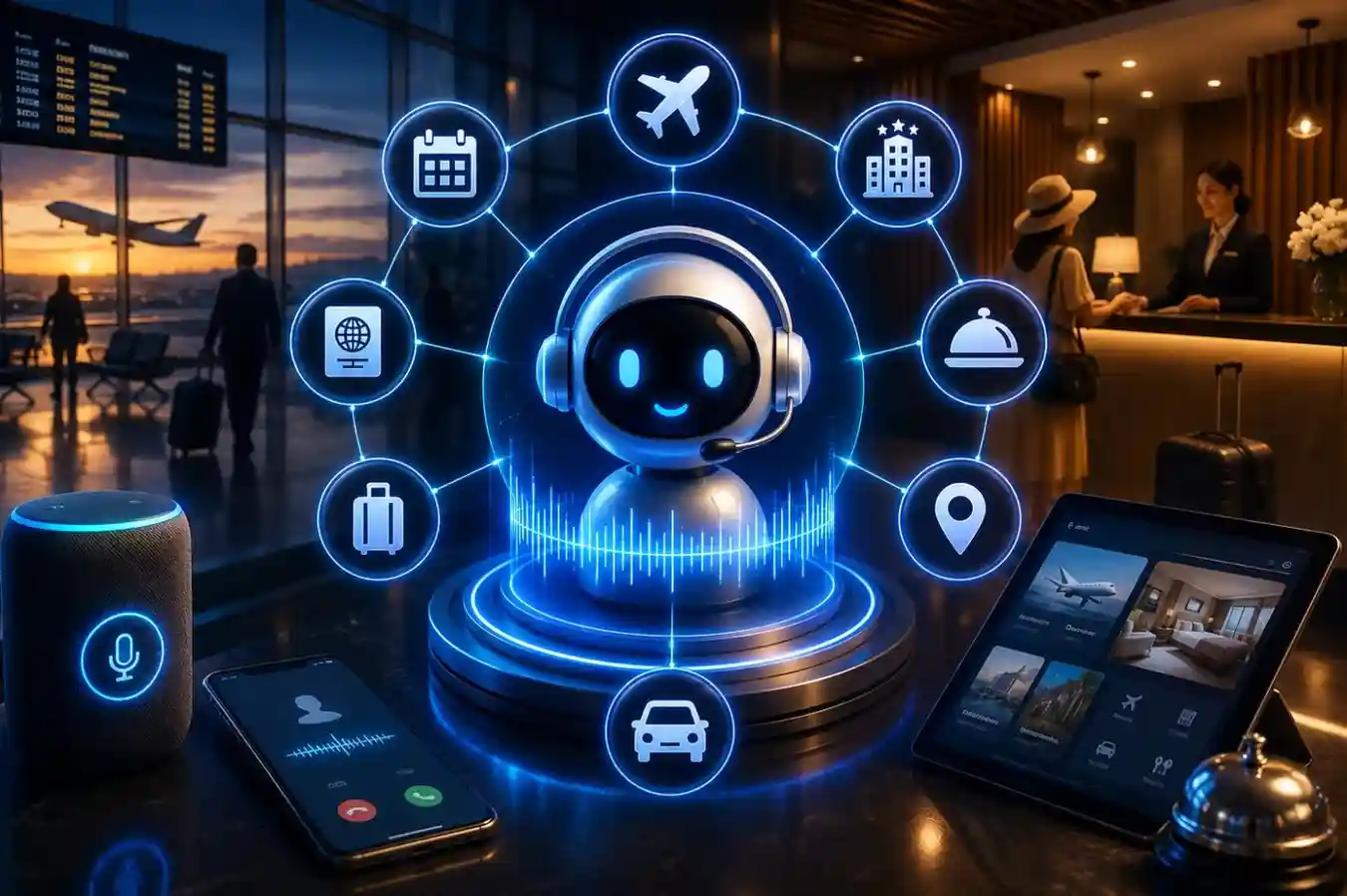
AI Voice Agent in Travel & Hospitality: Use Cases, Benefits, and Future Trends
Introduction
The travel and hospitality industry has always been built around experiences. Whether a customer is booking a flight, reserving a hotel room, planning a vacation itinerary, or requesting assistance during a trip, every interaction shapes the overall perception of a brand. In an industry where customer loyalty is heavily influenced by convenience and responsiveness, delays and communication gaps can quickly lead travelers to competitors.
The rapid growth of digital booking platforms and mobile travel applications has significantly changed customer expectations. Travelers now expect immediate responses, personalized recommendations, multilingual support, and assistance that remains available around the clock regardless of location or time zone.
This changing environment has accelerated investment in conversational technologies capable of supporting millions of customer interactions without sacrificing service quality. Artificial Intelligence Voice Agent in Travel & Hospitality is emerging as a major driver of this transformation by enabling airlines, hotels, travel agencies, cruise operators, and tourism companies to provide intelligent assistance throughout the customer journey.
Unlike traditional call centers or rigid IVR systems, modern voice agents understand context, maintain conversational continuity, and respond naturally to customer needs. Organizations such as Vegavid have observed increasing adoption of voice-first customer experiences as travel businesses seek more scalable and personalized engagement strategies.
The Evolution of Customer Communication in Travel
Travel communication has evolved dramatically during the last two decades. Customers once relied heavily on physical travel agencies, airport service desks, and hotel reception teams for information and assistance. While these channels continue to play important roles, digital transformation has fundamentally changed how travelers interact with service providers.
Modern travelers often make decisions quickly, compare dozens of options simultaneously, and expect immediate confirmation regarding bookings, cancellations, and itinerary updates. Traditional support models frequently struggle to meet these expectations during periods of high demand or unexpected disruptions.
Voice technologies address this challenge by creating conversational experiences that feel more natural and accessible than forms, menus, or chat interfaces. Customers can simply explain their requirements in everyday language rather than navigating multiple screens or selecting from predefined options.
A traveler can ask for evening flights to Singapore, family-friendly hotels near the city center, or transportation options from the airport without worrying about filters or search parameters.
This transition from transactional support toward intelligent conversations represents one of the most significant customer experience shifts currently taking place within the global travel industry.
Reservation Management and Booking Assistance
Booking travel often involves multiple decisions that customers must make within a relatively short period of time. Flights, accommodation, transportation, insurance, and activities frequently need to be coordinated simultaneously.
Voice technologies simplify this process by allowing customers to communicate naturally while receiving recommendations tailored to their preferences and constraints.
A traveler planning a business trip may request flights with morning departures, hotels close to conference venues, and airport transfers that fit within a specific budget. Families planning vacations may prioritize larger rooms, child-friendly facilities, and flexible cancellation options.
Voice systems can understand these preferences and narrow choices accordingly, reducing the complexity associated with travel planning.
Reservation platforms such as Amadeus Travel Platform and Sabre Hospitality Solutions increasingly support integrations that enable conversational booking experiences across airlines, hotels, and travel providers.
Reducing booking friction not only improves customer satisfaction but also increases conversion rates by minimizing abandonment during the planning process.
Personalized Trip Planning and Recommendations
Personalization has become one of the most important competitive differentiators in modern travel experiences. Customers increasingly expect providers to understand their preferences rather than offering generic recommendations.
Voice technologies make this possible by combining conversational interactions with customer history, previous bookings, loyalty program activity, and behavioral insights.
A traveler who frequently books boutique hotels may receive different recommendations than someone who prioritizes luxury resorts or business accommodations. Similarly, customers who regularly book adventure experiences may receive activity suggestions that differ substantially from those offered to families or corporate travelers.
The growing influence of AI In Travel is accelerating this shift toward individualized experiences that adapt to customer preferences over time.
Recommendation systems integrated with platforms such as Booking.com Partner Hub and Expedia Group Partner Solutions increasingly support these personalized experiences across global markets.
Travel organizations that improve personalization often achieve stronger customer loyalty because travelers value recommendations that feel relevant rather than promotional.
Alsob read: Conversational AI in Travel | Vegavid Technology
Airport Assistance and Passenger Support
Airports represent some of the most stressful environments that travelers encounter. Delays, gate changes, baggage concerns, and security procedures often create uncertainty that directly affects customer satisfaction.
Voice technologies help reduce this stress by providing immediate access to relevant information throughout the airport journey.
Passengers can request gate numbers, boarding times, baggage claim locations, and security wait times through simple conversational interactions. Travelers affected by delays can receive rebooking options and alternative routes without waiting in long customer service queues.
These capabilities become particularly valuable during weather disruptions or operational challenges when traditional support channels become overwhelmed.
Airport technology ecosystems involving providers such as SITA Airport Solutions and Collins Aerospace Airport Systems increasingly support real-time information flows that improve passenger experiences.
The ability to reduce uncertainty during travel disruptions often has a significant impact on customer perception and brand loyalty.
Hotel Guest Experiences Beyond the Front Desk
Hotels are increasingly moving beyond traditional front desk interactions and exploring digital experiences that improve convenience for guests while reducing operational burdens for staff.
Voice technologies play an important role in this transition by enabling guests to request services naturally from their rooms or mobile devices.
Guests can ask for housekeeping assistance, room service, wake-up calls, additional amenities, or local recommendations without needing to contact reception directly.
The use of Conversational AI Voice Agent Development Services is becoming increasingly common among hospitality brands seeking to improve guest engagement while maintaining service consistency across properties and regions.
Property management systems such as Oracle OPERA Cloud PMS and Cloudbeds Hospitality Platform increasingly support these experiences through integrated guest service workflows.
Hotels that simplify service requests often improve guest satisfaction scores while allowing employees to focus on higher-value interactions that require empathy and personal attention.
Multilingual Support for Global Travelers
The travel industry serves one of the most diverse customer populations in the world. Airlines, hotels, and tourism providers regularly interact with travelers from different countries, cultures, and linguistic backgrounds.
Providing support in multiple languages has traditionally required large customer service teams distributed across regions and time zones.
Voice technologies significantly reduce this challenge by enabling multilingual interactions that maintain conversational quality across numerous languages and dialects.
Travelers can receive assistance in their preferred language while booking services, requesting support, or navigating unfamiliar destinations.
This accessibility improves customer confidence while reducing communication barriers that might otherwise discourage bookings or create frustration during travel experiences.
Translation technologies and language services from providers such as DeepL Translator API and Google Cloud Translation API increasingly contribute to these multilingual capabilities.
Organizations that support customers in their native languages often achieve stronger satisfaction levels and improved international market penetration.
Managing Disruptions and Emergency Situations
Travel disruptions are inevitable. Weather events, airline strikes, technical failures, and geopolitical developments can affect thousands of travelers simultaneously.
During these situations, customer expectations rise significantly while support teams face enormous pressure.
Voice technologies provide scalable communication channels capable of delivering timely information and personalized assistance during crises.
Travelers can receive updates regarding cancellations, alternative itineraries, hotel accommodations, refund options, and transportation arrangements without waiting for human representatives.
This capability allows organizations to maintain communication even during periods of extraordinary demand.
Crisis communication platforms such as Everbridge Critical Event Management and OnSolve Critical Communications increasingly support these large-scale notification workflows.
The ability to communicate effectively during disruptions often influences customer loyalty more strongly than the disruption itself.
Loyalty Programs and Customer Retention
Travel brands invest heavily in loyalty programs because repeat customers contribute significantly to long-term profitability.
However, maintaining engagement requires more than offering points and discounts.
Voice technologies create opportunities for more personalized interactions by informing travelers about available rewards, upgrade eligibility, exclusive offers, and loyalty milestones during natural conversations.
Customers can redeem points, check balances, and explore available benefits without navigating applications or websites.
This convenience encourages greater participation while strengthening customer relationships.
Organizations such as Vegavid have observed that loyalty experiences become significantly more effective when they feel personalized rather than transactional.
Travel providers that successfully integrate loyalty initiatives into conversational experiences often achieve stronger customer retention and higher lifetime value.
Preparing for the Future of Travel Experiences
The travel industry continues evolving rapidly as customer expectations increase and digital channels become more important throughout the customer journey.
Voice technologies are becoming central to these changes because they simplify interactions while making travel experiences more personalized and accessible.
Infrastructure Requirements for Enterprise Travel Platforms
The success of voice technologies in travel and hospitality depends heavily on infrastructure capable of handling large volumes of customer interactions across multiple regions, time zones, and service channels. Unlike traditional customer support systems that operate within limited working hours, modern travel experiences demand continuous availability and immediate responsiveness.
Travel organizations often experience sudden demand spikes during holiday seasons, severe weather events, flight disruptions, and promotional campaigns. Systems supporting voice interactions must therefore scale rapidly while maintaining performance and reliability.
Cloud-native architectures have become increasingly important because they provide flexibility during peak booking periods while reducing infrastructure costs during quieter seasons. Hybrid environments also remain common, particularly among airlines and hospitality groups that operate legacy reservation systems alongside modern digital platforms.
Travel organizations increasingly rely on platforms such as Amazon Web Services for Travel and Hospitality, Microsoft Cloud for Travel and Transportation, and Google Cloud Travel Solutions to support these operational requirements.
Organizations that prioritize infrastructure planning early generally experience smoother deployments and stronger long-term performance outcomes.
Measuring Business Impact and Return on Investment
Travel businesses increasingly evaluate technology investments through measurable outcomes rather than innovation goals alone. Voice technologies must therefore demonstrate improvements in customer experience, operational efficiency, and revenue generation before becoming part of broader digital strategies.
One of the most immediate benefits comes from reducing customer support workloads associated with repetitive inquiries regarding reservations, cancellations, check-in times, baggage policies, and loyalty programs.
Organizations also benefit from improved conversion rates because customers receive assistance immediately rather than abandoning bookings due to unanswered questions or complicated processes.
Operational savings emerge as support teams spend less time on repetitive activities and more time addressing high-value customer interactions that require empathy or complex decision-making.
Customer retention improvements frequently provide additional value because travelers who experience fast and personalized service are more likely to return for future bookings.
Businesses that track customer satisfaction scores, support costs, booking completion rates, and repeat purchase behavior often develop stronger business cases for continued investment in conversational technologies.
Understanding Investment and Budget Planning
Financial planning remains one of the most important considerations for organizations exploring voice technologies within travel and hospitality environments.
The total investment required depends on factors such as integration complexity, multilingual support requirements, expected interaction volumes, and deployment scale across multiple business units.
Organizations implementing solutions across airlines, hotels, travel agencies, and customer support channels generally face different technical requirements than businesses focusing on a single use case or customer touchpoint.
Long-term planning should include infrastructure expenses, model maintenance, security requirements, and governance activities in addition to implementation costs.
Travel organizations that evaluate ownership costs over multiple years rather than focusing solely on initial investments often make more sustainable decisions regarding digital transformation priorities.
This broader perspective allows executives to align technology investments with customer experience objectives and long-term business growth strategies.
Personalization and the Future of Guest Experiences
Personalization is rapidly becoming one of the defining characteristics of successful travel brands. Customers increasingly expect organizations to understand their preferences, travel history, and service expectations without requiring repeated explanations during every interaction.
Voice technologies support this transition by combining customer profiles with conversational interactions to deliver recommendations that feel relevant and timely.
A business traveler may receive recommendations for express check-in services, airport lounges, and hotels near conference venues, while a family traveler may receive suggestions focused on activities, larger accommodations, and transportation convenience.
These experiences strengthen customer relationships because they reduce planning complexity while improving satisfaction throughout the travel journey.
The ability to anticipate needs before customers explicitly request assistance may become one of the most important differentiators within future travel markets.
Organizations that invest in personalization capabilities today are likely to build stronger loyalty and higher customer lifetime value over the coming years.
The Role of Generative AI in Travel Conversations
The emergence of generative technologies is transforming how organizations approach customer engagement across the travel sector.
Modern conversational systems can summarize itineraries, explain policies, answer destination questions, and generate responses tailored to individual customer circumstances rather than relying solely on predefined scripts.
Travelers increasingly expect interactions that feel natural and contextual rather than transactional and repetitive.
Businesses investing in AI Voice Agent Development Services are using these capabilities to create more adaptive customer experiences that improve both efficiency and personalization.
Generative technologies also support internal teams by assisting with knowledge retrieval, itinerary preparation, and customer communication tasks that would otherwise require significant manual effort.
As these systems continue improving, conversational interactions are likely to become increasingly proactive and predictive rather than reactive.
This transition represents one of the most important developments currently shaping the future of customer engagement within travel and hospitality industries.
Omnichannel Experiences and Connected Journeys
Modern travel experiences rarely occur through a single communication channel. A traveler may discover destinations on social media, complete bookings through websites, receive updates through mobile applications, and seek assistance through voice interactions.
Maintaining continuity across these touchpoints has therefore become a major strategic priority for travel organizations.
Voice systems contribute significantly by preserving context throughout the customer journey and reducing the need for repeated explanations or account verification procedures.
Customers appreciate interactions that recognize previous conversations and understand current travel plans without requiring manual repetition of information.
The adoption of Conversational AI Voice Agent Development Services is accelerating because businesses increasingly view seamless communication as a competitive differentiator rather than a technical enhancement.
Organizations capable of connecting channels effectively often achieve stronger customer satisfaction outcomes because travelers value convenience and consistency throughout the booking and travel process.
Smart Operations and Workflow Automation
The operational complexity of travel businesses continues increasing as organizations manage reservations, loyalty programs, pricing updates, supplier relationships, and customer support across global markets.
Voice technologies simplify these operations by improving information accessibility and reducing manual coordination requirements.
Employees can retrieve booking information, verify customer details, and coordinate service requests through natural interactions rather than navigating multiple systems and dashboards.
Organizations seeking broader workflow automation frequently involve an experienced AI Agent Development Company capable of supporting orchestration across departments and operational systems.
This approach improves productivity while reducing delays associated with fragmented communication processes.
Automation becomes particularly valuable during high-demand periods when operational teams must respond quickly to changing customer requirements and market conditions.
Businesses that improve operational coordination generally experience stronger service consistency and higher employee productivity.
Implementation Strategy and Organizational Readiness
Successful voice deployments rarely begin with enterprise-wide transformation initiatives involving every customer interaction simultaneously.
Most organizations achieve stronger outcomes by focusing initially on high-volume activities such as booking assistance, itinerary updates, customer support, and loyalty engagement before expanding capabilities gradually.
Establishing measurable objectives before deployment is equally important. Travel organizations should monitor customer satisfaction, booking conversion rates, support costs, and employee productivity throughout implementation phases.
Many businesses collaborate with an experienced AI Voice Agent Development Company to navigate technical decisions, integration requirements, and governance considerations associated with large-scale deployments.
Complex digital transformation initiatives often involve partnerships with an established AI Development Company capable of aligning conversational technologies with broader modernization programs already underway.
Vegavid has consistently observed that phased implementation approaches generate stronger adoption outcomes because they minimize operational disruption while demonstrating value early in the transformation journey.
Emerging Trends Shaping the Future of Travel
The next decade is likely to bring significant changes to how travelers interact with airlines, hotels, tourism providers, and transportation services.
Predictive recommendations may eventually suggest destinations, upgrades, or activities before customers begin searching for them. Voice biometrics are expected to simplify authentication while improving security and convenience.
Emotion-aware interactions may enable systems to recognize frustration during delays or disruptions and adapt responses accordingly.
Organizations investing in AI Voice Agent Development Services increasingly view these capabilities as long-term strategic opportunities rather than short-term experiments.
The rapid pace of innovation suggests that conversational experiences may eventually become as common as mobile applications and online booking portals are today.
Travel brands that invest early in these capabilities may gain meaningful advantages in customer engagement and operational efficiency.
Conclusion
The travel and hospitality industry is entering a period where intelligent conversations may become just as important as websites, mobile applications, and booking platforms.
The future of AI Voice Agent in Travel & Hospitality will likely involve predictive assistance, proactive communication, seamless personalization, and increasingly frictionless customer experiences that extend across the entire travel journey.
Organizations investing in AI Voice Agent Development Services today are positioning themselves to improve customer loyalty, strengthen operational resilience, and create more scalable service models for the future.
Businesses exploring intelligent travel experiences should begin evaluating how conversational technologies can support growth objectives, improve customer engagement, and simplify operational complexity.
As digital transformation continues accelerating across the industry, organizations that combine innovation with trust, accessibility, and customer-centric design will be best positioned for long-term success.
Vegavid has noted that businesses treating conversational technologies as strategic capabilities rather than isolated tools often achieve the strongest and most sustainable competitive advantages.
Ready to transform your business?
FAQs
An AI voice agent is a conversational system that uses speech recognition and natural language processing to help travelers with bookings, itinerary updates, customer support, room service requests, and travel assistance through voice interactions.
AI voice agents provide instant responses, personalized recommendations, multilingual support, and 24/7 assistance, helping businesses deliver faster and more convenient customer experiences.
Yes. AI voice agents can assist customers with flight delays, cancellations, rebooking options, itinerary changes, and travel notifications during disruptions.
Hotels use AI voice agents for room service requests, housekeeping coordination, concierge services, wake-up calls, local recommendations, and guest support.
Modern voice solutions support multiple languages and regional accents, helping travel businesses provide seamless service to global customers.
Tags

Yash Singh is the Chief Marketing Officer at Vegavid Technology, a leading AI-driven technology company specializing in AI agents, Generative AI, Blockchain, and intelligent automation solutions. With over a decade of experience in digital transformation and emerging technologies, Yash has played a key role in helping businesses adopt advanced AI solutions that enhance operational efficiency, automate workflows, and deliver personalized customer experiences across industries including fintech, healthcare, gaming, ecommerce, and enterprise technology. An alumnus of Indian Institute of Technology Bombay, Yash combines strong technical expertise with strategic marketing leadership to drive innovation in AI-powered applications, autonomous AI agents, Retrieval-Augmented Generation (RAG), Natural Language Processing (NLP), Large Language Models (LLMs), machine learning systems, conversational AI, and enterprise automation platforms. His expertise spans AI model integration, intelligent workflow automation, prompt engineering, smart data processing, and scalable AI infrastructure development, enabling organizations to accelerate digital transformation and business growth. Passionate about the future of intelligent systems, Yash actively shares insights on AI agents, Generative AI, LLM-powered applications, blockchain ecosystems, and next-generation digital strategies. He is committed to helping businesses embrace AI-first transformation while guiding teams to build impactful, industry-specific solutions that shape the future of innovation and intelligent technology.






Leave a Reply