

Are There AI Agents Specifically Designed for Small Businesses? Complete Guide
Introduction
The modern business landscape is undergoing a seismic shift, moving away from manual, repetitive processes toward a future defined by intelligent automation. For years, advanced artificial intelligence was the exclusive playground of enterprise-level corporations with massive R&D budgets. However, as we move through 2026, the democratization of technology has birthed a new era: the age of the small business AI agent.
There is a rapidly growing demand for affordable AI solutions that don't just "suggest" actions but actually execute them. Small business owners are no longer looking for simple chatbots; they are seeking digital teammates capable of managing complex workflows. This shift is essential for staying competitive in an economy where speed and personalization are the primary currencies of success.
What Are AI Agents?
An AI agent is an autonomous or semi-autonomous system powered by large language models (LLMs) that can perceive its environment, reason through tasks, and take actions to achieve specific goals. Unlike traditional software that follows a rigid "if-this-then-that" script, an AI agent uses reasoning to determine the best path forward.
Definition and Key Capabilities
At its core, an AI agent is designed to act on behalf of a user. Its key capabilities include:
Reasoning: Breaking down a complex goal into smaller, actionable steps.
Tool Use: Interacting with APIs, databases, and software (like your CRM or email).
Memory: Remembering past interactions to provide contextually relevant results.
Autonomy: Executing tasks with minimal human intervention.
Difference Between AI Agents and Traditional Automation Tools
Traditional automation tools are like a train on a track—efficient, but unable to turn unless the track is pre-laid. AI agents are more like a self-driving car; you give them a destination, and they navigate the traffic, road closures, and weather to get there. While traditional tools handle static data entry, AI agents can understand the intent and quality of a customer's inquiry and respond accordingly.
Are There AI Agents Built Specifically for Small Businesses?
The answer is a definitive yes. The market has evolved from "one-size-fits-all" AI to purpose-built agents designed to tackle the unique constraints of small-to-medium enterprises (SMEs), such as limited staffing and tighter budgets.
Overview of Purpose-Built AI Agents
Today’s AI agents for small businesses focus on high-impact areas like lead nurturing, appointment scheduling, and basic bookkeeping. These are often "out-of-the-box" solutions that require zero coding knowledge. Understanding what is an AI agent is the first step for any business owner looking to scale without significantly increasing their overhead.
Cloud-Based vs Custom AI Agents
Small businesses generally choose between two paths:
Cloud-Based Agents: Subscription-based services (SaaS) that are easy to deploy and maintain.
Custom AI Agents: Tailored solutions built by a machine learning development company to address specific, proprietary business logic or niche industry requirements.
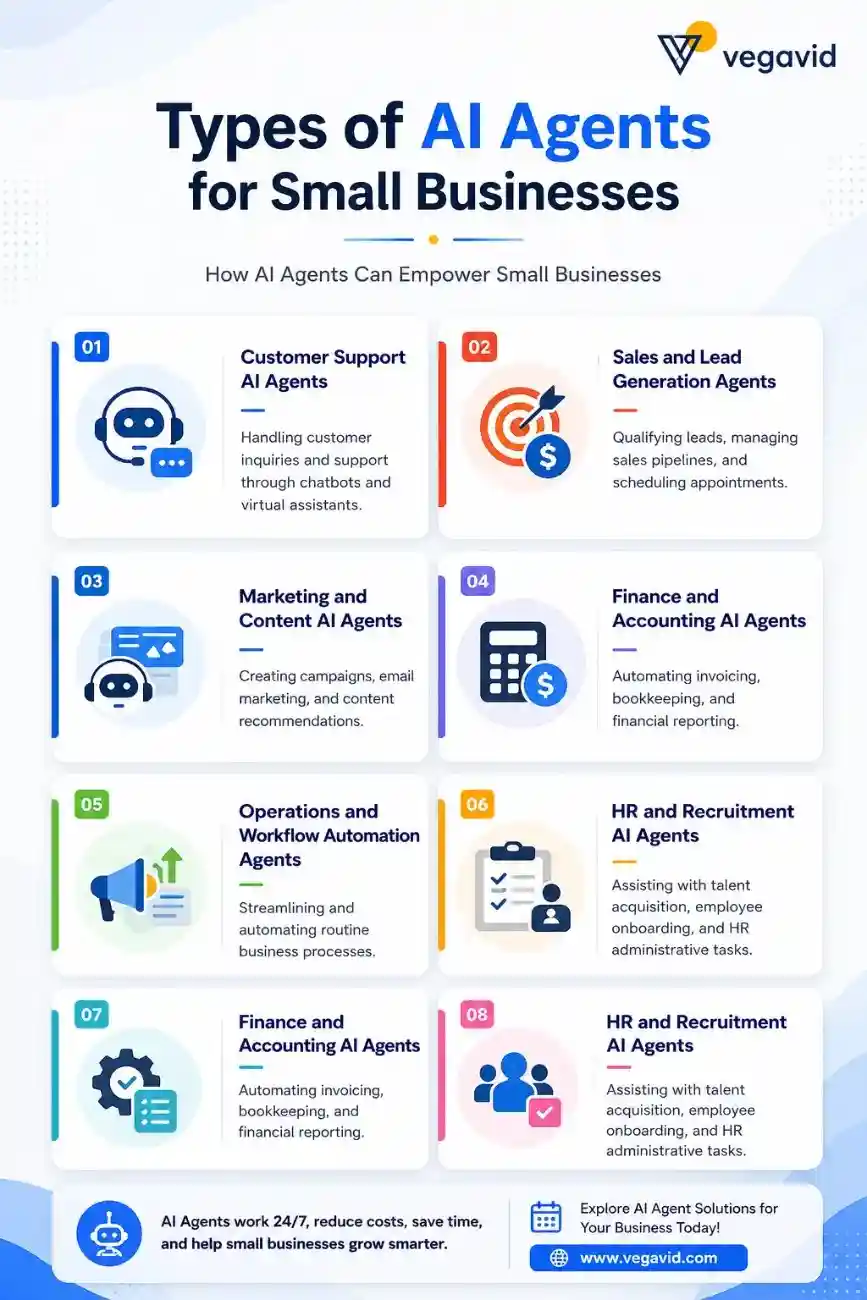
Types of AI Agents for Small Businesses
Small businesses can deploy a variety of specialized agents, each acting as a department head for a specific function.
Customer Support AI Agents
These agents handle the frontline of customer interaction. They don't just answer FAQs; they can process returns, check order statuses, and escalate complex issues to humans. By utilizing AI chatbot development for business, companies can provide 24/7 support without hiring a night shift.
Sales and Lead Generation Agents
Sales agents can browse LinkedIn, identify potential leads, and even send personalized outreach emails. They ensure that no lead goes cold by managing the initial "handshake" phase of the sales funnel, allowing your human sales team to focus on closing deals.
Marketing and Content AI Agents
From generating social media captions to optimizing blog posts for SEO, marketing agents act as digital creative directors. They analyze generative AI market stats to understand what content is currently performing best in your specific industry.
Operations and Workflow Automation Agents
These are the "glue" of the business. They move data between apps—for example, taking a client's verbal request from a Zoom transcript and automatically creating a task in a project management tool.
Finance and Accounting AI Agents
Managing cash flow is the biggest hurdle for SMEs. AI agents can now track expenses, flag irregular transactions, and even send polite automated reminders for overdue invoices, ensuring the financial health of the company remains stable.
HR and Recruitment AI Agents
For a growing small business, hiring is time-consuming. AI agents can screen hundreds of resumes against a job description, conduct initial text-based screenings, and schedule interviews with the top 5% of candidates.
Data Analytics and Insight Agents
Small businesses sit on a goldmine of data they rarely use. These agents scan your sales figures and customer behavior to provide data-driven decision-making insights, telling you exactly which products to restock and which to discontinue.
Top AI Agent Tools for Small Businesses
In 2026, several platforms have emerged as leaders in providing accessible AI agent technology.
GPT-Based AI Agents
Custom GPTs allow business owners to "program" an agent using simple English. You can upload your company handbook and create a "Support Agent" that knows your specific policies inside and out. This is often the most cost-effective entry point for enterprise AI agent adoption.
Google AI Agents
With Vertex AI and Gemini, Google provides agents that integrate seamlessly with Google Workspace. These agents can draft replies in Gmail, organize data in Sheets, and summarize long meetings in Google Meet automatically.
Microsoft Copilot-Based Agents
For businesses reliant on the Office 365 ecosystem, Copilot agents offer deep integration. They can build PowerPoint presentations from a simple prompt or analyze complex Excel data to find trends that a human might miss.
Twilio Voice AI Agents
Voice AI has come a long way. Small businesses can now use AI agents to answer phone calls with near-human naturalness. These agents can book appointments or provide store hours, significantly reducing the burden on front-desk staff.
No-Code AI Agent Platforms
Platforms like Zapier Central and MindStudio allow non-technical founders to build complex "agentic" workflows. These platforms bridge the gap between simple automation and true AI reasoning, making top AI development services accessible to everyone.
Key Features of AI Agents for Small Businesses
When evaluating an AI agent, small businesses should look for four specific pillars:
Easy Deployment: The tool should be "plug-and-play" or require minimal configuration.
Integration with Business Tools: It must talk to your existing stack (Slack, Shopify, HubSpot).
Custom Workflows: The ability to teach the agent your specific way of doing things.
Scalability and Affordability: A pricing model that grows with you, rather than charging enterprise fees upfront.
For businesses in specialized sectors, seeking a healthcare software development company that understands AI can ensure that these features also meet strict regulatory standards.
Use Cases of AI Agents in Small Businesses
How does this look in practice? Here are a few B2B scenarios:
Customer Service Automation A boutique e-commerce store uses an AI agent to handle "Where is my order?" (WISMO) queries. The agent accesses the shipping API, gives the customer a real-time update, and offers a discount code for their next purchase—all without a human clicking a button.
Sales and CRM Optimization A consulting firm uses an AI agent to monitor their CRM. When a lead hasn't been contacted in three days, the agent drafts a personalized follow-up email based on the lead's last interaction and places it in the consultant's "drafts" folder for a final check.
Marketing Personalization AI agents can analyze ai agent market stats to segment your email list and send custom-tailored product recommendations to different demographics, significantly increasing conversion rates compared to generic newsletters.
Operational Efficiency In the real estate sector, agents are using AI to manage property listings. By partnering with a real estate tokenization development company, small firms can automate the fractionalization of assets and manage investor relations through intelligent agents.
Benefits of Using AI Agents
The primary driver for AI adoption is the bottom line.
Cost Reduction: Replacing expensive, specialized software or repetitive manual labor with a versatile AI agent.
Productivity Improvement: Allowing your best employees to focus on strategy while the AI handles the "grunt work."
Faster Decision-Making: AI agents can process thousands of data points in seconds, providing a data mining in healthcare level of precision to any small business.
Enhanced Customer Experience: Instant responses and personalized service lead to higher retention rates.
Cost of AI Agents for Small Businesses
Understanding the financial commitment is crucial for B2B decision-makers.
Pricing Models
Most AI agents for small businesses follow a Usage-Based or Tiered Subscription model. You might pay $20/month for a basic seat, or $0.10 per "task" the agent completes. This allows small businesses to start small and only pay for what they use.
ROI Estimation
To calculate ROI, compare the cost of the agent against the hours saved. If an agent costing $100/month saves 20 hours of manual data entry (valued at $25/hour), the business saves $400/month—a 300% return on investment. Furthermore, the benefits of custom AI chatbot development often include increased sales that far outweigh the initial setup costs.
How to Choose the Right AI Agent
Not every agent is a good fit for every business. Follow this three-step framework:
Business Needs Assessment: What is your biggest bottleneck? If it's answering emails, start with a support agent. If it's finding clients, start with a sales agent.
Integration Requirements: Ensure the agent can connect to your current software. An agent that can't "talk" to your CRM is just another siloed tool.
Budget Considerations: Balance the cost against the expected growth. Sometimes, investing in custom large language model development services is more cost-effective in the long run than paying high monthly fees for a "locked" third-party platform.
Implementation Strategy
A successful AI rollout requires a phased approach to minimize disruption.
Identify High-Impact Use Cases
Don't try to automate everything at once. Pick one repetitive task that takes up at least 5 hours of your week and start there.
Select the Right Platform
Choose between a general-purpose tool like ChatGPT or a specialized blockchain consulting company if your needs involve decentralized finance or Web3 security.
Customize and Train AI Agents
Give your agent "context." Upload your brand voice guidelines, product catalogs, and past successful emails. The more data the agent has, the more "human" and accurate its output will be.
Deploy and Optimize
Monitor the agent's performance for the first 30 days. Most AI systems require a "tuning" phase where you correct minor errors and refine the prompts for better results.
Challenges and Limitations
AI is powerful, but it is not magic. Small businesses must be aware of:
Data Quality Issues: If your input data is messy, the AI's output will be unreliable.
Adoption Barriers: Employees may fear that AI is there to replace them. It’s vital to frame AI as a tool that empowers them.
Security Concerns: Protecting customer data is paramount. Always ensure your AI provider complies with standard data protection regulations. When in doubt, consult with a blockchain consulting company to see if decentralized security measures could benefit your data integrity.
Real-World Examples of AI Agents in Small Businesses
Consider a small legal firm that implemented an AI agent to handle document discovery. By training a custom agent on their specific case history, they reduced the time spent on research by 60%, allowing them to take on more clients without hiring more paralegals.
Another example is a local HVAC company using a voice AI agent to handle emergency calls. The agent can distinguish between a routine maintenance request and a burst pipe, dispatching the technician to the high-priority job immediately.
Future Trends in AI Agents
The world of AI is moving toward "Agentic AI"—where systems don't just wait for prompts but proactively suggest actions.
Multi-Agent Systems: Different agents (e.g., a "Sales Agent" and a "Finance Agent") will communicate with each other to complete complex goals.
Autonomous Workflows: AI that can recognize a problem (like low inventory) and fix it (by ordering from a supplier) without any human input.
Blockchain Integration: As we see in the blockchain revolution in technology, agents will soon use smart contracts to execute payments and verify transactions autonomously.
Strategic Roadmap for AI Adoption
Month 1: Audit manual processes and select one AI tool for a pilot program.
Month 2: Train the team and integrate the tool into the daily workflow.
Month 3: Evaluate ROI and explore how to become a blockchain developer or AI specialist in-house to maintain custom systems.
Month 6: Scale successful AI agents to other departments.
Conclusion
AI agents are no longer a "nice-to-have" for small businesses—they are becoming the engine of modern commerce. By leveraging these intelligent systems, SMEs can achieve a level of efficiency and customer service that was previously only possible for global corporations. Whether you are looking to automate your customer support, optimize your sales, or dive into the world of decentralized finance (DeFi), the right AI agent is waiting to help you scale.
Ready to transform your business?
Empower your workforce with autonomous AI agent development services that handle complex workflows and data analysis with ease.
FAQs
Not necessarily. Many modern AI agent platforms offer low-code or no-code interfaces, making it easy for small businesses to deploy and manage AI agents. However, advanced customization may require technical expertise.

Yash Singh is the Chief Marketing Officer at Vegavid Technology, a leading AI-driven technology company specializing in AI agents, Generative AI, Blockchain, and intelligent automation solutions. With over a decade of experience in digital transformation and emerging technologies, Yash has played a key role in helping businesses adopt advanced AI solutions that enhance operational efficiency, automate workflows, and deliver personalized customer experiences across industries including fintech, healthcare, gaming, ecommerce, and enterprise technology. An alumnus of Indian Institute of Technology Bombay, Yash combines strong technical expertise with strategic marketing leadership to drive innovation in AI-powered applications, autonomous AI agents, Retrieval-Augmented Generation (RAG), Natural Language Processing (NLP), Large Language Models (LLMs), machine learning systems, conversational AI, and enterprise automation platforms. His expertise spans AI model integration, intelligent workflow automation, prompt engineering, smart data processing, and scalable AI infrastructure development, enabling organizations to accelerate digital transformation and business growth. Passionate about the future of intelligent systems, Yash actively shares insights on AI agents, Generative AI, LLM-powered applications, blockchain ecosystems, and next-generation digital strategies. He is committed to helping businesses embrace AI-first transformation while guiding teams to build impactful, industry-specific solutions that shape the future of innovation and intelligent technology.





Leave a Reply