
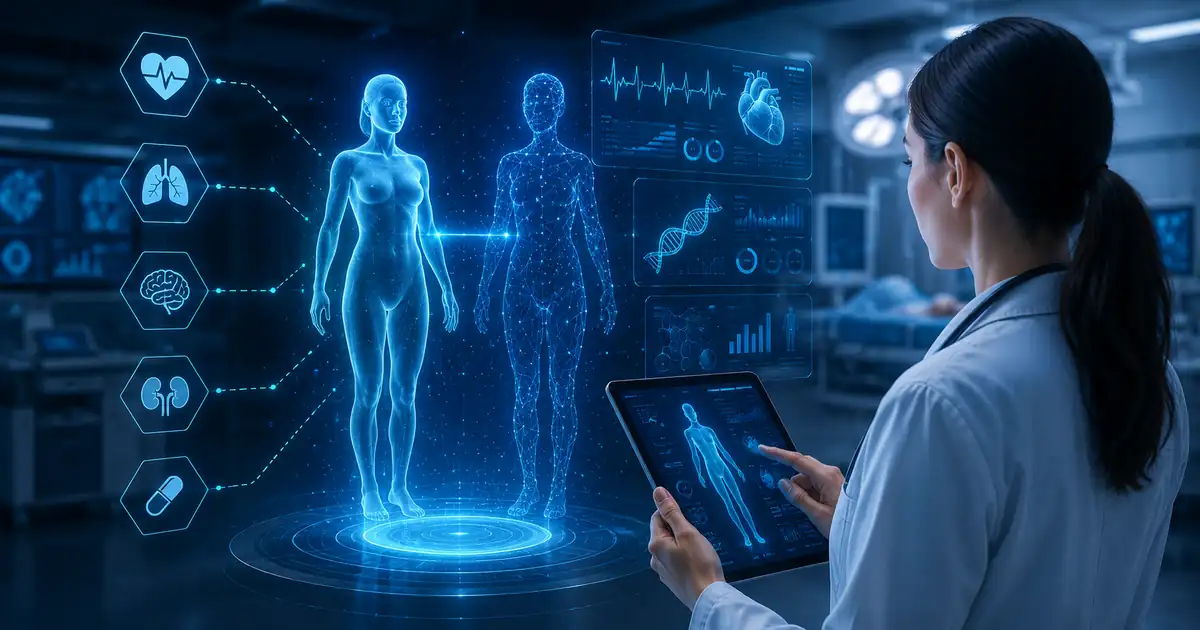
Digital Twins in Healthcare: Industry Trends and Innovations
Healthcare is undergoing a major digital transformation, with technologies like artificial intelligence (AI), the Internet of Things (IoT), cloud computing, and big data reshaping patient care. Among these innovations, digital twins have emerged as one of the most promising technologies for improving clinical outcomes, optimizing hospital operations, and accelerating medical research.
A digital twin is a virtual replica of a physical object, process, or system that continuously updates using real-time data. While the concept originated in manufacturing and aerospace, it is rapidly gaining momentum in healthcare due to its ability to simulate diseases, predict patient outcomes, personalize treatments, and improve healthcare efficiency, much like the broader shift toward healthcare software development that is transforming how hospitals operate.
As hospitals and healthcare organizations increasingly adopt artificial intelligence-driven technologies, digital twins are expected to become an essential part of precision medicine and smart healthcare ecosystems.
In this guide, we'll explore what digital twins are, how they work, their applications, industry trends, innovations, benefits, challenges, and the future of digital twin technology in healthcare.
What is a Digital Twin in Healthcare?
A digital twin in healthcare is a dynamic virtual representation of a patient, medical device, healthcare facility, or biological system that mirrors its real-world counterpart using continuous data. It draws on data collected from electronic health records (EHRs), wearable devices, imaging systems, IoT sensors, laboratory reports, and AI analytics.
Unlike traditional patient records, digital twins continuously evolve as new data becomes available, enabling healthcare professionals to monitor conditions, simulate treatment outcomes, and make data-driven clinical decisions — a capability increasingly powered by ai development company in healthcare partners building these systems.
Digital twins can represent:
Individual patients
Human organs
Hospital equipment
Medical devices
Hospital infrastructure
Clinical workflows
Pharmaceutical manufacturing processes
Population health models
How Digital Twins Work in Healthcare
Digital twins work by combining continuous data collection, AI modeling, and simulation to create a living virtual counterpart of a patient or system. Digital twins combine multiple technologies to create intelligent simulations.
Step 1: Data Collection
Healthcare data is gathered from multiple sources:
Electronic Health Records (EHR)
MRI and CT scans
Wearable fitness trackers
Smart medical devices
Laboratory systems
Genomic sequencing
IoT-enabled hospital equipment
Step 2: Digital Model Creation
AI algorithms build a virtual representation of the patient, organ, device, or healthcare process.
Step 3: Continuous Synchronization
The digital twin updates continuously as new patient or operational data becomes available.
Step 4: Simulation
Healthcare providers simulate:
Disease progression
Medication response
Surgical procedures
Recovery timelines
Risk factors
Step 5: Clinical Decision Support
Doctors use insights generated from the digital twin to personalize treatment plans and improve patient care.
Types of Digital Twins in Healthcare
Healthcare organizations deploy several distinct types of digital twins depending on their objectives, ranging from individual patient models to hospital-wide systems.
Patient Digital Twins
Virtual replicas of individual patients that help predict disease progression and personalize treatment.
Applications include:
Chronic disease management
Personalized medicine
Preventive healthcare
Drug response prediction
Organ Digital Twins
Virtual models of organs such as:
Heart
Liver
Kidneys
Brain
Lungs
These models allow physicians to simulate surgeries and optimize treatment plans.
Medical Device Digital Twins
Manufacturers create digital replicas of medical equipment to monitor performance and predict maintenance needs.
Examples include:
MRI machines
CT scanners
Ventilators
Pacemakers
Robotic surgical systems
Hospital Digital Twins
Hospitals use digital twins to optimize:
Bed management
Emergency departments
Patient flow
Resource allocation
Staff scheduling
Energy consumption
Population Digital Twins
Governments and healthcare organizations simulate disease outbreaks and healthcare demand across populations.
Key Applications of Digital Twins in Healthcare
Digital twins are applied across nearly every corner of healthcare, from personalized treatment planning to hospital-wide operations management.
Personalized Medicine
Every patient responds differently to treatment, which is why precision medicine is one of the fastest-growing search-style topics in digital health today.
Digital twins help physicians:
Predict treatment effectiveness
Reduce trial-and-error prescriptions
Customize therapies
Improve patient outcomes
Surgical Planning
Surgeons can practice complex procedures using digital replicas of patient anatomy before entering the operating room.
Benefits include:
Reduced surgical risk
Improved precision
Shorter operation times
Better recovery outcomes
Chronic Disease Management
Digital twins continuously monitor patients with conditions like:
Diabetes
Heart disease
COPD
Hypertension
Kidney disease
AI detects changes early and recommends interventions before complications occur.
Drug Development
Pharmaceutical companies use digital twins to:
Simulate drug interactions
Predict side effects
Optimize clinical trials
Reduce research costs
Accelerate drug discovery
Medical Device Monitoring
Manufacturers monitor equipment remotely using digital twins to predict failures before they occur.
Benefits include:
Reduced downtime
Predictive maintenance
Lower repair costs
Increased equipment lifespan
Hospital Operations
Healthcare administrators use digital twins to optimize:
Emergency room capacity
Patient scheduling
Inventory management
ICU utilization
Staff deployment
Medical Training
Students and healthcare professionals can practice procedures in realistic virtual environments powered by digital twin simulations.
Industry Trends Driving Digital Twins in Healthcare
A handful of converging technology trends are accelerating digital twin adoption across the healthcare industry.
AI-Powered Clinical Decision Support
Artificial intelligence enhances digital twins by identifying disease patterns, predicting outcomes, and recommending evidence-based treatment strategies, similar to how ai agents for healthcare are being deployed to support clinical teams.
IoT-Enabled Real-Time Monitoring
Wearable devices and connected sensors continuously feed data into digital twins, enabling proactive healthcare interventions, an area where iot development company expertise plays a growing role.
Precision Medicine
Digital twins are becoming central to precision medicine by combining:
Genetic information
Lifestyle data
Clinical history
Environmental factors
to personalize care.
Cloud-Based Digital Twin Platforms
Cloud computing infrastructure enables healthcare organizations to securely store, process, and analyze large volumes of digital twin data while improving scalability and collaboration.
Genomic Digital Twins
Advances in genomics allow researchers to create digital models that simulate how genetic variations influence disease risk and treatment effectiveness.
Smart Hospitals
Healthcare facilities are increasingly adopting hospital-wide digital twins to improve operational efficiency, reduce costs, and enhance patient experiences.
AI-Powered Predictive Analytics
Machine learning models help forecast:
Disease progression
Hospital admissions
Equipment failures
Patient deterioration
Readmission risks
Digital Twin Integration with Robotics
Digital twins are being integrated with robotic surgery systems to improve procedural planning and intraoperative precision.
Emerging Innovations in Digital Twins
Beyond current use cases, healthcare innovators are expanding digital twin capabilities with next-generation technologies still in early stages of adoption.
Virtual Human Models
Researchers are developing highly detailed digital human models that simulate interactions across organs and biological systems to support advanced diagnostics and treatment planning.
Digital Twin-Based Clinical Trials
Instead of relying solely on traditional control groups, researchers are exploring digital twins to simulate patient outcomes, potentially improving trial efficiency and reducing development costs.
AI Agents for Hospital Automation
AI-powered agents integrated with digital twins can automate routine administrative tasks, optimize resource allocation, and support clinical workflows.
Real-Time ICU Monitoring
Digital twins of critically ill patients can combine live monitoring data with predictive models to identify early signs of deterioration and recommend timely interventions.
Digital Twins for Medical Supply Chains
Healthcare organizations are applying digital twin technology to optimize inventory, predict supply shortages, and strengthen logistics for essential medical equipment and medications.
Benefits of Digital Twins in Healthcare
Healthcare organizations gain significant advantages from digital twin adoption, spanning clinical outcomes, cost savings, and operational efficiency.
Improved Patient Outcomes
Personalized treatment plans
Earlier diagnosis
Continuous monitoring
Better clinical decisions
Reduced Healthcare Costs
Digital twins help reduce costs by:
Preventing unnecessary hospitalizations
Optimizing resource utilization
Reducing equipment downtime
Improving operational efficiency
Faster Drug Development
Researchers can simulate drug responses, reducing time and cost associated with traditional research methods.
Predictive Healthcare
AI identifies potential health risks before symptoms become severe, supporting preventive care.
Better Hospital Management
Digital twins improve:
Patient flow
Resource planning
Staffing efficiency
Capacity utilization
Challenges of Implementing Digital Twins
Despite their potential, healthcare organizations face several implementation challenges before digital twins can be deployed at scale.
Data Privacy and Security
Protecting sensitive patient information requires strong cybersecurity, encryption, and compliance with healthcare regulations.
Data Integration
Healthcare data often resides in disconnected systems, making integration technically complex.
High Implementation Costs
Developing digital twin infrastructure requires investment in IoT devices, cloud platforms, AI technologies, and skilled professionals, which is why many organizations look to a healthcare software development partner to manage the cost and complexity.
Regulatory Compliance
Organizations must comply with healthcare regulations governing patient data, medical devices, and AI systems.
Model Accuracy
Digital twins depend on high-quality, up-to-date data. Inaccurate or incomplete data can reduce the reliability of predictions.
Ethical Considerations
Healthcare providers must ensure transparency, fairness, informed consent, and appropriate human oversight when using AI-driven digital twins in clinical settings.
Best Practices for Successful Digital Twin Implementation
Organizations that follow a structured, data-first approach see the most value from digital twin projects. Organizations can maximize value by following these best practices:
Define clear clinical and operational objectives before implementation.
Establish strong data governance and interoperability standards.
Integrate digital twins with EHRs, IoT devices, imaging systems, and analytics platforms.
Prioritize patient privacy through encryption, access controls, and regulatory compliance.
Validate AI models using clinical evidence and continuous monitoring.
Begin with pilot projects before scaling across departments or facilities.
Foster collaboration among clinicians, IT teams, data scientists, and administrators.
Continuously update digital twins with high-quality, real-time data.
Train healthcare professionals to interpret digital twin insights effectively.
Measure outcomes using KPIs such as patient outcomes, operational efficiency, cost savings, and resource utilization.
The Future of Digital Twins in Healthcare
The future of digital twins extends beyond virtual patient models toward intelligent, interconnected healthcare ecosystems. Advances in AI, multimodal analytics, edge computing, 5G connectivity, and quantum computing will enable increasingly sophisticated simulations that support real-time clinical decision-making and operational optimization.
Future developments are likely to include:
AI-driven digital twins for personalized preventive care
Whole-body digital twin simulations
Integration with robotic-assisted surgery
Virtual hospitals optimized through digital twin technology
Population-scale disease forecasting
Faster and more efficient clinical trials
Real-time remote patient management
Digital twins integrated with smart medical devices
Autonomous healthcare workflow optimization
Wider adoption of cloud-native digital twin platforms
As data quality, interoperability, and computational capabilities continue to improve, digital twins are expected to become a foundational technology for precision medicine, predictive healthcare, and value-based care.
Conclusion
Digital twins are redefining modern healthcare by creating intelligent virtual representations of patients, medical devices, hospitals, and healthcare processes. By combining AI, IoT, big data, and real-time data, organizations can deliver more personalized care, optimize operations, improve clinical decision-making, and accelerate innovation. For a closer look at how connected technology is already reshaping care delivery, see this overview of blockchain utility in healthcare industry.
Although challenges such as interoperability, privacy, and implementation costs remain, continued advances in digital health technologies are making digital twins increasingly practical and impactful. Healthcare organizations that invest in robust data infrastructure, AI capabilities, and governance frameworks today — including partnering with an experienced healthcare software development companies — will be better positioned to deliver safer, more efficient, and patient-centered care in the years ahead.
Frequently Asked Questions
Hospitals use digital twins to optimize patient flow, manage resources, monitor medical equipment, improve surgical planning, predict maintenance needs, and enhance operational efficiency.

Yash Singh is the Chief Marketing Officer at Vegavid Technology, a leading AI-driven technology company specializing in AI agents, Generative AI, Blockchain, and intelligent automation solutions. With over a decade of experience in digital transformation and emerging technologies, Yash has played a key role in helping businesses adopt advanced AI solutions that enhance operational efficiency, automate workflows, and deliver personalized customer experiences across industries including fintech, healthcare, gaming, ecommerce, and enterprise technology. An alumnus of Indian Institute of Technology Bombay, Yash combines strong technical expertise with strategic marketing leadership to drive innovation in AI-powered applications, autonomous AI agents, Retrieval-Augmented Generation (RAG), Natural Language Processing (NLP), Large Language Models (LLMs), machine learning systems, conversational AI, and enterprise automation platforms. His expertise spans AI model integration, intelligent workflow automation, prompt engineering, smart data processing, and scalable AI infrastructure development, enabling organizations to accelerate digital transformation and business growth. Passionate about the future of intelligent systems, Yash actively shares insights on AI agents, Generative AI, LLM-powered applications, blockchain ecosystems, and next-generation digital strategies. He is committed to helping businesses embrace AI-first transformation while guiding teams to build impactful, industry-specific solutions that shape the future of innovation and intelligent technology.




Leave a Reply