
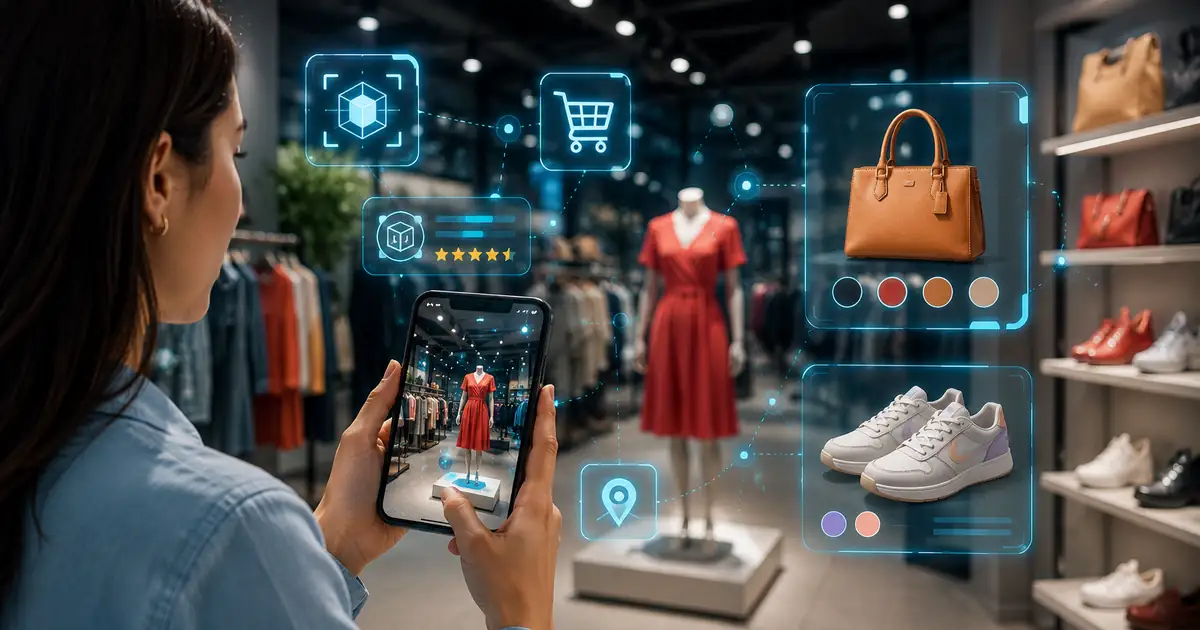
Augmented Reality in Retail: Benefits, Use Cases, Challenges & Future Trends
Introduction
Augmented Reality is one of the technologies quietly reshaping how people shop, letting retailers blend digital content with physical spaces so customers can try, preview, and understand products before they buy. The retail industry has undergone a significant digital transformation over the past decade. Today, customers expect personalized, interactive, and seamless shopping experiences whether they shop online or in physical stores. One technology that is reshaping the retail landscape is Augmented Reality (AR).
Augmented Reality enables retailers to blend digital content with the real world, allowing customers to virtually try products, visualize furniture in their homes, navigate stores, and interact with products in entirely new ways. From fashion brands and beauty companies to furniture retailers and grocery stores, AR is becoming an essential tool for improving customer engagement and increasing sales. Businesses exploring this space often pair it with a broader e-commerce app development strategy to bring these experiences to mobile shoppers.
In this article, we'll explore what Augmented Reality in retail is, its benefits, real-world use cases, challenges, and future trends shaping the industry.
What is Augmented Reality in Retail?
Augmented Reality in retail refers to digital technology that overlays virtual objects, images, animations, or product information onto the real world through smartphones, tablets, AR glasses, or smart mirrors. Augmented Reality (AR) in retail refers to the use of digital technology that overlays virtual objects, images, animations, or product information onto the real-world environment through smartphones, tablets, AR glasses, or smart mirrors.
Unlike Virtual Reality (VR), which creates a completely immersive virtual environment, AR enhances the user's real surroundings by adding interactive digital elements. For readers wanting a deeper comparison, our piece on metaverse vs virtual reality breaks down how these related technologies differ.
For retailers, AR bridges the gap between online and in-store shopping by enabling customers to experience products before making a purchase.
How Augmented Reality Works in Retail
AR retail solutions work by combining camera input, computer vision, and 3D modeling so that a device can recognize real-world surfaces and place realistic digital products into them. AR retail solutions combine several technologies to deliver immersive shopping experiences:
Smartphone or tablet cameras
Depth sensing
Object recognition
Motion tracking
The process typically works as follows:
The customer opens a retailer's mobile app or website.
The camera scans the surroundings.
AI identifies surfaces, objects, or faces.
The AR engine places a realistic 3D model into the scene.
Customers interact with the virtual product in real time.
They can customize colors, sizes, or configurations before purchasing.
Benefits of Augmented Reality in Retail
AR benefits both sides of the transaction: shoppers get a clearer picture of what they're buying, and retailers see fewer returns and higher conversion. AR provides advantages for both retailers and consumers.
1. Enhanced Customer Experience
AR creates engaging and interactive shopping experiences that make buying products more enjoyable and memorable, which is a key reason brands invest in augmented reality shopping experiences today.
Benefits include:
Interactive product visualization
Personalized shopping
Increased customer satisfaction
Better product understanding
2. Improved Purchase Confidence
Customers can see how products will look in real-life settings before purchasing, which is central to why virtual try-on technology has spread so quickly across fashion and beauty.
Examples include:
Trying on glasses
Visualizing furniture
Testing makeup
Previewing clothing
This reduces uncertainty and improves buying confidence.
3. Higher Conversion Rates
When customers better understand products, they are more likely to complete purchases. Retailers often experience:
Increased online sales
Higher add-to-cart rates
More completed purchases
Better customer engagement
4. Reduced Product Returns
One of the biggest challenges in e-commerce is product returns, and AR directly addresses this by giving shoppers a far more accurate sense of fit and scale before checkout. AR helps customers:
Choose correct sizes
Verify product fit
Match colors accurately
Understand dimensions
This significantly lowers return rates.
5. Better Product Visualization
Static product images cannot fully represent a product, which is exactly the gap AR-powered 3D visualization is designed to close. AR enables customers to:
Rotate products
Zoom in
View products from multiple angles
Interact with product features
6. Personalized Shopping
AI-powered AR applications recommend products based on customer data, and this kind of personalization is closely tied to the broader shift toward AI-driven personalization in e-commerce. Recommendations are typically based on:
Customer preferences
Shopping history
Body measurements
Home environment
This creates a highly customized shopping journey.
7. Increased Brand Engagement
Interactive AR experiences encourage customers to spend more time exploring products, boosting engagement and brand loyalty.
Common Use Cases of Augmented Reality in Retail
AR shows up across retail in several distinct forms, from virtual try-on to in-store navigation, each solving a different part of the shopping journey.
Virtual Try-On
One of the most popular AR applications allows customers to virtually try products before purchasing, a use case often described simply as virtual try-on technology.
Products include:
Eyeglasses
Sunglasses
Makeup
Jewelry
Watches
Hats
Shoes
Clothing
This improves purchase confidence and reduces returns.
Furniture Visualization
Furniture retailers allow customers to place virtual furniture inside their homes using smartphone cameras, so they can judge scale and style before ordering.
Customers can:
Check room fit
Compare sizes
Match colors
Rearrange furniture
Virtual Dressing Rooms
Smart mirrors and AR-powered dressing rooms enable customers to try on outfits without physically changing clothes.
Benefits include:
Faster shopping
Hygiene
Personalized recommendations
Better customer experience
Beauty and Cosmetics
Beauty brands use facial recognition technology to let customers test:
Lipstick
Foundation
Eyeshadow
Hair color
Eyeliner
Blush
Customers can instantly compare different looks.
Interactive Product Packaging
Retailers add AR-enabled QR codes or markers to packaging so a quick scan can unlock far more information than the box itself could ever hold.
Customers can scan products to access:
Product videos
User guides
Promotions
Recipes
Tutorials
Customer reviews
Indoor Store Navigation
Large retail stores use AR navigation to help customers find products quickly, cutting down on wasted time wandering the aisles.
Benefits include:
Faster shopping
Reduced staff assistance
Better customer satisfaction
Product Information
Pointing a smartphone at a product can display everything a shopper needs to make a decision on the spot.
Ingredients
Product specifications
Pricing
Reviews
Sustainability information
Inventory availability
Virtual Showrooms
Retailers create digital showrooms where customers explore products from home using AR, extending the reach of a physical showroom well beyond its walls.
This is especially useful for:
Furniture
Automobiles
Electronics
Home décor
Industries Using Augmented Reality in Retail
AR is transforming a wide range of retail sectors, from fashion and beauty to electronics and grocery, each adapting the technology to its own products.
1. Fashion
Uses include:
Virtual fitting rooms
Outfit recommendations
Digital mirrors
2. Beauty and Cosmetics
Applications include:
Makeup try-on
Skin analysis
Hair color simulation
3. Furniture and Home Decor
Retailers help customers visualize:
Sofas
Tables
Cabinets
Wall art
Lighting
Interior layouts
4. Footwear
Customers can virtually try shoes and compare different styles before purchasing.
5. Jewelry
AR allows shoppers to preview:
Rings
Earrings
Necklaces
Bracelets
6. Consumer Electronics
Customers can interact with virtual versions of:
Smartphones
TVs
Laptops
Smart home devices
7. Grocery Retail
AR applications help shoppers:
Find products
Access nutritional information
View recipes
Compare products
Technologies Behind AR Retail
AR shopping experiences are only possible because they combine several advanced technologies working together in the background, from AI and 3D modeling to spatial computing. Several advanced technologies power AR shopping experiences.
Artificial Intelligence (AI)
Computer Vision
3D Modeling
Facial Recognition
Cloud Computing
Internet of Things (IoT)
Spatial Computing
Mobile AR Platforms
Challenges of Augmented Reality in Retail
Despite its advantages, AR implementation comes with several challenges, ranging from the cost of building 3D assets to protecting customer privacy.
High Development Costs
Creating high-quality AR applications, 3D models, and interactive experiences requires significant investment.
Device Compatibility
Not all smartphones and devices support advanced AR features, which can limit accessibility.
Large 3D Asset Management
Retailers with extensive product catalogs need to create, optimize, and maintain thousands of 3D models.
Performance Optimization
AR applications require smooth rendering and fast loading times. Poor performance can negatively impact the customer experience.
Privacy Concerns
AR solutions often use cameras, facial recognition, and location data, making privacy protection and regulatory compliance essential.
User Adoption
Some customers may be unfamiliar with AR technology or hesitant to use it, requiring intuitive interfaces and education.
Integration Complexity
Connecting AR solutions with existing e-commerce platforms, inventory systems, and CRM software can be technically challenging, which is why many retailers lean on partners experienced in e-commerce development to manage the integration.
Future Trends of Augmented Reality in Retail
The future of retail will increasingly rely on immersive technologies and intelligent automation, with AI-driven personalization and AR smart glasses leading the way.
AI-Powered Personalization
AI will deliver hyper-personalized AR experiences based on customer behavior, preferences, and purchase history.
AR Smart Glasses
As lightweight AR glasses become more widely available, shoppers will enjoy hands-free product information, navigation, and personalized recommendations while browsing stores.
Spatial Commerce
Retailers will build immersive digital shopping environments where customers interact with products in real-world spaces using spatial computing.
Social Commerce with AR
Social media platforms will continue integrating AR filters and virtual shopping experiences, allowing users to try products directly from posts, livestreams, and influencer content.
Digital Twins
Retailers will create digital replicas of stores and products to optimize layouts, improve inventory management, and enhance customer experiences.
AI Shopping Assistants
AI-powered virtual assistants will combine conversational interfaces with AR to guide customers through product selection, answer questions, and provide personalized recommendations in real time, building on the same ideas explored in our guide to AI chatbots for e-commerce.
Omnichannel Shopping Experiences
AR will seamlessly connect online stores, mobile apps, and physical retail locations, allowing customers to start their shopping journey on one channel and continue it on another without disruption.
Best Practices for Implementing AR in Retail
To maximize the benefits of AR, retailers should follow these best practices:
Focus on solving real customer problems rather than adding AR as a novelty.
Use high-quality, accurate 3D product models.
Optimize AR experiences for fast loading and smooth performance.
Ensure compatibility across popular mobile devices and browsers.
Integrate AR with e-commerce, inventory, and CRM systems.
Protect user data and comply with privacy regulations.
Measure performance using metrics such as engagement, conversion rates, and return rates.
Continuously gather customer feedback and improve the AR experience.
Conclusion
Augmented Reality is transforming the retail industry by creating immersive, interactive, and personalized shopping experiences, and businesses that plan their AR development strategy carefully tend to see the strongest results. From virtual try-ons and furniture visualization to smart store navigation and AI-powered recommendations, AR helps retailers improve customer engagement, increase conversion rates, and reduce product returns.
Although challenges such as development costs, device compatibility, and system integration remain, ongoing advancements in AI, spatial computing, cloud technologies, and AR hardware are making implementation more accessible. As consumer expectations continue to evolve, businesses that embrace Augmented Reality will be better positioned to deliver innovative shopping experiences, strengthen customer loyalty, and gain a competitive advantage in the future of retail.
Frequently Asked Questions
Tags

Yash Singh is the Chief Marketing Officer at Vegavid Technology, a leading AI-driven technology company specializing in AI agents, Generative AI, Blockchain, and intelligent automation solutions. With over a decade of experience in digital transformation and emerging technologies, Yash has played a key role in helping businesses adopt advanced AI solutions that enhance operational efficiency, automate workflows, and deliver personalized customer experiences across industries including fintech, healthcare, gaming, ecommerce, and enterprise technology. An alumnus of Indian Institute of Technology Bombay, Yash combines strong technical expertise with strategic marketing leadership to drive innovation in AI-powered applications, autonomous AI agents, Retrieval-Augmented Generation (RAG), Natural Language Processing (NLP), Large Language Models (LLMs), machine learning systems, conversational AI, and enterprise automation platforms. His expertise spans AI model integration, intelligent workflow automation, prompt engineering, smart data processing, and scalable AI infrastructure development, enabling organizations to accelerate digital transformation and business growth. Passionate about the future of intelligent systems, Yash actively shares insights on AI agents, Generative AI, LLM-powered applications, blockchain ecosystems, and next-generation digital strategies. He is committed to helping businesses embrace AI-first transformation while guiding teams to build impactful, industry-specific solutions that shape the future of innovation and intelligent technology.








Leave a Reply