
What is a Diffusion Model? A Complete Guide to AI Image Generation
Introduction
Artificial intelligence has transformed the way digital content is created, and one of the most groundbreaking innovations is the diffusion model. From generating photorealistic artwork to creating marketing visuals, product designs, and videos, diffusion models have become the foundation of modern generative AI.
Popular AI tools such as Stable Diffusion, Midjourney, DALL·E, Adobe Firefly, and Flux use diffusion-based techniques to generate stunning images from simple text prompts. These models have significantly improved image quality, creativity, and realism compared to previous AI generation methods, and many businesses now search for the best AI image generator to speed up their creative workflows.
In this guide, you'll learn what diffusion models are, how they work, their architecture, advantages, applications, challenges, and future trends in AI image generation.
What is a Diffusion Model?
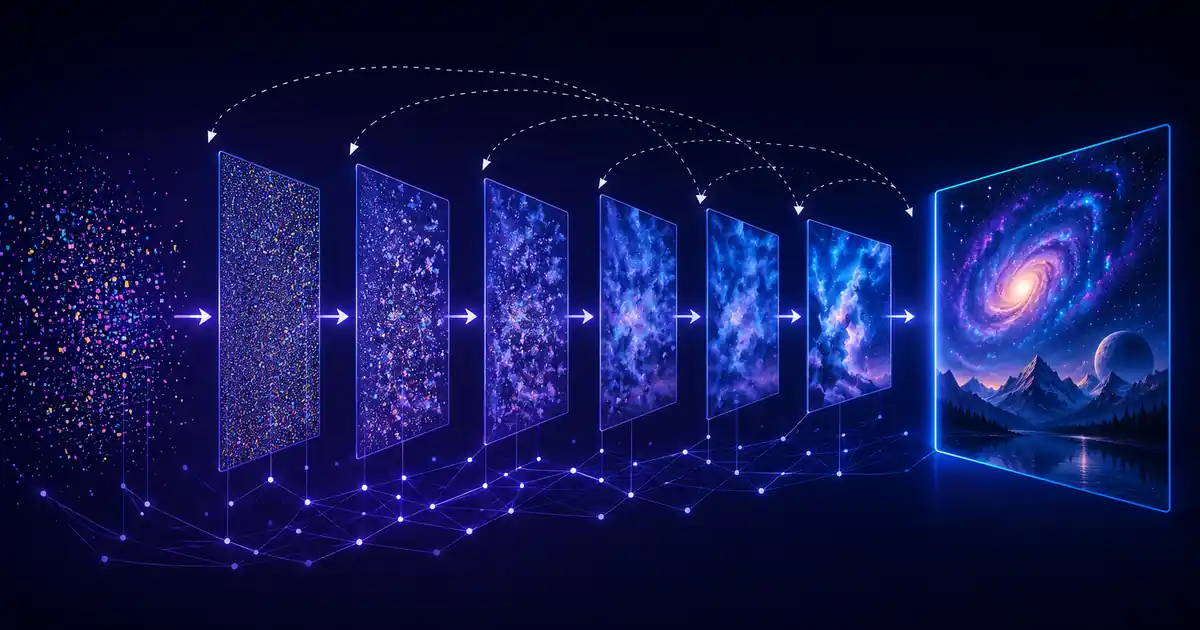
A diffusion model is a type of generative artificial intelligence (AI) model that creates new data—primarily images—by learning how to reverse a process of gradually adding random noise to training data.
During training, the model learns how images become increasingly noisy over multiple steps. Once trained, it performs the reverse operation by starting with random noise and progressively removing it until a realistic image is generated. You can read more about how this compares with related approaches in our guide on building a generative AI model for image synthesis.
Unlike traditional image generation methods that directly create an image in one step, diffusion models generate images gradually, resulting in higher quality, greater realism, and improved consistency.
Why Are Diffusion Models Important?
Diffusion models matter because they consistently produce the most realistic, detailed, and controllable AI-generated images available today, which is why AI image generation has become a mainstream creative and business tool.
Key benefits include:
Exceptional image quality
Highly detailed textures
Better prompt understanding
Improved artistic creativity
Fewer visual artifacts
Greater flexibility for editing images
Support for image-to-image generation
Foundation for modern generative AI systems
These advantages have made diffusion models the preferred technology for AI-powered creative applications, and they now sit at the core of many generative AI development projects worldwide.
How Does a Diffusion Model Work?
A diffusion model works by training on two opposite processes—one that destroys an image with noise and one that learns to rebuild it—so it consists of two primary phases.
Step 1: Forward Diffusion (Adding Noise)
Forward diffusion is the training phase where a real image is gradually turned into pure noise so the model can study every stage of that breakdown. During training:
Start with a real image.
Add small amounts of random Gaussian noise.
Repeat this process hundreds or thousands of times.
Eventually, the original image becomes completely random noise.
The AI learns every stage of this transformation.
Step 2: Reverse Diffusion (Removing Noise)
Reverse diffusion is the generation phase where the model starts from random noise and steadily reconstructs a coherent, prompt-matching image. During image generation:
Begin with pure random noise.
Predict which noise should be removed.
Gradually reconstruct meaningful structures.
Continue denoising step by step.
Produce a realistic image matching the text prompt.
The reverse diffusion process is what enables the model to generate entirely new images that have never existed before.
Diffusion Model Architecture
A typical diffusion model architecture combines a noise scheduler, a text encoder, a denoising network, and a decoder working together, although implementations vary across platforms.
1. Noise Scheduler
The noise scheduler decides how aggressively and how often noise is added or removed during each step of generation. The scheduler controls:
How much noise is added
Number of diffusion steps
Denoising schedule
Sampling strategy
Different schedulers can significantly affect image quality and generation speed.
2. Text Encoder
The text encoder is the component that translates a written prompt into numerical embeddings the image model can actually understand. When users provide a text prompt, a text encoder converts the prompt into mathematical embeddings that represent the meaning of the input.
Example prompt:
"A futuristic city at sunset with flying cars."
The text encoder transforms this sentence into vectors that guide the image generation process.
3. U-Net Neural Network
The U-Net is the core neural network responsible for predicting and removing noise at every diffusion step. Its responsibilities include:
Predicting image noise
Preserving image structure
Learning textures
Refining details
Guiding image reconstruction
Nearly every modern diffusion model uses a variation of the U-Net architecture, a technique closely related to advances in AI-powered image processing.
4. Latent Space
Latent space is a compressed mathematical representation of an image that lets the model work faster without sacrificing much quality. Many modern diffusion models perform denoising in a compressed latent space instead of directly processing full-resolution images.
This approach:
Reduces computation
Speeds up generation
Requires less memory
Enables higher resolutions
Stable Diffusion is a well-known latent diffusion model.
5. Decoder
The decoder is the final step that turns the compressed latent output back into a full, high-resolution image. Once denoising is complete, the decoder converts the latent representation into the final high-resolution image.
Types of Diffusion Models
Diffusion models fall into a few major categories, each suited to different generation tasks and computational budgets, and several diffusion model architectures have emerged for different AI applications.
Denoising Diffusion Probabilistic Models (DDPM)
DDPMs are the foundational diffusion architecture known for stable, high-quality training rather than speed. DDPMs are among the earliest and most influential diffusion models.
Features:
High image quality
Stable training
Reliable generation
Slower inference
Latent Diffusion Models (LDM)
Latent Diffusion Models are the efficiency-focused variant that made high-resolution AI image generation practical on everyday hardware. Latent Diffusion Models operate in compressed latent representations rather than pixel space.
Benefits include:
Faster image generation
Lower computational costs
Better scalability
Reduced GPU memory requirements
Stable Diffusion is based on this approach.
Conditional Diffusion Models
Conditional diffusion models generate images guided by extra inputs beyond plain text, giving creators far more precise control. These models generate outputs based on additional input conditions such as:
Text prompts
Sketches
Edge maps
Depth information
Segmentation masks
They provide greater control over the generated content.
Image-to-Image Diffusion Models
Image-to-image diffusion models transform an existing photo according to a prompt instead of generating a picture from scratch. Instead of starting from pure noise, these models transform an existing image according to a prompt.
Common tasks include:
Style transfer
Image enhancement
Background replacement
Photo editing
Artistic transformations
Popular Diffusion Models
Several well-known platforms dominate today's AI image generation market, each with its own strengths for design, marketing, or enterprise use. Several AI image generation systems are based on diffusion technology.
Stable Diffusion
Midjourney
Adobe Firefly
Imagen (Google)
Flux
DeepFloyd IF
Each model is optimized for different use cases such as design, marketing, artistic creation, or enterprise workflows, a topic explored further in our comparison of GPT image models, DALL·E, and diffusion architecture.
Applications of Diffusion Models
Diffusion models are transforming numerous industries by automating and enhancing visual content creation across creative, commercial, and technical fields.
Digital Art
Digital artists use diffusion models to speed up ideation and produce polished visuals in a fraction of the traditional time. Artists generate:
Concept art
Fantasy illustrations
Digital paintings
Character designs
Marketing
Marketing teams rely on diffusion-based tools to produce large volumes of on-brand visuals quickly and affordably. Businesses create:
Advertising creatives
Social media graphics
Product banners
Promotional visuals
Entertainment
Entertainment studios use diffusion models to accelerate early-stage visual development before full production begins. Studios use diffusion models for:
Storyboarding
Game assets
Movie concept art
Character visualization
Fashion
Fashion brands apply diffusion models to visualize designs and try-on experiences before a single physical sample is made. Applications include:
Clothing design
Virtual try-ons
Pattern generation
Fashion concept creation
Architecture
Architects use diffusion models to rapidly visualize buildings and spaces long before construction drawings are finalized. Architects generate:
Interior designs
Building concepts
Landscape visualizations
Urban planning mockups
Healthcare
Healthcare researchers apply diffusion models to generate synthetic medical imagery that supports research without exposing real patient data. Researchers use diffusion models for:
Medical image synthesis
Data augmentation
Imaging research
Disease visualization
Product Design
Product teams use diffusion models to visualize and iterate on physical products before committing to expensive prototypes. Manufacturers rapidly prototype:
Consumer products
Industrial equipment
Packaging
Furniture concepts
Advantages of Diffusion Models
Diffusion models outperform many earlier generative approaches on quality, diversity, and training stability, offering numerous benefits over earlier generative approaches.
Superior Image Quality
Diffusion models are widely regarded as producing the highest fidelity AI images currently possible. Generated images often appear highly realistic with fine details and accurate textures.
Better Diversity
A single prompt fed into a diffusion model can yield many meaningfully different, high-quality outputs. They can create a wide variety of unique outputs from the same prompt.
Improved Prompt Understanding
Modern diffusion systems interpret nuanced language far better than earlier generative approaches did. Modern diffusion models capture context, style, composition, and object relationships effectively.
Flexible Editing
Diffusion models let creators make targeted edits to an image instead of regenerating the whole thing from scratch. Users can modify:
Backgrounds
Objects
Lighting
Colors
Styles
without regenerating an image from scratch.
Stable Training
Diffusion models are generally more predictable to train than earlier generative approaches. Compared with GANs, diffusion models are generally easier to train and less prone to instability.
Challenges of Diffusion Models
Despite their strengths, diffusion models come with real trade-offs in speed, cost, and ethical risk that businesses need to plan around.
Slow Image Generation
Multi-step denoising makes diffusion models inherently slower than single-pass generation methods. Generating an image requires multiple denoising steps, making the process slower than some alternative models.
High Computational Requirements
Training a diffusion model from scratch demands enterprise-grade hardware and significant time investment. Training large diffusion models demands:
Powerful GPUs
Large datasets
Significant storage
Extended training time
Prompt Sensitivity
Diffusion models can respond unpredictably to minor wording changes in a prompt. Small changes in wording can produce very different results.
Ethical Concerns
Widespread AI image generation raises real questions about ownership, authenticity, and misuse that the industry is still working through. Challenges include:
Copyright issues
Deepfakes
Misinformation
AI-generated content ownership
Responsible AI usage
Diffusion Models vs GANs
Diffusion models generally beat GANs on quality, diversity, and training stability, while GANs still hold an edge on raw generation speed.
Feature | Diffusion Models | GANs |
|---|---|---|
Image Quality | Excellent | Very Good |
Training Stability | High | Moderate |
Diversity | High | Moderate |
Speed | Slower | Faster |
Detail | Excellent | Good |
Scalability | High | Moderate |
Prompt Conditioning | Excellent | Limited |
Today, diffusion models are widely regarded as the leading approach for high-quality AI image generation.
Future of Diffusion Models
Diffusion models are expanding well beyond static images into video, audio, 3D content, and scientific research, and this expansion is only expected to accelerate. Future advancements are expected to deliver faster inference, lower computational costs, improved prompt understanding, higher-resolution outputs, and greater creative control. As multimodal AI advances, diffusion models will increasingly integrate with large language models, enabling intelligent systems capable of generating text, images, video, music, and interactive experiences from a single prompt, a shift already visible in emerging video generation models. These innovations are set to power the next generation of creative tools, enterprise automation, digital design, and immersive applications.
Industries Using Diffusion Models
Diffusion models are driving innovation across a wide range of sectors, from entertainment and marketing to healthcare and manufacturing.
Media and entertainment
Marketing and advertising
E-commerce
Gaming
Film production
Healthcare
Architecture and construction
Fashion and apparel
Manufacturing
Education
Publishing
Automotive design
As generative AI adoption grows, diffusion models are becoming a core technology for organizations seeking to accelerate creativity, streamline workflows, and deliver personalized digital experiences, which is why many enterprises now explore dedicated generative AI integration support.
Conclusion
Diffusion models have redefined AI-powered content creation by enabling machines to generate highly realistic images from simple text prompts. Their step-by-step denoising process produces exceptional quality, making them the technology behind many of today's leading generative AI platforms. Although they require significant computational resources, ongoing improvements in efficiency, scalability, and multimodal capabilities are making diffusion models more practical for businesses and creators alike. As AI continues to evolve, diffusion models will remain at the forefront of image generation and play an increasingly important role in the future of digital creativity. Businesses exploring this space can learn more in our guides on training a diffusion model and how to generate AI images, or review our best AI image generator comparison, our guide to generating photorealistic AI images, and our overview of enterprise Stable Diffusion development.
Frequently Asked Questions
Common types include Denoising Diffusion Probabilistic Models (DDPM), Latent Diffusion Models (LDM), Conditional Diffusion Models, and Image-to-Image Diffusion Models.

Yash Singh is the Chief Marketing Officer at Vegavid Technology, a leading AI-driven technology company specializing in AI agents, Generative AI, Blockchain, and intelligent automation solutions. With over a decade of experience in digital transformation and emerging technologies, Yash has played a key role in helping businesses adopt advanced AI solutions that enhance operational efficiency, automate workflows, and deliver personalized customer experiences across industries including fintech, healthcare, gaming, ecommerce, and enterprise technology. An alumnus of Indian Institute of Technology Bombay, Yash combines strong technical expertise with strategic marketing leadership to drive innovation in AI-powered applications, autonomous AI agents, Retrieval-Augmented Generation (RAG), Natural Language Processing (NLP), Large Language Models (LLMs), machine learning systems, conversational AI, and enterprise automation platforms. His expertise spans AI model integration, intelligent workflow automation, prompt engineering, smart data processing, and scalable AI infrastructure development, enabling organizations to accelerate digital transformation and business growth. Passionate about the future of intelligent systems, Yash actively shares insights on AI agents, Generative AI, LLM-powered applications, blockchain ecosystems, and next-generation digital strategies. He is committed to helping businesses embrace AI-first transformation while guiding teams to build impactful, industry-specific solutions that shape the future of innovation and intelligent technology.








Leave a Reply