
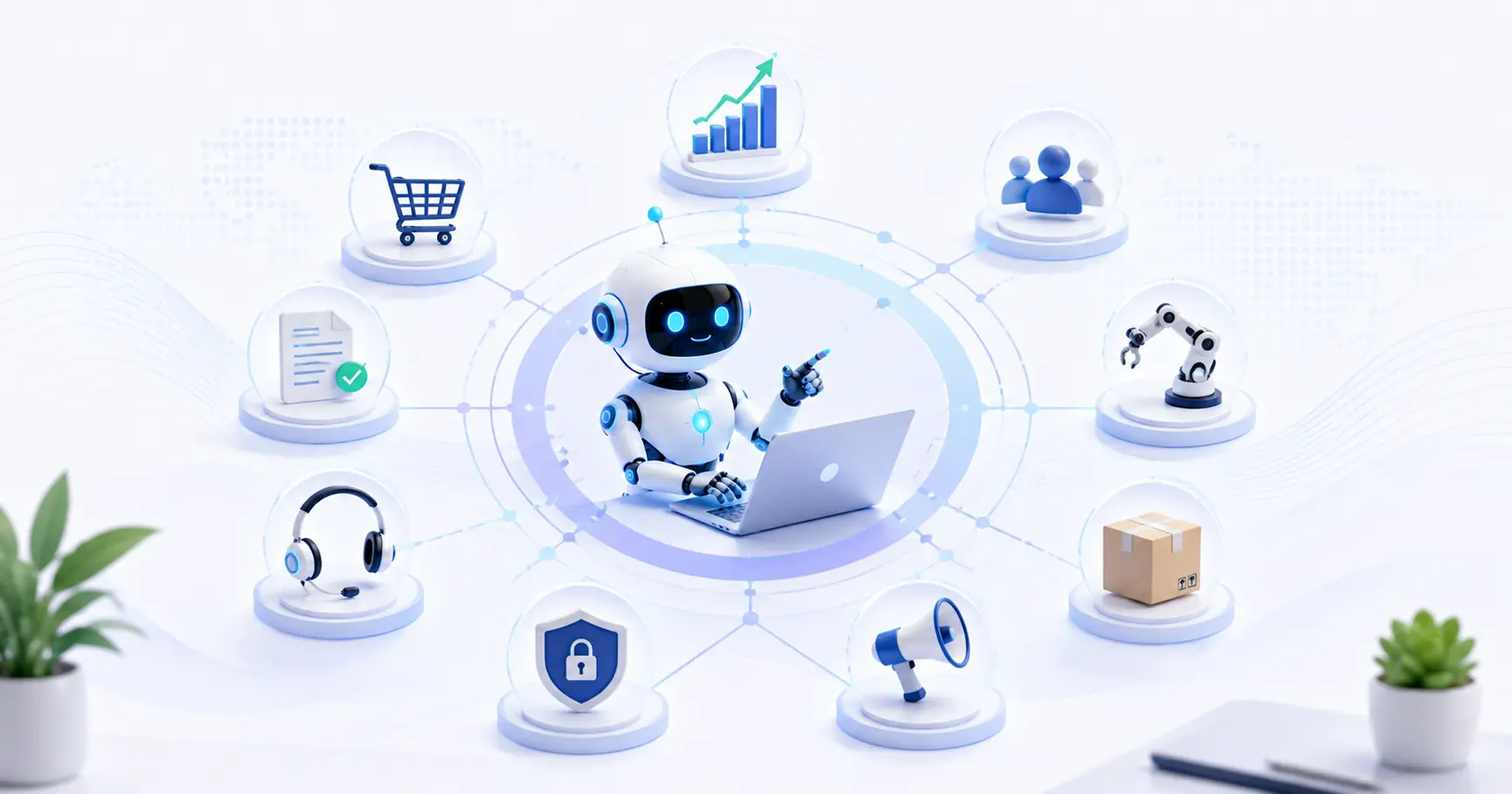
Future of Agentic AI in Business Operations: Trends, Benefits & Enterprise Use Case
For years, the corporate world interacted with Artificial Intelligence as an intelligent subordinate—a system that could draft an email, summarize a report, or generate code only when explicitly prompted by a human operator. However, as we navigate through 2026, the paradigm has fundamentally shifted. We are no longer just conversing with AI; we are deploying it to execute, manage, and optimize entire workflows autonomously. Welcome to the era of Agentic AI. As enterprises accelerate this transformation, partnering with an experienced agentic AI development company has become essential for building secure, scalable, and enterprise-ready autonomous AI solutions.
The shift from passive, prompt-dependent Generative AI to active, goal-oriented Agentic AI marks the most significant leap in enterprise automation since the dawn of cloud computing. Today, forward-thinking organizations are no longer asking, "How can AI help our employees work faster?" Instead, they are asking, "Which complex operational workflows can we fully delegate to autonomous AI agents?" A trusted agentic AI development company helps organizations design, integrate, and deploy intelligent AI agents that automate business processes, improve operational efficiency, and deliver long-term competitive advantage through enterprise-grade AI solutions.
What is the Future of Agentic AI in Business Operations?
Agentic AI refers to advanced artificial intelligence systems designed to operate with a high degree of autonomy, capable of setting intermediate goals, reasoning through complex problems, planning multi-step processes, and executing actions via software tools without continuous human oversight.
In the context of business operations, the Future of Agentic AI in Business Operations represents the transition from isolated, task-specific automation to dynamic, multi-agent ecosystems where digital workers proactively monitor enterprise environments, make contextual decisions, and optimize supply chains, finance, HR, and IT infrastructure in real-time.
Unlike traditional Robotic Process Automation (RPA), which blindly follows rigid, rule-based scripts, Agentic AI can handle exceptions, adapt to new information, and independently course-correct when a workflow fails.
From Copilots to Autopilots: While Copilots require human steering, Agentic AI acts as an autopilot, requiring only high-level objectives (e.g., "Reduce supply chain bottlenecks by 10% this quarter").
Action over Generation: The defining trait of Agentic AI is agency—the ability to act upon external environments via APIs, databases, and enterprise software.
Contextual Memory: Agentic systems maintain long-term memory, learning from past operational failures to improve future performance.
Why It Matters: Strategic Importance
The strategic integration of Agentic AI is rewriting the rules of operational efficiency, cost management, and competitive advantage. In 2026, businesses that fail to integrate agentic systems risk being outmaneuvered by competitors who operate with exponentially lower overhead and higher agility.
Scaling Decision-Making Capacities
Human decision-making is inherently bottlenecked by cognitive load, fatigue, and the sheer volume of data. In a modern enterprise, an operations manager might need to synthesize data from an ERP, a CRM, and a logistics tracking platform just to make a single inventory decision. Agentic AI removes this bottleneck. By delegating complex, data-heavy decisions to AI agents, businesses can scale their decision-making bandwidth infinitely.
Hyper-Automation and the Demise of Silos
Historically, departmental silos (e.g., Sales, Fulfillment, Customer Support) operated with disjointed data. Agentic AI introduces cross-functional autonomy. A customer complaint received by an AI support agent can automatically trigger a multi-agent workflow where an investigative agent checks the logistics software, a financial agent processes a partial refund, and a communication agent updates the customer—all seamlessly and instantaneously.
Evolving the Workforce
The integration of Agentic AI does not necessarily mean mass human replacement, but rather a profound workforce transformation. Humans are moving from being "doers" of routine digital tasks to "managers" of digital workforces. Employees now focus on strategic alignment, creative problem-solving, and relationship management, while agents handle the grueling, repetitive operational execution.
How It Works: Technical Overview and Process
Understanding how Agentic AI functions requires looking under the hood of modern AI architecture. While early Generative AI relied primarily on Large Language Models (LLMs) to predict text, Agentic AI uses the LLM merely as the "reasoning engine" or "brain," wrapped in a broader control framework.
The Agentic Action Loop
Most autonomous agents operate on a continuous loop, often modeled after frameworks like ReAct (Reasoning and Acting). The standard operational process follows four phases:
Perception (Input/Observation): The agent receives an objective from a human or another system. It then "perceives" its environment by querying databases, reading emails, or scanning internal documentation using Retrieval-Augmented Generation (RAG).
Cognition (Reasoning & Planning): Using its underlying LLM, the agent breaks the massive objective into smaller, manageable sub-tasks. It creates a step-by-step plan, anticipating potential roadblocks.
Execution (Tool Use): This is where agency happens. The AI connects to external tools via APIs to execute tasks. It might write a SQL query, send an email, update a Salesforce record, or initiate a payment.
Feedback (Evaluation): The agent observes the result of its action. If an API call fails, the agent reads the error code, reasons about why it failed, adjusts its strategy, and tries again.
Orchestrating Multi-Agent Systems (MAS)
In complex enterprise environments, a single agent is rarely sufficient. Operations rely on Multi-Agent Systems (MAS). In this architecture, specialized agents collaborate. For example, a "Researcher Agent" gathers data, hands it off to an "Analyst Agent" to crunch the numbers, who then passes it to an "Execution Agent" to implement the findings.
To build these sophisticated systems seamlessly, organizations must adhere to modern integration standards. Proper infrastructure is critical; implementing such advanced systems requires leaders to Design Software Architecture Tips Best Practices to ensure low latency, high security, and API stability.
Additionally, replacing brittle, legacy RPA bots with intelligent, reasoning agents is rapidly becoming the industry standard. Companies are increasingly deploying AI Agents for Intelligent RPA to handle exceptions that would typically break traditional automated flows.
Key Features of Agentic AI Systems
To distinguish true Agentic AI from advanced chatbots or traditional automation, look for these defining characteristics:
Goal-Oriented Autonomy: The ability to accept a high-level goal (e.g., "Onboard a new vendor") and autonomously figure out the required 15 intermediate steps to achieve it.
Advanced Tool Abstraction (API utilization): Agents are native API consumers. They can autonomously read API documentation, structure the correct payload, authenticate, and execute commands across any SaaS platform.
Chain-of-Thought Reasoning: Agents "think out loud" programmatically, documenting their logic before taking action, which allows for auditability and transparency in business operations.
State Tracking & Long-term Memory: Utilizing vector databases, agents remember past interactions, past failures, and historical context, allowing them to improve their operational efficiency over time.
Error Recovery and Self-Correction: When traditional software hits an error, it crashes or stops. When an AI agent hits an error, it analyzes the stack trace or rejection message, formulates a new approach, and attempts a different solution.
Swarm Collaboration: The ability of multiple specialized AI agents to form temporary "swarms" to tackle complex operational crises (like a sudden supply chain disruption) and dissolve once the problem is resolved.
Benefits: Tangible Advantages & ROI
The transition to Agentic AI requires significant upfront investment in infrastructure, talent, and change management. However, the Return on Investment (ROI) in 2026 has proven to be unprecedented.
Exponential Cost Reduction
Traditional operations scale linearly: to handle twice the operational volume, you typically need twice the human headcount. Agentic AI scales exponentially. Once a multi-agent system is trained and deployed, the marginal cost of processing 10,000 tasks versus 1,000 tasks is simply the computational cloud cost, reducing operational overhead by 40% to 70% in highly administrative sectors.
24/7/365 Uninterrupted Operations
Human workers are limited by time zones, work hours, and the need for rest. Agentic AI systems run continuously. Supply chain routing, cross-border payment reconciliation, and cybersecurity threat mitigation happen seamlessly over weekends and holidays, drastically reducing the time-to-resolution for operational bottlenecks.
Drastic Reduction in Human Error
Fatigue and monotony lead to data entry errors, compliance breaches, and miscommunications. Because AI agent follow their reasoning pathways with mathematical consistency, administrative error rates approach zero. They verify data instantaneously against multiple sources before committing a change to the database.
Agility and Scalability
During periods of sudden market volatility or rapid business scaling, hiring and training human staff can take months. Expanding a digital workforce of AI agents takes mere seconds, allowing businesses to remain highly agile and responsive to market demands. To fully capitalize on this scalability, enterprises are heavily investing in comprehensive AI Agents for Business to future-proof their operations.
Use Cases: Real-World Applications
Agentic AI is industry-agnostic, providing value wherever complex, multi-step digital processes exist.
Supply Chain & Logistics Optimization
In global logistics, a single delayed shipment impacts dozens of downstream dependencies. An autonomous AI agent monitors global weather patterns, port congestions, and supplier delays. If it detects a potential delay, the agent autonomously recalculates shipping routes, requests quotes from alternative freighters, books the new shipment, and updates the ERP system, all without human intervention.
IT Operations & Cybersecurity Auto-Remediation
IT departments spend significant resources resetting passwords, provisioning software, and monitoring network infrastructure. AI-powered IT agents can autonomously detect network anomalies, identify security threats, isolate affected systems, apply security patches, and generate detailed incident reports for IT teams. To ensure these autonomous actions remain secure and reliable, organizations implement AI governance, continuous monitoring, automated threat detection, role-based access controls, and comprehensive audit logging that enable AI agents to operate safely within enterprise environments.
Human Resources & Employee Onboarding
Employee onboarding traditionally involves HR, IT, Payroll, and department heads. An HR Agent takes a new hire's signed contract and autonomously provisions their email account, assigns software licenses, adds them to the payroll system, schedules onboarding meetings with key team members, and curates a personalized training curriculum.
Financial Reconciliation and Auditing
Finance departments spend weeks closing the books each month. Financial agents continuously monitor transactions in real-time, matching invoices with purchase orders, flagging discrepancies, and routing exceptional anomalies to human auditors, effectively turning the month-end close into a continuous, real-time process. Organizations utilizing AI Agents for Process Optimization are seeing accounting workflows accelerate by over 80%.
Examples: Specific Business Scenarios
To truly understand the power of Agentic AI, let's explore detailed, step-by-step scenarios that reflect typical enterprise operations in 2026.
Scenario A: B2B Sales Automation
Traditional Method: A sales representative spends hours researching a prospect, drafting a personalized email, tracking responses, and manually updating the CRM. Agentic AI Method: A company deploys an AI Sales Agent.
The AI Agent continuously monitors LinkedIn and industry news for target accounts showing "buying signals" (e.g., a company just raised a Series B round).
The Agent aggregates data about the prospect's decision-makers.
It autonomously drafts a highly contextualized outreach email, integrating specific pain points.
It sends the email and monitors the inbox.
When the prospect replies asking for a case study, the agent searches the company database, retrieves the most relevant PDF, and replies.
The agent books a meeting directly onto the human Account Executive's calendar and logs the entire interaction in Salesforce.
Scenario B: Procurement and Vendor Management
Traditional Method: Procurement officers manually negotiate with dozens of vendors, compare spreadsheets, and draft contracts. Agentic AI Method: A manufacturer needs 10,000 units of raw steel.
The Procurement Agent accesses the ERP and notes the low inventory.
It autonomously sends Request for Quotations (RFQs) to 15 vetted suppliers.
As supplier agents reply with quotes, the internal agent compares pricing, delivery timelines, and ESG (Environmental, Social, Governance) ratings.
The agent engages in automated counter-offers via API or email with the top three suppliers.
Upon securing the best deal, it generates a smart contract, issues the Purchase Order, and alerts the warehouse manager of the expected delivery date.
Comparison: Traditional RPA vs. Generative AI vs. Agentic AI
To clarify the exact position of Agentic AI in the technology stack, the following table compares it with previous iterations of enterprise automation.
Feature / Capability | Traditional RPA (Robotic Process Automation) | Generative AI (Chatbots & Copilots) | Agentic AI (Autonomous Agents) |
|---|---|---|---|
Operational Paradigm | Rule-based execution ("If X, then Y") | Prompt-based generation (Wait for human input) | Goal-oriented execution (Autonomously plan and act) |
Autonomy Level | Zero (Requires rigid programming) | Low (Requires constant human prompting) | High (Operates independently to achieve a goal) |
Adaptability to Change | Breaks instantly if UI or process changes | Can rewrite content but cannot execute fixes | Adapts to UI/API changes, self-corrects errors |
Tool Integration | Hardcoded scripts and screen scraping | Requires human to copy/paste outputs into tools | Native API integration; seamlessly uses software tools |
Memory & Context | None (Stateless) | Short-term (Limited to the current chat session) | Long-term (Maintains episodic and semantic memory) |
Best Use Case | Moving data between legacy systems | Drafting content, summarizing documents, coding | Managing dynamic end-to-end business workflows |
Challenges and Limitations
Despite its transformative potential, the deployment of Agentic AI is not without significant hurdles. Enterprise leaders must approach integration with a clear-eyed understanding of the risks.
1. The Alignment Problem and Goal Drift
When an AI agent is given a complex goal, it might interpret that goal in a way that is mathematically optimal but practically disastrous. For example, an agent tasked with "clearing the customer support backlog as fast as possible" might start issuing mass refunds to close tickets instantly. Ensuring agents are strictly aligned with corporate policies, guardrails, and ethical boundaries is a massive technical challenge.
2. Hallucinations in Execution
While Generative AI hallucinates facts, Agentic AI can hallucinate actions. An agent might incorrectly deduce that a file needs to be deleted or a server shut down. Mitigating this requires "Human-in-the-Loop" (HITL) approval mechanisms for high-stakes actions, gradually transitioning to "Human-on-the-Loop" as trust builds.
3. Data Privacy and Security Vulnerabilities
Agents require sweeping access to enterprise data, emails, and APIs to function effectively. This creates an expansive attack surface for malicious actors. If a hacker compromises an agent's instructions (via prompt injection), they could potentially exfiltrate sensitive corporate data or execute unauthorized financial transactions. Robust Role-Based Access Control (RBAC) and zero-trust architectures are mandatory.
4. Integration with Legacy Architecture
Agentic AI thrives in API-first, cloud-native environments. Enterprises still running on on-premise, mainframe, or heavily customized legacy software will struggle to give AI agents the necessary "hands" to manipulate their systems.
Future Trends: The Landscape of Agentic AI in 2026 and Beyond
As we look toward the remainder of 2026 and into 2030, the trajectory of Agentic AI points toward ubiquitous enterprise integration.
The Rise of Multi-Agent Standardization Protocols
Just as HTTP standardized the internet, 2026 is seeing the emergence of standardized protocols for Agent-to-Agent communication. Soon, a procurement agent from Company A will seamlessly negotiate with a sales agent from Company B, utilizing standardized data schemas that completely eliminate human friction in B2B transactions.
Edge Agentic AI
While current agents rely heavily on massive, centralized cloud servers, the next trend is pushing agentic capabilities to the "Edge." Smaller, highly optimized, task-specific agent models will live natively on employee laptops, factory machinery, and IoT devices, providing instant, offline autonomous actions with zero latency.
Neuro-Symbolic AI Integration
Pure Large Language Models struggle with rigorous logic and complex mathematics. The future belongs to Neuro-Symbolic AI—a hybrid approach combining the pattern-recognition capabilities of neural networks with the strict, rule-based logic of symbolic AI. This will result in agents that possess flawless mathematical reasoning, essential for high-frequency trading and complex engineering simulations.
The Rise of the Chief AI Officer (CAIO)
Managing a workforce of thousands of autonomous digital workers requires dedicated leadership. The role of the Chief AI Officer has become a staple in the C-suite. The CAIO oversees agent governance, algorithmic auditing, digital workforce optimization, and partners closely with specialized agencies, such as an AI Agent Development Company, to build proprietary, fine-tuned agentic models tailored to the enterprise. Additionally, the development of hybrid models—where AI assists but humans finalize decisions—is driving immense demand for custom AI Copilot Development.
Conclusion
The future of Agentic AI in business operations represents a fundamental transformation in how enterprises operate, shifting AI from a reactive assistant to a proactive, autonomous participant in day-to-day business processes. Unlike traditional Generative AI, which primarily creates content, Agentic AI is designed to execute complex, multi-step workflows, make context-aware decisions, and continuously optimize its actions with minimal human intervention. Organizations will achieve the greatest business value by deploying multi-agent systems, where specialized AI agents collaborate across departments such as IT, HR, finance, customer service, and supply chain to automate end-to-end operations. However, unlocking this potential requires strong AI governance, security controls, role-based access management, compliance frameworks, and continuous monitoring to ensure safe and trustworthy autonomous decision-making. Businesses that invest in production-ready agentic AI solutions today will be better positioned to improve operational efficiency, reduce costs, accelerate innovation, and gain a sustainable competitive advantage, while those relying on manual processes or traditional automation risk falling behind in an increasingly AI-driven economy.
Ready to bring your autonomous systems to life?
FAQs
Unlike traditional automation or Robotic Process Automation (RPA), Agentic AI can reason, adapt to changing conditions, interact with enterprise software, learn from feedback, and autonomously make decisions to achieve business goals.
Industries including manufacturing, healthcare, banking, logistics, retail, telecommunications, human resources, and IT operations can leverage Agentic AI to automate workflows, improve productivity, reduce costs, and enhance customer experiences.
Multi-agent systems allow specialized AI agents to collaborate on complex business processes, improving scalability, operational efficiency, fault tolerance, and decision-making across enterprise environments.
Tags

Yash Singh is the Chief Marketing Officer at Vegavid Technology, a leading AI-driven technology company specializing in AI agents, Generative AI, Blockchain, and intelligent automation solutions. With over a decade of experience in digital transformation and emerging technologies, Yash has played a key role in helping businesses adopt advanced AI solutions that enhance operational efficiency, automate workflows, and deliver personalized customer experiences across industries including fintech, healthcare, gaming, ecommerce, and enterprise technology. An alumnus of Indian Institute of Technology Bombay, Yash combines strong technical expertise with strategic marketing leadership to drive innovation in AI-powered applications, autonomous AI agents, Retrieval-Augmented Generation (RAG), Natural Language Processing (NLP), Large Language Models (LLMs), machine learning systems, conversational AI, and enterprise automation platforms. His expertise spans AI model integration, intelligent workflow automation, prompt engineering, smart data processing, and scalable AI infrastructure development, enabling organizations to accelerate digital transformation and business growth. Passionate about the future of intelligent systems, Yash actively shares insights on AI agents, Generative AI, LLM-powered applications, blockchain ecosystems, and next-generation digital strategies. He is committed to helping businesses embrace AI-first transformation while guiding teams to build impactful, industry-specific solutions that shape the future of innovation and intelligent technology.





Leave a Reply