
Intelligent Document Processing: The Workflow, Components, Tech Stack, Use Cases, Benefits, and Implementation
A claims adjuster opens an email attachment. A phone photograph of a repair estimate, taken at an angle, the second page folded so the bottom line is missing. Somebody must read it. Classify it. Match it to the correct open claim. Check it against the policy on file. Then repeat the exercise several hundred times a week, across email, fax, a mobile upload portal, and whatever else turns up in the post that morning. This is the actual problem Intelligent Document Processing was built to answer — documents that refuse to sit still inside a template, arriving however the sender happened to leave them.
Nobody builds a document capture system because the tidy cases are difficult. Those were solved decades ago, by way of a scanner, an OCR engine, and a fixed set of coordinates telling the software precisely where the invoice number sits. What unsettles that arrangement is variation: a supplier who redesigns their invoice twice a year, a patient form photographed on someone's kitchen table, a claim submitted as a screenshot of a screenshot. At its heart, IDP is software learning to withstand the sort of inconsistency that once guaranteed a document its resting place on a desk rather than in a database. Much of the disappointment organisations later report with IDP can be traced back to forgetting this — to treating the technology as a faster scanner rather than as a system built expressly to tolerate the disorder scanners were never equipped to handle.
What Intelligent Document Processing Actually is?
IDP brings together artificial intelligence and machine learning to classify incoming documents, extract the data they contain, and validate that data before it is permitted to travel further downstream. It is worth drawing a distinction here between IDP and plain document processing, which manages perfectly well provided every file arriving shares a single format — the same government form, the same bank statement layout, submitted in the same manner each time. Once formats begin to vary, and at any meaningful volume they invariably do, template-based capture starts to falter, and someone is left routing the exception to a human being. IDP exists to diminish that pile by teaching a system to read variation rather than to memorise a single layout it will only half-recognise the next time it appears.
This was, until recently, considerably harder than it now sounds. Training a model to extract data reliably from unstructured or semi-structured documents demanded genuine data science expertise and thousands of labelled samples, which in turn meant a long wait before anyone saw a return on the effort. A finance team greenlighting such a project a decade ago was, in effect, funding a research undertaking with no fixed conclusion, and no small number of such projects quietly perished before ever reaching production.
Two developments altered that arithmetic. Deep learning models grew markedly more adept at discerning patterns in documents they had never before encountered transfer learning in AI, broadly speaking which reduced the volume of training data required to arrive at something workable. A model pretrained on a substantial, general corpus of documents already possesses a reasonable sense of what an address block or a line-item table tends to resemble, so the specialised training that follows need only teach it the particulars relevant to one use case, rather than the entire concept of document structure from nothing. And no-code tooling allowed a business analyst, not merely a data scientist, to train and adjust a classification model directly, without languishing in an engineering queue for weeks on end. This second development matters rather more than it is usually credited with — a model that only a data science team is able to retrain will drift quietly out of date the moment that team is redirected elsewhere, an occurrence common enough in most organisations to be treated as a near-certainty rather than a mere risk. Anyone weighing this up beyond a vendor's slide deck might do well to consult where document processing AI has actually earned its keep in practice, rather than where it merely promises to.
How IDP Works: The Workflow
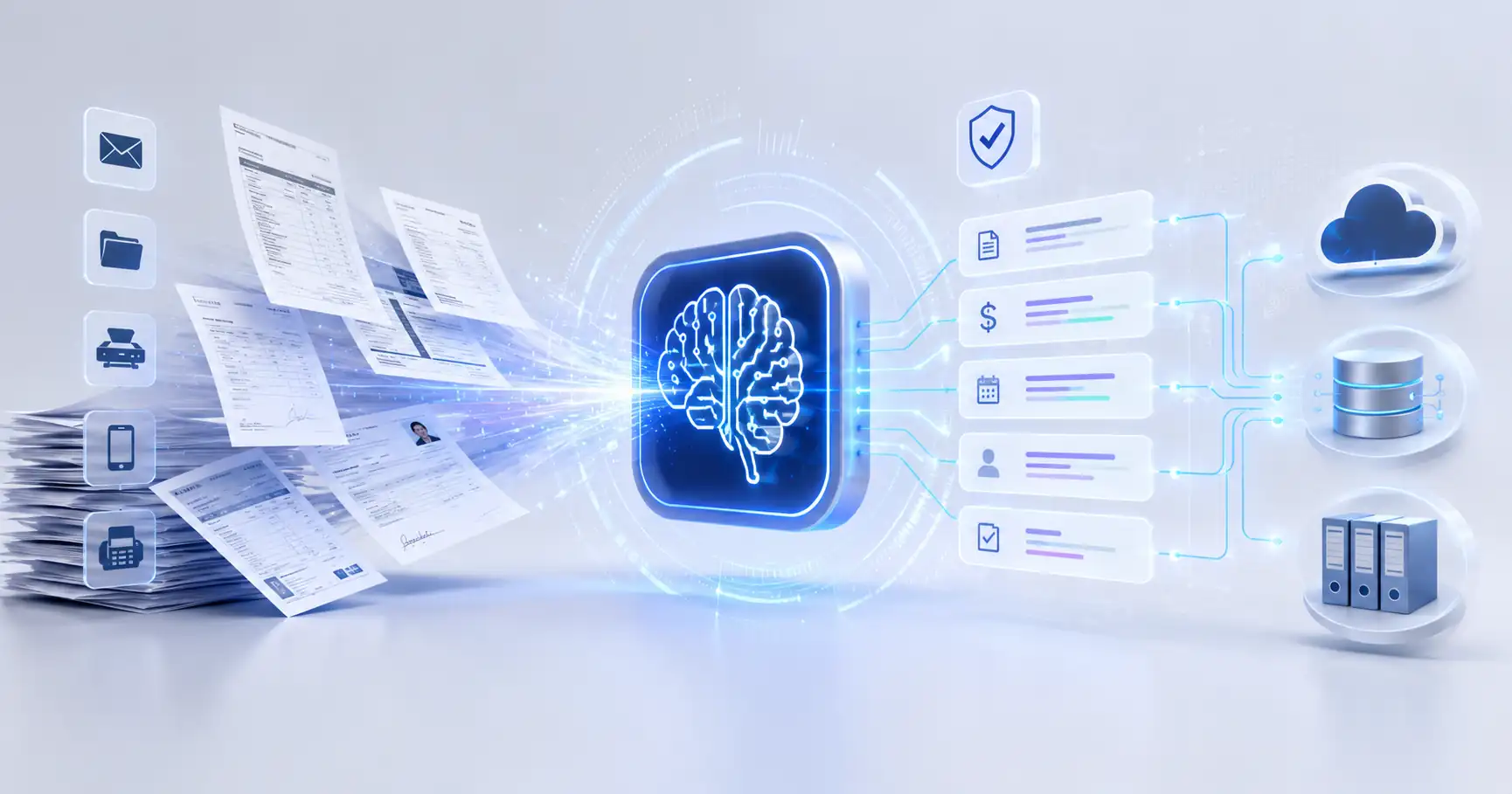
Vendors dress this up under different names depending on the product. Beneath the surface, however, three activities do the actual work of carrying a document from inbox to database.
Document classification determines what has arrived — an invoice, a tax form, a claim submission — before anything further is done to it. A model trained on sample documents learns which fields and values tend to accompany each type, and this step earns its keep twice over: it feeds the extraction stage that follows, and it sharpens search across a document repository once files have been filed away. A repository that knows what a file is proves a rather different asset from one that merely knows a file exists somewhere. Anyone who has ever attempted to locate a single document within a shared drive containing ten thousand identically named PDFs will recognise at once why that distinction is no small matter.
Data extraction is where values actually come off the page — an account number, an amount owed, a policy identifier — achieved through some combination of identifying key-value pairs, holding a rough sense of where a value sits on a given document type, and training against sufficient real examples that the model generalises beyond the exact layout it originally learned. Metadata is captured alongside the extracted fields here too, and this constitutes a fair portion of what later makes search and audit possible; a perfectly extracted figure with no accompanying context is, in truth, merely a number set adrift. This is also the stage at which most of the visible drama unfolds during a pilot, since it is the part vendors are most eager to demonstrate, and the part a prospective buyer is most tempted to judge the entire system by. That temptation is worth resisting, for reasons the benefits section below makes plain.
Data output receives the least attention in most vendor overviews, and probably merits rather more. Extracted values are cleaned up — spelling corrected, phone numbers reformatted, currency normalised to two decimal places — before being written out, typically as JSON, to whatever downstream workflow or content system requires it. A model that extracts a dollar figure correctly, yet formats it differently from one document to the next, still leaves work for whoever built the integration on the far end, and that cost tends to surface only once the pilot has concluded and the system is meant to be running unassisted. It is, in a sense, the least glamorous of the three stages, and the one most likely to go underfunded — which is precisely why it so often becomes the source of the support tickets nobody foresaw.
The Key Components Behind the Workflow
Two further pieces underlie those three stages, and they seldom warrant the term "components" in vendor material, even though a rollout's fate tends to rest upon them.
The validation layer — the business rules, cross-checks, and, in more adversarial contexts, external lookups that determine whether an extracted value may be trusted before it proceeds downstream. For an invoice, this might amount to nothing more than confirming that a total matches the sum of its line items. For an identity document, as the section on KYC below explains, it demands something considerably more exacting. Validation is treated as an afterthought bolted onto extraction far too often, when it deserves to be scoped and resourced as a component in its own right.
Human-in-the-loop review — no extraction model, however capably trained, achieves perfect accuracy, and to pretend otherwise is one of the surer ways a rollout disappoints the people who funded it. Documents that fail validation, or that fall beneath a confidence threshold, must land before someone capable of correcting them — and ideally, whose corrections feed back into retraining the model, so that accuracy accrues over time rather than remaining static. A workflow with no route back to a human reviewer is not more automated. It is simply blind to its own errors.
The Technology Building Blocks
An IDP deployment typically draws upon a handful of underlying technologies working in concert, rather than a single all-in-one purchase:
Optical character recognition and computer vision — convert a scanned image or photograph into machine-readable text, and assist the system in recognising document layout and structure.
Machine learning and natural language processing — classify document types, extract key fields, and interpret context, discerning that a figure situated near the word "total" plays a rather different role from one situated near "subtotal."
Robotic process automation — takes up validated, structured output and carries it into the next step of a business process, whether booking an appointment or updating an account, without a person retyping what has already been read once.
Cloud infrastructure and APIs — grant the pipeline sufficient room to absorb volume spikes, and allow it to connect with whichever content systems, databases, or line-of-business applications the data must ultimately reach.
Most organisations end up combining a handful of specialised tools rather than adopting one monolithic platform — and that is, more often than not, the sturdier choice, however untidy it may appear on a slide.
Use Cases, With Numbers
Commercial insurance quoting
The quote-and-approval race in commercial insurance is won by whoever responds first, and manual review of supporting documentation is usually what slows a response to a crawl. IDP reads and classifies each submitted document — loss history, financial statements, prior policy records — and passes the relevant fields directly into the underwriting workflow, sparing an underwriter the tedium of retyping figures already read once. Insurers further along this road, particularly those examining closely how AI is reshaping claims processing, tend to treat quoting and claims as two facets of the same document problem rather than as separate undertakings — which, in fairness, is precisely what they are, given that the paperwork arriving at the outset of a policy's life and the paperwork arriving at a moment of loss are frequently drawn from the same body of source documents and demand much the same discipline of reading.
The benefits are seldom dramatic in isolation, but they accumulate:
More business closed without additional underwriting headcount, since the same team simply gets through more submissions in a working day.
Faster response times — and in a market where the first quote often prevails, this matters directly.
Better retention on existing business, since agents spend less time keying data and more time on the advisory conversations that keep a client from looking elsewhere.
Healthcare eligibility and intake
Patient intake forms, eligibility checks, and prior authorisation requests arrive through a genuinely inconsistent array of channels — a mailed form, a fax from a referring physician's office (some still rely on them, more than any newcomer to the industry might expect), a PDF attached to a message through the patient portal. Low-code IDP tooling permits an operations team, not solely IT, to configure recognition for the fields that matter — insurance ID, date of birth, referring provider — and to build in validators that catch plainly erroneous entries before they reach someone obliged to chase them down by telephone. This last point merits dwelling upon: a badly formed field discovered days later within a claims system tends to cost considerably more staff time than catching it at intake would have done.
The benefits that typically follow:
Faster turnaround on eligibility checks, which shortens how long a patient must wait before an appointment can actually be booked.
Role-based access to the personal and protected health information the forms contain, designed into the workflow from the outset rather than appended once someone raises the matter during an audit.
Solutions that operations staff may adjust themselves, without waiting on a development queue each time a partner clinic introduces a new form. There is a broader picture worth reading on how this fits into clinical operations more generally, in this look at AI's role in transforming patient care and healthcare operations.
Retail banking account servicing
A mid-sized bank may easily have twenty-odd account servicing forms live at any one time — change of address, beneficiary updates, account closure requests — each requiring a person to read it, verify the data against existing records, and key it into the core banking system by hand. IDP trained across each form type learns the fields common to all of them, name and account number, alongside the fields peculiar to one particular request, without requiring a separate hand-built pipeline for every form in the catalogue. This shared-learning property is among the more underappreciated economics of the technology: the marginal cost of adding a twenty-first form is nowhere near the cost of building the first, provided the underlying fields overlap sufficiently for the model to generalise.
The benefits that typically follow:
Faster turnaround on routine servicing requests — nobody wishes to wait a week for a change of address to be processed.
Identify potential account closures sooner, allowing customer retention teams to proactively engage customers before they close their accounts.
Lower operational costs by automating multiple account servicing forms through a unified IDP pipeline instead of relying on separate manual workflows. Institutions weighing this against a wider set of priorities may find it worth situating within the broader picture offered by this implementation guide for AI in finance.
A genuine tangent: the KYC problem nobody templates well
This deserves its own detour, for it rarely receives one in overviews that otherwise cover the ground reasonably well. Know Your Customer verification differs from the three cases above in one significant respect: the documents under verification are adversarial by design, in a manner an invoice or a claim form simply is not. A forged identity document is constructed specifically to pass a template check, and so classification and extraction accuracy cannot solve the problem unassisted — the validation layer must cross-reference extracted data against watch lists and sanctions databases, and a document that extracts perfectly, every field crisp and correctly labelled, may still fail that check without any contradiction whatsoever.
This constitutes a different engineering problem from the insurance or banking cases described above — nearer to fraud detection than to data entry — and treating it as a minor extension of ordinary IDP tends to under-deliver, typically in ways that only become apparent once genuine forged submissions begin to appear, often well after the system has been declared a success on the strength of its extraction metrics alone. The exceptions within a KYC pipeline are not noise to be minimised, as they are within an insurance intake queue — they are frequently the entire point, since a well-made forgery is designed specifically to avoid becoming one. Teams that have studied why exception handling behaves so differently once genuine judgement is required tend to build the validation layer as its own workstream, staffed and funded apart from the extraction pipeline that feeds it, rather than appending it to the tail end of a project already underway.
Benefits: Where the Payoff Actually Lands
The extraction itself is not where the value is captured — what follows determines whether the whole exercise was worthwhile. Validated, structured data may feed straight into a transaction rather than languishing in a queue awaiting a data-entry step that once consumed several hours of somebody's day.
Feed poor or inconsistent data into a robotic process automation bot and one obtains a faulty next step just as surely as one would in feeding it to a person — so the quality of that output stage is really what determines how much of the automation spend pays for itself.
Teams already running, or seriously contemplating, broader workflow automation AI programmes tend to find IDP is the entry point that renders the rest of the pipeline trustworthy, rather than something appended once the automation begins to misbehave.
Extraction accuracy alone is a misleading measure to steer by. A pipeline extracting at ninety-eight per cent that delivers its output in a format the receiving system only half understands will accumulate more support tickets than one running at ninety-four per cent that hands off cleanly.
A useful discipline when reviewing any IDP proposal is to ask not "how accurate is the extraction" but "how much manual cleanup occurs between extraction and the system that finally makes use of the data." The latter question proves far more revealing of what daily operations will actually feel like.
Implementation: Governance, Build-vs-Buy, and a Realistic Rollout
Data governance is not a late-stage concern
Documents run through IDP routinely contain protected health information, personal identifiers, and financial account numbers.
Every third-party service a pipeline calls upon while processing — an OCR API, a cloud classification model, whichever vendor performs the heavy lifting behind the interface — requires mapping against the relevant regulatory framework before production, and not after an auditor poses the question nobody had a ready answer for.
This is rather less a technical requirement than an organisational one. It demands compliance and operations personnel in the room during design, not consulted after the architecture is already fixed and painful to unwind.
A governance failure uncovered by a regulator rather than by the organisation itself tends to poison trust in the entire automation programme, not merely the one pipeline responsible, and that reputational drag may outlast the fix by years.
Choosing between building in-house and buying a platform
Building in-house affords genuine control over the model, the training data, and the roadmap — but also entails carrying the ongoing labour of retraining as document formats drift, and as new document types arise that nobody scoped for at the outset.
Buying a platform exchanges some of that control for a vendor's accumulated experience across other customers' edge cases, though it introduces its own dependency. A fair evaluation examines how the vendor handles the messiest ten per cent of documents, not merely the cleanest ninety.
It is worth comparing options against a framework such as this one for assessing enterprise claims management platforms — the criteria that matter for claims, exception handling, audit trails, integration with an existing core system, carry over reasonably well to other document-heavy processes besides.
A team processing a narrow, stable set of document types at very high volume often finds the in-house route pays for itself within a year or two. A team facing a wide, shifting mix of document types from partners who will never standardise tends to fare better purchasing that variety-handling expertise than building it from nothing.
What a realistic rollout actually looks like
A pilot confined to a single, well-behaved document type can genuinely proceed from kickoff to production within a matter of weeks — that is not the portion that stretches out.
What stretches is everything following the pilot's success, once the scope is widened: a second document type behaves differently from the first, a third arrives bearing entirely different regional formatting conventions, and the model requires retraining against a slightly altered problem each time the boundary shifts.
A sensible pattern: three months for the first document type, proven and stable, followed by a slower expansion — six to twelve months, depending upon how many document types are involved — during which accuracy is checked constantly rather than assumed.
Someone within the organisation must own the ongoing relationship between the model and the documents it encounters: watching for drift, retraining when a partner alters their form, deciding when a new document type warrants its own classification rules.
That role does not vanish at launch — a model left entirely to its own devices after deployment degrades quietly, and nobody notices until the exception queue has crept back up to roughly where it began. Its very invisibility, when the role is performed well, is precisely why it so often gets quietly excised in a budget review a year or two afterward.
What's Actually Changing in This Space
Document complexity continues to climb — intricate table structures, government identification bearing holograms and watermarks, documents never intended to be machine-read at any point in their existence. Extraction accuracy along that long tail lags well behind what vendors advertise upon their cleanest benchmark documents.
The field's own name is arguably already outdated. Video and audio are moving into the same critical path documents presently occupy, particularly within insurance claims and incident reporting, where a recorded call or a video walkthrough of vehicle damage is increasingly treated as evidence in its own right rather than as a mere supplement to the paperwork.
A pipeline built purely around static-page extraction will require genuine architectural rework, not a modest bolt-on, once that shift arrives in earnest. Worth asking any vendor directly how their roadmap accounts for that convergence.
Neither point argues against adopting IDP now. They argue for treating today's deployment as version one of something that will continue to change — and for asking, before signing with any vendor, what becomes of accuracy on document types unlike the demo, and how far that figure falls before the model catches up.
There is no tidier moment coming. Document variety will keep increasing, not settling down. The organisations already several years into this work are those who chose a single, painful, well-bounded document problem, solved it properly, and allowed the next one to queue up behind it.
Transform Document-Heavy Workflows with Vegavid
FAQs
Intelligent Document Processing combines AI, OCR, machine learning, and natural language processing to classify documents, extract key information, validate data, and automate business workflows with minimal manual intervention.
An IDP solution follows a workflow that includes document classification, data extraction, validation, human-in-the-loop review, and integration with downstream enterprise systems such as ERP, CRM, and workflow automation platforms.
Insurance, healthcare, banking, financial services, government, logistics, and retail organizations use IDP to automate claims processing, patient intake, KYC verification, account servicing, invoice processing, and other document-heavy workflows.
Modern IDP solutions use Optical Character Recognition (OCR), Computer Vision, Machine Learning, Natural Language Processing (NLP), Robotic Process Automation (RPA), cloud infrastructure, APIs, and AI models to automate document processing.
Vegavid develops enterprise-grade Intelligent Document Processing solutions that automate document classification, data extraction, validation, workflow automation, and enterprise integrations while ensuring security, scalability, and compliance.
Tags

Yash Singh is the Chief Marketing Officer at Vegavid Technology, a leading AI-driven technology company specializing in AI agents, Generative AI, Blockchain, and intelligent automation solutions. With over a decade of experience in digital transformation and emerging technologies, Yash has played a key role in helping businesses adopt advanced AI solutions that enhance operational efficiency, automate workflows, and deliver personalized customer experiences across industries including fintech, healthcare, gaming, ecommerce, and enterprise technology. An alumnus of Indian Institute of Technology Bombay, Yash combines strong technical expertise with strategic marketing leadership to drive innovation in AI-powered applications, autonomous AI agents, Retrieval-Augmented Generation (RAG), Natural Language Processing (NLP), Large Language Models (LLMs), machine learning systems, conversational AI, and enterprise automation platforms. His expertise spans AI model integration, intelligent workflow automation, prompt engineering, smart data processing, and scalable AI infrastructure development, enabling organizations to accelerate digital transformation and business growth. Passionate about the future of intelligent systems, Yash actively shares insights on AI agents, Generative AI, LLM-powered applications, blockchain ecosystems, and next-generation digital strategies. He is committed to helping businesses embrace AI-first transformation while guiding teams to build impactful, industry-specific solutions that shape the future of innovation and intelligent technology.





Leave a Reply