
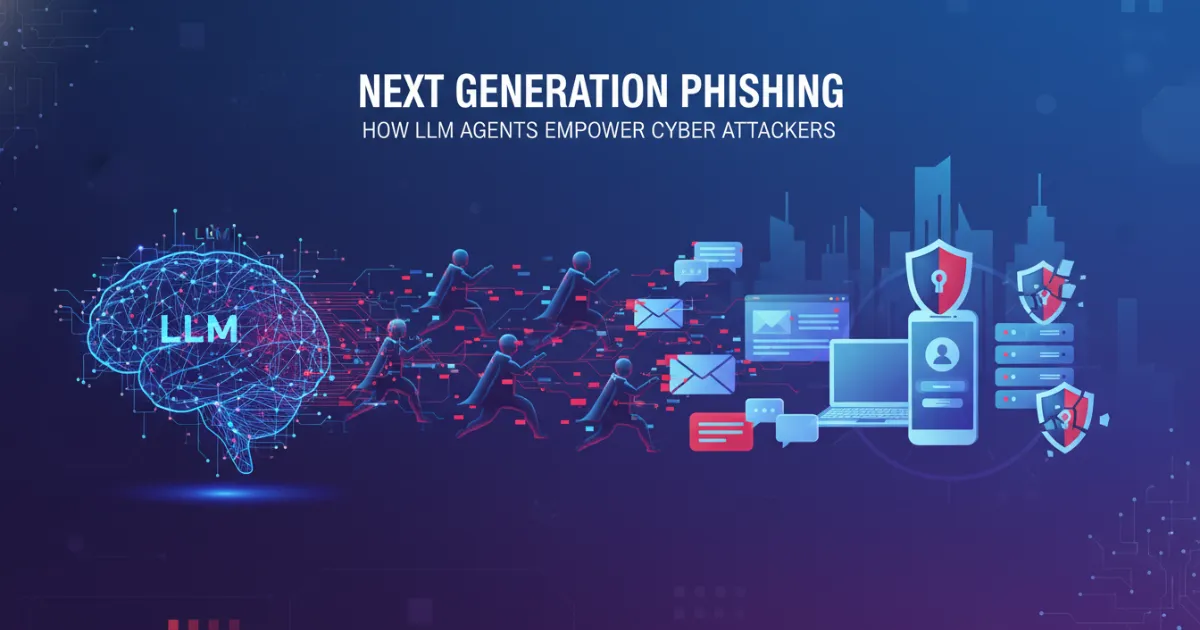
Next Generation Phishing How LLM Agents Empower Cyber Attackers
Artificial intelligence has transformed industries ranging from healthcare and finance to customer support and software development. However, the same technological advancements that help businesses innovate are also enabling cybercriminals to launch increasingly sophisticated attacks. Among the most concerning developments is the rise of Large Language Model (LLM) agents being leveraged to automate, personalize, and scale phishing campaigns.
Traditional phishing relied on poorly written emails, generic messages, and manually crafted scams that could often be detected by vigilant users or spam filters. Today, attackers can use LLM-powered agents to generate highly convincing emails, imitate writing styles, conduct reconnaissance, create multilingual content, and even interact with victims in real time. This shift has given rise to next-generation phishing, where AI dramatically increases the effectiveness and reach of cyberattacks.
For organizations, the implications are significant. Email remains one of the most common attack vectors, and AI-enhanced phishing campaigns are becoming harder to distinguish from legitimate communications. Businesses must therefore rethink cybersecurity strategies, combining employee awareness with AI-driven defense mechanisms to stay ahead of evolving threats.
This article explores what next-generation phishing is, how LLM agents empower cyber attackers, the techniques they use, emerging risks, and the security practices organizations can adopt to protect themselves.
What Is Next-Generation Phishing?
Next-generation phishing refers to cyberattacks that leverage artificial intelligence, machine learning, automation, and advanced social engineering techniques to deceive victims into revealing sensitive information or performing unauthorized actions.
Unlike traditional phishing campaigns that rely on mass-distributed emails with generic messaging, next-generation phishing focuses on personalization, automation, and adaptability. AI enables attackers to craft messages that closely resemble legitimate communications, making detection significantly more challenging.
Characteristics of Next-Generation Phishing
AI-generated email content
Personalized social engineering
Real-time conversational phishing
Multilingual phishing campaigns
Automated reconnaissance
Dynamic message generation
AI-powered impersonation
Context-aware communication
Adaptive attack strategies
Scalable campaign automation
Rather than sending millions of identical emails, attackers can now generate thousands of unique phishing messages tailored to specific individuals or organizations.
What Are LLM Agents?
Large Language Model (LLM) agents are AI systems built on advanced language models that can perform tasks autonomously or semi-autonomously. Unlike simple chatbots, LLM agents can reason through multi-step tasks, retrieve information, use external tools, and generate context-aware responses.
Modern LLM agents can:
Understand natural language instructions
Analyze large amounts of text
Generate human-like responses
Search public information
Summarize documents
Write emails
Translate languages
Answer follow-up questions
Maintain conversational context
Automate repetitive workflows
These capabilities make LLM agents highly valuable for legitimate business applications such as customer service, software development, knowledge management, and content generation. However, the same capabilities can also be abused by malicious actors to enhance phishing operations.
It is important to note that LLMs themselves are neutral technologies. The risk arises when attackers misuse publicly available AI tools or customized models to automate malicious workflows.
Understanding the Evolution of Phishing
Phishing has evolved significantly over the past two decades.
Generation | Characteristics |
|---|---|
First Generation | Generic spam emails sent to millions of users |
Second Generation | Targeted spear-phishing campaigns |
Third Generation | Business Email Compromise (BEC) attacks |
Fourth Generation | AI-assisted phishing using automation |
Next Generation | Autonomous LLM-powered phishing agents |
Early phishing emails often contained obvious spelling mistakes, suspicious links, and poor grammar. Users became increasingly aware of these indicators, prompting attackers to adopt more sophisticated tactics.
Today, AI enables attackers to produce professionally written emails with correct grammar, personalized content, and context that closely matches legitimate business communications.
Why LLM Agents Are Attractive to Cybercriminals
Cybercriminals constantly seek methods that increase success rates while reducing manual effort. LLM agents provide exactly that by automating many stages of the phishing lifecycle.
Some key advantages include:
Massive Content Generation
Instead of manually writing phishing emails, attackers can instruct an LLM to generate thousands of unique messages within minutes.
Examples include:
Fake HR emails
Fake invoice reminders
Password reset notifications
Executive communications
Customer support messages
Shipping notifications
Banking alerts
Each message can be phrased differently, reducing the likelihood of detection by traditional spam filters.
Personalized Communication
LLM agents can incorporate publicly available information about a target, such as:
Job title
Company name
Industry
Recent LinkedIn activity
Public presentations
Press releases
News articles
This allows phishing messages to appear highly relevant and credible.
For example:
Instead of:
"Dear Customer"
An AI-generated phishing email might say:
"Hi Sarah, congratulations on your recent promotion to Director of Finance. We noticed your expense management portal requires immediate verification following the latest policy update."
Such personalization increases the likelihood that recipients will trust the message.
Multilingual Attacks
Traditional phishing campaigns often struggled with translation quality.
Modern LLM agents can produce fluent content in dozens of languages, enabling attackers to target global organizations more effectively.
This capability allows cybercriminals to:
Launch simultaneous international campaigns
Target regional offices
Mimic local business terminology
Reduce obvious translation errors
Continuous Adaptation
Unlike static phishing templates, LLM-generated messages can evolve based on feedback.
If certain wording triggers spam filters, attackers can automatically generate alternative versions with different phrasing while preserving the same deceptive intent.
This constant variation makes signature-based detection less effective.
The AI-Driven Phishing Workflow
Modern phishing attacks increasingly resemble automated workflows rather than isolated email campaigns.
A simplified workflow may include:
Collect public information about the target organization.
Identify key employees and departments.
Generate personalized phishing emails using an LLM.
Create unique subject lines.
Tailor messaging to each recipient.
Send messages through compromised infrastructure.
Monitor responses.
Generate follow-up emails automatically.
Escalate conversations if victims engage.
The automation provided by AI significantly reduces the time and effort required to conduct large-scale phishing operations.
Common Capabilities Attackers Seek in LLM Agents
While responsible AI systems include safeguards against generating malicious content, attackers may attempt to misuse or modify models to automate aspects of phishing. Desired capabilities can include:
Writing persuasive emails
Rewriting messages to evade spam filters
Summarizing publicly available information about targets
Generating multilingual communications
Producing varied writing styles
Simulating professional business language
Creating context-aware replies
Automating repetitive communication tasks
These capabilities lower the barrier to creating convincing social engineering content, making phishing campaigns more scalable and personalized.
Why Businesses Should Pay Attention
AI-powered phishing is no longer a theoretical concern. Organizations across industries are encountering increasingly sophisticated social engineering attempts that leverage generative AI to produce polished, context-aware messages. As these tools continue to improve, distinguishing legitimate communications from fraudulent ones becomes more challenging.
How LLM Agents Empower Cyber Attackers
Large Language Model (LLM) agents are reshaping how cybercriminals execute phishing campaigns by automating repetitive tasks, generating convincing content, and adapting communications based on context. While responsible AI providers implement safeguards to prevent malicious use, attackers may attempt to misuse AI tools or develop their own models to streamline social engineering activities.
Rather than replacing traditional phishing techniques, LLM agents enhance them by improving efficiency, personalization, and scalability.
1. Automated Reconnaissance
Before launching a phishing campaign, attackers often gather publicly available information about their targets. LLM agents can help organize and summarize this information, reducing the time needed to prepare targeted messages.
Common sources include:
Company websites
Public employee profiles
Press releases
Conference presentations
Job postings
Technology stack disclosures
News articles
Public financial reports
From these sources, attackers may identify:
Executive names
Department structures
Business partners
Ongoing projects
Corporate terminology
Seasonal business activities
This context enables phishing messages to appear more relevant and believable.
2. Personalized Email Generation
One of the most significant advantages of LLMs is their ability to produce natural, context-aware writing. Attackers may attempt to use this capability to create phishing emails tailored to individual recipients.
For example, messages can be customized based on:
Job role
Department
Geographic location
Industry
Company size
Recent public announcements
Instead of sending identical emails to thousands of recipients, attackers can generate unique variations that are less likely to be flagged by pattern-based email filters.
3. Business Email Compromise (BEC) Enhancement
Business Email Compromise (BEC) is among the costliest forms of cybercrime. In these attacks, criminals impersonate executives, vendors, or trusted partners to convince employees to transfer funds or disclose sensitive information, a risk that has pushed many banking, financial services, and insurance institutions to tighten verification controls.
LLM agents can improve the realism of fraudulent communications by:
Matching professional writing styles
Using industry-specific terminology
Referencing publicly known projects
Producing grammatically correct messages
Maintaining consistent conversational tone
For organizations that rely heavily on email approvals, this increased realism can make fraudulent requests more difficult to recognize.
4. Real-Time Conversational Phishing
Traditional phishing often ends after a single email. AI-powered conversational systems can instead maintain ongoing interactions with victims.
Potential capabilities include:
Responding to follow-up questions
Clarifying fake requests
Providing consistent explanations
Maintaining context across multiple messages
Simulating customer support conversations
This allows attackers to extend social engineering attempts beyond a single interaction, increasing the chance that a target may trust the communication.
5. Multilingual Campaigns
Global organizations operate across many regions and languages. Modern language models can generate fluent content in numerous languages, allowing phishing campaigns to be adapted for international audiences.
Advantages for attackers include:
Native-sounding translations
Region-specific terminology
Local business etiquette
Consistent messaging across offices
Reduced reliance on human translators
Organizations with distributed teams should therefore provide security awareness training in all relevant languages, not just English.
AI Techniques Used in Modern Phishing Campaigns
Attackers may combine multiple AI capabilities to improve the effectiveness of phishing operations. Common techniques include:
Natural Language Generation
Generates polished emails, chat messages, or documents that resemble legitimate business communications, drawing on the same natural language processing techniques used in legitimate applications.
Text Rewriting
Produces multiple versions of similar messages with different wording, making campaigns harder to detect using simple pattern matching.
Sentiment Adaptation
Adjusts tone based on the intended audience, such as formal language for executives or conversational language for customer-facing employees.
Context Awareness
Incorporates publicly available details about a company, recent events, or industry trends to make messages appear timely and authentic.
Workflow Automation
Coordinates repetitive tasks such as drafting follow-up emails or organizing publicly available information, allowing attackers to focus on higher-level campaign management.
Types of AI-Powered Phishing Attacks
Spear Phishing
Targets a specific individual using personalized information to increase credibility.
Typical targets include:
Finance managers
HR personnel
IT administrators
Legal teams
Procurement departments
Whaling
Focuses on senior executives such as CEOs, CFOs, or directors. These messages often reference strategic initiatives, confidential projects, or financial approvals.
Business Email Compromise (BEC)
Attempts to trick employees into making fraudulent payments or revealing sensitive information by impersonating trusted business contacts.
Clone Phishing
Copies the appearance of legitimate emails while replacing links or attachments with malicious alternatives.
Smishing
Uses SMS or messaging platforms to deliver fraudulent communications. AI can help tailor messages to different audiences and languages.
Vishing
Voice phishing has evolved with AI-generated speech technologies. Attackers may use synthetic voices or voice cloning to impersonate trusted individuals during phone calls, making verification more challenging.
Real-World Trends in AI-Assisted Cyber Threats
Security researchers have observed several emerging trends associated with generative AI and phishing:
More polished phishing emails with fewer grammar mistakes.
Faster creation of targeted campaigns.
Increased use of multilingual lures.
Greater personalization using publicly available information.
Integration of AI into broader social engineering workflows.
These developments do not mean AI is the sole driver of phishing, but it has become a force multiplier that can increase both efficiency and scale.
Why Traditional Email Security Is No Longer Enough
Conventional email security tools often rely on:
Known malicious signatures
Blacklisted domains
Static keyword detection
Historical attack patterns
AI-generated phishing content challenges these methods because messages can be:
Unique for every recipient
Grammatically correct
Contextually relevant
Free of common phishing indicators
Continuously rephrased
As a result, organizations increasingly need layered defenses that combine technical controls with user education and behavioral analysis.
Warning Signs Employees Should Watch For
Even sophisticated phishing attempts often contain subtle warning signs:
Unexpected requests for credentials or sensitive information.
Urgent demands for immediate action.
Requests to bypass established approval processes.
Unusual payment instructions.
Links directing to unfamiliar domains.
Attachments that were not expected.
Messages that create pressure or fear.
Encouraging employees to verify unusual requests through trusted communication channels remains one of the most effective defenses.
Emerging Threat: AI-Enhanced Voice and Video Scams
Generative AI is also enabling more convincing voice and video impersonation. In some reported cases, attackers have used synthetic audio or manipulated video to mimic executives or colleagues during fraudulent requests.
While these technologies continue to evolve, organizations should strengthen verification procedures for high-risk actions such as financial transfers or changes to payment information. Multi-person approval workflows and out-of-band verification can significantly reduce risk.
Key Takeaways
LLM agents can streamline reconnaissance and content creation for phishing campaigns.
Personalized, multilingual, and conversational phishing is becoming more common.
Traditional signature-based defenses are less effective against highly varied AI-generated messages.
Organizations should adopt layered security strategies that combine technology, employee awareness, and verification procedures.
How to Detect AI-Generated Phishing Attempts
As phishing attacks become more sophisticated, organizations must move beyond relying solely on obvious indicators like spelling mistakes or suspicious formatting. AI-generated phishing emails are often grammatically correct, professionally written, and tailored to the recipient, making them harder to identify.
Instead of looking for a single warning sign, organizations should evaluate communications based on context, sender authenticity, and business processes.
Common Indicators of AI-Assisted Phishing
Indicator | Why It Matters |
|---|---|
Unexpected requests | Messages asking for credentials, payments, or sensitive information without prior notice. |
Sense of urgency | Artificial pressure such as "Act within one hour" or "Immediate action required." |
Unusual sender behavior | Requests that differ from a person's normal communication style or process. |
Suspicious links | URLs that imitate legitimate domains or use misleading redirects. |
Unexpected attachments | Files received without prior discussion or from unfamiliar contacts. |
Requests to bypass procedures | Messages encouraging users to ignore standard approval or verification processes. |
Generic greetings with personalized content | A mismatch that may indicate automated message generation. |
Organizations should encourage employees to verify high-risk requests using trusted communication channels rather than responding directly to suspicious emails.
Best Practices to Defend Against LLM-Powered Phishing
No single security control can eliminate phishing risk. A layered defense strategy provides the best protection against AI-enhanced attacks.
1. Implement Multi-Factor Authentication (MFA)
Even if credentials are compromised through phishing, MFA significantly reduces the likelihood of unauthorized account access.
Modern MFA solutions may include:
Authenticator applications
Hardware security keys
Biometric authentication
Passkeys
Push-based verification
2. Deploy Advanced Email Security
Modern email security platforms increasingly use AI and behavioral analysis to identify suspicious communications.
Capabilities include:
URL reputation analysis
Attachment sandboxing
Domain impersonation detection
Behavioral anomaly detection
Machine learning-based threat identification
These technologies help identify phishing attempts that traditional signature-based filters might miss.
3. Conduct Continuous Security Awareness Training
Employees remain one of the strongest defenses against phishing.
Effective training should include:
Recognizing phishing indicators
Identifying Business Email Compromise (BEC)
Safe handling of attachments
Secure password practices
Reporting suspicious emails
Voice phishing awareness
Deepfake awareness
Organizations that conduct regular phishing simulations often improve employee readiness and reporting rates.
4. Verify High-Risk Requests
Financial transfers, payroll changes, vendor updates, and requests involving sensitive data should always be verified through an independent communication channel.
Examples include:
Calling the requester using a known phone number.
Confirming requests through approved collaboration platforms.
Requiring dual authorization for financial transactions.
Verification procedures are especially important when requests involve urgency or confidentiality.
5. Apply the Principle of Least Privilege
Employees should only have access to the systems and data necessary for their roles.
Benefits include:
Reduced attack surface
Limited lateral movement after compromise
Better containment of security incidents
Improved compliance with security frameworks
6. Monitor User and Entity Behavior
User and Entity Behavior Analytics (UEBA) solutions can identify unusual activity such as:
Logins from unexpected locations
Unusual download volumes
Access outside normal working hours
Suspicious privilege escalation
Abnormal email activity
Behavioral monitoring helps detect compromised accounts even when attackers use legitimate credentials.
AI vs. AI: Fighting Cybercriminals with Artificial Intelligence
The same AI technologies that can be misused by attackers are also strengthening cyber defenses. Security vendors increasingly use AI to analyze large volumes of data, detect anomalies, and respond to threats more quickly.
Examples of defensive AI include:
Intelligent Email Filtering
AI models analyze email content, metadata, sender reputation, and behavioral patterns to identify phishing attempts that may evade traditional filters.
Threat Intelligence Correlation
AI can process global threat intelligence feeds to identify emerging phishing campaigns and indicators of compromise in near real time.
Automated Incident Response
Security orchestration platforms, often built around AI agents for incident detection automation, can automatically:
Quarantine suspicious emails
Disable compromised accounts
Block malicious domains
Alert security teams
Initiate investigation workflows
Behavioral Analytics
Machine learning helps detect deviations from normal user behavior, providing early warning of potential account compromise.
Enterprise Security Strategies for the AI Era
Organizations should update their cybersecurity programs to address AI-enhanced threats.
Strengthen Identity Security
Identity has become the new security perimeter.
Recommended measures include:
Passwordless authentication
Passkeys
Risk-based authentication
Conditional access policies
Identity governance
Improve Vendor Security
Third-party suppliers are frequently targeted by phishing campaigns.
Organizations should:
Assess vendor cybersecurity practices.
Require MFA for partner access.
Monitor third-party accounts.
Review supply chain risks regularly.
Develop an Incident Response Plan
Preparation reduces the impact of phishing incidents, and many teams now lean on AI agents for risk monitoring to catch issues early.
A comprehensive response plan should include:
Incident identification
Containment procedures
Forensic investigation
Communication protocols
Recovery processes
Lessons learned
Security improvements
Regular tabletop exercises help ensure teams can respond effectively under pressure.
Adopt Zero Trust Security
Zero Trust assumes that no user or device is inherently trusted, regardless of location.
Core principles include:
Verify every request.
Enforce least-privilege access.
Continuously monitor activity.
Segment networks.
Authenticate users and devices.
This approach limits the damage that can occur if phishing successfully compromises an account.
The Future of AI-Driven Phishing
Generative AI will continue to evolve, and phishing tactics are likely to become more adaptive and convincing. Future trends may include:
More realistic multilingual phishing campaigns.
AI-assisted reconnaissance using publicly available data.
Better imitation of writing styles.
Increased use of synthetic voice and video in social engineering.
Highly personalized attacks targeting specific industries or roles.
At the same time, cybersecurity solutions are advancing rapidly. AI-powered detection, stronger identity controls, and improved user education are helping organizations build resilience against these evolving threats.
The long-term challenge will not be preventing every phishing attempt but minimizing the likelihood that successful phishing leads to significant business impact.
Conclusion
The rise of generative AI has fundamentally changed the phishing landscape. Large Language Model agents enable attackers to automate content creation, personalize communications, and scale social engineering campaigns with unprecedented speed. While these technologies present new challenges, they do not make successful attacks inevitable.
Organizations that combine modern email protection, AI-assisted compliance monitoring, Zero Trust security, multi-factor authentication, and ongoing employee education are far better positioned to resist evolving phishing tactics.
Ultimately, cybersecurity in the AI era is a balance between innovation and vigilance. As defenders increasingly harness AI to strengthen detection and response, the focus should remain on building resilient systems, verifying high-risk requests, and fostering a security-conscious culture. By preparing for AI-enhanced threats today, businesses can significantly reduce the impact of next-generation phishing campaigns and protect their people, data, and operations.
Frequently Asked Questions (FAQs)
An LLM phishing agent is an autonomous artificial intelligence program that uses Large Language Models to research targets, write highly convincing phishing messages, and respond to victim replies in real-time without human intervention.
LLMs help attackers by dramatically reducing the time and cost required to launch highly targeted spear-phishing campaigns. They automate target reconnaissance, fix grammatical errors, translate languages natively, and generate context-aware lures at scale.
Usually, no. Traditional security relies heavily on detecting bad grammar, suspicious links, and known malicious sender IPs. AI phishing uses flawless grammar, compromised legitimate accounts, and polymorphic text that bypasses standard signature-based detection.
Organizations must deploy AI-native email security tools that analyze behavioral patterns and contextual anomalies rather than just text. Additionally, implementing Zero Trust architecture, robust digital asset management, and continuous AI-focused employee training are essential.
Yes. Modern LLM agents are multi-modal, meaning they can orchestrate text alongside AI-generated deepfake audio (vishing) or video to verify a fraudulent request, making the attack exponentially more convincing.
While mainstream platforms like ChatGPT have strict safety guardrails, attackers often bypass these using prompt injection techniques (jailbreaking) or utilize specialized, uncensored open-source models (like FraudGPT) specifically trained for malicious purposes.
Tags

Yash Singh is the Chief Marketing Officer at Vegavid Technology, a leading AI-driven technology company specializing in AI agents, Generative AI, Blockchain, and intelligent automation solutions. With over a decade of experience in digital transformation and emerging technologies, Yash has played a key role in helping businesses adopt advanced AI solutions that enhance operational efficiency, automate workflows, and deliver personalized customer experiences across industries including fintech, healthcare, gaming, ecommerce, and enterprise technology. An alumnus of Indian Institute of Technology Bombay, Yash combines strong technical expertise with strategic marketing leadership to drive innovation in AI-powered applications, autonomous AI agents, Retrieval-Augmented Generation (RAG), Natural Language Processing (NLP), Large Language Models (LLMs), machine learning systems, conversational AI, and enterprise automation platforms. His expertise spans AI model integration, intelligent workflow automation, prompt engineering, smart data processing, and scalable AI infrastructure development, enabling organizations to accelerate digital transformation and business growth. Passionate about the future of intelligent systems, Yash actively shares insights on AI agents, Generative AI, LLM-powered applications, blockchain ecosystems, and next-generation digital strategies. He is committed to helping businesses embrace AI-first transformation while guiding teams to build impactful, industry-specific solutions that shape the future of innovation and intelligent technology.




Leave a Reply