
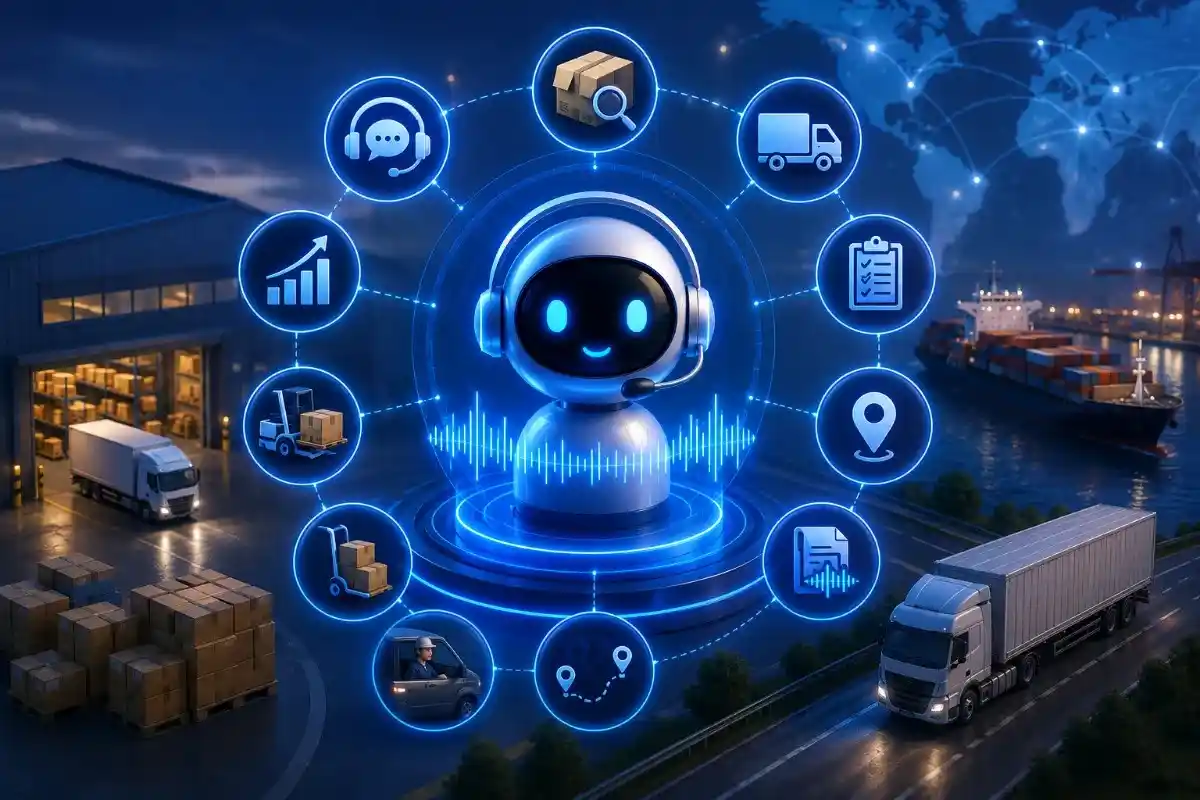
Top 10 AI Voice Agent Use Cases in Logistics & Supply Chain
Introduction
Every day, logistics networks run on thousands of phone conversations that rarely make headlines but keep freight moving, warehouses stocked, and customers informed. A truck driver calls to confirm a dock appointment, a shipper asks where an order stands, a carrier negotiates a rate, and a warehouse worker confirms a pick location, all before lunch. For years, this communication load fell entirely on human dispatchers and customer service teams, which meant limited hours, inconsistent answers, and rising staffing costs during peak seasons. That is shifting quickly as companies explore Artificial Intelligence Voice Agent Use Cases in Logistics & Supply Chain that automate these routine but essential conversations without sacrificing accuracy or tone. This article walks through what these systems are, how they function, why they matter, ten genuine benefits they bring to supply chain operations, ten practical use cases already running in the field, and ten trends shaping where the technology is headed next.
What Are AI Voice Agents in Logistics & Supply Chain?
An AI voice agent is a software system capable of holding a natural, spoken conversation over the phone or a connected device, understanding what the caller needs, and responding in a human-like voice while taking real action in the background. Unlike the rigid, menu-driven phone trees many logistics companies still use, modern voice agents rely on Large Language Models paired with speech technology, letting them follow open-ended requests, ask clarifying questions, and complete tasks such as updating a shipment record or confirming a delivery window.
The Technical Building Blocks
A working system combines speech recognition to convert audio into text, a language model to interpret intent and hold context across the conversation, text-to-speech to generate a natural voice response, and integration with backend platforms like transportation management or warehouse management software. Most AI Voice Agent Development for logistics use cases focuses heavily on this integration layer, since a system that converses well but cannot read or write to the right database provides little real operational value. When a carrier calls to check a load status, the agent transcribes the call, retrieves the relevant record, and answers within a second or two, all without a human ever picking up the phone.
Where This Fits Within Supply Chain Operations
Rather than replacing existing enterprise software, a voice agent typically sits in front of it as a conversational interface. It reads and writes to systems that already store shipment, inventory, and order data, meaning companies do not need to overhaul their technology stack to start benefiting from AI In Supply Chain automation. This makes adoption considerably less disruptive than many businesses initially assume.
How AI Voice Agents Work in Logistics & Supply Chain?
Understanding the mechanics behind a single phone call helps explain why this technology has matured so quickly over the past two years.
Speech Recognition and Intent Understanding
When a call connects, speech recognition engines such as those built by Deepgram convert spoken audio into text in real time, filtering out background noise common in trucks, warehouses, and loading docks. That transcript then passes to a language model that identifies what the caller actually wants, whether that is a delivery estimate, a rescheduled pickup, or a damage report. Platforms like Bland AI and Retell AI specialize in building this conversational layer specifically for phone-based interactions, managing natural turn-taking so the exchange feels like a real conversation rather than a scripted response.
Backend Integration and Action Execution
Once intent is understood, the agent queries connected systems, often a transportation management system, a warehouse management platform, or a customer relationship tool, to retrieve or update information. Developer platforms such as Vapi and Voiceflow simplify this integration step with pre-built connectors, letting a status lookup or appointment change happen mid-call without any manual data entry afterward.
Voice Response Generation and Delivery
After the system produces an answer, text-to-speech engines like ElevenLabs convert it into natural-sounding audio, while telephony infrastructure from providers such as Twilio carries the actual call. The full loop, listening, understanding, retrieving data, and responding, typically completes in under two seconds, fast enough to feel like a normal phone conversation rather than an automated one.
Why Are AI Voice Agents Important for Logistics & Supply Chain?
Supply chains generate an enormous volume of routine phone communication every single day, and that volume has grown faster than the workforce available to manage it.
The Widening Gap Between Call Volume and Staffing
Freight brokerages, carriers, and distribution centers field constant streams of calls covering appointment confirmations, status checks, and exception reports, each taking several minutes of a dispatcher's time even when the answer is simple. Analysis from firms such as Gartner has pointed to Conversational AI as one of the fastest-growing categories of enterprise technology adoption, driven largely by this mismatch between demand and available staff.
Persistent Labor Shortages Across the Industry
The logistics sector has faced a well-documented shortage of qualified drivers, warehouse staff, and dispatchers for several years running. Research published by McKinsey has repeatedly identified labor constraints as a top operational risk for supply chain leaders, making automation of routine voice communication a practical necessity for AI In Logistics rather than a luxury reserved for large enterprises.
Rising Expectations for Instant Answers
Shippers, carriers, and end customers now expect answers immediately regardless of the hour, and a voice agent that operates continuously closes the gap between when a question is asked and when it gets resolved, turning responsiveness into a genuine competitive advantage.
Benefits of AI Voice Agents in Logistics & Supply Chain
The advantages of deploying voice agents extend well past simple cost savings, though cost remains an important factor for most companies evaluating this technology through AI Voice Agent Development.
Reduced Dispatcher Workload
Automating routine calls, appointment confirmations, load status checks, and delivery rescheduling, frees dispatchers to focus on loads that genuinely require judgment or negotiation, rather than spending hours repeating the same information to different callers throughout the day.
Lower Total Communication Costs
A single voice agent can handle dozens of simultaneous conversations without additional headcount, which means the cost per call drops sharply compared to a human-staffed call center, especially once training, turnover, and overtime expenses are factored into the comparison.
Continuous Twenty-Four-Hour Availability
Unlike a dispatch office that closes overnight or during holidays, a voice agent answers calls at any hour, which matters enormously for international shipments crossing time zones or urgent exceptions that cannot wait until the next business day.
Faster Response Times for Every Caller
Because the system can handle unlimited simultaneous calls, no one sits on hold waiting for the next available representative, which shortens the average resolution time for routine inquiries from several minutes to under thirty seconds in most cases.
Improved Accuracy and Data Consistency
Human dispatchers vary in how they phrase information, and fatigue toward the end of a long shift increases the likelihood of mistakes. A properly configured voice agent delivers the same accurate answer every time, which matters greatly in regulated areas like hazardous materials transport.
Effortless Scaling During Peak Season
Seasonal surges, such as the holiday shipping rush or harvest season for agricultural freight, place enormous strain on teams staffed for average call volume. A voice agent scales instantly without requiring temporary hires or rushed training programs.
Native Multilingual Communication
The same underlying agent can converse fluently in multiple languages, allowing a single system to serve drivers, vendors, and customers across different regions without the added expense of hiring separate multilingual staff for each market.
Stronger Regulatory Compliance
Voice agents can be configured to follow scripted compliance language exactly, whether that involves hazardous material disclosures, cross-border documentation requirements, or industry-specific disclaimers, removing the risk of a tired or rushed employee skipping a required statement.
Higher Driver and Carrier Satisfaction
Faster answers and shorter hold times translate directly into a better experience for the drivers and carriers who call in daily, which over time strengthens loyalty and reduces churn among independent owner-operators who have other brokerages competing for their business.
Structured Data Capture for Better Analytics
Every voice interaction generates a clean, structured record of what was asked and what was resolved, giving operations teams far richer data for identifying recurring bottlenecks than a traditional call log ever could.
Top 10 Use Cases of AI Voice Agents in Logistics & Supply Chain
Following are the Use Cases of AI Voice Agents in Logistics & Supply Chain
The real value of this technology becomes clear when looking at the specific, practical scenarios where it is already deployed across freight, warehousing, and distribution today.
1. Automated Freight Booking and Rate Negotiation
Freight brokers spend a large share of their day calling carriers to confirm rates, equipment availability, and pickup windows. A voice agent can place these calls automatically, negotiate within pre-approved parameters, and log the outcome directly into the transportation management system, cutting the time needed to book a load from several minutes down to seconds.
2. Real-Time Shipment Tracking and Status Calls
Rather than customers waiting on hold to ask where a shipment currently stands, a voice agent can answer instantly by pulling live data from visibility platforms such as Project44 or FourKites, turning a previously manual inquiry into an immediate, self-service interaction available at any hour.
3. Warehouse Voice Picking and Inventory Confirmation
Inside distribution centers, workers can use hands-free voice commands to confirm pick locations, quantities, and bin transfers, which speeds up order fulfillment and reduces the scanning errors common in high-volume, fast-paced warehouse environments.
4. Carrier and Vendor Onboarding Conversations
New carrier onboarding typically involves collecting insurance documents, tax details, and compliance paperwork through a series of repetitive phone calls. A voice agent can walk a new vendor through this process conversationally, cross-checking details against systems like Oracle or SAP logistics modules without tying up a staff member for every call.
5. Appointment Scheduling and Dock Slot Confirmation
Warehouses and distribution centers manage a constant stream of calls to confirm delivery appointments and available dock slots. A voice agent can check real-time scheduling data and confirm or reschedule an appointment on the spot, eliminating the back-and-forth email chains that often delay confirmation by hours or days.
6. Proof of Delivery and Exception Reporting
When a driver arrives at a delivery point, a quick voice call can confirm proof of delivery details, capture signatures verbally, and log any exceptions such as damaged packaging or short shipments directly into the system, reducing the paperwork burden drivers typically carry.
7. Customer Service and Order Status Inquiries
Retail and wholesale customers frequently call to ask about order status, expected delivery dates, or return authorizations. A voice agent connected to order management systems can resolve these inquiries immediately, reserving human agents for complex complaints or account-specific negotiations that genuinely require judgment.
8. Fleet Maintenance and Driver Check-In Calls
Fleet managers rely on regular check-in calls to confirm vehicle condition, mileage, and maintenance needs. A voice agent can conduct these routine check-ins automatically, flagging any reported issue for a human technician while logging routine confirmations without requiring staff time at all.
9. Cross-Border Customs and Documentation Verification
International freight involves extensive documentation checks at every border crossing. A voice agent can verify that required customs paperwork, tariff codes, and country-specific compliance details are complete before a shipment departs, reducing costly delays caused by missing documentation discovered too late.
10. Cold Chain and Healthcare Logistics Coordination
Temperature-sensitive shipments, including vaccines and perishable medical supplies, require constant coordination and rapid escalation if a cold chain breach occurs. A voice agent monitoring these shipments can immediately alert the relevant staff member if a temperature threshold is crossed, combining automation with the urgency healthcare logistics genuinely demands.
Future Trends in AI Voice Agents in Logistics & Supply Chain
The technology is still evolving quickly, and several developments will likely reshape how voice agents operate within supply chains over the next several years.
Multimodal Agents Combining Voice and Visual Data
Future systems will likely combine voice conversation with visual inputs, such as a driver sending a photo of damaged freight mid-call, allowing the agent to assess a situation more completely than voice alone permits.
Predictive and Proactive Outreach
Rather than waiting for a customer to call about a delay, future voice agents will place outbound calls automatically when predictive models flag a likely disruption, informing affected parties before they even notice a problem exists.
Autonomous Agent-to-Agent Negotiation
As language models improve at multi-step reasoning, voice agents will begin negotiating rates and schedules directly with other carrier systems or AI agents , with humans stepping in only for exceptions outside pre-approved parameters.
Deeper ERP and TMS Integration
Expect voice agents to move beyond simple lookups toward full read-write access across enterprise resource planning and transportation management systems, enabling more complex multi-step transactions to complete entirely through conversation.
Voice Biometrics for Identity Verification
Security-conscious logistics operators will increasingly use voice biometrics to confirm a caller's identity before granting access to sensitive shipment or account information, adding a layer of fraud protection that traditional phone systems lack.
Emotion-Aware Conversational Responses
Newer models are increasingly able to detect frustration or urgency in a caller's tone and adjust their response accordingly, escalating genuinely upset callers to a human representative rather than continuing an automated script that might worsen the situation.
Edge-Based Processing for Low-Connectivity Warehouses
As voice models become lighter and more efficient, expect more processing to happen directly on local devices within warehouses that have unreliable internet connectivity, reducing dependence on constant cloud access for basic voice picking tasks.
Industry-Specific Fine-Tuned Models
Rather than relying on general-purpose language models, providers will increasingly fine-tune voice agents specifically on logistics terminology, carrier jargon, and regulatory language, improving accuracy for industry-specific requests that a generic model might misinterpret.
Voice-Driven Sustainability and Emissions Reporting
As carbon reporting requirements expand across freight networks, voice agents will likely help collect emissions and fuel usage data conversationally from drivers and carriers, feeding that information directly into sustainability reporting systems without added administrative work.
Broader Adoption Among Small and Mid-Sized Carriers
Much of the early adoption has come from larger brokerages with the engineering resources for custom builds. As pricing becomes more accessible and pre-built industry templates reduce setup time, expect voice automation to spread quickly among smaller regional carriers and independent warehouse operators.
Conclusion
Voice technology has moved quickly from a novelty to a genuine operational necessity across freight, warehousing, and supply chain communication. What began as simple automated status lines has evolved into systems capable of booking freight, coordinating warehouse tasks, and managing sensitive healthcare shipments with real accuracy and consistency. The ten use cases and ten benefits outlined above show how broadly this technology already applies across daily logistics operations, while the trends ahead suggest the scope will only widen further as models become more capable and integrations grow deeper. Companies that adopt this technology thoughtfully, choosing the right scope and the right development partner, stand to gain a meaningful and lasting operational edge over competitors still relying entirely on manual phone communication.
If your organization is ready to explore how a well-built voice system could reduce dispatcher workload and improve customer response times, investing in proper AI Voice Agent Development Services from the start pays off far more reliably than patching together a system in-house without the right telephony and integration experience. Companies offering genuine Conversational AI Voice Agent Development Services understand that a logistics deployment succeeds or fails based on its backend integrations, not just how natural the voice sounds. Starting with a focused pilot project centered on one or two high-volume call types is often the most practical way to see measurable results before expanding further. Vegavid works with logistics and supply chain businesses to design, build, and integrate voice agents suited to their specific operational needs, helping teams move from routine phone calls to genuinely scalable, conversational automation.
Ready to transform your business?
FAQs
AI voice agents are conversational AI systems that automate phone-based interactions such as shipment tracking, appointment scheduling, freight booking, and customer support within logistics operations.
They reduce dispatcher workload, provide instant responses, automate repetitive calls, improve data accuracy, and ensure 24/7 communication availability.
Yes, AI voice agents can integrate with Transportation Management Systems (TMS), Warehouse Management Systems (WMS), ERP platforms, and CRM solutions.
Yes, modern AI voice solutions are becoming more affordable and scalable, making them accessible for small and medium-sized logistics providers.
Common use cases include shipment tracking, freight booking, dock scheduling, driver check-ins, customer support, and documentation verification.
Tags

Yash Singh is the Chief Marketing Officer at Vegavid Technology, a leading AI-driven technology company specializing in AI agents, Generative AI, Blockchain, and intelligent automation solutions. With over a decade of experience in digital transformation and emerging technologies, Yash has played a key role in helping businesses adopt advanced AI solutions that enhance operational efficiency, automate workflows, and deliver personalized customer experiences across industries including fintech, healthcare, gaming, ecommerce, and enterprise technology. An alumnus of Indian Institute of Technology Bombay, Yash combines strong technical expertise with strategic marketing leadership to drive innovation in AI-powered applications, autonomous AI agents, Retrieval-Augmented Generation (RAG), Natural Language Processing (NLP), Large Language Models (LLMs), machine learning systems, conversational AI, and enterprise automation platforms. His expertise spans AI model integration, intelligent workflow automation, prompt engineering, smart data processing, and scalable AI infrastructure development, enabling organizations to accelerate digital transformation and business growth. Passionate about the future of intelligent systems, Yash actively shares insights on AI agents, Generative AI, LLM-powered applications, blockchain ecosystems, and next-generation digital strategies. He is committed to helping businesses embrace AI-first transformation while guiding teams to build impactful, industry-specific solutions that shape the future of innovation and intelligent technology.







Leave a Reply