
AI for Invoice Processing: Significance, Use Cases, Benefits, and Implementation Explained
A finance director at a mid-sized manufacturing firm in Ohio is closing the books for the month. On her desk: a stack of exceptions she'd rather not deal with. Forty-one invoices flagged for mismatched purchase order numbers. Nineteen duplicate submissions from a vendor who got impatient and resent an unpaid batch. Three invoices priced in a currency her accounting system won't convert on its own. Her AP team is six people. Between them they push through something like four thousand invoices a month, arriving by email, by scanned PDF, and by paper that still, somehow, shows up. Average time to approval: eleven days.
Nothing about this company is unusual. This is roughly the default state of accounts payable at any organization that has never sat down and rebuilt how an invoice moves from "received" to "paid" — and that's as good a starting point as any for understanding why AI invoice processing stopped being a slide in someone's innovation deck a while back and became something finance teams just run.
The change goes deeper than the software itself. Fraud exposure. Working capital. Audit prep. None of that used to have much to do with document scanning, and now it does. So here's a walkthrough of what AI invoice processing actually is, how the stack underneath works, where companies are already using it, and what a realistic rollout tends to look like — warts included.
What Is AI Invoice Processing and Why It Matters for Finance Teams
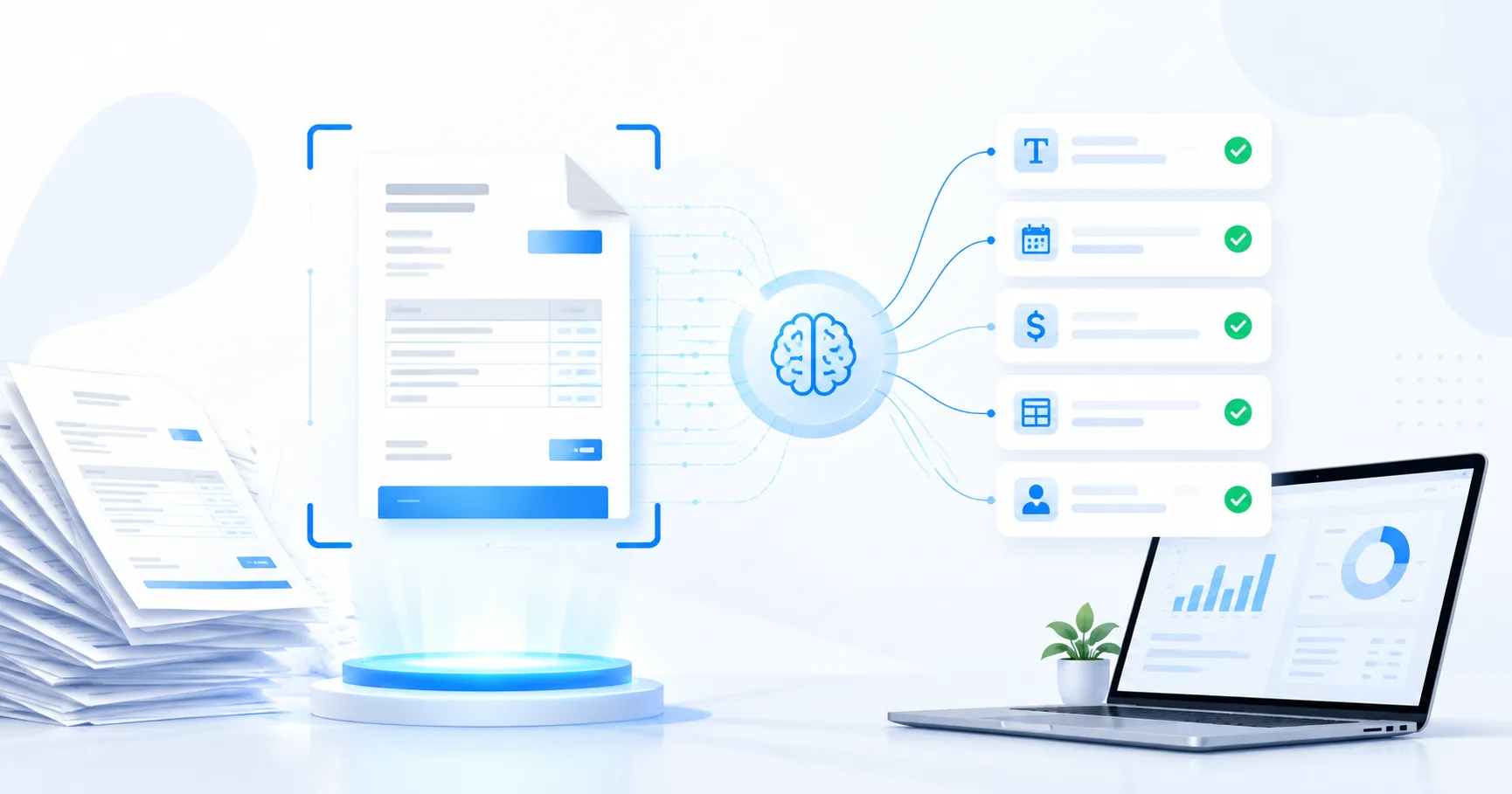
Put simply: AI invoice processing uses machine learning, computer vision, natural language processing, and large language models to capture, extract, validate, and route invoice data on its own, from the moment a document lands to the moment it's posted and paid. The real difference from older "smart capture" tools comes down to one thing. No fixed template per vendor. The system learns the shape of a document well enough to handle formats it has never come across.
That puts it somewhere between two older disciplines and one much newer. OCR sits on one end, robotic process automation next to it, and out past both sits agentic AI, where the software itself decides what happens next: query the ERP, run the match, escalate the exception, nobody triggering each step by hand.
How AI Invoice Processing Works From Capture to Payment
Invoices show up from everywhere — a shared AP inbox, a vendor portal upload, a scan somebody did in the mailroom, a PDF sitting in a downloads folder nobody's touched since March. Capture software pulls it all together into one consistent digital record no matter where it started.
OCR and document-understanding models then read the file and work out which parts correspond to invoice number, date, line items, totals. This is where it genuinely departs from old-school OCR. Instead of spitting out flat text, it builds a structural map of the page. Doesn't sound like much. But it matters the moment a vendor decides, who knows why, to put the tax total above the subtotal instead of below it.
Extraction pulls specific values off that map — vendor name, PO reference, quantities, unit prices, tax codes — and turns them into records the accounting system can use. Vendor validation checks the extracted vendor against master data to confirm it's an approved, active entity. This is also how a fraudulent invoice with a name one letter off from a real supplier gets caught before it ever gets near a payment run.
Purchase order matching lines up invoice against PO. Three-way matching goes a step further, pulling in the goods receipt note too, so what was ordered, delivered, and billed all line up before any money moves. This is generally where AI agents for intelligent document processing earn their keep. Three-way matching means cross-checking three documents that almost never share a format.
Approval routing kicks in next, sending invoices to the right approver based on amount and cost centre, escalating on its own if nobody acts fast enough. ERP integration posts validated invoices straight into SAP, NetSuite, whatever's running, and the re-keying that used to eat entire afternoons just goes away. Payment gets scheduled against negotiated terms. Every extraction, match, and approval decision gets logged along the way — useful for a regulator, more useful still the next time a vendor disputes what it was paid.
Traditional OCR vs. AI-Powered Invoice Processing: Key Differences
OCR has been part of AP for two decades plus, usually built as template-matching software tuned to read fixed-position fields on a familiar vendor's layout. Fine, as long as nothing changes. A new vendor sends something the template wasn't built for, and the whole thing grinds to a halt.
Dimension | Traditional OCR | AI-Powered Processing |
|---|---|---|
Format handling | Needs a template per vendor layout | Generalizes across layouts it's never seen |
Extraction accuracy | ~75–85% on unfamiliar formats | Up to 99% on trained document types |
Exception handling | Routes almost everything mismatched to a human | Resolves routine mismatches on its own |
Learning behavior | Static once set up | Improves as corrected exceptions feed back in |
Context understanding | Reads characters | Reads meaning — line items, tax codes, intent |
Fraud detection | Usually a separate bolted-on tool | Built into extraction and validation |
Honestly, the accuracy number gets more attention than it deserves. The exception-handling gap matters more. An OCR setup running at 85% straight extraction still kicks fifteen out of every hundred invoices to a human queue, and those fifteen are usually the messiest, highest-dollar ones in the batch. Right where a mistake costs something.
Key Components and Technologies Behind AI Invoice Processing
No single model handles this start to finish. It's a stack, a handful of distinct technologies each doing its own piece, and that's a big reason rollout takes longer than buying one piece of software would suggest.
OCR is still the base layer, turning pixels into text a machine can read. Layout analysis sits next to it, spotting tables, headers, signature blocks rather than treating the page as one flat wall of characters. Computer vision handles classification and quality checks before extraction even starts. It tells an invoice apart from a packing slip. It flags a scan too blurry to trust.
Large language models step in once there's raw text to work with. They interpret line items, sort out ambiguous labels (is "amount due" the same as "balance forward"? not always), and normalize vendor names written five different ways across five submissions from the same company. ML models trained on a company's own AP history handle the classification work, routing to the right cost centre, figuring out which exceptions actually deserve a person's time. NLP pulls entities like PO numbers and payment terms out of free text, where you can't count on much structure.
Retrieval-augmented generation adds something plain OCR never had: a way to check an extracted invoice against a company's own vendor master data, contract terms, and payment history before deciding if anything actually matches. AI agents orchestrate all of it. They call the extraction model, query the ERP, run the match, decide whether to route for approval or flag an exception. RPA handles the boring, fully deterministic stuff at the edges: logging into a vendor portal, pulling a remittance file.
Most companies building this from scratch end up working with an AI agent development company just to figure out how the pieces talk to one another. Bolting them together after the fact tends to end badly. Pretrained document-understanding models, available through places like Hugging Face, have made this a lot more accessible than it was two years back too. The barrier to entry for mid-market teams has dropped noticeably.
Benefits of AI Invoice Processing for Accounts Payable Teams
Speed is the obvious headline. Approval cycles that used to take eleven days routinely drop to under one, once routing runs on rules instead of forwarded emails. There's a second benefit that almost never shows up in a vendor's pitch deck, though, and it has nothing to do with accuracy.
When approval drops from eleven days to under one, early-payment discounts that used to be out of reach suddenly become usable. Simply because the old approval cycle burned through the entire discount window before anyone could act on it. A 2/10 net 30 term — 2% off if paid within ten days — is basically unreachable for a company whose approvals take eleven days, no matter how good the intentions are. Faster processing doesn't just cut labor cost; it opens up a whole category of savings that's really about timing, not efficiency. A lot of the ROI models finance teams build ignore that line item completely. They fixate on headcount and skip the discount-capture math, which quietly understates the real return.
Beyond that, extraction accuracy on trained document types climbs to around 99% in mature deployments. Processing-cost reductions land anywhere from 30% in a narrow single-invoice-type pilot to 90% once a rollout spans PO and non-PO invoices across multiple ERPs. AP productivity gains of roughly six times, measured in invoices per employee before and after, get cited often enough to be worth taking seriously. Duplicate payments trend toward zero because fuzzy matching catches near-duplicates that differ by nothing more than a formatting quirk. And every step gets logged automatically, so compliance reporting turns from a quarterly scramble into a standing report someone can just pull up.
Real-World Applications of AI in Accounts Payable
Accounts payable automation is the obvious entry point. Run the full capture-to-payment cycle, cut manual touchpoints per invoice from five or six down to one or two, save the rest for exceptions that actually need a person.
Non-PO invoices need somewhere to go too — utility bills, subscription renewals, one-off service invoices that never had a purchase order to begin with. Models classify these against historical spend patterns and route them to the right approval tier. No more dumping every non-PO item into manual review out of habit.
Three-way matching, already mentioned above, deserves its own callout. Automated reconciliation across PO, invoice, and goods receipt catches price or quantity mismatches before payment goes out. Not six months later during an audit, when the money's already gone.
Fraud detection leans on pattern recognition. A vendor's bank details changing right before a new submission is a fairly well-known signature of business email compromise. Duplicate detection works alongside it, fuzzy-matching invoice number, amount, and vendor to catch near-duplicates.
Vendor verification happens even earlier, checking new submissions against tax registration databases and internal watchlists before onboarding starts. That closes off exposure to shell-vendor schemes. Classification sorts documents by type, department, or spend category on intake, feeding straight into reporting so nobody has to remember to tag it by hand.
Tax and GST/VAT validation checks IDs, rates, and jurisdictional rules against current regulation, an area where manual review slips fairly often since rates change more than people expect. Payment scheduling optimizes timing against discount terms and cash position, not just defaulting everything to net-30 because that's what's always been done.
Financial reporting gets real-time visibility into liabilities and accrued expenses once invoices post continuously rather than arriving in one lump at month-end. Spend analytics rolls up vendor spend and contract compliance into something procurement can actually use heading into renewal, often paired with AI agents for analytics to surface patterns across thousands of invoices nobody would catch reviewing them one by one. Compliance monitoring closes the loop, checking processed invoices continuously against policy and regulation, and AI agents for compliance monitoring are handling more and more of that unaided now, rather than someone piecing the audit log together after the fact.
Industry-Specific Use Cases for AI Invoice Processing
Manufacturing firms with high-volume, multi-vendor supply chains tend to see ROI fastest. Three-way matching is already core to how they operate, so AI mostly just removes the manual reconciliation grind around it. Retail and consumer goods companies face a different problem: seasonal invoice spikes, thousands of small suppliers, format generalization mattering more than raw speed. Healthcare piles stricter compliance on top of all this — invoices often touch regulated procurement, so a complete audit trail matters just as much as extraction accuracy. Professional services and tech firms deal mostly in non-PO invoices, subscriptions, contractor bills, recurring charges, which shifts the priority toward smart classification over PO matching. Logistics and distribution companies often juggle multiple currencies and tax jurisdictions at once. Multi-currency normalization and GST/VAT handling end up deciding which platform actually fits.
Challenges and Limitations of AI Invoice Processing
Poor-quality scanned invoices are still a real problem, and better models don't fix bad source documents. A faxed or photocopied invoice with faded text or a skewed scan hurts extraction no matter how good the underlying model is. Any company getting a meaningful share of invoices that way should plan for a manual review layer rather than assume full automation out of the gate.
No single template will ever cover hundreds of vendors' worth of formats. That's exactly the problem AI-based understanding handles better than legacy OCR, though even these models need periodic retraining as new formats show up. Nothing stays static for long.
Legacy ERP integration is a real technical wall, not just an annoyance during setup. Older on-prem systems sometimes have no REST API at all, forcing integration through file-based batch transfers that quietly bring back the exact latency AI was supposed to remove.
Data privacy adds another wrinkle, especially for companies handling banking details across several jurisdictions at once. Data residency rules can dictate where extraction models are allowed to run and where invoice data physically lives. That affects platform choice more than most procurement teams expect going in.
Human-in-the-loop review stays necessary even in mature deployments. It's not a training-wheels phase. It's a permanent control point for anything above a defined risk threshold. AI hallucination, where a model produces a plausible-but-wrong field value instead of admitting it isn't sure, is a documented failure mode in LLM-based extraction. That's exactly why confidence scoring matters — a system that reports how sure it is about each field lets a reviewer focus on the cases actually worth suspicion instead of re-checking everything equally.
Best Practices for Implementing AI Invoice Processing
Measure the baseline honestly before sitting through a single vendor demo. Processing time, cost per invoice, exception rate, duplicate payment rate. All of it needs a real pre-deployment number, not a guess, or "improvement" ends up measured against something that was never accurate to begin with.
Standardize formats where it's realistic to. Getting top vendors to submit through a structured portal instead of free-form email takes real pressure off the extraction models downstream. This only goes so far, since large vendors rarely rebuild their own invoicing system for one customer, but even getting the top twenty suppliers by volume to shift meaningfully lowers the exception rate.
Weigh accuracy claims against real performance on the company's own historical invoices, not the vendor's benchmark numbers. A platform tuned on retail receipts might do noticeably worse on manufacturing POs with dense line-item tables. Keep human review tied to confidence scores rather than blanket sampling, so reviewer time actually goes toward invoices worth a second look. Treat retraining as ongoing work, not a one-time setup task. Exception patterns after go-live are the best training signal you'll get, and they go stale fast if nobody feeds them back in.
Implementation Strategy for Rolling Out AI Invoice Processing
A structured rollout heads off the two most common ways these projects fail. Scope creep during the pilot. Integration breaking once someone tries to scale it.
Assessment comes first, documenting the current AP workflow in real detail: invoice volume by channel, current exception rate, the existing system landscape, before picking a vendor. This step decides whether the org actually needs a full agentic platform or something narrower built on OCR plus RPA.
Platform selection weighs accuracy claims against performance on real historical invoices. Model training, whether fine-tuning a vendor's base model or configuring an off-the-shelf system with company-specific rules, usually needs several hundred labeled invoices before it's reliable on formats it hasn't seen.
Integration with ERP and accounting software tends to eat more implementation time than accuracy tuning does, especially where a legacy ERP version lacks decent API support. Most platforms plug into whatever finance already has running. SAP and Oracle integrations post straight into the general ledger, preserving cost centre and GL mapping without anyone re-keying data. Dynamics 365 and NetSuite follow a similar pattern through native connectors rather than custom middleware built from scratch. Smaller and mid-market shops using QuickBooks, Xero, or Sage tend to trade configurability for simplicity. And even with a native connector, someone still has to confirm a "cost centre" field in the AI platform actually lines up with the right dimension in the chart of accounts. Skip that mapping step, and there's one of the more common ways pilots quietly go sideways.
A pilot scoped tightly to one business unit or one invoice type proves the workflow end to end before an enterprise rollout expands it further. Continuous monitoring closes the loop. Exception patterns after go-live feed back into retraining, and the KPI set defined during assessment — processing time, cost per invoice, straight-through processing rate, first-pass accuracy, duplicate payment rate, days payable outstanding — turns into an ongoing measurement framework instead of a report nobody reads twice.
Future Trends and Emerging Developments in AI Invoice Processing
What's coming next looks like the rise of agentic AI, not just more automation. Systems are moving away from a pipeline that only extracts and routes, toward agents that make bounded judgment calls: deciding, within set risk limits, whether an exception needs a human or can get resolved against precedent from similar past invoices. That direction already shows up in how vendors position newer releases. Both Microsoft and Google have pushed toward multi-step, tool-using agents as the default architecture for document workflows, not single-pass extraction.
Predictive cash flow modeling is another thread worth watching. Processed invoice data doesn't just pay bills anymore; it forecasts working capital needs weeks out, since a continuous stream of posted invoices gives finance a much richer signal than a monthly batch ever could. Cross-document reasoning is getting better too — models increasingly check an invoice against a contract's actual negotiated rate card on their own, catching pricing drift a human reviewer might miss without pulling up the original agreement.
Fraud detection is getting more adversarial-aware as well. It leans on behavioral signals now: timing patterns, unusual submission channels, subtle formatting shifts, rather than static rule sets, especially since fraud attempts themselves are starting to use generative tools to mimic legitimate vendor documents convincingly.
Why Businesses Should Care About AI Invoice Processing
The real case for AI invoice processing isn't about invoices. Not really. It's about what finance leadership can actually see and act on in near real time, versus once a month after the books close. Continuous posting instead of batch posting gives a genuinely current picture of liabilities and cash position, and that feeds straight into borrowing decisions, vendor negotiations, forecasting accuracy — the stuff that actually moves a business. The competitive gap keeps widening, too. A company capturing early-payment discounts and running lean AP headcount has real cost advantages over one still routing invoices through shared inboxes. That gap compounds every month it's left alone.
Vegavid works with enterprises to design and deploy custom AI-powered invoice processing systems, rather than reselling a fixed off-the-shelf package, bringing together OCR, large language models, AI agents, and RPA into a pipeline shaped around whatever ERP mix and invoice volume the organization already has. That work runs through AI agent consulting services for the architecture itself, model training on a company's own historical invoice data, and integration with systems including SAP, Oracle, Dynamics 365, NetSuite, and lighter-footprint platforms like QuickBooks and Xero. For finance functions looking past invoices alone, Vegavid's work on AI agents for finance goes quite a bit further.
Conclusion
AI invoice processing has moved past the pilot-project novelty stage at most large enterprises. It's now an operational lever touching approval speed, fraud exposure, audit readiness, and working capital in ways easy to underestimate from the outside looking in. The technology itself, a layered stack of OCR, computer vision, language models, and orchestrating agents, has matured to the point where extraction accuracy is rarely the actual bottleneck anymore. What separates a deployment that works from one that stalls out is almost always the unglamorous part: honest baseline measurement, disciplined ERP field mapping, a pilot scoped narrowly enough to actually finish, and a retraining loop that treats every corrected exception as useful data instead of a one-off fix and forget.
Automate Invoice Processing with AI-Powered Intelligence
FAQs
AI invoice processing uses technologies such as OCR, machine learning, natural language processing (NLP), computer vision, and large language models (LLMs) to automatically extract, validate, route, and process invoice data with minimal human intervention.
Traditional OCR extracts text from documents using predefined templates, while AI invoice processing understands document layouts, validates extracted data, performs intelligent matching, detects fraud, and continuously improves through machine learning.
Modern AI invoice processing platforms integrate with leading ERP and accounting systems, including SAP, Oracle ERP, Microsoft Dynamics 365, NetSuite, QuickBooks, Xero, and Sage, enabling seamless invoice posting and financial automation.
AI invoice processing reduces manual data entry, speeds up invoice approvals, improves extraction accuracy, prevents duplicate payments, detects fraud, lowers processing costs, enhances compliance, and provides real-time financial visibility.
Vegavid develops custom AI invoice processing solutions tailored to your business by combining OCR, LLMs, AI agents, and RPA with seamless ERP integrations. Our solutions help enterprises automate accounts payable, improve accuracy, strengthen compliance, and scale financial operations efficiently.
Tags

Yash Singh is the Chief Marketing Officer at Vegavid Technology, a leading AI-driven technology company specializing in AI agents, Generative AI, Blockchain, and intelligent automation solutions. With over a decade of experience in digital transformation and emerging technologies, Yash has played a key role in helping businesses adopt advanced AI solutions that enhance operational efficiency, automate workflows, and deliver personalized customer experiences across industries including fintech, healthcare, gaming, ecommerce, and enterprise technology. An alumnus of Indian Institute of Technology Bombay, Yash combines strong technical expertise with strategic marketing leadership to drive innovation in AI-powered applications, autonomous AI agents, Retrieval-Augmented Generation (RAG), Natural Language Processing (NLP), Large Language Models (LLMs), machine learning systems, conversational AI, and enterprise automation platforms. His expertise spans AI model integration, intelligent workflow automation, prompt engineering, smart data processing, and scalable AI infrastructure development, enabling organizations to accelerate digital transformation and business growth. Passionate about the future of intelligent systems, Yash actively shares insights on AI agents, Generative AI, LLM-powered applications, blockchain ecosystems, and next-generation digital strategies. He is committed to helping businesses embrace AI-first transformation while guiding teams to build impactful, industry-specific solutions that shape the future of innovation and intelligent technology.






Leave a Reply