
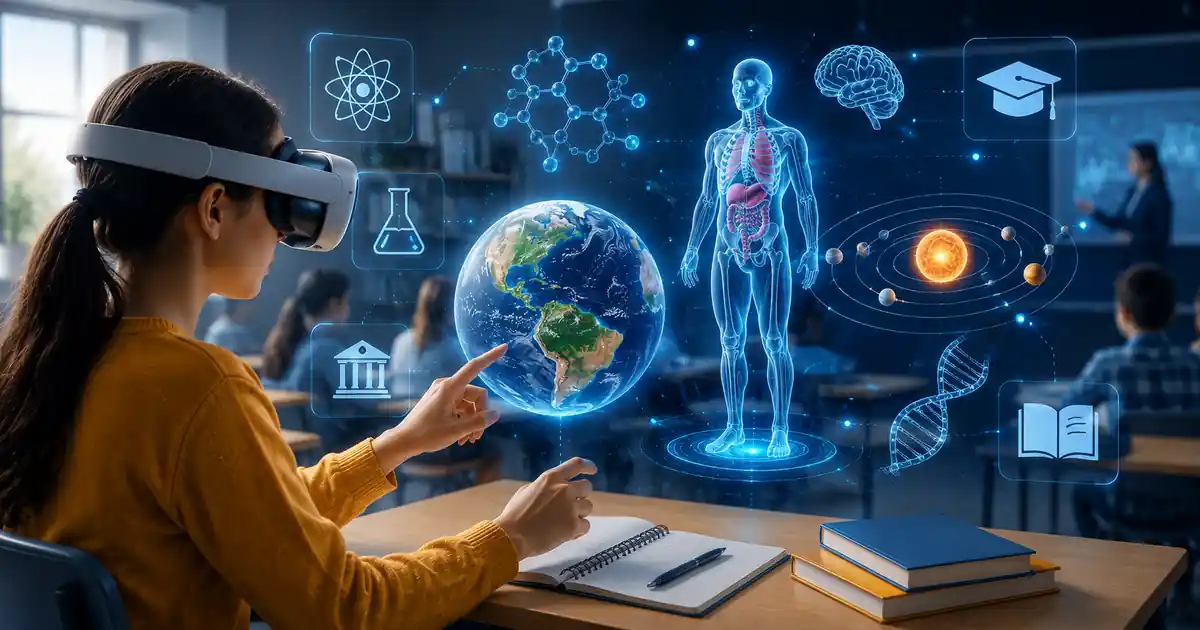
Benefits of Augmented Reality in Education for Students and Teachers
Technology has fundamentally transformed how students learn and how educators teach. Among the most promising innovations is Augmented Reality (AR), which blends digital content with the real world to create immersive, interactive learning experiences. Unlike traditional teaching methods that rely heavily on textbooks and lectures, AR enables students to visualize complex concepts, interact with 3D models, and engage with educational content in real time.
From elementary classrooms to universities and corporate training programs, augmented reality in education is reshaping how learning happens by making it more engaging, personalized, and practical.
In this article, we'll explore the benefits of augmented reality in education, practical use cases, implementation challenges, future trends, and why educational institutions are increasingly investing in AR-powered learning through platforms like metaverse education platform development.
What is Augmented Reality in Education?
Augmented reality in education refers to overlaying digital elements onto the physical classroom so students can see and interact with information layered directly on top of real objects. Augmented Reality (AR) is a technology that overlays digital elements—such as 3D models, animations, images, videos, and interactive information—onto the physical environment using smartphones, tablets, AR glasses, or specialized devices.
In education, AR enhances traditional learning by allowing students to:
Visualize abstract concepts
Explore interactive 3D objects
Perform virtual experiments
Learn through gamification
Experience real-world simulations
Collaborate in immersive environments
Instead of simply reading about a concept, students can experience it firsthand, much like the shift already seen with metaverse virtual world platforms reshaping how people interact with digital spaces.
How Augmented Reality Works in Classrooms
An AR classroom setup typically combines everyday devices with specialized software that recognizes real-world markers and layers digital content on top of them. A typical AR learning system includes:
Mobile apps or tablets
AR-enabled educational software
Cameras and sensors
Image recognition technology
Cloud-based learning content
Interactive 3D models
AI-powered personalization (in advanced platforms)
When a student points a device at a textbook, classroom object, or marker, digital content appears on the screen, creating an engaging mixed-reality learning experience powered by artificial intelligence and computer vision.
Benefits of Augmented Reality for Students
1. Improved Learning Engagement
Augmented reality keeps students actively involved in lessons instead of passively listening, which is one of the biggest advantages of AR is increased student engagement.
Interactive lessons encourage students to actively participate rather than passively consume information.
Students are more motivated when learning feels like exploration instead of memorization.
Examples
Interactive science lessons
3D historical landmarks
Virtual field trips
Gamified quizzes
Animated storytelling
2. Better Understanding of Complex Concepts
AR turns hard-to-picture topics into interactive 3D experiences that students can view from any angle, which is especially useful for subjects that involve abstract ideas that are difficult to visualize.
AR transforms these concepts into interactive 3D experiences.
Examples include:
Human anatomy
Solar system
Chemical molecules
Mathematical geometry
Mechanical engineering
Physics simulations
Students can rotate, zoom, and interact with objects from every angle.
3. Higher Knowledge Retention
Students remember lessons longer when they learn by doing rather than by reading alone, and research consistently shows that active learning improves memory retention.
AR supports experiential learning by allowing students to:
Learn by doing
Explore visually
Interact physically
Solve real-world problems
This combination improves long-term understanding.
4. Personalized Learning Experiences
AR platforms can adjust lessons to match each learner's pace and ability, since every student learns differently.
AR platforms can adapt lessons based on:
Learning pace
Skill level
Assessment performance
Subject difficulty
Individual preferences
This makes learning more inclusive and effective, an approach also explored in benefits use cases of ai in education.
5. Increased Student Motivation
Immersive AR experiences turn routine lessons into something students look forward to, since students enjoy immersive experiences.
Interactive AR lessons reduce classroom boredom and increase curiosity through:
Virtual rewards
Interactive challenges
Educational games
Achievement tracking
Visual storytelling
Motivated students tend to perform better academically.
6. Safe Learning Environment
AR lets students practice risky procedures virtually before ever facing real-world consequences, since certain experiments or practical exercises involve safety risks.
AR allows students to practice safely without physical hazards.
Examples include:
Chemistry experiments
Medical procedures
Industrial training
Engineering simulations
Laboratory exercises
Mistakes become valuable learning opportunities without real-world consequences.
7. Better Collaboration
Many AR applications support collaborative learning, letting students work together on shared virtual tasks.
Students can work together on:
Interactive projects
Problem-solving exercises
Virtual group activities
STEM challenges
Team presentations
This develops communication and teamwork skills.
8. Accessibility and Inclusive Education
AR supports diverse learning needs, making lessons more accessible to students of varying abilities.
AR supports diverse learning needs through:
Visual learning aids
Audio guidance
Interactive instructions
Multilingual content
Adaptive learning paths
Students with different abilities can participate more effectively.
Benefits of Augmented Reality for Teachers
Enhanced Lesson Delivery
Teachers can use AR to turn abstract explanations into clear visual demonstrations rather than static images.
Lessons become more interactive and easier to understand.
Simplified Classroom Management
AR platforms often reduce the administrative burden on teachers by automating everyday tracking tasks.
AR platforms often include:
Student progress tracking
Digital assignments
Real-time assessments
Interactive attendance
Classroom analytics
This reduces administrative workload.
Improved Student Participation
Interactive AR lessons encourage students to ask questions, participate in discussions, and explore topics independently.
Higher participation often leads to improved academic outcomes.
Better Assessment Methods
AR gives teachers richer, real-time ways to evaluate how well students are actually learning.
Teachers can evaluate learning through:
Interactive quizzes
Virtual tasks
Practical simulations
Real-time performance analytics
Instant feedback
This provides deeper insights into student progress.
Professional Development
Teachers can also use AR for ongoing training and skill-building outside the classroom.
Teachers can also use AR for:
Classroom training
Instructional design
Skill enhancement
Virtual workshops
Teaching simulations
Continuous learning helps educators stay current with modern teaching methods.
Real-World Use Cases of AR in Education
Science Education
AR lets students explore complex scientific systems visually without needing costly physical lab setups.
Students explore:
Human anatomy
DNA structures
Ecosystems
Physics experiments
Chemical reactions
without requiring expensive laboratory equipment.
Medical Education
Medical students use AR to rehearse procedures safely before working with real patients, an approach similarly discussed in augmented reality virtual reality use cases in healthcare.
Medical students use AR to:
Practice surgeries
Study anatomy
Simulate emergency procedures
Learn diagnostic techniques
before interacting with real patients.
Engineering Education
Engineering students can examine complex components in interactive 3D space instead of relying only on flat diagrams.
Engineering students can examine:
Mechanical parts
Electrical systems
Building structures
CAD models
Manufacturing processes
using interactive 3D visualizations.
History and Geography
AR enables students to virtually visit places and eras they could otherwise only read about.
AR enables students to:
Visit historical monuments virtually
Explore ancient civilizations
Study geographical formations
Experience cultural heritage
without leaving the classroom.
Language Learning
AR helps students build vocabulary and pronunciation through real-world object recognition rather than rote memorization.
Students improve language skills through:
Interactive vocabulary
Object recognition
Real-world translation
Pronunciation practice
Immersive conversations
Mathematics
AR simplifies difficult topics like geometry and statistics by letting students manipulate visual models directly.
AR simplifies difficult topics like:
Geometry
Trigonometry
Graph visualization
Statistics
Algebraic models
through interactive visualization.
Technologies Powering AR in Education
AR in education relies on a combination of advanced technologies working together behind the scenes. Modern AR education platforms often combine several advanced technologies:
Artificial Intelligence (AI)
Computer Vision
3D Modeling
Internet of Things (IoT)
Real-Time Analytics
These technologies make AR experiences more intelligent, adaptive, and interactive, similar to how edtech software development combines multiple technology layers into one platform.
Challenges of Implementing AR in Education
Despite its benefits, institutions may face several challenges, ranging from cost to teacher readiness.
High Initial Investment
Educational institutions need devices, software licenses, and infrastructure to deploy AR effectively.
Technical Infrastructure
Reliable internet connectivity and compatible hardware are essential for smooth AR experiences.
Teacher Training
Educators require training to integrate AR into lesson plans and classroom activities successfully.
Content Development
Creating high-quality AR educational content can require specialized expertise and time.
Device Compatibility
Students may use different devices with varying capabilities, creating consistency challenges.
Data Privacy
Educational platforms must protect student data and comply with privacy regulations.
Classroom Integration
AR should complement—not replace—effective teaching methods and curriculum goals.
Best Practices for Implementing AR in Education
Successful AR adoption in schools depends on careful planning rather than jumping straight into full-scale deployment. Educational institutions can maximize success by following these best practices:
Define clear learning objectives before adopting AR.
Start with pilot programs to evaluate effectiveness.
Provide teacher training and ongoing technical support.
Choose curriculum-aligned AR content.
Ensure accessibility for all learners.
Measure student engagement and learning outcomes.
Regularly update AR applications and educational materials.
Maintain strong cybersecurity and data privacy practices.
Encourage collaboration between educators, IT teams, and content developers.
Gather feedback from students to improve future implementations.
Future Trends of Augmented Reality in Education
AR is expected to become an integral part of modern education as hardware becomes more affordable and software grows more intelligent.
Emerging trends include:
AI-powered adaptive learning experiences
AR smart glasses replacing handheld devices
Mixed Reality (MR) classrooms
Digital twin technology for educational simulations
Haptic feedback for hands-on virtual learning
Cloud-based collaborative AR environments
Spatial computing in schools and universities
Real-time language translation in AR lessons
Immersive STEM education
Integration with learning management systems (LMS)
These innovations will make education more personalized, engaging, and accessible across all levels of learning.
Why Schools and Universities Are Investing in AR
Educational institutions are adopting AR because it delivers measurable value that extends well beyond novelty.
Educational institutions are adopting AR because it delivers measurable value:
Improves student engagement and participation
Enhances understanding of difficult concepts
Supports personalized learning paths
Increases knowledge retention
Enables safe practical training
Encourages collaboration and creativity
Bridges the gap between theory and real-world application
Provides innovative teaching tools
Prepares students for technology-driven careers
Supports hybrid and remote learning models
As digital transformation accelerates, AR is becoming a strategic investment for future-ready education, much like institutions turning to benefits blockchain education sector solutions to modernize record-keeping and credentialing.
Conclusion
Augmented Reality is redefining education by transforming passive learning into immersive, interactive experiences. For students, it makes complex subjects easier to understand, boosts engagement, improves retention, and supports personalized learning. For teachers, AR enriches lesson delivery, streamlines assessments, and creates more dynamic classrooms.
While implementation requires thoughtful planning, infrastructure, and educator training, the long-term benefits outweigh the challenges. As AI, spatial computing, and wearable technologies continue to evolve, augmented reality will play an increasingly important role in preparing learners with the skills and experiences needed for the future.
Organizations specializing in educational technology and custom AR development can help schools, universities, and training providers build scalable, curriculum-aligned AR solutions that enhance teaching and learning outcomes.
Frequently Asked Questions
AR helps teachers deliver interactive lessons, simplify difficult topics, assess student performance in real time, improve classroom participation, and reduce administrative tasks with digital tools.

Yash Singh is the Chief Marketing Officer at Vegavid Technology, a leading AI-driven technology company specializing in AI agents, Generative AI, Blockchain, and intelligent automation solutions. With over a decade of experience in digital transformation and emerging technologies, Yash has played a key role in helping businesses adopt advanced AI solutions that enhance operational efficiency, automate workflows, and deliver personalized customer experiences across industries including fintech, healthcare, gaming, ecommerce, and enterprise technology. An alumnus of Indian Institute of Technology Bombay, Yash combines strong technical expertise with strategic marketing leadership to drive innovation in AI-powered applications, autonomous AI agents, Retrieval-Augmented Generation (RAG), Natural Language Processing (NLP), Large Language Models (LLMs), machine learning systems, conversational AI, and enterprise automation platforms. His expertise spans AI model integration, intelligent workflow automation, prompt engineering, smart data processing, and scalable AI infrastructure development, enabling organizations to accelerate digital transformation and business growth. Passionate about the future of intelligent systems, Yash actively shares insights on AI agents, Generative AI, LLM-powered applications, blockchain ecosystems, and next-generation digital strategies. He is committed to helping businesses embrace AI-first transformation while guiding teams to build impactful, industry-specific solutions that shape the future of innovation and intelligent technology.






Leave a Reply