
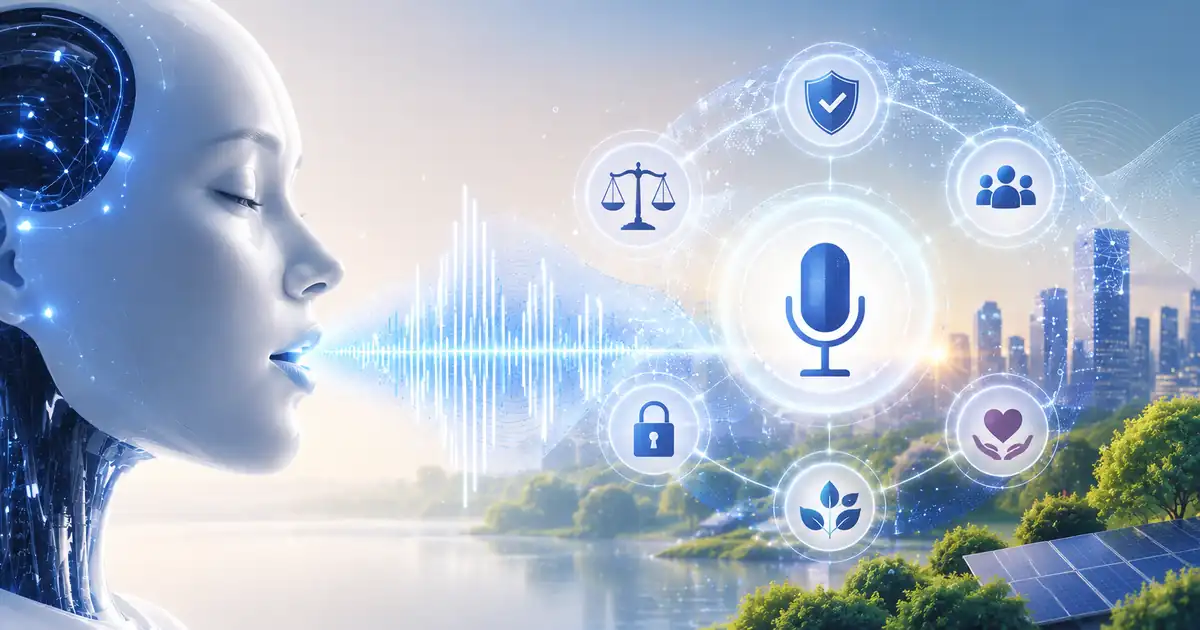
The Future of Ethical AI Voice: Trends and Innovations
We have officially crossed the uncanny valley of audio. As of 2026, artificial intelligence can clone a human voice with zero-shot learning from a mere three-second audio sample, capturing not only tone and pitch but also breathing patterns, emotional expression, and subtle conversational nuances. While this breakthrough has transformed customer service, accessibility, content creation, and enterprise automation, it has also fueled demand for AI voice agent development services that prioritize security, transparency, and ethical AI practices. Organizations are increasingly investing in intelligent AI voice agents that can automate conversations while safeguarding user privacy and maintaining regulatory compliance. This growing discipline of Responsible AI in voice systems now sits alongsideEthical AI Voice as the two pillars enterprises are expected to build on.
The rapid proliferation of synthetic media has forced a global reckoning. When a voice can be perfectly replicated, how do we verify authenticity? When a person's vocal identity can be endlessly synthesized, how do they retain ownership and control over their digital voice? The answer lies not in slowing innovation but in building the Future of Ethical AI Voice—where AI voice agents are developed with consent-based data, transparent governance, and robust safeguards against misuse. This shift also connects to a broader question that enterprises are asking about every AI system they deploy: what does ethical artificial intelligence actually require in practice, beyond a marketing slogan?
What is the Future of Ethical AI Voice?
The future of ethical AI voice refers to the responsible development, deployment, and management of synthetic audio technologies. It involves using strict consent mechanisms, cryptographic audio watermarking, and transparent commercial compensation models to ensure that AI-generated voices do not infringe on personal identity rights, spread misinformation, or displace human creators without fair remuneration.
In practice, ethical AI voice platforms require explicit "opt-in" verification from the original speaker before a voice model can be trained. Furthermore, the output generated by these models contains embedded, imperceptible metadata that universally identifies the audio as machine-generated, allowing platforms and users to verify its synthetic origin instantly. This is closely tied to the underlying AI speech models that power modern voice cloning, since the architecture of the model itself determines how easily consent and provenance signals can be baked into the output.
Consent First: Ethical AI voice requires explicit, revocable cryptographic consent from the voice owner.
Traceability: Every synthetic audio file must be traceable to its generation source via imperceptible watermarking.
Fair Compensation: Smart contracts and decentralized ledgers are increasingly used to pay voice owners royalties every time their AI clone is used.
Regulatory Compliance: Adherence to the 2026 iterations of the EU AI Act and global deepfake prevention mandates is mandatory, alongside emerging frameworks discussed in broader analyses of AI regulation in Europe.
Why It Matters: The Strategic Importance of Voice Ethics
The strategic importance of ethical AI voice cannot be overstated. As synthetic audio permeates every digital touchpoint, the risks associated with unregulated voice cloning pose severe threats to both individuals and global enterprise systems. This is precisely whereResponsible AI in voice systems earns its keep. it is the operational discipline that turns these strategic concerns into enforceable engineering and governance practices.
Protecting Biometric Identity
A person's voice is a distinct biometric identifier, akin to a fingerprint or a retinal scan. Historically, voice biometrics have been used to secure bank accounts, authorize transactions, and verify identity over the phone. Unregulated AI voice cloning effectively hands bad actors a master key to these biometric locks. Establishing ethical boundaries and technical safeguards prevents malicious entities from bypassing security protocols using synthetic deepfakes. This is precisely why enterprise security teams increasingly study AI cybersecurity threat detection and defense alongside their voice-cloning safeguards, since the two attack surfaces increasingly overlap.
Combating Misinformation and Deepfakes
In the political and social arenas, the weaponization of cloned voices has caused significant disruption. Audio deepfakes of political leaders, CEOs, and public figures can manipulate stock markets, swing elections, and destroy reputations in minutes. Ethical AI voice frameworks—specifically those mandating watermarking and source verification—provide the necessary friction to identify and neutralize synthetic misinformation before it goes viral. The same generative techniques that make this possible are explored in depth in resources covering how to tell if a voice is AI-generated, a skill that is quickly becoming essential media literacy.
Empowering the Creator Economy
For voice actors, narrators, and entertainers, AI presents an existential threat if left unregulated. However, the ethical application of AI voice transforms this challenge into a valuable opportunity. By establishing clear ownership rights over vocal data, creators can securely license their AI voice models for audiobooks, dubbing, advertising, gaming, and commercial applications. They can expand their reach globally and generate recurring royalty income while maintaining full control over how their voice is used.
A critical part of this process is to train an AI voice model responsibly. Ethical AI voice models are trained using explicitly consented, high-quality voice recordings that are cleaned, labeled, and processed to capture pronunciation, tone, emotion, and speaking style.
To understand how these broad AI capabilities fit into the wider technological ecosystem, it is helpful to review the various Types Of Artificial Intelligence that drive these innovations, moving from narrow AI toward more generalized, agentic systems.
How It Works: The Technical Framework of Ethical Voice AI
Creating an ethical AI voice system requires a robust technical architecture that spans from the initial data ingestion to the final audio output. Here is the step-by-step process of how enterprise-grade ethical AI voice operates in 2026.
Phase 1: Cryptographic Identity Verification
Before a voice can be cloned, the platform must verify the identity of the speaker. This goes beyond a simple checkbox. Users must read a dynamically generated, randomized script on camera to prove liveness. This biometric capture is then cryptographically hashed and linked to the user's digital identity. This liveness step depends heavily on the reliability of the underlying automatic speech recognition systems used to confirm that the spoken script matches what was requested.
Phase 2: Secure Consent Frameworks
Consent is managed dynamically. Instead of a one-time perpetual license, ethical platforms use smart contracts to manage permissions. The voice owner can specify exactly how their voice can be used (e.g., "Approved for educational content, denied for political or adult content"). If the terms are violated, the user can revoke the license, cryptographically invalidating the voice model across the network.
Phase 3: Ethical AI Model Training
Once the voice data has been verified and prepared, the AI voice model is trained using advanced speech AI architectures such as transformer-based models, neural vocoders, and diffusion models. Throughout training, responsible AI practices ensure the model learns only from authorized, consent-based datasets while protecting sensitive voice information. Teams building these systems from the ground up often start with the fundamentals outlined in guides on how to build a speech recognition model from scratch, since the same neural pipelines underpin both recognition and generation. Deeper technical grounding, including the role of deep learning in speech recognition, also informs how these voice-generation models are architected and validated before release.
Phase 4: Imperceptible Audio Watermarking
When the AI generates speech, it simultaneously embeds an imperceptible watermark into the audio frequency. This is not metadata that can be stripped out by converting an MP3 to a WAV file; it is woven into the phase and frequency of the audio itself. Even if the audio is compressed, played over a loudspeaker, and recorded on a smartphone, the watermark persists. AI detectors can read this watermark to reveal exactly which model generated the audio and when.
Phase 5: Continuous AI Monitoring and Audit Logging
Once an AI voice agent is deployed, every interaction, model decision, and system event is securely logged to create a comprehensive audit trail. These logs capture key information such as user consent, AI-generated responses, model versions, policy decisions, and security events, enabling organizations to monitor performance, investigate incidents, and demonstrate regulatory compliance. This continuous oversight mirrors the broader discipline of AI governance frameworks for enterprise, which increasingly treat voice data as a first-class citizen alongside text and image outputs.
Key Features of an Ethical AI Voice Platform
If an enterprise is looking to adopt an AI voice solution in 2026, the platform must possess the following key features to be considered ethical and compliant:
Active Liveness Detection: Prevents users from uploading scraped audio of celebrities or unauthorized individuals to create a clone.
Granular Usage Restrictions: Allows creators to dictate the context, tone, and industry in which their AI voice can be utilized.
Resilient Cryptographic Watermarking: Embeds un-erasable digital signatures directly into the acoustic properties of the generated audio.
Automated Royalty Distribution: Integrates with payment gateways or smart contracts to automatically pay voice owners per word, minute, or project generated.
Dynamic Revocation: The ability for a creator to press a "kill switch," immediately rendering their voice model unusable by third-party APIs.
Content Moderation Guardrails: Built-in AI agents that analyze the input text and refuse to synthesize hate speech, phishing attempts, or illegal content.
Multilingual Fidelity: Reliable handling of regional accents and code-switching, a challenge covered extensively in discussions of handling accents and multilingual speech in AI models.
Benefits and Strategic Advantages
Adopting ethical AI voice is not just about avoiding regulatory fines; it delivers profound, tangible advantages and high Return on Investment (ROI) for modern enterprises.
1. Brand Trust and Reputation Management
In an era of deepfakes, consumers are deeply skeptical of digital content. Brands that transparently use ethical AI voice—and openly declare when a voice is synthetic—build stronger trust with their audiences. Transparency becomes a competitive differentiator, much like the broader push toward explainable AI across every customer-facing AI deployment.
2. Legal Compliance and Risk Mitigation
With sweeping regulations like the EU AI Act strictly enforcing transparency in generative AI, companies that use unregulated voice cloning face massive liabilities. Ethical AI platforms inherently comply with these frameworks by maintaining audit logs and watermarks. Establishing a clear internal LLM Policy that governs generative audio alongside text ensures total corporate compliance, and pairing it with a dedicated generative AI security policy closes the gap between text-based and audio-based governance.
3. Hyper-Scalable Localization
Ethical AI voice allows media companies to take a single actor's verified voice and dub it into 50 different languages instantly, preserving the emotional intent of the original performance. Because the system is ethical, the original actor is compensated for every language variant, creating a win-win scenario for production studios and talent.
4. Accessibility and Inclusivity
Ethical AI voice enables highly customized text-to-speech applications for the visually impaired or individuals who have lost their ability to speak (e.g., ALS patients). Patients can ethically bank their voices, ensuring they retain their vocal identity securely, without fear of their voice being exploited. This use case sits at the intersection of assistive technology and generative audio, an area explored further in resources on speech AI in accessibility for disabled users.
To explore how these benefits translate across various industries, review broader Artificial Intelligence Real World Applications.
Real-World Use Cases
The practical applications of ethical AI voice in 2026 span across multiple verticals. Here is how industries are deploying this technology responsibly.
Customer Service and Call Centers
Modern call centers are replacing robotic IVR systems with highly conversational, empathetic AI voices. However, ethically, companies must ensure that customers know they are speaking to an AI. Integrating AI Agents for Customer Service with licensed, high-quality synthetic voices allows for 24/7 support that sounds human but identifies itself as a digital assistant, maintaining transparency. Many enterprises track the tangible impact of this shift through data on how voice AI is changing customer service and how it improves resolution times without eroding customer trust.
EdTech and Personalized Learning
In education, AI tutors can guide students through complex subjects using engaging, personalized voices. For example, AI Agents for Education can utilize the licensed voices of renowned historians or scientists (with their explicit consent and compensation) to narrate interactive lessons, making learning deeply immersive without infringing on intellectual property.
Audiobooks and Publishing
The publishing industry has been revolutionized by ethical voice cloning. Instead of spending weeks in a recording booth, an author or voice actor can license their AI voice to narrate an entire 15-hour audiobook in minutes. The ethical framework ensures the narrator receives their standard union rates or royalties for the AI-generated project.
Video Games and Interactive Entertainment
Game developers are creating dynamic, infinite dialogue trees using ethical AI voices. Non-Playable Characters (NPCs) can react to player choices in real-time. By licensing the voices of union actors ethically, studios can expand the depth of their games indefinitely while ensuring fair labor practices.
Healthcare and Telemedicine
Hospitals and clinics are deploying ethical voice agents for appointment reminders, triage intake, and post-discharge follow-ups. Because health information is sensitive, these deployments lean heavily on strict consent and audit requirements, echoing the standards described in overviews of voice assistants in healthcare and their measurable benefits for patient engagement.
Retail, Sales, and Conversion Optimization
Outside of support, ethical voice AI is increasingly used in outbound and inbound sales contexts. Retailers are studying exactly how businesses use AI voice bots to increase conversions, provided the bots clearly disclose their synthetic nature at the start of every call to remain compliant with disclosure requirements.
Specific 2026 Industry Examples
To ground these concepts, let us look at specific, realistic scenarios that define the ethical AI voice landscape in 2026.
Scenario A: The SAG-AFTRA Synthetic Audio Standard
Following the labor strikes of the early 2020s, major acting unions have established strict synthetic audio standards. In 2026, a top-tier voice actor registers their voice with an encrypted guild database. When a Hollywood studio wants to use the actor's voice for post-production Automated Dialogue Replacement (ADR) or localization, the studio's AI software must ping the guild's API. The API verifies the smart contract, synthesizes the audio with a localized watermark, and automatically routes the payment to the actor's digital wallet.
Scenario B: Secure Enterprise Voice Communications
A global enterprise deploys AI voice agents to deliver internal announcements, executive updates, and operational notifications across multiple offices. To prevent voice spoofing, deepfake attacks, and unauthorized AI-generated messages, every AI-generated audio response is verified through advanced voice authentication, acoustic watermarking, and real-time security monitoring. If a message originates from an unverified source or fails authentication checks, it is automatically flagged and blocked before reaching employees. This responsible AI approach protects sensitive corporate communications, strengthens enterprise security, and ensures that only trusted AI voice agents can deliver business-critical information — the same principle that underlies best practices for choosing a voice AI agent platform for enterprise businesses.
Comparison: Ethical AI Voice vs. Unregulated Voice Cloning
Understanding the stark differences between ethical enterprise platforms and rogue, unregulated tools is critical for decision-makers.
Feature / Aspect | Ethical AI Voice Platforms | Unregulated / Rogue Voice Cloning |
|---|---|---|
Consent Mechanism | Cryptographic liveness verification & opt-in. | None. Allows uploading any MP3 (web scraping). |
Output Transparency | Embedded, resilient audio watermarks. | Undetectable outputs; actively avoids watermarking. |
Actor Compensation | Built-in smart contracts and royalty tracking. | Zero compensation; blatant IP theft. |
Content Moderation | Refuses to generate hate speech, scams, or non-consensual deepfakes. | Unrestricted generation of any text input. |
Corporate Liability | High compliance, low legal risk (EU AI Act compliant). | Extreme risk of copyright infringement and privacy lawsuits. |
Data Privacy | Zero-knowledge architecture; models are siloed and encrypted. | User data and voice models are often sold to third parties. |
Challenges and Limitations
Despite massive advancements, the future of ethical AI voice is not without significant hurdles.
The "Cat and Mouse" Game of Deepfakes
While ethical platforms mandate watermarks, bad actors will always seek open-source, jailbroken models to create malicious deepfakes. The challenge for 2026 is that AI detection software must constantly evolve. As soon as a new detection heuristic is developed, adversarial AI is trained to bypass it. Defending against synthetic audio remains an ongoing cybersecurity battle, one increasingly folded into enterprise-wide strategies for generative AI for cybersecurity.
Global Regulatory Fragmentation
While the European Union has established stringent rules regarding AI transparency, and the US has enacted localized digital likeness laws, global regulation remains fragmented. An unethical voice cloning server hosted in a non-compliant jurisdiction can still scrape data and generate deepfakes of international citizens. Enforcing ethical standards across borders is a profound legal challenge, and it is one reason many multinational teams are studying AI regulations around the world (USA, EU, UK) before finalizing a global voice-cloning rollout.
Latency in Real-Time Verification
Embedding resilient cryptographic watermarks and running content moderation guardrails requires computational overhead. For real-time applications—such as live translation or real-time AI customer support avatars—this processing time can introduce latency. Balancing ethical security measures with ultra-low latency requirements remains a significant engineering hurdle, closely related to ongoing work on the broader difference between speech-to-text and text-to-speech AI pipelines and where each introduces delay.
Distinguishing Ethical Ambiguity from Bad Faith
Not every gray area is malicious. A grieving family member using a loved one's voice clone for a private memorial, or a fan creating a parody, sits in murkier territory than outright fraud. Ethical AI voice platforms are increasingly building nuanced policy layers, informed by broader thinking on responsible AI versus ethical AI, to distinguish context and intent rather than applying blanket bans.
Future Trends: Looking Beyond 2026
As we navigate 2026, we can clearly see the trajectory of synthetic audio for the remainder of the decade. Here are the defining trends that will shape the next evolution of ethical AI voice.
1. Decentralized Voice Registries (Self-Sovereign Identity)
The future points toward decentralized, user-owned voice registries. Instead of trusting a centralized tech corporation with your voice model, individuals will store their encrypted AI voice on a decentralized network. Users will have absolute, self-sovereign control over who can access their voice API, leveraging blockchain technology to guarantee ultimate privacy and control.
2. Universal Hardware-Level Provenance
By 2028, we expect to see hardware-level provenance built directly into microphones and recording devices. A microphone will mathematically sign the audio it captures at the silicon level. If audio lacks this hardware signature, digital platforms (like social media networks or news organizations) will automatically classify it as potentially synthetic.
3. Emotion and Intent-Based Guardrails
Currently, AI moderation focuses on what words are being synthesized. The next trend is moderating how they are synthesized. Future ethical AI systems will analyze the emotional intent requested by the user. If a user attempts to generate a cloned voice expressing extreme, uncharacteristic aggression or panic (common in extortion scams), the AI will flag the request and refuse generation based on biometric incongruence.
4. Convergence with Multimodal and Agentic Systems
Voice cloning is no longer developing in isolation. It is increasingly one component of larger multimodal, agentic pipelines that combine voice, vision, and text reasoning, a direction explored in broader coverage of agentic AI and multimodal interaction. As voice agents gain the ability to see, reason, and act, the ethical guardrails built for audio alone will need to extend across the entire agent stack.
Conclusion
The Future of Ethical AI Voice is fundamentally about preserving the sanctity of human identity in an increasingly synthetic world. As AI voice generation reaches flawless realism in 2026, the technology itself is no longer the primary differentiator—the differentiator is trust.
Enterprises, creators, and developers must actively choose to build and utilize platforms that prioritize consent, enforce cryptographic watermarking, and ensure fair compensation. By treating a digital voice with the same legal and ethical reverence as a physical identity, we can unlock the incredible potential of AI—from hyper-personalized education to seamless global communication—without sacrificing our security or our truth.
The tools to secure synthetic media exist today. It is now up to corporate leadership, regulatory bodies, and technologists to enforce these ethical standards universally.
Ready to transform your business?
Partner with Vegavid's AI Voice Generator Services team to build realistic, scalable, and brand-aligned voice experiences that drive customer engagement and business growth.
FAQs
Ethical AI Voice solutions help organizations protect user privacy, ensure fair use of voice data, reduce legal risks, prevent unauthorized voice cloning, and build trust through responsible AI practices.
AI voice agent development services involve designing intelligent voice assistants using speech recognition, natural language processing (NLP), large language models (LLMs), and text-to-speech (TTS) technologies to automate conversations securely and efficiently.
Tags

Yash Singh is the Chief Marketing Officer at Vegavid Technology, a leading AI-driven technology company specializing in AI agents, Generative AI, Blockchain, and intelligent automation solutions. With over a decade of experience in digital transformation and emerging technologies, Yash has played a key role in helping businesses adopt advanced AI solutions that enhance operational efficiency, automate workflows, and deliver personalized customer experiences across industries including fintech, healthcare, gaming, ecommerce, and enterprise technology. An alumnus of Indian Institute of Technology Bombay, Yash combines strong technical expertise with strategic marketing leadership to drive innovation in AI-powered applications, autonomous AI agents, Retrieval-Augmented Generation (RAG), Natural Language Processing (NLP), Large Language Models (LLMs), machine learning systems, conversational AI, and enterprise automation platforms. His expertise spans AI model integration, intelligent workflow automation, prompt engineering, smart data processing, and scalable AI infrastructure development, enabling organizations to accelerate digital transformation and business growth. Passionate about the future of intelligent systems, Yash actively shares insights on AI agents, Generative AI, LLM-powered applications, blockchain ecosystems, and next-generation digital strategies. He is committed to helping businesses embrace AI-first transformation while guiding teams to build impactful, industry-specific solutions that shape the future of innovation and intelligent technology.




Leave a Reply