
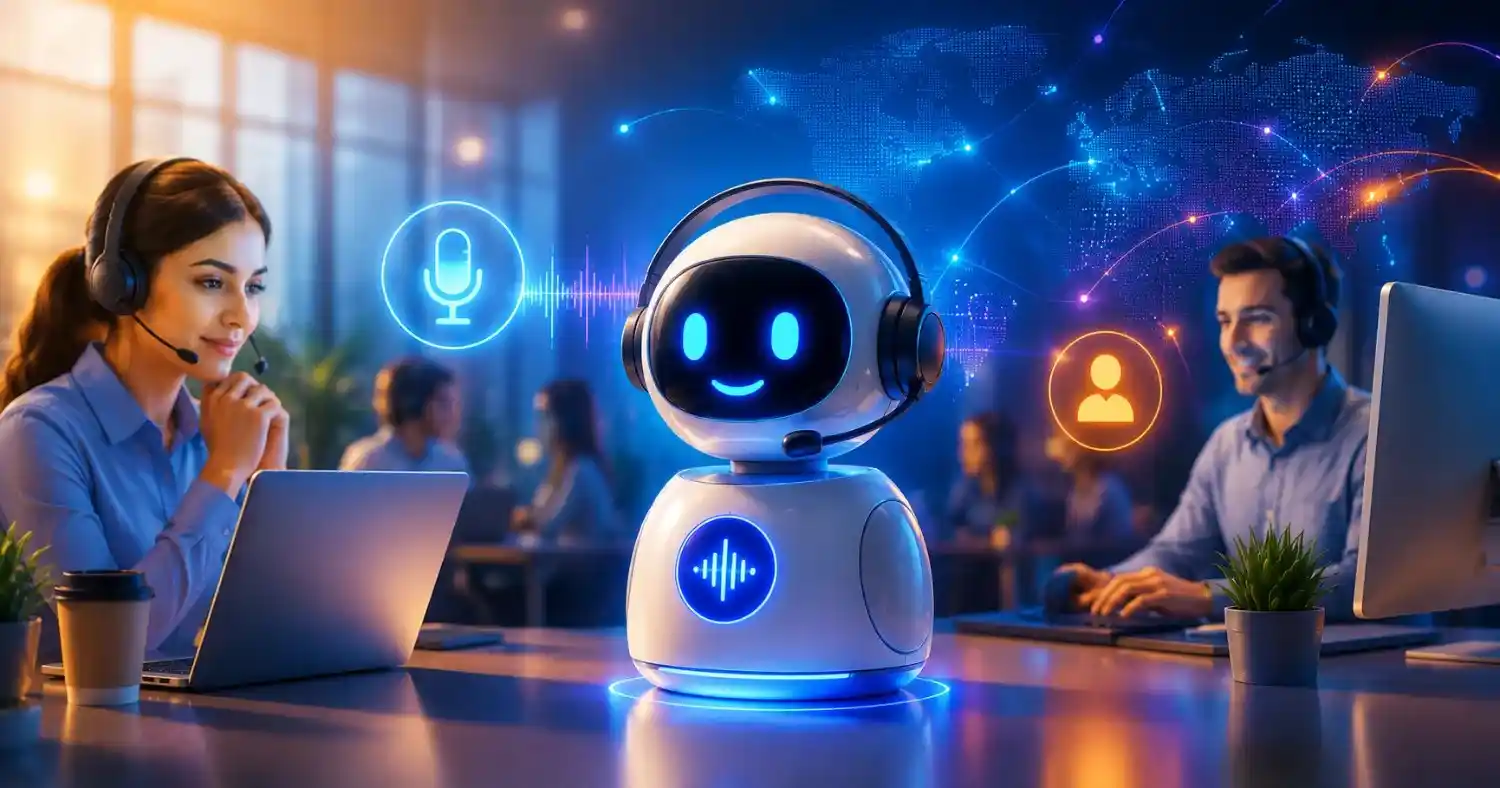
AI Voice Agent in Customer Support Automation: Use Cases, Benefits, and Future Trends
Introduction
Customer support has quietly gone through one of the biggest shifts in its history. Hold music, endless IVR menus, and "your call is important to us" loops are being replaced by something that actually listens, understands, and responds like a real conversation. That something is the AI voice agent, and it's changing how businesses handle support at scale.
If you've called a bank, an insurance provider, or an e-commerce helpline recently and felt like you were speaking to a surprisingly capable assistant rather than a rigid phone tree, there's a good chance an AI voice agent was on the other end. This guide breaks down what AI Voice Agent in Customer Support Automation actually means, how it works step by step, why it matters, and where it's headed.
What is an AI Voice Agent in Customer Support Automation?
An AI voice agent is a software system that can understand spoken language, interpret intent, and respond in a natural, human-like voice, all without a human operator on the line. Unlike the touch-tone IVR systems of the past ("Press 1 for billing, press 2 for technical support"), these agents rely on speech recognition, natural language understanding, and speech synthesis working together in real time.
In the context of customer support automation, an AI voice agent handles the kinds of conversations that used to require a live agent: answering FAQs, checking order status, resetting passwords, scheduling appointments, processing simple refunds, or routing complex issues to the right department. It's a core part of what's known as conversational AI in customer support, where the goal is to make automated interactions feel less like navigating a menu and more like talking to a knowledgeable representative.
What separates a modern AI voice agent from an old-school voicebot is context awareness. It can remember what was said two sentences ago, handle interruptions, deal with accents and background noise, and escalate gracefully to a human when the conversation calls for it. Businesses evaluating this technology often start by comparing it directly with older systems, which is why guides on the difference between AI voice agents and traditional IVR are some of the most searched resources in this space.
How AI Voice Agents Work in Customer Support Automation
Understanding the mechanics behind an AI Voice Agent helps clarify why it can hold a natural conversation instead of just playing pre-recorded prompts. Here's the typical pipeline:
Step 1: Call Initiation and Speech Capture
When a customer calls in (or the agent makes an outbound call), the system captures the audio stream in real time. This can happen over a traditional phone line, VoIP, or an in-app voice channel.
Step 2: Speech-to-Text Conversion
The raw audio is converted into text using an automatic speech recognition (ASR) engine. Modern systems are trained to handle varied accents, speech speeds, and background noise, which is why handling accents and multilingual speech in AI models has become such a critical area of development.
Step 3: Natural Language Understanding (NLU)
Once the speech is transcribed, an NLU layer extracts intent and entities from the text. For example, "I want to check the status of my order placed last Tuesday" is parsed into an intent (order status check) and an entity (a specific date reference).
Step 4: Dialogue Management and Business Logic
The system decides what to do next. This might mean querying a database, calling a CRM API, checking an order management system, or fetching account information. This is the layer where the agent starts to feel less like a script and more like a decision-maker.
Step 5: Response Generation
Based on the retrieved data and conversation context, the system generates an appropriate response. Many providers combine templated logic with generative AI to keep replies both accurate and conversational.
Step 6: Text-to-Speech Synthesis
The generated text response is converted back into natural-sounding speech using text-to-speech (TTS) technology. Quality here matters enormously, since a robotic or flat voice undermines trust even if the answer is correct.
Step 7: Escalation or Resolution
If the query is resolved, the call ends with a summary or confirmation. If not, the system escalates to a human agent, passing along the full conversation context so the customer never has to repeat themselves.
This entire loop typically happens within a second or two of latency, which is what makes the interaction feel conversational rather than laggy. Companies offering AI Voice agent development services spend a significant amount of engineering effort specifically on reducing this latency and improving accuracy at each step.
Why AI Voice Agents Are Important in Customer Support Automation?
Support teams today face a familiar set of pressures: rising call volumes, high agent turnover, growing customer expectations for instant responses, and the cost of scaling human teams around the clock. AI voice agents address these pressures directly.
First, they solve the availability problem. Customers don't call only during business hours, and a voice agent doesn't need shifts, breaks, or time zones. Second, they solve the consistency problem — a well-configured agent gives the same accurate answer every time, rather than varying by which representative happens to pick up. Third, they solve the scalability problem. A contact center that once needed fifty agents to handle peak-season call volume can absorb that spike without a proportional increase in headcount.
There's also a strategic angle. As more businesses move away from clunky legacy systems, understanding AI in Customer Support has become part of broader digital transformation planning, not just a cost-cutting exercise. Voice remains the preferred channel for many customers, especially for complex or sensitive issues like billing disputes or medical scheduling, where typing out a problem feels slower or less reassuring than simply talking it through.
Finally, there's the data angle. Every conversation an AI voice agent handles generates structured data on customer pain points, common questions, and sentiment trends — insights that are much harder to extract consistently from human-agent calls that aren't always logged or tagged the same way.
Benefits of AI Voice Agents in Customer Support Automation
It helps to look at benefits through the lens of real, practical scenarios rather than abstract claims.
Reduced Operational Costs
A mid-sized e-commerce company handling 10,000 support calls a month can offload a large percentage of repetitive queries (order tracking, return policy questions, refund status) to a voice agent, cutting the need for additional seasonal hires during sales events. Detailed cost breakdowns are covered in resources on how to calculate cost savings from AI support.
24/7 Availability Without Overtime Costs
A healthcare clinic can let patients call anytime to confirm appointment times or ask about clinic hours, without paying for a night-shift receptionist. This is especially valuable in industries like insurance and healthcare, where AI voice agents in insurance are already used for policy inquiries outside standard office hours.
Faster First-Response and Resolution Times
Instead of customers waiting in a queue, a voice agent can pick up instantly and resolve simple requests like balance inquiries or password resets within the first call, improving overall customer satisfaction scores.
Consistent Compliance and Accuracy
In regulated industries like banking, scripted disclosures and compliance language must be delivered exactly the same way every time. A voice agent guarantees this consistency in a way that's harder to enforce across dozens of human agents, a benefit explored in depth in guides on AI voice agents in banking and finance.
Reduced Agent Burnout
By automating repetitive, low-complexity calls, human agents are freed to focus on emotionally demanding or complex cases, which reduces burnout and turnover — a well-documented benefit discussed in pieces comparing AI assistants vs. human support teams.
Multilingual Support Without Multilingual Hiring
A retail brand expanding into new regions can deploy voice agents that handle multiple languages fluently, avoiding the cost and complexity of hiring native-speaking agents for every market, as detailed in resources about AI voice assistants for regional languages.
Use Cases of AI Voice Agents in Customer Support Automation
While the benefits above focus on outcomes, the use cases below focus on the specific jobs AI voice agents are actually deployed to do across industries.
Order and Delivery Tracking
E-commerce and logistics companies use voice agents to let customers check shipment status by simply saying an order number out loud, eliminating the need to navigate a website or app. This is a major driver behind AI voice agent use cases in logistics and supply chain.
Appointment Scheduling and Reminders
Healthcare providers, salons, and service businesses use voice agents to book, confirm, reschedule, or cancel appointments over the phone, reducing no-shows through automated reminder calls.
Insurance Claims and Policy Inquiries
Insurance companies deploy voice agents to answer policy questions, guide customers through claims filing, and check claim status, a use case explored further in coverage of AI voice agents in insurance.
Bill Payment and Account Inquiries
Utility companies and telecom providers let customers check their balance, make payments, or dispute charges through a voice agent instead of waiting for a live representative.
Retail and Travel Booking Support
Retail and hospitality brands use voice agents to handle product availability questions, room reservations, and cancellation policies, which ties directly into use cases around AI voice agents in travel and hospitality.
Technical Support Triage
SaaS and IT companies use voice agents as a first line of defense for technical issues, gathering diagnostic information before escalating to a specialist, which reduces average handling time significantly, as outlined in discussions of top AI voice agent use cases in SaaS and IT support.
Manufacturing and Field Service Support
Manufacturers use voice agents to handle dealer and distributor inquiries about parts availability, warranty claims, and service scheduling, a growing application area covered in AI voice agents in manufacturing.
Outbound Follow-ups and Satisfaction Surveys
Beyond inbound support, businesses use voice agents to make outbound calls for post-service feedback, renewal reminders, or proactive issue notifications, without needing a dedicated outbound call team.
A real-world example of this in action can be seen in how a retail chain boosted customer experience with an AI agent, consolidating several of these use cases into a single deployment.
Future Trends of AI Voice Agents in Customer Support Automation
The technology is still evolving quickly, and several trends are shaping where it's headed next.
Emotionally Aware Conversations
Future voice agents will increasingly detect tone, frustration, or urgency in a caller's voice and adjust their responses accordingly, escalating faster when a customer sounds upset rather than relying solely on keyword triggers.
Deeper Agentic Capabilities
Rather than just answering questions, voice agents are moving toward taking multi-step actions autonomously, such as processing a refund end-to-end or rebooking a flight without human sign-off, a shift closely tied to how agentic AI is transforming AI voice agents.
Omnichannel Continuity
Customers increasingly start a conversation on chat and finish it on a call, or vice versa. Future systems will maintain full context across channels so customers never have to repeat themselves, a direction explored in omnichannel AI voice agent trends.
Stronger Security and Fraud Prevention
As voice becomes a primary support channel, voice cloning and spoofing risks are rising in parallel. Expect wider adoption of voice biometrics and liveness detection, a concern already being addressed through research on deepfake detection in AI voice agents and voice spoofing attacks in AI voice agents.
Hyper-Personalization at Scale
Voice agents will draw on CRM history, past purchases, and previous interactions to tailor responses in real time, moving from generic scripts toward conversations that feel individually tailored, similar to trends already visible in personalization in marketing with AI voice agents.
Regulatory and Ethical Maturity
As adoption grows, expect clearer industry standards around disclosure (customers being told they're speaking to an AI), data privacy, and responsible use, an area already gaining attention through work on responsible AI in voice systems and GDPR-compliant AI voice agents.
Choosing the Right Partner for Implementation
Deploying a capable, reliable voice agent isn't a plug-and-play exercise. It requires integration with existing CRM and telephony systems, careful tuning of speech models for your industry's vocabulary, and ongoing monitoring to catch edge cases the system wasn't trained for. This is exactly why many businesses choose to work with an established provider of AI Voice agent development services rather than attempting to build this capability entirely in-house.
An experienced development partner brings pre-built frameworks for speech recognition, dialogue management, and telephony integration, along with the domain expertise to fine-tune the system for your industry, whether that's healthcare, banking, retail, or logistics. Before selecting a vendor, it's worth reviewing guidance on how to choose the right AI voice agent development company and understanding common mistakes when choosing an AI voice agent development partner so the investment pays off rather than becoming another abandoned automation project.
Final Thoughts
AI voice agents have moved well past the novelty stage. They're now a practical, cost-effective way to handle the bulk of routine customer support conversations while freeing human agents for the cases that genuinely need a human touch. From order tracking and appointment scheduling to claims processing and technical triage, the range of real-world use cases keeps expanding, and the underlying technology keeps getting better at sounding, and reasoning, like a real person.
For businesses evaluating where to start, the smartest first step is usually a narrow, well-defined pilot: pick one or two high-volume, low-complexity call types, measure the results, and expand from there. Done well, this approach turns customer support from a cost center into a genuine competitive advantage.
Ready to transform your business?
Discover how Vegavid's AI Voice Generator Services can help you create realistic, multilingual, and brand-aligned AI voices that elevate customer experiences and streamline communication at scale.
FAQs
No. In almost every deployment, voice agents handle the high-volume, repetitive queries — order status, appointment scheduling, basic account questions — while complex, emotionally sensitive, or high-stakes conversations are routed to trained human agents. The goal is augmentation, not full replacement, which is why so many businesses study the difference between AI voice agents and human agents before deciding how to split responsibilities between the two.
Timelines vary depending on integration complexity, but a narrowly scoped pilot covering one or two use cases can typically go live in a matter of weeks, while a full enterprise rollout across multiple departments and languages takes longer. Much of this depends on how well the existing CRM, telephony, and knowledge base systems are structured before the project starts.
Costs depend heavily on call volume, the number of languages supported, and how deeply the agent needs to integrate with backend systems. Off-the-shelf platforms tend to be cheaper upfront but less flexible, while custom-built systems cost more initially but scale better and adapt more precisely to a business's workflows. Many companies compare these paths through resources on the factors affecting AI voice agent development cost before committing to a budget.
Increasingly, well-built systems are difficult to distinguish from human agents in the first few seconds of a call, though most reputable providers disclose upfront that the caller is speaking with an automated assistant, both for transparency and, in many regions, regulatory compliance.
A properly designed system recognizes its own limits. When it can't confidently resolve a query, it escalates to a human agent and passes along the full conversation transcript and context, so the customer doesn't have to explain the issue from scratch.
Tags

Yash Singh is the Chief Marketing Officer at Vegavid Technology, a leading AI-driven technology company specializing in AI agents, Generative AI, Blockchain, and intelligent automation solutions. With over a decade of experience in digital transformation and emerging technologies, Yash has played a key role in helping businesses adopt advanced AI solutions that enhance operational efficiency, automate workflows, and deliver personalized customer experiences across industries including fintech, healthcare, gaming, ecommerce, and enterprise technology. An alumnus of Indian Institute of Technology Bombay, Yash combines strong technical expertise with strategic marketing leadership to drive innovation in AI-powered applications, autonomous AI agents, Retrieval-Augmented Generation (RAG), Natural Language Processing (NLP), Large Language Models (LLMs), machine learning systems, conversational AI, and enterprise automation platforms. His expertise spans AI model integration, intelligent workflow automation, prompt engineering, smart data processing, and scalable AI infrastructure development, enabling organizations to accelerate digital transformation and business growth. Passionate about the future of intelligent systems, Yash actively shares insights on AI agents, Generative AI, LLM-powered applications, blockchain ecosystems, and next-generation digital strategies. He is committed to helping businesses embrace AI-first transformation while guiding teams to build impactful, industry-specific solutions that shape the future of innovation and intelligent technology.




Leave a Reply