
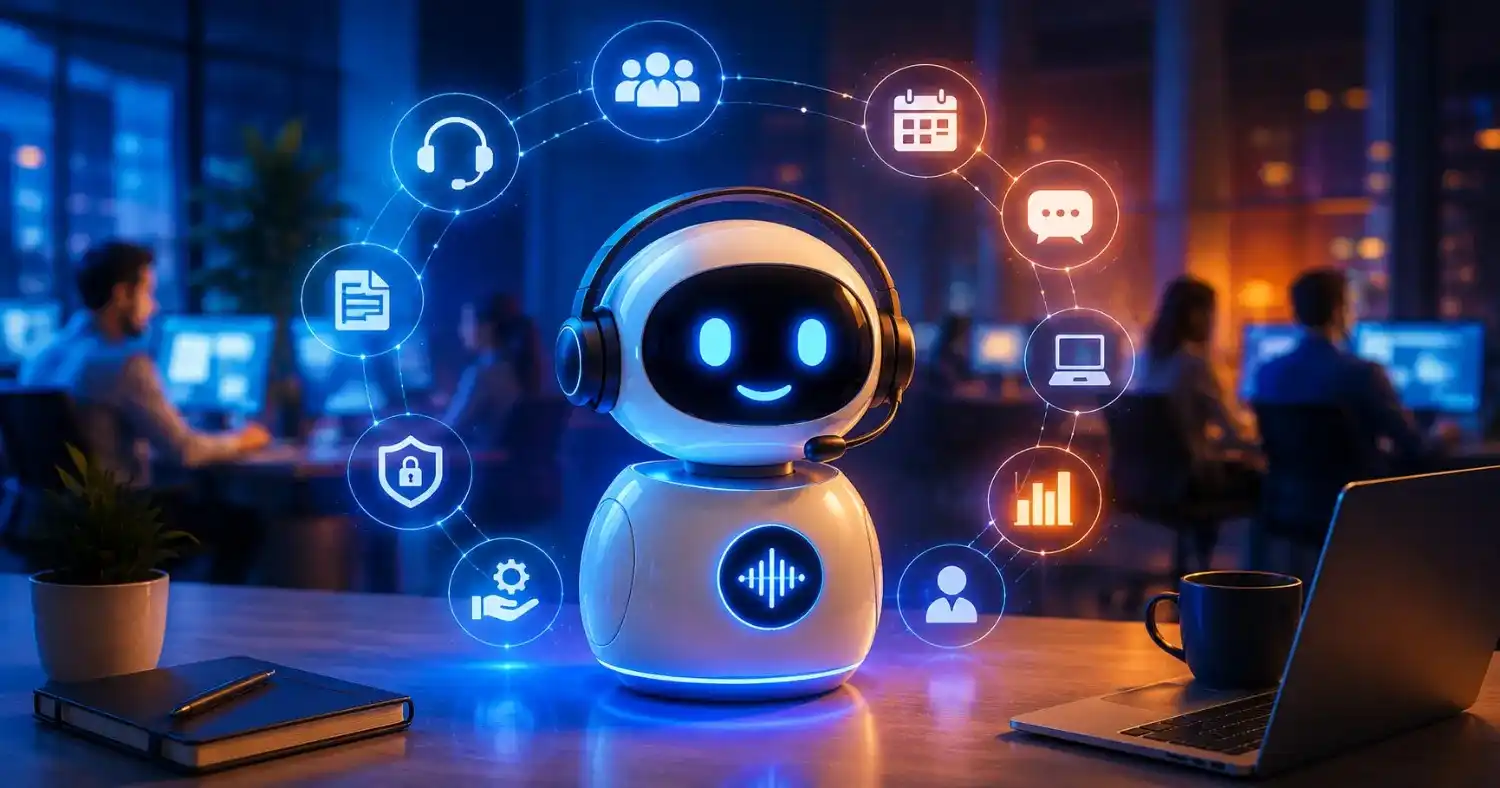
Top 10 Use Cases of AI Voice Agent in Internal Employee Support
Introduction
Every company loses hours every week to the same repetitive employee questions. "How much PTO do I have left?" "Why isn't my laptop connecting to VPN?" "Who do I contact about my benefits enrollment?" HR and IT teams answer these questions on a loop, and employees often wait days for a reply that should take seconds. This is the exact gap an AI voice agent is designed to close inside an organization.
Companies that want this handled reliably at scale are increasingly turning to specialized AI Voice agent development services rather than stitching together generic chatbots that were never built for internal workflows. This guide breaks down what these systems are, how they function step by step, why they matter for the modern workplace, and where the top ten real-world use cases are already delivering results today.
What Is AI Voice Agent in Internal Employee Support?
An AI voice agent in internal employee support is a conversational system that lets employees speak naturally to get answers about HR policies, IT issues, payroll questions, and internal processes, without waiting in a ticket queue or searching through a scattered intranet. Instead of typing a request into a form and waiting for a human to respond, an employee simply asks a question out loud, over the phone, through a desk device, or via a voice-enabled app, and receives an accurate answer immediately.
Unlike a basic FAQ chatbot that matches keywords, a true voice agent for internal support relies on conversational AI to understand intent, context, and follow-up questions. An employee can ask "Can I carry over my unused vacation days into next year?" and the system will interpret the question, check the relevant policy document, and respond in plain language rather than pointing to a generic help page.
Where It Fits Inside the Organization
Internal employee support voice agents typically sit at the intersection of HR, IT, and facilities functions. They are connected to internal systems such as the HRIS platform, the ticketing system, the knowledge base, and sometimes the payroll software, so they can pull real, personalized answers rather than generic scripted responses. This is what separates a genuinely useful internal voice agent from a simple recorded-message system that cannot actually resolve anything.
Why Voice Rather Than Just Chat
Many companies already have text-based chatbots for internal support, so it is worth clarifying why voice specifically adds value. Speaking is faster than typing for most people, especially for employees working in the field, on a factory floor, or driving between job sites who cannot easily stop to type out a detailed question. Voice also removes the friction of opening a separate app or portal, since employees can simply speak to a device or call a number they already use daily. For frontline and non-desk workers in particular, a voice interface is often the only realistic way to give them the same instant access to HR and IT support that desk-based employees already enjoy through a laptop.
How AI Voice Agents Work in Internal Employee Support? (Step-by-Step Process)
Understanding the mechanics behind an internal voice agent helps HR and IT leaders see exactly where the time savings come from. The process generally follows a consistent sequence regardless of department.
Step 1: Employee Initiates the Conversation
The employee reaches out through whichever channel is available, a dedicated internal phone line, a voice assistant on their desktop, or a mobile app, and states their question or request in natural language.
Step 2: Intent and Department Classification
The system analyzes the request and classifies it into a category, such as HR policy, IT troubleshooting, payroll, or facilities, so it knows which internal systems and knowledge sources to consult.
Step 3: Employee Identity Verification
The voice agent confirms the employee's identity using their employee ID, single sign-on credentials, or a voice-based authentication method, ensuring that sensitive information like salary details or medical leave records is only shared with the right person.
Step 4: Knowledge Retrieval From Internal Systems
The agent queries connected systems such as the HRIS, the IT service desk, or the internal knowledge base to find the specific, up-to-date answer rather than relying on outdated static scripts. This real-time lookup approach mirrors the same underlying logic used in systems built for AI Voice Agent in Sales and Lead Qualification, where instant data retrieval determines the most relevant response in a live conversation.
Step 5: Response Generation and Delivery
The system converts the retrieved information into a clear, spoken answer and delivers it back to the employee, often confirming understanding by summarizing the key point before ending the interaction.
Step 6: Action Execution When Needed
For requests that require action rather than just information, such as submitting a leave request or resetting a password, the voice agent executes the task directly inside the connected system instead of just describing how to do it.
Step 7: Escalation to a Human When Necessary
If the request is too complex, sensitive, or outside the system's scope, the voice agent transfers the conversation to the right human team member along with a summary, so the employee never has to repeat their question from scratch.
Why AI Voice Agents Are Important in Internal Employee Support?
Internal support functions are often treated as a cost center, but the hidden cost of slow, inconsistent employee support adds up quickly across a growing organization. Voice agents matter because they directly address the friction points that make internal support frustrating for both employees and the teams who staff it.
They Eliminate the Wait for Routine Answers
Most HR and IT questions are repetitive and do not require judgment, yet employees often wait hours or days in a ticket queue for something that could be answered instantly. A voice agent removes that wait entirely for the majority of common requests.
They Reduce the Burden on HR and IT Teams
Every routine password reset or PTO balance question answered by an automated system is one less ticket sitting in a queue that a human specialist would otherwise need to open, research, and close manually.
They Provide Consistent Answers Across the Company
When ten different HR representatives answer the same policy question ten different ways, confusion and mistrust build up. A voice agent delivers the same accurate, policy-based answer every time, regardless of which employee is asking or which shift they work.
They Support a Distributed and Global Workforce
Remote and international teams often need support outside standard office hours across different time zones. A voice agent is available at any hour, closing the gap that comes from having HR or IT staff concentrated in a single time zone.
They Improve the Employee Experience From Day One
New hires form early impressions of a company based on how smoothly onboarding questions get resolved. An always-available voice agent means a new employee is never stuck waiting to find out how to set up their email or where to find the benefits portal.
They Free Skilled Staff for Higher-Value Work
Experienced HR business partners and senior IT engineers add the most value when they are solving complex, judgment-based problems, not repeating the same answer about the dress code policy for the tenth time in a week. Automating the routine layer of questions lets these specialists focus on the work that actually requires their expertise.
They Scale Naturally With Company Growth
Hiring additional HR or IT support staff every time headcount grows is expensive and slow. A voice agent can absorb a growing volume of routine requests without needing proportional increases in support staff, making it a far more scalable model for fast-growing organizations.
Benefits of AI Voice Agent in Internal Employee Support
Beyond the general importance described above, there are specific, measurable benefits organizations experience once a voice agent is deployed for internal support.
Faster Ticket Resolution Times
Routine requests that used to sit in a queue for a day or more get resolved in the same conversation, dramatically shortening the average time-to-resolution reported by HR and IT service desks.
Lower Support Staffing Costs
Handling a large share of repetitive HR and IT questions through automation reduces the need to keep expanding the support team headcount in step with company growth, freeing budget for more strategic hires.
Reduced Password Reset and Access Request Backlogs
Password resets and basic access requests are consistently among the highest-volume tickets any IT desk receives. Automating this single category alone often produces a noticeable drop in overall ticket volume.
Better Compliance With Internal Policies
Because the voice agent pulls answers directly from the current, approved policy documents, employees are far less likely to receive outdated or incorrect guidance that could create compliance risk for the company.
Improved Visibility Into Recurring Employee Pain Points
Every conversation handled by the voice agent can be logged and analyzed, giving HR and IT leadership clear data on which questions come up most often, which policies are confusing, and where process improvements would have the biggest impact.
Higher Employee Satisfaction With Internal Support
Employees consistently report higher satisfaction when their basic questions are answered instantly rather than sitting in a ticket queue, which contributes to broader engagement and retention metrics over time.
More Accurate Workforce Planning Data
Because every interaction is logged and categorized, HR and IT leadership gain a much clearer picture of seasonal spikes in requests, such as benefits questions during open enrollment or password reset volume after a system update, allowing teams to plan staffing and system changes proactively instead of reactively.
Reduced Burnout Among Support Teams
Answering the same repetitive questions dozens of times a day is one of the leading causes of burnout among HR coordinators and IT help desk staff. Removing that repetitive layer of work through automation directly improves morale and retention within the support teams themselves.
Top 10 Use Cases of AI Voice Agent in Internal Employee Support
Beyond the general benefits, here are ten concrete, practical situations where organizations are actively deploying voice agents inside their internal support functions today.
1. IT Password Resets and Account Unlocks
Employees can verbally request a password reset or account unlock, and the voice agent verifies their identity and completes the reset directly inside the identity management system, similar to the workflows explored in guides on AI voice agent use cases in SaaS and IT support.
2. PTO Balance Checks and Leave Requests
Employees ask how many vacation or sick days they have remaining, and the voice agent checks the HRIS in real time and can even submit a formal leave request on the spot if the employee confirms the dates.
3. Benefits Enrollment Guidance
During open enrollment periods, employees frequently have questions about plan options, coverage details, and deadlines. A voice agent can walk employees through their specific benefits package based on their actual enrollment data rather than a generic brochure.
4. New Hire Onboarding Q&A
New employees can ask about badge access, equipment setup, or first-week logistics, and the voice agent answers based on onboarding checklists tailored to their specific role and location.
5. IT Ticket Status Updates
Instead of emailing the help desk to check on an open ticket, employees can simply ask the voice agent for a status update, and the system pulls the current ticket state directly from the service desk platform.
6. Payroll and Paycheck Inquiries
Employees asking about pay date changes, tax withholding questions, or discrepancies in their paycheck can get immediate, personalized answers pulled from the payroll system rather than waiting for a payroll specialist to respond by email.
7. Internal Policy and Compliance Questions
Questions about expense reporting limits, remote work policies, or code-of-conduct guidelines are answered directly from the current internal policy documents, reducing the number of employees who guess or ask a coworker for outdated information.
8. Facilities and Office Logistics Requests
Employees can ask about meeting room availability, parking access, or building hours, and the voice agent checks the relevant facilities system to give an accurate, real-time answer.
9. Internal Directory and Org Chart Lookups
Rather than digging through an outdated intranet page, employees can simply ask who leads a particular team or how to reach a specific department, and the voice agent pulls the current organizational data instantly.
10. Employee Wellness and EAP Program Navigation
Employees looking for information about mental health resources, employee assistance programs, or wellness benefits can get a private, judgment-free answer from the voice agent rather than having to ask a manager or HR representative directly.
Future Trends of AI Voice Agent in Internal Employee Support
The technology powering internal voice agents continues to evolve quickly, and several trends are shaping where this space is headed next.
Proactive Notifications Instead of Reactive Answers
Future systems will move beyond waiting for employees to ask questions, proactively calling or messaging staff about upcoming policy deadlines, expiring certifications, or unused benefits before those items become a problem.
Deeper Personalization Based on Role and History
Voice agents will increasingly tailor responses based on an employee's specific role, tenure, and past interactions, so a manager and an individual contributor asking the same question receive answers relevant to their specific permissions and responsibilities.
Tighter Integration With Enterprise Platforms
Expect deeper native integration with platforms like ServiceNow, Workday, and other core HR and ITSM systems, allowing a single conversation to trigger actions across multiple back-end systems at once, an approach already gaining traction in discussions of embedding AI into ServiceNow ticketing workflows.
Sentiment-Aware Escalation
Upcoming voice models will be better at detecting frustration or urgency in an employee's tone, allowing sensitive situations, such as a harassment complaint or a serious technical outage, to be escalated to a human immediately rather than being handled purely by automation.
Expansion Into Full Employee Lifecycle Support
Voice agents will extend beyond simple Q&A into full lifecycle support, guiding employees through onboarding, internal transfers, and even offboarding conversations, all through the same conversational interface. This broader shift mirrors how many organizations are already combining internal support automation with AI Voice Agent in Sales and Lead Qualification capabilities on the customer-facing side, recognizing that the same underlying voice infrastructure can support both internal and external conversations effectively.
Stronger Data Privacy and Access Controls
As voice agents handle increasingly sensitive employee data such as medical leave details or salary information, expect continued investment in encryption, role-based access controls, and audit trails to keep pace with growing regulatory scrutiny around workplace AI tools.
Multilingual Support for Global Workforces
As more organizations operate across multiple countries, voice agents are increasingly being built to switch fluidly between languages within the same conversation, allowing a single internal support system to serve employees in different regions without maintaining separate localized tools for each market.
Final Thoughts
AI voice agents have moved from a novelty to a genuinely practical tool for reducing the daily friction employees face when trying to get simple questions answered. The technology understands natural speech, pulls real data from HR and IT systems instantly, and works around the clock without adding to a support team's ticket backlog.
Organizations that want this capability implemented correctly, securely, and tailored to their specific internal systems are increasingly partnering with specialized AI Voice agent development services rather than relying on generic, off-the-shelf chatbots that were never designed for internal workflows. As this technology matures, the companies that adopt it early for internal employee support will be well positioned to extend the same voice infrastructure into other areas of the business, including sales and customer-facing conversations, building one connected voice experience across the entire organization.
Ready to transform your business?
Discover how Vegavid's AI Voice Generator Services can help you create realistic, multilingual, and brand-aligned AI voices that elevate customer experiences and streamline communication at scale.
FAQs
An AI voice agent is a conversational AI system that helps employees access HR, IT, payroll, and workplace information through natural voice interactions without waiting for human assistance.
AI voice agents can automate password resets, PTO balance checks, leave requests, payroll inquiries, onboarding support, policy questions, ticket status updates, and benefits guidance.
They provide instant responses, reduce HR and IT workloads, improve employee satisfaction, ensure consistent policy communication, and offer 24/7 support across the organization.
Yes, modern AI voice agents use identity verification, role-based access controls, encryption, and secure integrations to protect sensitive employee data.
Future AI voice agents will deliver proactive notifications, multilingual assistance, personalized employee experiences, sentiment-aware escalation, and deeper integration with enterprise systems.
Tags

Yash Singh is the Chief Marketing Officer at Vegavid Technology, a leading AI-driven technology company specializing in AI agents, Generative AI, Blockchain, and intelligent automation solutions. With over a decade of experience in digital transformation and emerging technologies, Yash has played a key role in helping businesses adopt advanced AI solutions that enhance operational efficiency, automate workflows, and deliver personalized customer experiences across industries including fintech, healthcare, gaming, ecommerce, and enterprise technology. An alumnus of Indian Institute of Technology Bombay, Yash combines strong technical expertise with strategic marketing leadership to drive innovation in AI-powered applications, autonomous AI agents, Retrieval-Augmented Generation (RAG), Natural Language Processing (NLP), Large Language Models (LLMs), machine learning systems, conversational AI, and enterprise automation platforms. His expertise spans AI model integration, intelligent workflow automation, prompt engineering, smart data processing, and scalable AI infrastructure development, enabling organizations to accelerate digital transformation and business growth. Passionate about the future of intelligent systems, Yash actively shares insights on AI agents, Generative AI, LLM-powered applications, blockchain ecosystems, and next-generation digital strategies. He is committed to helping businesses embrace AI-first transformation while guiding teams to build impactful, industry-specific solutions that shape the future of innovation and intelligent technology.


Leave a Reply