
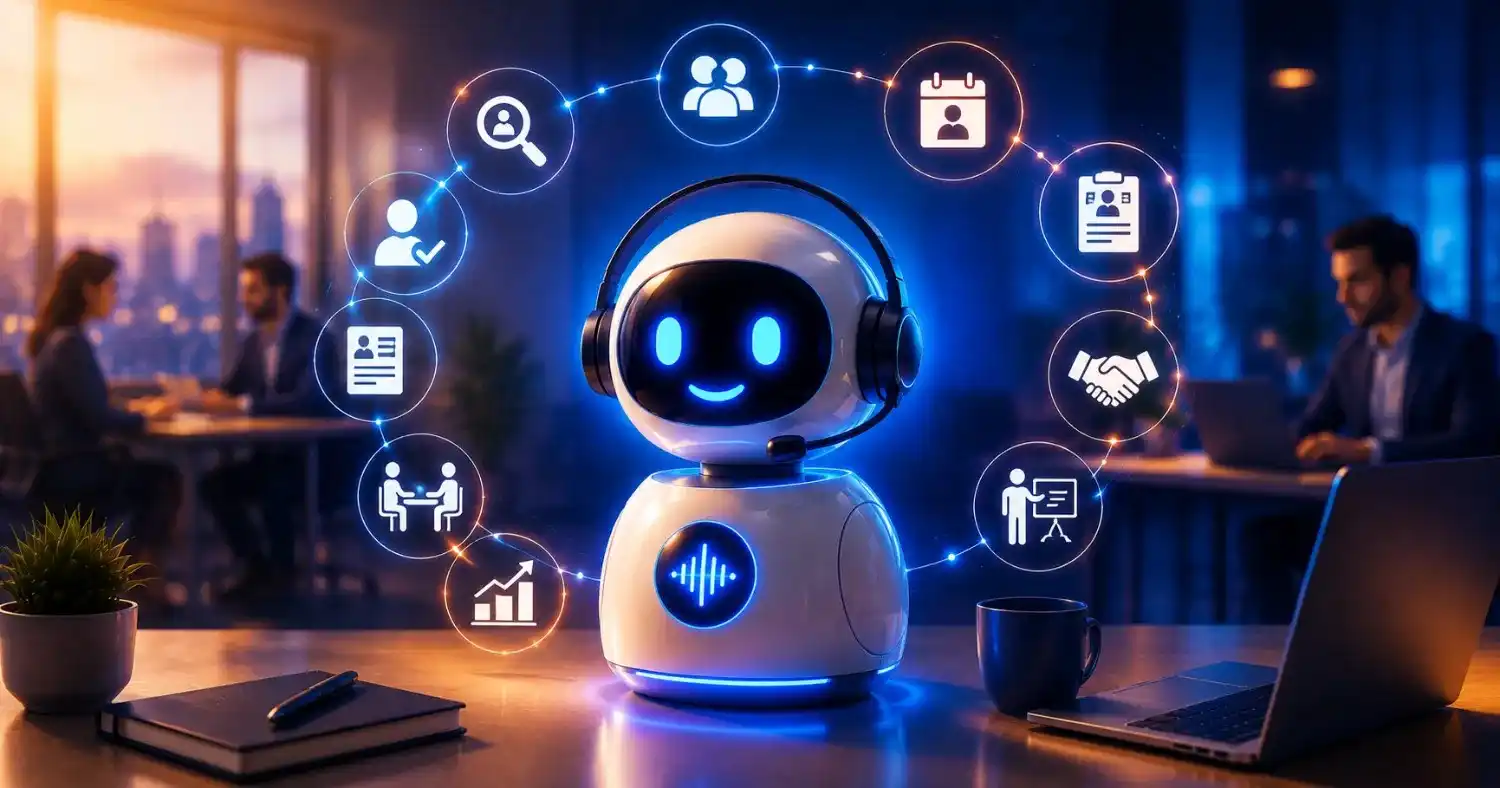
Top 10 Use Cases of AI Voice Agent in HR & Recruitment
Introduction
Every HR team knows the drill: hundreds of resumes for a single opening, dozens of candidates to screen, interviews to schedule across time zones, and new hires who need onboarding calls before their first day even starts. It's repetitive, time-consuming work, and it's exactly the kind of workload that AI voice agents are now stepping in to handle.
If you've ever received a call from a "recruiter" asking a set of consistent screening questions about your experience and availability, only to later find out it was an AI system rather than a person, you've already seen this shift in action. This guide breaks down what an AI Voice Agent in HR & Recruitment actually is, how it works step by step, why it matters for talent teams, and the top ten ways organizations are putting it to use today.
What is an AI Voice Agent in HR & Recruitment?
An AI voice agent in HR and recruitment is a software system that can place or answer phone calls, hold a natural spoken conversation with candidates or employees, and carry out HR-specific tasks like screening, scheduling, and answering policy questions, all without a human recruiter or HR representative on the line. It combines speech recognition, natural language understanding, and speech synthesis with recruitment-specific logic, such as pre-screening criteria, interview scheduling rules, or onboarding checklists.
In practice, this means the moment a candidate applies for a role, a voice agent can call them within minutes to confirm basic eligibility, ask a handful of screening questions, and either schedule them for the next interview stage or politely close out the application. This is a meaningfully different experience than the generic automated systems of the past; it's closer to what's described in resources on conversational AI for HR, where the system adapts its questions and tone based on how the candidate actually responds.
What makes these systems genuinely valuable to talent acquisition teams is that they don't just ask questions, they interpret answers and make decisions. If a candidate mentions they can't relocate, or that their salary expectations are well above the budgeted range, the agent can flag this immediately rather than letting a mismatched candidate advance through several rounds before anyone notices. This level of judgment is part of why so many organizations are exploring AI use cases in HR as a broader category, with voice specifically addressing the phone-based parts of the hiring and employee lifecycle that chat and email tools can't reach as naturally.
How AI Voice Agents Work in HR & Recruitment
Understanding the mechanics behind these systems clarifies why they can hold a genuinely useful screening or onboarding conversation instead of just reading from a script.
Step 1: Trigger and Call Initiation
The process typically begins the moment a candidate applies through a careers page, a job board, or an applicant tracking system (ATS), or when a new hire's start date is confirmed. The voice agent is triggered to place a call, often within minutes, which matters because candidates who don't hear back quickly frequently accept offers elsewhere.
Step 2: Speech Capture and Transcription
Once the call connects, the system captures the candidate's or employee's spoken responses and converts them into text in real time using automatic speech recognition (ASR), the same underlying technology described in guides on how AI voice agents are built.
Step 3: Intent and Entity Extraction
A natural language understanding (NLU) layer parses the transcribed responses to identify intent (interested, not interested, needs to reschedule) and entities (years of experience, notice period, salary expectations, availability dates).
Step 4: Dynamic Screening or Onboarding Logic
Based on what's extracted, the system references a pre-configured screening rubric or onboarding checklist and decides what to ask or explain next. This is where how AI tools improve the HR recruitment process becomes tangible, since the agent branches its questions dynamically rather than following one fixed script for every candidate.
Step 5: ATS and HRIS Data Sync
As the conversation unfolds, the system writes structured data back into the applicant tracking system or HR information system, updating candidate status, screening scores, and scheduling details in real time, an approach closely tied to how organizations integrate AI recruiting tools with their ATS.
Step 6: Response Generation and Natural Speech Output
The agent generates a spoken response using text-to-speech (TTS) technology tuned to sound warm and professional, since tone matters enormously in a candidate experience context, where a robotic voice can leave a poor impression of the employer brand.
Step 7: Scheduling, Routing, or Escalation
Once the conversation concludes, the system either books the next interview slot directly on a recruiter's or hiring manager's calendar, sends a summary to the HR team for review, or escalates to a human recruiter if the candidate has questions outside the agent's scope.
This entire loop happens in near real time, which is what makes the interaction feel like an actual conversation rather than a delayed, clunky exchange. Providers offering AI Voice agent development services invest heavily in tuning each of these steps specifically for HR use cases, since candidate experience and data privacy expectations are especially high in recruitment and employee-facing conversations.
Why AI Voice Agents Are Important in HR & Recruitment?
HR and talent acquisition teams face a familiar set of pressures that AI voice agents directly address. Speed to first contact is one of the biggest. Studies on candidate engagement consistently show that applicants who don't hear back within a day or two often lose interest or accept another offer, yet most recruiting teams struggle to call every applicant promptly because they're juggling dozens of open requisitions at once.
There's also the consistency problem. Different recruiters ask different screening questions, remember different details, and log candidate notes with varying thoroughness. A voice agent asks the same core screening questions on every call and logs the answers with identical structure every time, which improves fairness in the hiring process and makes it easier to compare candidates apples-to-apples.
Scale is another major factor. A company running a large hiring campaign, whether for seasonal retail staff, a call center expansion, or graduate recruitment, can generate hundreds of applications in a single week, far more than a small recruiting team can call individually. Voice agents absorb that spike without needing temporary recruiting staff, a capability closely tied to how agentic AI is being applied to HR use cases across growing organizations.
There's also a candidate experience angle that's easy to overlook. A prompt, professional phone screening, even an automated one, often leaves a better impression than radio silence or a generic rejection email days later. And for internal HR functions, from benefits questions to policy clarifications, an always-available voice agent reduces the burden on HR staff who would otherwise field the same repetitive questions dozens of times a week.
Benefits of AI Voice Agents in HR & Recruitment
Following are the Benefits of AI Voice Agents in HR & Recruitment :
Faster Candidate Response Times
A retail chain hiring for hundreds of seasonal positions can have a voice agent call every applicant within minutes of submission, dramatically increasing the number of candidates who complete the initial screening compared to the industry norm of days-long callback delays.
Higher Screening Consistency
A staffing agency can configure the agent to ask identical pre-screening questions on every single call, eliminating the variability where one recruiter probes deeply into availability and another forgets to confirm it, which improves the overall quality of candidates passed to hiring managers.
Lower Cost Per Hire
A growing company that once needed to hire additional recruiting coordinators just to keep up with applicant volume can instead deploy a voice agent to handle first-pass screening, reserving human recruiters for the more nuanced, relationship-driven parts of the hiring process.
Reduced Recruiter Burnout
By offloading repetitive screening calls and scheduling logistics, human recruiters spend more time on candidate relationship-building, offer negotiations, and hiring manager collaboration, rather than repeating the same questions dozens of times a day, a shift closely related to broader conversations about blending automation with human-led sales and recruiting efforts.
Better After-Hours Coverage
Candidates applying from different time zones or working other jobs during business hours can be screened by a voice agent that calls in the evening or on weekends, ensuring no application sits untouched simply because it arrived outside standard office hours.
Cleaner ATS and HRIS Data
Since the agent enters structured data directly into recruiting and HR systems after every call, HR operations teams get more reliable reporting on time-to-fill, source quality, and pipeline health, extending the kind of data hygiene benefits already discussed in relation to AI in recruitment more broadly.
Improved Candidate Experience at Scale
Even in high-volume hiring, every candidate gets a prompt, polite, and consistent conversation rather than a generic form email or no response at all, which protects employer brand reputation across large applicant pools.
Top 10 Use Cases of AI Voice Agents in HR & Recruitment
Following are the Top 10 Use Cases of AI Voice Agents in HR & Recruitment:
1. Initial Candidate Screening Calls
Voice agents call new applicants to confirm basic eligibility, such as work authorization, availability, and salary expectations, before a human recruiter invests time in a full interview.
2. Interview Scheduling and Rescheduling
Rather than exchanging multiple emails to find a mutually available time, a voice agent calls the candidate directly, checks calendar availability in real time, and books the interview slot immediately, a use case that pairs naturally with AI interview software for tech roles.
3. High-Volume Seasonal and Hourly Hiring
Retailers, warehouses, and hospitality businesses use voice agents to screen large volumes of hourly applicants quickly during peak hiring seasons, when speed matters more than deep evaluation.
4. Reference and Background Check Coordination
Voice agents call listed references to confirm employment dates and ask standard reference questions, freeing HR staff from spending hours on phone tag with former employers.
5. New Hire Pre-boarding Calls
Before a new employee's first day, a voice agent can call to confirm start date details, answer common questions about paperwork, and walk through what to expect, a practical extension of AI agents used in HR onboarding.
6. Employee Benefits and Policy Q&A
Instead of routing every benefits enrollment question to an overworked HR generalist, a voice agent can answer common questions about health plans, PTO policies, or payroll timing around the clock.
7. Exit Interviews and Offboarding Calls
Voice agents can conduct structured exit interviews with departing employees, capturing honest feedback about their experience in a consistent format that's easier to analyze in aggregate than notes taken during a rushed manual call.
8. Internal Mobility and Redeployment Screening
Large organizations use voice agents to screen employees for internal transfer or redeployment opportunities, quickly matching skills and interests to open internal roles without a lengthy manual process.
9. Attendance and Shift Confirmation Calls
Call centers, healthcare facilities, and manufacturing plants use voice agents to confirm shift attendance the night before or morning of a scheduled shift, reducing no-shows through a quick automated reminder call.
10. Compliance and Structured Application Data Collection
Voice agents can ask standardized questions during the application process using consistent, pre-approved phrasing, reducing the risk of inconsistent or non-compliant questioning that can arise when different recruiters improvise their own wording.
Several of these use cases can be layered together in a single hiring funnel, similar to how the AI virtual receptionist's lead qualification features combine multiple qualifying steps into one seamless conversation across a business's front-of-house operations.
Future Trends of AI Voice Agents in HR & Recruitment
The technology is evolving quickly, and several trends are shaping where it's headed next in the HR and recruitment space.
Deeper Agentic Decision-Making in Screening
Future voice agents will move beyond scripted screening toward autonomously deciding how to probe further on ambiguous answers, such as following up on a vague response about notice periods or relocation flexibility, a direction closely tied to the broader shift from generative AI to agentic AI across enterprise systems.
Bias Auditing Built Into Voice Screening
As voice agents take on more screening responsibility, expect growing demand for built-in auditing tools that check whether the system is treating candidates consistently and fairly across demographic groups, an extension of ongoing conversations about responsible AI in voice systems.
Emotion and Sentiment-Aware Conversations
Future systems will increasingly detect nervousness, hesitation, or enthusiasm in a candidate's tone during a screening call, allowing recruiters to review flagged moments in a transcript rather than relying purely on the literal words spoken.
Tighter ATS and HRIS Integration
Voice agents will plug even more directly into existing recruiting and HR platforms, automatically triggering the next recruiting workflow step, such as sending an assessment link or notifying a hiring manager, based on call outcomes, building on integration patterns already common in AI interview copilots working with existing ATS systems.
Multilingual Recruitment at Global Scale
As companies hire across borders, voice agents will conduct screening calls in multiple languages without needing region-specific recruiting staff, extending the reach of a single centralized talent acquisition team, building on foundational work in handling accents and multilingual speech in AI models.
Continuous Employee Listening
Beyond recruitment, voice agents will increasingly support ongoing employee engagement, conducting periodic pulse-check calls to surface morale issues or flight risks before they show up in exit interview data.
Human-AI Collaboration Models in Recruiting
Rather than fully replacing recruiters, the more common future model will have voice agents handle first-round screening and logistics, then hand off a full transcript and summary to a human recruiter for the higher-value relationship-building parts of the process, a balance closely related to debates around whether AI is going to replace HR altogether, and more specifically whether AI will replace recruiters in the near term.
Choosing the Right Partner for Implementation
Standing up a reliable voice agent for HR and recruitment isn't as simple as recording a few scripted questions. It requires careful integration with your ATS and HRIS, thoughtful configuration of screening logic to match your specific compliance requirements, and ongoing monitoring to ensure the candidate experience stays warm and professional rather than robotic. This is exactly why many talent acquisition teams choose to work with an experienced provider of AI Voice Agent in HR & Recruitment solutions instead of trying to build and maintain this capability entirely in-house.
An experienced development partner brings pre-built frameworks for speech recognition, dialogue management, and ATS integration, along with the HR domain expertise to fine-tune screening and onboarding logic for your specific industry and hiring volume. Many HR leaders find that partnering with a specialized provider of AI Voice agent development services is far more cost-effective than building speech recognition and dialogue management infrastructure from scratch, since the underlying technology stack is complex and requires ongoing maintenance as speech models improve. Before selecting a vendor, it's worth reviewing broader guidance on questions to ask before hiring an AI voice agent development company, so the rollout avoids common pitfalls around compliance, data privacy, and candidate experience quality.
How to Get Started with Voice Automation in HR
Organizations considering this technology don't need to automate the entire hiring funnel on day one. A phased approach tends to work best.
Start With One High-Volume Funnel
Rather than trying to automate every hiring workflow at once, pick a single high-volume role type, such as seasonal retail staff or entry-level call center hires, where the screening questions are relatively standardized and the volume justifies the investment.
Define Clear Screening Criteria Upfront
Work with hiring managers to codify the exact eligibility questions and disqualifying answers before configuring the voice agent, since vague or inconsistent criteria will produce inconsistent results regardless of how good the underlying technology is.
Pilot, Measure, and Iterate
Track metrics like contact rate, screening completion rate, and time-to-schedule before and after the pilot, then use those results to justify expanding the voice agent into additional hiring funnels or HR use cases such as onboarding and internal mobility.
Keep a Clear Human Escalation Path
Ensure every candidate has an easy way to reach a human recruiter if they have questions the voice agent can't answer, since a good escalation path protects both compliance and candidate goodwill.
Final Thoughts
AI voice agents have moved well past the experimental stage in HR and recruitment functions. They're now a practical way to make sure no applicant waits days for a callback, no screening question gets skipped, and no recruiter's time gets consumed by repetitive scheduling logistics that a system can handle just as well. From high-volume seasonal hiring and interview scheduling to exit interviews and internal mobility screening, the range of real-world use cases keeps expanding as the underlying technology gets better at sounding, and reasoning, like an experienced recruiter.
For HR teams evaluating where to start, the smartest approach is usually a narrow pilot: pick one high-volume hiring funnel, such as entry-level or seasonal roles, measure candidate response rates and screening consistency against your current process, and expand from there once the results speak for themselves. Done well, this turns recruitment from a resource-constrained bottleneck into a faster, fairer, and more scalable part of the business, freeing recruiters to spend their time where it matters most: building genuine relationships with the candidates who are the best fit for the role, rather than chasing down basic logistics that a well-designed voice agent can handle just as reliably.
Ready to transform your business?
Discover how Vegavid's AI Voice Generator Services can help you create realistic, multilingual, and brand-aligned AI voices that elevate customer experiences and streamline communication at scale.
FAQs
An AI voice agent is a conversational AI system that automates recruitment and HR tasks such as candidate screening, interview scheduling, onboarding, and employee support through natural voice interactions.
AI voice agents accelerate candidate screening, automate interview scheduling, maintain consistent evaluations, reduce recruiter workload, and improve the overall candidate experience.
AI voice agents can automate candidate screening, interview scheduling, onboarding calls, benefits inquiries, policy FAQs, attendance confirmations, exit interviews, and internal mobility screening.
Yes, AI voice agents can integrate with applicant tracking systems (ATS), HRIS platforms, calendars, and other HR tools to automate workflows and synchronize candidate data.
Future AI voice agents will deliver multilingual hiring, sentiment-aware conversations, deeper ATS integrations, autonomous screening decisions, and stronger human-AI collaboration.
Tags

Yash Singh is the Chief Marketing Officer at Vegavid Technology, a leading AI-driven technology company specializing in AI agents, Generative AI, Blockchain, and intelligent automation solutions. With over a decade of experience in digital transformation and emerging technologies, Yash has played a key role in helping businesses adopt advanced AI solutions that enhance operational efficiency, automate workflows, and deliver personalized customer experiences across industries including fintech, healthcare, gaming, ecommerce, and enterprise technology. An alumnus of Indian Institute of Technology Bombay, Yash combines strong technical expertise with strategic marketing leadership to drive innovation in AI-powered applications, autonomous AI agents, Retrieval-Augmented Generation (RAG), Natural Language Processing (NLP), Large Language Models (LLMs), machine learning systems, conversational AI, and enterprise automation platforms. His expertise spans AI model integration, intelligent workflow automation, prompt engineering, smart data processing, and scalable AI infrastructure development, enabling organizations to accelerate digital transformation and business growth. Passionate about the future of intelligent systems, Yash actively shares insights on AI agents, Generative AI, LLM-powered applications, blockchain ecosystems, and next-generation digital strategies. He is committed to helping businesses embrace AI-first transformation while guiding teams to build impactful, industry-specific solutions that shape the future of innovation and intelligent technology.


Leave a Reply