
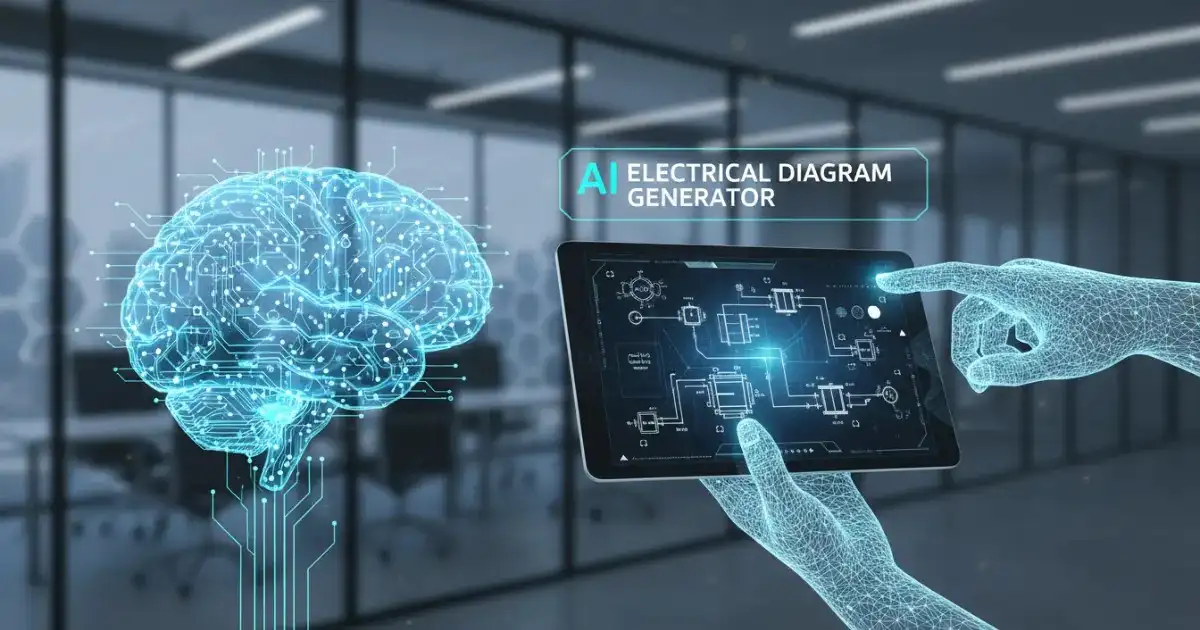
AI Electrical Diagram Generator
Electrical diagrams are the foundation of every electrical engineering project. Whether you're designing residential wiring, industrial automation systems, power distribution networks, control panels, PCB layouts, or renewable energy installations, creating accurate electrical diagrams is essential for safety, compliance, and efficient execution.
Traditionally, engineers spend hours—or even days—creating single-line diagrams, wiring diagrams, circuit schematics, panel layouts, and electrical documentation using CAD software. The process requires extensive manual effort, frequent revisions, and careful verification.
Artificial Intelligence can automatically generate electrical diagrams from simple text prompts, engineering requirements, existing documents, or imported circuit information. Instead of manually drawing every component, engineers can describe the system, and AI produces professional electrical drawings in minutes. Businesses building these capabilities often work with an experienced AI development company to turn these engineering workflows into production-ready software.
From architects and electrical contractors to manufacturing companies and energy firms, AI-powered electrical diagram generators are helping businesses reduce engineering costs while improving design quality.
In this comprehensive guide, we'll explore everything about AI electrical diagram generators, how they work, their benefits, applications, features, limitations, future trends, and how businesses can develop custom AI-powered electrical design solutions.
What is an AI Electrical Diagram Generator?
An AI Electrical Diagram Generator is an intelligent software system that uses Artificial Intelligence, Machine Learning, Computer Vision, Natural Language Processing (NLP), and engineering rules to automatically create electrical diagrams.
Instead of manually placing every switch, relay, transformer, breaker, motor, sensor, PLC, or wire connection, users simply describe the electrical system or upload existing documentation.
The AI then generates:
Single Line Diagrams (SLD)
Wiring Diagrams
Circuit Schematics
Panel Layouts
PLC Diagrams
Electrical Floor Plans
Power Distribution Diagrams
Control System Diagrams
Cable Routing Plans
Industrial Automation Diagrams
Modern AI systems also verify engineering rules, detect missing connections, optimize layouts, and recommend improvements before the design reaches production, much like the validation logic used across broader machine learning development services.
Why Traditional Electrical Diagram Design is Challenging
Electrical engineering projects involve significant complexity.
Common challenges include:
Manual drafting takes hours
Human errors during wiring
Repetitive design work
Version control issues
Difficulty maintaining standards
Complex documentation
Compliance verification
Frequent customer revisions
Large component libraries
Cross-team collaboration challenges
As projects become more complex, manual CAD workflows become increasingly inefficient.
This is where AI dramatically improves productivity.
How an AI Electrical Diagram Generator Works
AI electrical design software combines several intelligent technologies.
1. Requirement Understanding
The AI first analyzes project requirements.
Input may include:
Text prompts
PDFs
Existing CAD drawings
Excel BOM
Equipment specifications
PLC I/O lists
Customer requirements
Example prompt:
Design a three-phase motor control circuit with overload protection, emergency stop, and PLC integration.
The AI understands engineering intent before generating diagrams.
2. Component Recognition
The system identifies required electrical components.
Examples include:
Circuit breakers
Contactors
Relays
Fuses
PLCs
Sensors
Motors
Transformers
Power supplies
Terminal blocks
Large engineering libraries enable automatic component selection.
3. Engineering Rule Engine
Unlike ordinary diagram software, AI follows engineering principles.
It checks:
Voltage compatibility
Current ratings
Grounding
Cable sizing
Protection devices
Load balancing
Control logic
Safety regulations
4. Automatic Layout Optimization
AI intelligently arranges components.
It minimizes:
Wire crossings
Empty spaces
Long cable routes
Visual clutter
This creates clean professional diagrams.
5. Documentation Generation
Besides diagrams, AI generates:
Bill of Materials (BOM)
Cable schedules
Component lists
Terminal reports
Wiring labels
Installation documentation
Types of Electrical Diagrams AI Can Generate
Single Line Diagram (SLD)
Represents entire power systems using simplified symbols.
Used in:
Utilities
Manufacturing
Commercial buildings
Solar plants
Data centers
Wiring Diagram
Shows physical wiring between devices.
Common for:
Buildings
Control panels
Machinery
Vehicles
Circuit Schematic
Displays logical electrical connections rather than physical placement.
Widely used for:
PCB design
Electronics
Embedded systems
Control Panel Layout
Shows physical arrangement of:
PLC
Relays
Power supplies
Breakers
Terminal blocks
PLC Diagrams
AI creates:
Ladder logic diagrams
PLC wiring
I/O mapping
Control circuits
Power Distribution Diagram
Illustrates electrical distribution from:
Main panel
Transformers
Switchgear
Distribution boards
End loads
Renewable Energy Diagrams
Supports:
Solar farms
Battery storage
EV charging
Wind turbines
Microgrids
Benefits of AI Electrical Diagram Generators
Faster Design
Projects that once required several days can now be completed within hours or even minutes.
Reduced Human Errors
AI automatically checks:
Missing wires
Duplicate components
Incorrect ratings
Unsafe connections
Engineering Standard Compliance
AI follows:
IEC standards
IEEE standards
NEC
NFPA
ISO guidelines
Lower Engineering Costs
Automation reduces repetitive drafting work, allowing engineers to focus on system design rather than manual documentation.
Improved Collaboration
Cloud-based AI platforms allow multiple engineers to work simultaneously on the same project, similar to how teams collaborate through SaaS development company platforms built for distributed engineering teams.
Automatic Documentation
Instead of manually creating reports, AI automatically generates engineering documentation.
Better Revision Management
Design updates automatically propagate across all related diagrams and reports.
Industries Using AI Electrical Diagram Generators
Manufacturing
Industrial automation systems, robot wiring, control panels, and factory upgrades increasingly rely on AI agents for manufacturing to keep documentation synchronized with production changes.
Construction
Commercial buildings, residential wiring, hospitals, shopping malls, and hotels all depend on accurate electrical drawings, an area where AI agents for construction are increasingly used for planning and coordination.
Energy
Solar plants, wind farms, power stations, and battery storage projects benefit from the same automation trends seen among AI agents for energy providers.
Automotive
Electric vehicles, charging stations, vehicle electronics, and battery management systems all require detailed electrical documentation, a need also served by AI agents for automotive applications.
Oil & Gas
Refineries, pipeline automation, SCADA systems, and hazardous area designs.
Aerospace
Aircraft electrical systems, avionics, and ground equipment.
Smart Buildings
IoT systems, HVAC, security, lighting automation, and energy monitoring are frequently powered by IoT development company expertise alongside electrical design automation.
AI Technologies Behind Electrical Diagram Generation
Modern AI Electrical Diagram Generators rely on a combination of advanced Artificial Intelligence technologies rather than a single AI model. These systems integrate Machine Learning, Natural Language Processing (NLP), Computer Vision, Generative AI, Knowledge Graphs, and rule-based engineering engines to understand project requirements, generate accurate electrical diagrams, and validate designs against engineering standards.
By combining these technologies, AI can automate tasks that traditionally required experienced electrical engineers while still supporting human review and decision-making.
Machine Learning (ML)
Machine Learning is one of the core technologies powering AI Electrical Diagram Generators. ML algorithms learn from thousands of historical electrical engineering projects, allowing the system to recognize common design patterns, component relationships, wiring practices, and industry standards. Teams building this capability often turn to specialized machine learning development services to train and refine these models.
Instead of manually programming every design rule, machine learning models continuously improve by analyzing:
Previous electrical projects
Circuit schematics
Wiring diagrams
Panel layouts
Power distribution systems
PLC control circuits
Manufacturing documentation
Engineering revisions
Customer feedback
As more projects are processed, the AI becomes better at recommending components, predicting optimal layouts, identifying design inconsistencies, and generating diagrams that closely resemble those created by experienced engineers.
Machine learning also enables AI to identify recurring engineering practices across different industries, making the system increasingly accurate over time.
Computer Vision (CV)
Computer Vision enables AI to understand visual engineering documents rather than relying only on structured digital data. This technology allows the system to interpret images, scanned drawings, PDFs, blueprints, and legacy documentation, capabilities that overlap closely with dedicated image processing solutions.
Computer Vision can recognize:
Electrical symbols
Circuit components
Wiring connections
Panel layouts
Hand-drawn diagrams
Engineering annotations
Tables and legends
Equipment labels
For organizations with decades of existing engineering documentation, Computer Vision makes it possible to convert paper drawings into editable digital electrical diagrams.
Common applications include:
Reading scanned wiring diagrams
Digitizing old electrical blueprints
Extracting information from PDF drawings
Converting paper schematics into CAD-compatible formats
Identifying damaged or missing symbols
Comparing engineering revisions
Advanced Optical Character Recognition (OCR) is often combined with Computer Vision to extract text such as component names, cable numbers, terminal labels, voltage ratings, and engineering notes from technical documents.
Natural Language Processing (NLP)
Natural Language Processing allows engineers to interact with AI using everyday language instead of manually drawing circuits or writing complex programming instructions. This conversational approach mirrors the interfaces built by conversational AI development services for other industries.
Users can simply describe an electrical system, and the AI interprets the engineering intent before generating the appropriate diagram.
For example, an engineer might enter:
"Create a backup generator transfer circuit with Automatic Transfer Switch (ATS)."
"Generate a three-phase motor starter with overload protection."
"Design a solar inverter connection for a 500 kW photovoltaic plant."
"Build a PLC-controlled conveyor system with emergency stop buttons."
"Create a lighting control panel for a commercial office building."
NLP analyzes the request by identifying:
Required electrical equipment
Circuit type
Voltage level
Protection requirements
Control logic
Power distribution architecture
Industry-specific terminology
The AI then converts these natural language instructions into structured engineering diagrams without requiring manual drafting.
As large language models continue to improve, NLP systems are becoming increasingly capable of understanding complex engineering requirements and generating highly accurate electrical documentation, an area where a specialized large language model development company can add significant value.
Knowledge Graphs
Electrical engineering involves complex relationships between thousands of components, standards, and design rules. Knowledge Graphs help AI understand these relationships in a structured manner.
Instead of viewing components independently, Knowledge Graphs map how electrical devices interact with one another.
These relationships include:
Circuit breakers protecting feeders
Relays controlling contactors
Transformers supplying distribution panels
PLC outputs activating motors
Sensors communicating with controllers
Power supplies feeding automation equipment
Grounding systems protecting electrical installations
Knowledge Graphs also connect engineering information such as:
Electrical components
Manufacturer specifications
Industry standards
Safety regulations
Equipment compatibility
Wiring rules
Voltage classifications
Protection coordination
Because of these interconnected relationships, AI can recommend appropriate components, identify missing equipment, detect incompatible connections, and generate diagrams that follow accepted engineering practices, a strength commonly built through RAG development company approaches that ground AI outputs in structured knowledge.
Generative AI
Generative AI is responsible for creating entirely new electrical diagrams rather than simply copying existing templates. Vendors offering generative AI development work frequently apply these same deep learning techniques to design and drafting problems outside electrical engineering as well.
Using advanced deep learning models, Generative AI can automatically produce:
Single-line diagrams
Wiring diagrams
Circuit schematics
PLC control diagrams
Control panel layouts
Power distribution systems
Renewable energy electrical designs
Electrical floor plans
Unlike traditional CAD software that requires manual drawing, Generative AI predicts the most appropriate arrangement of electrical components based on engineering requirements.
It can automatically:
Position components
Route wiring
Optimize layouts
Minimize cable crossings
Generate labels
Create documentation
Build Bills of Materials (BOMs)
Engineers can also modify diagrams through conversational prompts such as:
"Add overload protection."
"Replace the transformer with a higher-capacity model."
"Move the PLC to the left side of the control panel."
"Generate an emergency backup circuit."
The AI updates the design instantly without requiring extensive manual editing, a workflow pattern similar to how AI copilot development tools assist professionals in other technical fields.
Rule-Based Expert Systems
Although machine learning and generative AI are highly capable, electrical engineering requires strict adherence to technical standards and safety regulations. Rule-Based Expert Systems ensure that every generated diagram follows established engineering principles.
These systems contain thousands of predefined engineering rules covering:
Voltage compatibility
Current ratings
Cable sizing
Grounding requirements
Protective device coordination
Load balancing
Short-circuit protection
Motor control logic
Transformer sizing
Equipment spacing
Safety clearances
Electrical code compliance
When AI generates a design, the rule engine automatically validates every connection against these engineering rules.
If a problem is detected, the system can:
Flag incorrect wiring
Recommend alternative components
Identify overloaded circuits
Detect missing protection devices
Highlight safety violations
Suggest engineering improvements
This combination of AI intelligence and deterministic engineering rules greatly improves design reliability and reduces the likelihood of costly errors, similar to how AI agents for compliance and risk management validate outputs against regulatory rule sets in other domains.
Deep Learning
Deep Learning is an advanced branch of machine learning that uses artificial neural networks to recognize highly complex engineering patterns.
Deep learning models are particularly effective for:
Symbol recognition
Diagram classification
Layout prediction
Component identification
Wiring pattern analysis
Image interpretation
Design optimization
Unlike traditional algorithms, deep learning systems improve their performance as they process larger engineering datasets, enabling them to generate increasingly accurate electrical diagrams over time, much like the models built by a dedicated deep learning development company.
Key Features to Look for
A modern AI electrical diagram generator should include:
Text-to-diagram generation
Automatic wiring
Symbol libraries
IEC/IEEE compliance
CAD export
Auto BOM
PLC support
Revision management
Cloud collaboration
Component recommendations
Error detection
Version history
Template generation
API integration
ERP integration
AI vs Traditional CAD Software
Feature | Traditional CAD | AI Generator |
|---|---|---|
Manual Drawing | Yes | No |
Auto Wiring | Limited | Yes |
Error Detection | Manual | Automatic |
Layout Optimization | Manual | AI Powered |
BOM Creation | Partial | Automatic |
Revision Updates | Manual | Automatic |
Design Suggestions | No | Yes |
Learning Capability | No | Yes |
Common Use Cases of AI Electrical Diagram Generators
AI Electrical Diagram Generators are transforming electrical engineering workflows across multiple industries. By automating diagram creation, documentation, validation, and revisions, these solutions help organizations reduce engineering effort, improve design accuracy, and accelerate project delivery. Below are some of the most common real-world applications.
Electrical Contractors
Electrical contractors manage a wide variety of projects, from residential wiring and commercial buildings to industrial installations. Preparing accurate electrical drawings for each project is often one of the most time-consuming stages of the job.
AI Electrical Diagram Generators enable contractors to quickly create:
Residential wiring diagrams
Commercial electrical layouts
Lighting control diagrams
Power distribution drawings
Panel schedules
Load calculations
Cable routing plans
Installation documentation
By automating repetitive drafting tasks, contractors can produce professional electrical documentation in significantly less time, respond faster to customer requests, and reduce costly design errors before installation begins.
Control Panel Manufacturers
Control panel manufacturers design and assemble electrical panels used in manufacturing plants, automation systems, utilities, and industrial machinery. Every project requires detailed panel layouts, wiring diagrams, terminal plans, and Bills of Materials (BOMs).
AI can automate much of this engineering work by generating:
Control panel layouts
Terminal block arrangements
Internal wiring diagrams
PLC wiring documentation
Cable numbering
Component labeling
Bill of Materials (BOM)
Manufacturing documentation
This automation improves consistency across projects, reduces engineering hours, and enables manufacturers to deliver customized control panels more efficiently while maintaining quality standards.
Solar and Renewable Energy Companies
Renewable energy projects involve complex electrical systems that connect solar panels, inverters, batteries, transformers, switchgear, and utility grids. Designing these systems manually can require extensive engineering effort.
AI-powered electrical design tools simplify renewable energy projects by automatically generating:
Solar plant single-line diagrams
Inverter connection diagrams
Battery Energy Storage System (BESS) layouts
DC and AC wiring diagrams
String configuration diagrams
Grid interconnection drawings
EV charging infrastructure diagrams
Power distribution documentation
These capabilities help renewable energy companies accelerate project planning, standardize designs, and reduce engineering costs for both residential and utility-scale installations.
Utility and Power Distribution Companies
Electric utility providers operate large-scale electrical infrastructure that includes substations, transmission lines, transformers, switchgear, and distribution networks. Maintaining accurate engineering documentation is critical for operational reliability and regulatory compliance.
AI Electrical Diagram Generators assist utility companies by creating:
Single-line substation diagrams
Distribution network layouts
Protection relay schematics
Transformer connection diagrams
Feeder line documentation
Switching procedures
Grid modernization plans
Maintenance documentation
Automated diagram generation improves engineering efficiency while ensuring that electrical documentation remains current throughout infrastructure upgrades and maintenance projects.
Industrial Automation Companies
Industrial automation firms build sophisticated control systems that integrate PLCs, sensors, motors, HMIs, robotic equipment, SCADA platforms, and industrial communication networks.
These projects often require extensive documentation, including:
PLC wiring diagrams
Ladder logic documentation
Motor control circuits
Sensor wiring layouts
I/O mapping diagrams
Industrial network diagrams
Control cabinet layouts
Automation system schematics
AI reduces repetitive engineering work by automatically generating these documents while applying standard automation design practices. Engineers can then focus on optimizing control strategies instead of manually drawing repetitive circuits, a shift also visible in how AI agents for process optimization are reshaping industrial workflows more broadly.
Electrical Engineering Consultants
Consulting firms are frequently responsible for designing electrical systems for commercial buildings, factories, hospitals, airports, educational institutions, and infrastructure projects. Clients often require multiple design revisions throughout the project lifecycle.
AI Electrical Diagram Generators help consultants:
Create conceptual electrical designs
Produce detailed engineering drawings
Generate client presentation diagrams
Prepare construction documentation
Update revisions automatically
Create compliance reports
Produce Bills of Materials
Generate project documentation
By shortening design cycles, consultants can handle more projects simultaneously, improve turnaround times, and deliver higher-quality engineering documentation to clients.
Construction and Building Design Firms
Construction companies and MEP (Mechanical, Electrical, and Plumbing) engineering firms use electrical diagrams throughout every stage of building development.
AI assists in generating:
Building electrical layouts
Lighting circuit diagrams
Emergency power system diagrams
Fire alarm wiring plans
HVAC electrical schematics
Generator connection diagrams
Distribution board layouts
Smart building automation diagrams
This reduces coordination issues between architects, civil engineers, and electrical teams while improving project scheduling and documentation accuracy.
Manufacturing Facilities
Large manufacturing plants continuously expand production lines, install new machinery, and upgrade electrical infrastructure. Every equipment modification requires updated electrical documentation.
AI can rapidly generate:
Machine wiring diagrams
Factory power distribution layouts
Motor control center (MCC) diagrams
Equipment installation drawings
Maintenance documentation
Electrical upgrade plans
Preventive maintenance schematics
Asset documentation
Keeping engineering documents synchronized with factory modifications helps reduce downtime and simplifies future maintenance activities.
Data Centers
Modern data centers depend on reliable electrical infrastructure to ensure uninterrupted operation. Designing redundant power systems requires highly detailed electrical documentation.
AI Electrical Diagram Generators support the creation of:
UPS distribution diagrams
Redundant power layouts
Rack power distribution drawings
Generator backup systems
Cooling system electrical diagrams
Grounding plans
Switchgear documentation
Power monitoring system diagrams
AI enables faster infrastructure planning while maintaining high levels of accuracy required for mission-critical environments.
Electric Vehicle (EV) Infrastructure Providers
As electric vehicle adoption grows worldwide, companies are rapidly deploying EV charging stations for residential, commercial, and public use.
AI simplifies the design of:
EV charging station wiring diagrams
Power distribution layouts
Load management systems
Charging network infrastructure
Battery backup systems
Renewable energy integration diagrams
Utility connection documentation
Smart charging control systems
Automation enables engineering teams to scale charging infrastructure projects while maintaining consistency across multiple installations.
Educational Institutions and Training Centers
Universities, engineering colleges, and technical institutes increasingly use AI-powered diagram generation tools to teach electrical engineering concepts more effectively, an approach paralleled by education software development services built for technical training programs.
Students and instructors can use AI to create:
Basic circuit schematics
Laboratory wiring diagrams
Power system models
Industrial control examples
PLC training diagrams
Electronics schematics
Renewable energy systems
Electrical safety demonstrations
AI helps students visualize electrical systems more quickly while allowing educators to create customized instructional materials with minimal effort.
Research and Product Development Teams
Organizations developing new electrical products, industrial equipment, IoT devices, robotics, or embedded systems frequently create multiple design iterations before finalizing a product.
AI Electrical Diagram Generators accelerate product development by automatically generating:
Prototype circuit diagrams
Electrical architecture designs
Functional block diagrams
Wiring documentation
Design revision comparisons
Test configuration diagrams
Validation documentation
Engineering reports
By reducing manual drafting time, research and development teams can focus more on innovation, testing, and product optimization.
Government and Infrastructure Projects
Government agencies responsible for transportation, public utilities, defense, healthcare, and infrastructure development require extensive electrical documentation throughout project lifecycles, work that increasingly involves AI agents for government initiatives for documentation and compliance.
AI assists in preparing:
Airport electrical systems
Railway signaling diagrams
Smart city electrical infrastructure
Water treatment plant schematics
Public lighting systems
Hospital emergency power layouts
Defense facility electrical documentation
Infrastructure maintenance records
Automated diagram generation improves documentation quality, reduces project delays, and helps ensure compliance with government engineering standards.
System Integrators
System integration companies combine hardware, software, automation, networking, and electrical infrastructure into complete operational systems for enterprise customers, often relying on enterprise software development partners to tie these systems together.
AI enables system integrators to rapidly produce:
Multi-system wiring diagrams
Industrial communication network layouts
Integrated control system schematics
SCADA architecture diagrams
PLC and HMI connection drawings
Instrumentation diagrams
Cable schedules
System documentation packages
This reduces engineering effort during deployment while making future maintenance and system upgrades significantly easier.
AI Electrical Diagram Workflow
Typical workflow:
Receive customer requirements.
AI analyzes project inputs.
Components are selected.
Wiring logic is generated.
Layout is optimized.
Engineering rules are validated.
Documentation is created.
Engineers review and approve.
Export to CAD/PDF.
Production begins.
Challenges of AI Electrical Diagram Generation
Although AI Electrical Diagram Generators have significantly improved the speed and efficiency of electrical design, they are not without limitations. Creating safe, standards-compliant, and production-ready electrical diagrams often requires a combination of AI automation and experienced engineering judgment. Understanding these challenges helps organizations set realistic expectations and implement AI solutions effectively.
Complex Custom Designs
AI performs exceptionally well when generating diagrams based on standard electrical practices, predefined templates, and historical design data. However, highly customized industrial systems often present unique engineering challenges that AI cannot fully address on its own.
Industries such as aerospace, semiconductor manufacturing, nuclear power, oil and gas, and heavy industrial automation frequently require specialized electrical architectures with custom protection schemes, proprietary control logic, and unique equipment configurations. These projects may involve complex interdependencies, safety-critical systems, and customer-specific design standards that are difficult for AI models to generalize.
In such cases, experienced electrical engineers must review, modify, and validate AI-generated diagrams to ensure they meet functional requirements, operational objectives, and industry-specific standards. AI serves as a powerful design assistant, but expert engineering knowledge remains essential for handling highly specialized projects.
Regulatory Differences
Electrical design regulations vary significantly across countries, industries, and local jurisdictions. A diagram that complies with one region's standards may not satisfy another's legal or technical requirements.
For example, electrical projects may need to comply with:
National Electrical Code (NEC)
International Electrotechnical Commission (IEC) standards
IEEE standards
NFPA regulations
BS 7671 Wiring Regulations
Local utility requirements
Building and fire safety codes
AI systems must be trained using the correct regional regulations and continuously updated as standards evolve. Failure to apply the appropriate code requirements can lead to non-compliant designs, costly project delays, failed inspections, or potential safety hazards. Organizations implementing AI electrical design tools should ensure that the software supports configurable rule sets for different countries and industries.
Legacy Documentation
Many organizations continue to rely on decades-old electrical documentation stored as paper drawings, scanned PDFs, hand-drawn schematics, or low-resolution images. These legacy documents often present significant challenges for AI-powered systems.
Common issues include:
Faded or damaged drawings
Low-quality scans
Handwritten engineering notes
Outdated electrical symbols
Missing documentation
Inconsistent formatting
Multiple revisions with unclear version history
Although modern Computer Vision (CV) and Optical Character Recognition (OCR) technologies have improved dramatically, AI may still struggle to accurately interpret poor-quality legacy documents. Engineers often need to manually verify extracted information before converting it into digital electrical diagrams. Organizations with extensive historical documentation may also need document-cleaning and digitization processes before AI can effectively analyze their drawings.
Component Library Updates
Electrical technology evolves continuously as manufacturers release new circuit breakers, PLCs, relays, sensors, drives, transformers, smart meters, EV charging equipment, renewable energy components, and industrial automation devices.
An AI Electrical Diagram Generator depends heavily on accurate and up-to-date component libraries. If these libraries are outdated, the AI may recommend obsolete components, incorrect symbols, or incompatible devices.
To maintain design accuracy, organizations should regularly update:
Manufacturer component catalogs
Electrical symbols
Wiring specifications
Product dimensions
Technical datasheets
Voltage and current ratings
Communication protocols
Industry certification information
Continuous updates ensure that AI-generated diagrams reflect the latest technologies and comply with current engineering practices.
Human Review Still Required
While AI can automate repetitive drafting tasks and significantly improve engineering productivity, it should not replace professional engineering oversight.
Electrical systems directly impact human safety, operational reliability, and regulatory compliance. Errors in electrical diagrams can lead to equipment failures, production downtime, financial losses, or serious safety incidents.
Qualified electrical engineers should always review AI-generated designs to verify:
Circuit correctness
Load calculations
Short-circuit protection
Grounding and bonding
Cable sizing
Voltage drop analysis
Protective device coordination
Control logic
Compliance with applicable electrical codes
Project-specific engineering requirements
Human expertise remains critical for identifying project-specific risks that AI may overlook. AI should be viewed as an intelligent engineering assistant that accelerates design work, while final approval and responsibility continue to rest with licensed professionals.
Integration with Existing Engineering Software
Many engineering organizations already use established software ecosystems such as AutoCAD Electrical, EPLAN, SolidWorks Electrical, ETAP, Revit, PLC programming tools, ERP systems, and Product Lifecycle Management (PLM) platforms.
Integrating an AI Electrical Diagram Generator with these existing systems can be technically challenging. Differences in file formats, proprietary data structures, symbol libraries, and workflow processes may require custom APIs or middleware to ensure seamless interoperability, work commonly handled through AI agent API integration services.
Without proper integration, engineers may face duplicate work, data inconsistencies, and inefficient workflows. Successful AI implementation often depends on carefully planning software compatibility and data synchronization.
Data Security and Intellectual Property Protection
Electrical diagrams often contain sensitive engineering information, proprietary system architectures, and confidential customer data. Organizations working in sectors such as defense, healthcare, energy, or manufacturing must ensure that AI platforms protect this information.
Key security considerations include:
Secure cloud storage
End-to-end encryption
Role-based access control
Compliance with ISO 27001 and GDPR
Protection of intellectual property
Secure collaboration features
Audit logs and version tracking
Businesses deploying AI-powered electrical design solutions should prioritize cybersecurity to prevent unauthorized access and protect valuable engineering assets, an area where AI agents for cybersecurity can add continuous monitoring on top of standard controls.
Training and Change Management
Introducing AI into traditional electrical engineering workflows requires more than installing new software. Engineers, designers, and project managers need training to effectively use AI tools and understand their capabilities and limitations.
Organizations may encounter challenges such as:
Resistance to adopting new technology
Learning new AI-assisted workflows
Updating engineering processes
Revising quality assurance procedures
Managing collaboration between AI and engineering teams
A structured change management strategy—including user training, pilot projects, and ongoing support—can help teams successfully integrate AI into their daily engineering activities.
Continuous Learning and Model Improvement
AI models are only as effective as the data they are trained on. As electrical standards, technologies, and engineering practices evolve, AI systems require continuous retraining and refinement, work often supported through dedicated LLM fine-tuning services when large language models are part of the pipeline.
Organizations should regularly improve their AI models by incorporating:
Newly completed engineering projects
Updated regulatory standards
Customer feedback
Design revisions
Field installation data
Maintenance records
Engineering best practices
Continuous learning enables AI Electrical Diagram Generators to become more accurate, efficient, and reliable over time, ensuring they remain valuable tools for modern electrical engineering projects.
Future of AI Electrical Diagram Generators
The next generation of AI-powered electrical engineering tools will offer even greater capabilities.
Future innovations include:
Voice-to-diagram generation
Real-time code compliance validation
Digital twin integration
Augmented Reality (AR) visualization
Predictive maintenance recommendations
Automatic cable routing optimization
AI-powered load calculations
Self-learning engineering assistants
Multi-language engineering support
Autonomous project documentation
Voice-to-diagram generation in particular builds on the same underlying technology as an AI voice agent development service, adapted for engineering commands instead of conversational support. These advancements will further reduce design time while improving safety and engineering accuracy.
How Businesses Can Build a Custom AI Electrical Diagram Generator
Organizations with specialized engineering workflows often benefit from custom AI solutions rather than off-the-shelf software, typically developed in partnership with an experienced AI agent development company.
A custom AI electrical diagram generator can be tailored to:
Company-specific electrical standards
Proprietary component libraries
Internal design templates
Compliance requirements
ERP integration
PLM integration
CAD software integration
Engineering approval workflows
Manufacturing systems
Cloud collaboration
Typical development involves:
Requirement analysis
Data collection and model training
Electrical symbol library creation
AI model integration
Rule engine implementation
User interface development
CAD export functionality
Testing and validation
Deployment and maintenance
Such platforms can significantly improve engineering productivity and reduce repetitive drafting work across large organizations, and teams that need specialized talent often choose to hire AI engineers to build and maintain the system long-term.
Best Practices for Using AI Electrical Diagram Generators
To maximize the value of AI-generated electrical diagrams:
Provide clear and detailed project requirements.
Maintain an up-to-date component library.
Configure the AI with relevant electrical standards (IEC, IEEE, NEC, etc.).
Review all AI-generated outputs through qualified electrical engineers.
Integrate the platform with CAD, ERP, and PLM systems for seamless workflows.
Continuously train the AI using completed engineering projects and approved designs.
Keep version control and documentation synchronized throughout the project lifecycle, supported where needed by data analytics services to track design performance over time.
Conclusion
AI Electrical Diagram Generators are redefining how electrical systems are designed, documented, and maintained. By combining artificial intelligence, machine learning, engineering rule engines, and automation, these tools dramatically reduce design time, minimize human errors, and improve documentation quality.
As industries continue to adopt automation and digital engineering workflows, AI-powered diagram generation will become an essential capability for electrical contractors, consultants, manufacturers, utilities, and infrastructure organizations. While human expertise remains critical for validation and compliance, AI enables engineers to focus on innovation rather than repetitive drafting tasks.
Businesses looking to gain a competitive advantage should consider adopting or developing custom AI electrical diagram generation solutions that align with their engineering standards, workflows, and compliance requirements. Early adoption can lead to faster project delivery, lower operational costs, and more accurate electrical designs in an increasingly digital engineering landscape.
Frequently Asked Questions (FAQs)
An AI electrical diagram generator is a software tool that uses artificial intelligence to automatically design and route electrical schematics based on text prompts, specifications, or historical data.
Yes. Advanced AI models can generate full electrical schematics by analyzing input requirements, selecting appropriate components, and routing wires logically while adhering to electrical safety standards.
Leading enterprise AI generators feature built-in rule engines that cross-reference designs against NEC, IEC, and other global standards, though a human engineer must still review them for final certification.
Most AI generators export to standard industry formats, including DWG, DXF, PDF, and specialized formats compatible with AutoCAD Electrical, EPLAN, and SolidWorks.
Absolutely. AI is an assistive tool that drastically speeds up the drafting process, but a qualified electrical engineer is required to provide the correct prompts, validate the logic, and take liability for the final design.

Yash Singh is the Chief Marketing Officer at Vegavid Technology, a leading AI-driven technology company specializing in AI agents, Generative AI, Blockchain, and intelligent automation solutions. With over a decade of experience in digital transformation and emerging technologies, Yash has played a key role in helping businesses adopt advanced AI solutions that enhance operational efficiency, automate workflows, and deliver personalized customer experiences across industries including fintech, healthcare, gaming, ecommerce, and enterprise technology. An alumnus of Indian Institute of Technology Bombay, Yash combines strong technical expertise with strategic marketing leadership to drive innovation in AI-powered applications, autonomous AI agents, Retrieval-Augmented Generation (RAG), Natural Language Processing (NLP), Large Language Models (LLMs), machine learning systems, conversational AI, and enterprise automation platforms. His expertise spans AI model integration, intelligent workflow automation, prompt engineering, smart data processing, and scalable AI infrastructure development, enabling organizations to accelerate digital transformation and business growth. Passionate about the future of intelligent systems, Yash actively shares insights on AI agents, Generative AI, LLM-powered applications, blockchain ecosystems, and next-generation digital strategies. He is committed to helping businesses embrace AI-first transformation while guiding teams to build impactful, industry-specific solutions that shape the future of innovation and intelligent technology.





Leave a Reply