
The Shift from Generative AI to Agentic AI: The Future of Enterprise Automation
Artificial intelligence has evolved at an extraordinary pace over the last few years. Initially, organizations focused on predictive analytics and machine learning models capable of identifying patterns in data. The emergence of Large Language Models (LLMs) transformed this landscape by enabling machines to understand, generate, summarize, and translate human language with remarkable fluency. This breakthrough marked the beginning of the Generative AI era, where businesses rapidly adopted AI-powered assistants to improve productivity, automate content creation, and enhance customer interactions.
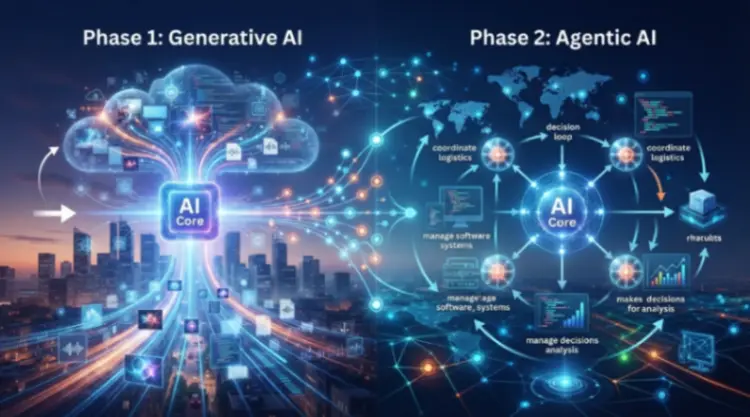
While Generative AI has dramatically improved knowledge work, it still operates primarily as a reactive system. It responds when prompted, generates outputs, and waits for the next instruction. Today's enterprises, however, require AI systems capable of making informed decisions, coordinating complex workflows, utilizing enterprise tools, and completing multi-step objectives with minimal human intervention. This need has accelerated the rise of Agentic AI.
Agentic AI represents the next major evolution of enterprise artificial intelligence. Rather than acting solely as a conversational assistant, it functions as an autonomous problem solver capable of reasoning, planning, using external applications, remembering context, and continuously adapting to changing objectives. These intelligent agents are increasingly becoming active participants in business operations instead of passive assistants.
As organizations seek higher operational efficiency, faster decision-making, and scalable automation, the conversation is shifting from "How can AI generate better responses?" to "How can AI independently accomplish business goals?" This transition marks one of the most significant technological shifts since the emergence of cloud computing.
Businesses exploring this transformation often begin by understanding Agentic AI before evaluating how autonomous systems can fit into their digital transformation strategy.
Understanding Generative AI
Generative AI refers to artificial intelligence models designed to create new content based on patterns learned from vast amounts of training data. These systems generate text, images, code, audio, videos, and structured information by predicting the most likely output for a given prompt.
Modern Generative AI relies heavily on Large Language Models (LLMs), which are trained on billions of words collected from books, websites, research papers, and other publicly available sources. These models understand context, grammar, reasoning patterns, and semantic relationships, enabling them to produce highly coherent outputs.
Popular enterprise applications of Generative AI include:
Content creation and marketing
Code generation
Email drafting
Knowledge management
Document summarization
Translation
Customer support chatbots
Data analysis assistance
Despite these impressive capabilities, Generative AI has an important limitation: it is fundamentally reactive. Every action begins with a human prompt. Once the response is generated, the model stops working unless another instruction is provided.
For example, imagine asking an AI assistant to prepare a market analysis report. A Generative AI system may produce a high-quality report based on existing information, but it will not independently collect updated market data, validate sources, compare competitors, create visualizations, send emails, or schedule follow-up tasks. Humans remain responsible for orchestrating every step.
This limitation becomes increasingly apparent inside enterprise environments where business processes involve multiple systems, stakeholders, approvals, APIs, databases, and ongoing decision-making.
Organizations are therefore moving beyond isolated AI conversations toward intelligent systems capable of executing complete workflows with minimal supervision.
What Is Agentic AI?
Agentic AI is an advanced form of artificial intelligence that enables autonomous AI agents to reason, plan, make decisions, interact with digital tools, and complete complex objectives with minimal human intervention. As businesses increasingly adopt autonomous AI solutions, partnering with an experienced agentic AI development company helps organizations design, deploy, and scale secure, enterprise-ready AI agents tailored to their unique business requirements.
Unlike traditional AI assistants that simply answer questions, Agentic AI continuously evaluates its environment, breaks objectives into manageable tasks, executes them using external tools, monitors outcomes, and adjusts its strategy whenever necessary. An agentic AI development company combines technologies such as Large Language Models (LLMs), Retrieval-Augmented Generation (RAG), multi-agent system, and enterprise integrations to build intelligent AI agents capable of automating complex workflows, improving operational efficiency, and accelerating digital transformation.
In practical terms, an Agentic AI system behaves more like a skilled digital employee than a conversational chatbot.
For example, instead of merely recommending how to resolve customer complaints, an Agentic AI platform can:
Retrieve customer history from CRM systems
Analyze previous conversations
Check inventory availability
Calculate refund eligibility
Draft personalized responses
Escalate high-priority cases
Update internal databases
Notify relevant teams automatically
All of these actions occur as part of a coordinated workflow rather than isolated AI responses.
This evolution is explained further in Vegavid's guide on Agentic AI architecture, which discusses how reasoning engines, memory modules, planning systems, and orchestration frameworks work together to create autonomous intelligence.
Agentic AI combines several technologies, including LLMs, planning algorithms, memory systems, Retrieval-Augmented Generation (RAG), APIs, workflow orchestration engines, and external software integrations. Together, these components allow AI agents to continuously pursue objectives instead of waiting for prompts.
Generative AI vs. Agentic AI: Key Differences
Although both technologies rely on modern language models, their capabilities differ significantly.
Generative AI | Agentic AI |
|---|---|
Produces responses | Completes objectives |
Prompt driven | Goal driven |
Reactive | Proactive |
Limited memory | Persistent memory |
Minimal planning | Multi-step planning |
Limited tool usage | Extensive tool orchestration |
Single interactions | Continuous workflows |
Requires human guidance | Operates autonomously with oversight |
Consider a software development project. A Generative AI assistant may write code snippets or explain programming concepts. An Agentic AI system can analyze project requirements, generate implementation plans, assign development tasks, review pull requests, execute automated testing, deploy updates, monitor application health, and notify engineering teams if issues occur.
Organizations comparing these technologies can better understand their differences through Vegavid's article on Generative AI vs AI Agents vs Agentic AI, which explains where each approach delivers the greatest business value.
Why Businesses Are Moving Beyond Generative AI
Enterprise adoption of Generative AI has demonstrated measurable productivity improvements. Employees spend less time writing reports, creating presentations, summarizing meetings, and researching information. However, executives increasingly recognize that productivity gains alone do not fundamentally transform business operations.
Modern enterprises require intelligent systems capable of executing end-to-end workflows rather than simply assisting employees during isolated tasks.
Several business drivers are accelerating this transition.
First, organizations face increasing operational complexity. Modern businesses rely on hundreds of SaaS platforms, internal databases, AI APIs, cloud services, collaboration tools, and customer engagement systems. Coordinating these environments manually is expensive and time-consuming.
Second, customer expectations continue to rise. Consumers expect instant responses, personalized experiences, proactive support, and uninterrupted service across multiple channels. Meeting these expectations requires AI systems capable of making decisions in real time rather than simply generating responses.
Third, enterprises seek greater operational scalability. Hiring additional staff to manage repetitive workflows becomes increasingly costly, whereas autonomous AI agents can execute thousands of repetitive decisions simultaneously while maintaining consistency.
Finally, competitive pressure is forcing organizations to automate increasingly sophisticated business functions. Companies adopting autonomous AI today are likely to achieve substantial operational advantages over competitors that rely solely on traditional automation.
This growing shift explains why enterprise investment is rapidly moving toward multi-agent systems, intelligent orchestration, and autonomous business operations rather than standalone chatbots.
How Agentic AI Works
Agentic AI combines multiple specialized capabilities that allow autonomous AI systems to solve problems much like experienced professionals. Instead of generating a single response, these systems continuously evaluate goals, gather information, make decisions, execute tasks, and learn from outcomes.
The core capabilities include reasoning, planning, memory, tool integration, and autonomous execution.
Reasoning
Reasoning enables Agentic AI to evaluate situations before taking action. Rather than predicting the next word like traditional language models, reasoning systems analyze objectives, identify constraints, evaluate possible solutions, and determine the most effective course of action.
For example, if an enterprise procurement agent receives a request to purchase hardware, it may compare multiple vendors, evaluate pricing, verify inventory availability, review previous purchasing history, ensure policy compliance, and recommend the most cost-effective option before placing an order.
This capability allows AI agents to solve business problems rather than merely answering questions.
Planning
Planning transforms high-level business objectives into structured sequences of executable tasks.
If an organization instructs an AI agent to onboard a new employee, the system may automatically divide the objective into smaller actions such as creating user accounts, requesting IT equipment, scheduling orientation sessions, granting application permissions, notifying managers, generating documentation, and tracking completion status.
Planning enables Agentic AI to handle long-running workflows that may extend across multiple days, departments, or software platforms.
Memory
Unlike traditional chatbots that often forget previous interactions, Agentic AI incorporates persistent memory to maintain long-term context.
Memory allows agents to remember customer preferences, previous conversations, completed tasks, business rules, historical decisions, organizational policies, and project milestones.
This continuity significantly improves personalization, reduces repetitive interactions, and enables more informed decision-making over time.
Tool Integration
One of the defining characteristics of Agentic AI is its ability to interact directly with enterprise software.
Instead of remaining confined to a chat interface, AI agents can connect with CRM platforms, ERP systems, cloud storage, ticketing software, calendars, databases, payment systems, analytics dashboards, and internal APIs.
Modern implementations frequently combine these capabilities with Retrieval-Augmented Generation (RAG) to access trusted enterprise knowledge bases. Organizations interested in improving factual accuracy often deploy RAG-powered enterprise knowledge systems alongside autonomous AI agents.
Autonomous Execution
The final capability that distinguishes Agentic AI from traditional Generative AI is autonomous execution.
After reasoning, planning, retrieving relevant information, and selecting appropriate tools, the AI independently performs actions while continuously monitoring progress.
If unexpected events occur, such as missing information, system failures, or changing priorities, the agent dynamically adjusts its execution strategy rather than terminating the workflow.
This adaptive behavior enables enterprises to automate increasingly sophisticated business operations without requiring constant human supervision, laying the foundation for intelligent digital workforces capable of operating around the clock.
The Evolution from AI Assistants to Autonomous AI Agents
The journey from conversational AI assistants to autonomous AI agents reflects one of the most significant technological transformations in enterprise computing. The history of AI agents dates back to early rule-based expert systems and intelligent software programs that could automate simple, predefined tasks. Over time, advances in machine learning,deep learning, Large Language Models (LLMs), and Retrieval-Augmented Generation (RAG) transformed these limited systems into intelligent agents capable of reasoning, planning, and autonomous decision-making. Early AI assistants were primarily designed to answer questions, summarize documents, translate languages, or generate text based on user prompts. While these capabilities dramatically improved productivity, they still relied on continuous human guidance for every step of a workflow.
Today's enterprises require far more than intelligent conversations. Modern organizations operate across hundreds of interconnected systems, including customer relationship management platforms, enterprise resource planning software, cloud infrastructure, collaboration tools, analytics dashboards, and proprietary databases. Coordinating these systems manually creates operational bottlenecks that traditional Generative AI cannot solve on its own.
Autonomous AI agents bridge this gap by combining reasoning, planning, memory, and execution into a single intelligent system. Rather than responding to isolated prompts, they continuously pursue business objectives, make decisions based on changing conditions, interact with multiple enterprise applications, and collaborate with both humans and other AI agents, representing the next major milestone in the history of AI agents and the evolution of enterprise artificial intelligence.
This progression is further explored in Vegavid's guide to the history of AI agents, which highlights how intelligent systems have evolved from rule-based automation into sophisticated autonomous decision-makers.
Another important milestone is the emergence of multi-agent systems. Instead of relying on one AI model to perform every task, enterprises increasingly deploy specialized agents responsible for different business functions. One agent may perform research, another validates compliance, another executes workflows, while another monitors outcomes and reports exceptions.
This collaborative approach enables enterprises to automate increasingly complex processes without sacrificing transparency, scalability, or governance.
Benefits of Agentic AI for Enterprises
The adoption of Agentic AI extends far beyond productivity improvements. Organizations implementing autonomous AI systems are fundamentally redesigning how work is performed across departments. Rather than automating individual tasks, Agentic AI automates complete business processes while enabling employees to focus on strategic decision-making and innovation.
One of the most significant advantages is operational efficiency. AI agents can perform repetitive, time-consuming activities around the clock without interruptions. Whether processing invoices, responding to customer inquiries, generating reports, or monitoring infrastructure, autonomous systems significantly reduce manual workloads.
Another major benefit is faster decision-making. Traditional workflows often require multiple approvals, manual research, and coordination across teams. Agentic AI can gather information from multiple sources, evaluate available options, recommend optimal actions, and execute approved decisions within seconds.
Consistency also improves considerably. Human teams naturally introduce variability into repetitive processes, while AI agents follow predefined policies, business rules, and governance frameworks consistently across every interaction. This consistency becomes especially valuable in regulated industries such as healthcare, banking, insurance, and manufacturing.
Scalability represents another compelling advantage. Hiring additional employees to support business growth often requires significant investment in recruitment, onboarding, and training. AI agents, however, can scale horizontally across thousands of concurrent workflows without proportional increases in operational costs.
Organizations also gain deeper business insights through continuous monitoring and analytics. Autonomous agents generate detailed execution logs, performance metrics, operational trends, and optimization recommendations that help leadership improve business processes over time.
Finally, Agentic AI enables enterprises to deliver highly personalized customer experiences. By maintaining long-term memory and integrating with CRM systems, AI agents understand customer preferences, previous interactions, purchasing history, and service requirements, allowing every interaction to become more contextual and relevant.
Real-World Use Cases Across Industries
Agentic AI is rapidly moving from experimental deployments to enterprise-wide adoption across virtually every industry. Unlike traditional automation tools that perform predefined tasks, autonomous AI agents adapt dynamically to changing situations while continuously optimizing business outcomes.
Customer Support
Customer support AI agents remains one of the earliest and most mature applications of Agentic AI. Traditional chatbots typically answer frequently asked questions before escalating more complicated requests to human representatives. Agentic AI dramatically expands these capabilities.
Modern customer service agents can verify customer identities, retrieve purchase histories, diagnose issues, process refunds, coordinate shipping updates, schedule technician visits, escalate urgent cases, update CRM records, and proactively follow up with customers after resolution.
Instead of transferring conversations multiple times, autonomous AI agents coordinate every stage of the customer journey while involving human agents only when necessary. This significantly reduces response times while improving customer satisfaction.
Healthcare
AI agents for Healthcare organizations are increasingly adopting Agentic AI to improve clinical operations without replacing healthcare professionals.
AI agents assist with appointment scheduling, patient triage, insurance verification, clinical documentation, medication reminders, treatment coordination, and post-discharge monitoring. By integrating with electronic health record systems, they provide clinicians with comprehensive patient summaries before consultations.
Hospitals also use autonomous agents to optimize resource allocation, predict patient demand, coordinate operating room schedules, and monitor medical supply inventories. These capabilities allow healthcare providers to focus more time on direct patient care while reducing administrative burdens.
Finance
AI agents for Finance institutions process enormous volumes of transactions, regulatory requirements, fraud investigations, and customer requests every day. Agentic AI significantly accelerates these operations through intelligent automation.
Autonomous agents analyze financial transactions for suspicious behavior, monitor regulatory compliance, generate investment reports, automate loan processing, evaluate credit risk, reconcile accounts, and support wealth management advisors with real-time market insights.
Rather than replacing financial professionals, AI agents enhance their productivity by handling repetitive analytical tasks while humans focus on complex financial decision-making.
Manufacturing
Manufacturing AI agents companies increasingly deploy Agentic AI across production planning, predictive maintenance, quality assurance, inventory optimization, procurement, and logistics.
AI agents continuously monitor factory equipment using IoT sensors, identify early signs of equipment failure, automatically schedule maintenance, coordinate spare parts procurement, and optimize production schedules based on customer demand.
Because these systems continuously learn from operational data, manufacturers experience reduced downtime, improved production efficiency, and better supply chain resilience.
Retail & E-commerce
Retail AI agents organizations leverage Agentic AI to deliver personalized shopping experiences while improving operational efficiency.
Autonomous agents recommend products, manage inventory replenishment, optimize pricing strategies, forecast seasonal demand, detect fraudulent purchases, automate order fulfillment, and coordinate returns processing.
AI agents also analyze customer browsing behavior across multiple channels, enabling retailers to deliver highly personalized promotions and improve customer retention through intelligent engagement.
Software Development
Software engineering teams are increasingly adopting Agentic AI throughout the software development lifecycle.
Instead of merely generating code, autonomous AI agents can analyze requirements, decompose development tasks, write code, perform automated testing, review pull requests, identify security vulnerabilities, optimize infrastructure, generate technical documentation, and monitor application performance after deployment.
This collaborative model enables developers to spend more time solving architectural challenges while AI agents handle repetitive engineering tasks.
Organizations implementing autonomous software engineering workflows often combine AI agents with enterprise orchestration frameworks to improve scalability, governance, and deployment reliability.
Technologies Powering the Agentic AI Revolution
Agentic AI is not powered by a single technology. Instead, it combines several advanced AI disciplines into an integrated ecosystem capable of autonomous decision-making.
Large Language Models remain the primary reasoning engine responsible for understanding objectives, generating plans, interpreting instructions, and communicating naturally with users. However, LLMs alone are insufficient for enterprise autonomy.
Retrieval-Augmented Generation (RAG) extends these capabilities by enabling AI agents to retrieve trusted information from enterprise knowledge bases rather than relying solely on model memory. This significantly improves factual accuracy while reducing hallucinations.
Businesses implementing enterprise AI frequently explore LLMOps for enterprise LLM management to monitor model performance, versioning, governance, and deployment across production environments.
Vector databases provide semantic search capabilities that allow AI agents to retrieve highly relevant information based on meaning instead of simple keyword matching. This enables contextual decision-making across massive enterprise knowledge repositories.
Workflow orchestration platforms coordinate interactions between multiple AI agents, enterprise software systems, APIs, databases, and human stakeholders. They ensure tasks are executed in the correct sequence while handling exceptions, retries, approvals, and monitoring.
Memory architectures enable AI agents to preserve context across long-running workflows, while planning algorithms decompose complex objectives into executable actions.
Finally, robust API integration frameworks allow autonomous agents to interact securely with enterprise applications, cloud platforms, communication systems, analytics tools, and third-party services.
Challenges and Risks of Agentic AI
Although Agentic AI offers substantial business value, its increasing autonomy introduces new technical, operational, and ethical challenges that organizations must address before large-scale deployment.
One of the most significant concerns involves decision accuracy. Autonomous agents may occasionally make incorrect assumptions when operating with incomplete information, outdated knowledge, or ambiguous objectives. Without proper validation mechanisms, these errors can propagate across entire workflows.
Security is another major consideration. Since Agentic AI interacts directly with enterprise systems, improper access controls could expose sensitive customer information, financial records, intellectual property, or proprietary business data.
Integration complexity also presents challenges. Large enterprises often operate legacy software alongside modern cloud platforms, making interoperability a significant implementation hurdle.
Operational transparency remains equally important. Business leaders must understand why autonomous agents reached specific decisions, particularly in highly regulated industries where explainability and auditability are mandatory.
Enterprises preparing for large-scale deployments should also understand broader AI risks and ethical considerations for business to ensure responsible implementation.
Governance, Security, and Human Oversight
As AI systems become increasingly autonomous, governance evolves from a compliance requirement into a strategic business capability.
Organizations must establish comprehensive governance frameworks defining how AI agents access enterprise systems, make decisions, interact with customers, handle sensitive information, and escalate uncertain situations.
Human oversight remains essential throughout the lifecycle of autonomous AI. High-impact decisions involving legal matters, financial approvals, healthcare diagnoses, or strategic business operations should always include clearly defined human review processes.
Security frameworks should implement role-based access control, encrypted communications, secure API authentication, continuous monitoring, anomaly detection, and comprehensive audit logging to protect enterprise environments.
Organizations building enterprise-grade autonomous systems increasingly rely on structured AI governance frameworks to balance innovation with security, compliance, transparency, and responsible AI practices.
Future Trends: The Next Phase of Enterprise AI
The evolution toward Agentic AI is only the beginning of a much broader transformation. Over the next several years, enterprises will increasingly adopt intelligent digital workforces composed of multiple specialized AI agents collaborating across departments and business functions.
Multi-agent ecosystems will become a standard architectural pattern. Rather than assigning every responsibility to a single AI model, organizations will deploy research agents, planning agents, coding agents, compliance agents, security agents, customer service agents, and analytics agents that communicate with one another to accomplish shared objectives.
As these ecosystems mature, orchestration platforms will become increasingly sophisticated. AI agents will dynamically assign work, negotiate priorities, exchange knowledge, and optimize workflows based on changing business conditions without requiring constant human intervention.
Another emerging trend is domain-specific Agentic AI. Instead of relying solely on general-purpose language models, organizations will build autonomous agents specialized for healthcare, finance, manufacturing, legal services, logistics, insurance, retail, and software engineering. These specialized agents will incorporate industry regulations, operational best practices, and enterprise-specific knowledge directly into their reasoning processes.
Advancements in enterprise AI infrastructure will also play a major role. Improved vector databases, distributed memory architectures, LLMOps platforms, AI observability tools, and governance frameworks will make autonomous systems more reliable, scalable, and secure.
Human-AI collaboration will evolve rather than disappear. Employees will increasingly supervise, coordinate, and optimize AI agents instead of performing repetitive operational work themselves. New job roles focused on AI governance, prompt engineering, workflow orchestration, agent supervision, and AI operations will continue to emerge.
Organizations investing in these capabilities today will be better positioned to respond to future technological advances while maintaining competitive advantages in increasingly AI-driven markets.
Why Partnering with an Agentic AI Development Company Matters
While the business value of Agentic AI is compelling, developing enterprise-grade autonomous systems requires specialized expertise that extends beyond deploying Large Language Models. Successful implementations involve workflow engineering, enterprise architecture, API integrations, security frameworks, governance policies, data infrastructure, monitoring systems, and continuous optimization.
An experienced Agentic AI development company understands how to design autonomous workflows that align with business objectives rather than simply integrating AI into existing processes. This strategic perspective ensures that organizations achieve measurable operational improvements instead of isolated productivity gains.
Technical expertise is equally important. Building production-ready AI agents requires experience with orchestration frameworks, Retrieval-Augmented Generation, vector databases, memory architectures, model evaluation, LLMOps, observability platforms, and enterprise integration patterns. These components must work together reliably within complex production environments.
Security and governance also become increasingly important as AI agents gain access to sensitive enterprise systems. A trusted development partner helps organizations implement role-based access controls, audit logging, compliance policies, human approval workflows, and responsible AI governance from the beginning rather than retrofitting these capabilities later.
Scalability represents another major advantage of working with experienced AI specialists. Many organizations begin with a single autonomous workflow before expanding to multiple departments. A well-designed architecture allows AI agents to grow alongside the business without requiring significant redevelopment.
Conclusion
The shift from Generative AI to Agentic AI represents one of the most important technological transitions shaping the future of enterprise automation. While Generative AI transformed how businesses create content, analyze information, and assist employees, Agentic AI expands these capabilities by enabling autonomous systems to reason, plan, make decisions, use enterprise tools, and execute complex workflows independently.
This evolution is changing the role of artificial intelligence from a reactive assistant into an intelligent digital workforce capable of driving measurable business outcomes. Organizations across customer service, healthcare, finance, manufacturing, retail, and software development are already leveraging autonomous AI agents to improve operational efficiency, reduce costs, enhance customer experiences, and accelerate innovation.
However, achieving these benefits requires more than adopting advanced language models. Success depends on building secure enterprise architectures, implementing responsible governance frameworks, integrating trusted knowledge sources, maintaining human oversight, and continuously optimizing AI performance.
Ready to transform your business?
FAQs
Generative AI creates content such as text, images, code, and summaries based on user prompts, whereas Agentic AI goes a step further by reasoning, planning, making decisions, using external tools, and autonomously completing complex business workflows with minimal human intervention.
Organizations are adopting Agentic AI because it enables end-to-end workflow automation, autonomous decision-making, enterprise system integration, and continuous optimization, helping businesses improve productivity, reduce operational costs, and accelerate digital transformation.
Agentic AI combines Large Language Models (LLMs), Retrieval-Augmented Generation (RAG), vector databases, planning engines, memory architectures, workflow orchestration platforms, APIs, and multi-agent systems to create intelligent autonomous AI agents capable of executing enterprise workflows.
Industries including healthcare, finance, retail, manufacturing, logistics, customer service, software development, cybersecurity, and human resources are increasingly deploying autonomous AI agents to automate complex workflows, improve operational efficiency, and enhance customer experiences.
An experienced agentic AI development company helps organizations design, develop, integrate, and optimize enterprise-grade autonomous AI solutions using LLMs, RAG, multi-agent systems, AI governance, enterprise integrations, MLOps, and scalable AI infrastructure to ensure secure and successful AI adoption.
Tags

Yash Singh is the Chief Marketing Officer at Vegavid Technology, a leading AI-driven technology company specializing in AI agents, Generative AI, Blockchain, and intelligent automation solutions. With over a decade of experience in digital transformation and emerging technologies, Yash has played a key role in helping businesses adopt advanced AI solutions that enhance operational efficiency, automate workflows, and deliver personalized customer experiences across industries including fintech, healthcare, gaming, ecommerce, and enterprise technology. An alumnus of Indian Institute of Technology Bombay, Yash combines strong technical expertise with strategic marketing leadership to drive innovation in AI-powered applications, autonomous AI agents, Retrieval-Augmented Generation (RAG), Natural Language Processing (NLP), Large Language Models (LLMs), machine learning systems, conversational AI, and enterprise automation platforms. His expertise spans AI model integration, intelligent workflow automation, prompt engineering, smart data processing, and scalable AI infrastructure development, enabling organizations to accelerate digital transformation and business growth. Passionate about the future of intelligent systems, Yash actively shares insights on AI agents, Generative AI, LLM-powered applications, blockchain ecosystems, and next-generation digital strategies. He is committed to helping businesses embrace AI-first transformation while guiding teams to build impactful, industry-specific solutions that shape the future of innovation and intelligent technology.







Leave a Reply