
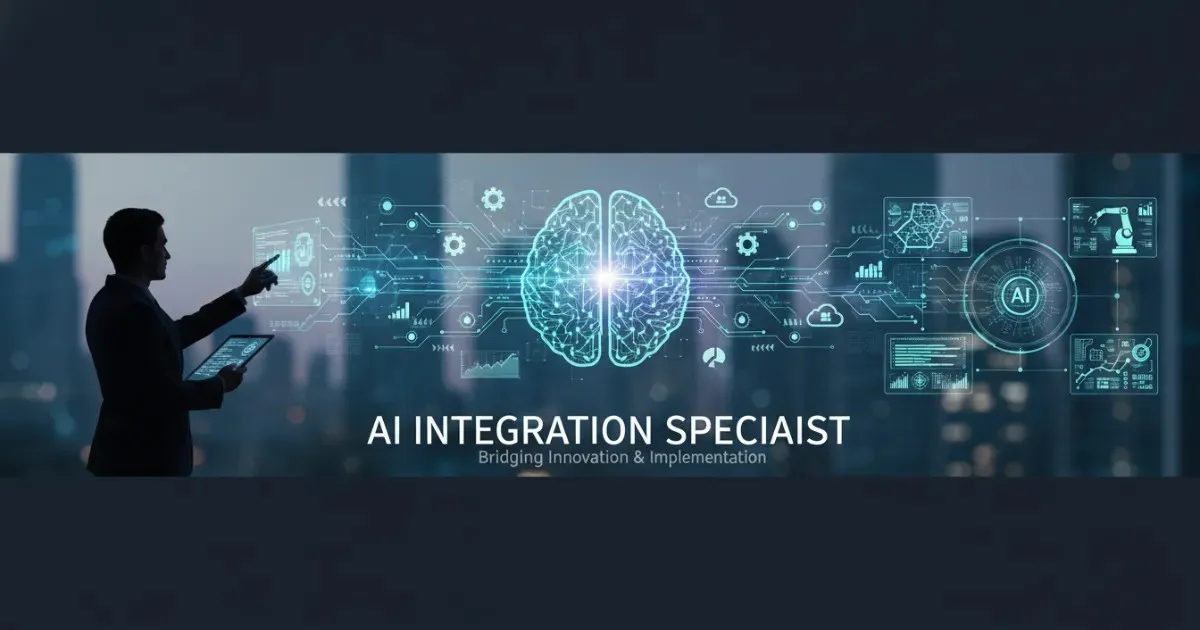
AI Integration Specialist
Introduction
Artificial Intelligence (AI) has rapidly evolved from an emerging technology into a fundamental business necessity. Organisations across industries are integrating AI into their operations to automate repetitive tasks, improve decision-making, enhance customer experiences, and gain a competitive advantage. However, implementing AI solutions is far more complex than simply purchasing software or deploying machine learning models. Businesses require professionals who can bridge the gap between AI technologies and existing business systems.
This growing demand has given rise to one of the most valuable technology roles today—the AI Integration Specialist.
An AI Integration Specialist ensures that AI-powered applications, platforms, and automation tools work seamlessly with an organisation's existing software, databases, workflows, and business processes. They act as the connector between technical teams, business stakeholders, and AI solutions, ensuring successful implementation while maintaining security, efficiency, and scalability.
As companies increasingly invest in digital transformation, AI Integration Specialists have become essential across healthcare, finance, retail, manufacturing, education, logistics, and government sectors.
This article explores what an AI Integration Specialist is, their responsibilities, required skills, tools, career opportunities, salary prospects, challenges, and future trends.
What is an AI Integration Specialist?
An AI Integration Specialist is an IT and AI professional responsible for integrating artificial intelligence solutions into an organisation's existing digital infrastructure. Their primary objective is to ensure that AI technologies work effectively with current software applications, cloud services, databases, APIs, enterprise systems, and business workflows.
Rather than building AI models from scratch, AI Integration Specialists focus on connecting AI systems with real-world business operations. They ensure that AI tools can communicate with existing applications, exchange data securely, automate workflows, and deliver measurable business value.
For example, an AI Integration Specialist may:
Connect an AI chatbot with a company's customer relationship management (CRM) platform.
Integrate generative AI into document management systems.
Deploy AI-powered analytics dashboards for executives.
Connect AI recommendation engines with e-commerce platforms.
Integrate computer vision systems into manufacturing processes.
Automate repetitive business tasks using AI-powered workflow tools.
They collaborate with software developers, AI engineers, data scientists, cybersecurity professionals, project managers, and business leaders to ensure AI implementations align with organisational goals.
In simple terms, if AI engineers build the intelligence, AI Integration Specialists make sure that intelligence functions effectively within the business environment.
Why AI Integration Specialists Are Important
Many organisations already have complex technology ecosystems consisting of:
Enterprise Resource Planning (ERP) systems
Customer Relationship Management (CRM) software
Cloud platforms
Business intelligence tools
Internal databases
Legacy software
APIs
Mobile applications
Introducing AI into these environments without proper planning can create compatibility issues, security risks, data silos, and operational disruptions.
AI Integration Specialists solve these challenges by ensuring AI technologies integrate smoothly without affecting existing operations.
Their work enables businesses to:
Improve productivity
Reduce manual work
Enhance customer experiences
Increase operational efficiency
Improve data-driven decision-making
Scale AI initiatives successfully
Key Responsibilities of an AI Integration Specialist
The daily responsibilities of an AI Integration Specialist vary depending on the organisation but generally include the following.
1. AI Solution Integration
Their primary responsibility is integrating AI tools with existing business applications.
This includes:
CRM integration
ERP integration
HR systems
Accounting software
Marketing platforms
Customer support systems
2. API Management
Modern AI applications communicate using APIs.
AI Integration Specialists:
Configure APIs
Test API connections
Secure API endpoints
Monitor API performance
Troubleshoot integration issues
3. Workflow Automation
They automate repetitive business tasks using AI technologies.
Examples include:
Email automation
Customer service automation
Document processing
Invoice management
Data extraction
Lead qualification
4. Data Integration
AI systems require quality data.
Responsibilities include:
Data mapping
Data transformation
Data migration
Data validation
Database connectivity
5. Cloud Integration
Most AI platforms operate in cloud environments.
Professionals integrate AI services using:
Microsoft Azure
Amazon Web Services (AWS)
Google Cloud Platform (GCP)
6. Security and Compliance
Security is essential when handling AI systems.
Responsibilities include:
User authentication
Data encryption
Access control
Regulatory compliance
Privacy protection
7. Performance Monitoring
After deployment, they continuously monitor:
System performance
AI response time
Integration failures
Resource utilisation
User adoption
8. Troubleshooting
When integration issues occur, they identify and resolve:
API failures
Data inconsistencies
Authentication errors
Connectivity problems
Workflow interruptions
Skills Required for an AI Integration Specialist
Success in this role requires a blend of technical expertise and business understanding.
Technical Skills
Important technical skills include:
API integration
REST APIs
GraphQL
Python
JavaScript
SQL
Cloud computing
Automation platforms
AI platforms
Database management
DevOps basics
Networking fundamentals
AI Knowledge
Professionals should understand:
Machine learning basics
Large Language Models (LLMs)
Natural Language Processing
Computer Vision
Predictive analytics
AI ethics
Prompt engineering
Business Skills
They also require:
Communication
Business analysis
Process improvement
Documentation
Stakeholder management
Project coordination
Soft Skills
Essential soft skills include:
Problem-solving
Critical thinking
Adaptability
Collaboration
Time management
Continuous learning
Tools Used by AI Integration Specialists
AI Integration Specialists work with numerous technologies.
Common categories include:
AI Platforms
OpenAI
Anthropic
Google Gemini
Microsoft Copilot
Azure AI
Vertex AI
Automation Platforms
Zapier
Make
Microsoft Power Automate
UiPath
API Tools
Postman
Swagger
Insomnia
Databases
MySQL
PostgreSQL
MongoDB
SQL Server
Cloud Platforms
AWS
Azure
Google Cloud
Programming Languages
Python
JavaScript
SQL
Bash
Industries Hiring AI Integration Specialists
Demand spans nearly every sector.
Healthcare
Healthcare organisations integrate AI for:
Medical imaging
Patient scheduling
Clinical documentation
Diagnostic support
Finance
Financial institutions use AI for:
Fraud detection
Risk assessment
Customer support
Investment analysis
Retail
Retail companies implement AI for:
Personalised recommendations
Inventory forecasting
Customer service
Dynamic pricing
Manufacturing
Manufacturers use AI for:
Predictive maintenance
Quality inspection
Robotics
Supply chain optimisation
Education
Educational institutions deploy AI for:
Personalised learning
Automated grading
Student support
Administrative automation
Logistics
AI improves:
Route optimisation
Warehouse automation
Demand forecasting
Fleet management
Educational Requirements
While there is no single path into this profession, common qualifications include:
Computer Science
Information Technology
Software Engineering
Data Science
Artificial Intelligence
Information Systems
Relevant certifications include cloud platforms, AI fundamentals, automation tools, cybersecurity, and project management.
Career Path
A typical progression may include:
IT Support Specialist
Systems Administrator
Software Developer
Integration Engineer
AI Integration Specialist
Senior AI Integration Specialist
AI Solutions Architect
AI Transformation Consultant
Head of AI Implementation
Salary Expectations
Compensation varies based on experience, industry, and location.
Typical influencing factors include:
Technical expertise
AI platform experience
Cloud certifications
Industry specialisation
Leadership responsibilities
As AI adoption grows, professionals with strong integration skills often command competitive salaries compared with many traditional IT roles.
Challenges Faced by AI Integration Specialists
Some common challenges include:
Legacy Systems
Older software may not support modern AI capabilities.
Data Quality
Poor-quality or incomplete data can significantly reduce AI effectiveness.
Security Risks
Protecting sensitive information is essential throughout AI deployments.
User Adoption
Employees may require training and support to use new AI-powered tools effectively.
Rapid Technological Change
AI technologies evolve quickly, making continuous learning a core part of the role.
Best Practices for Successful AI Integration
Successful AI Integration Specialists typically follow these practices:
Understand business objectives before selecting AI tools.
Start with pilot projects before organisation-wide deployment.
Maintain high standards for data quality and governance.
Build scalable, modular integrations.
Monitor system performance continuously.
Document integrations thoroughly.
Prioritise cybersecurity and compliance.
Gather user feedback and refine solutions over time.
Future of the AI Integration Specialist Role
The demand for AI Integration Specialists is expected to grow as organisations continue expanding their AI capabilities. Emerging technologies such as generative AI, autonomous agents, multimodal AI, edge AI, and intelligent automation will require professionals who can connect these innovations with real-world business environments.
Future responsibilities are likely to include:
Integrating AI agents into enterprise workflows.
Deploying AI copilots across departments.
Managing hybrid AI ecosystems combining cloud and on-premises systems.
Ensuring responsible AI governance and regulatory compliance.
Optimising AI performance through continuous monitoring and feedback loops.
Professionals who stay current with evolving AI tools, cloud technologies, and integration frameworks will be well-positioned for leadership opportunities.
Conclusion
The AI Integration Specialist has become one of the most important roles in modern digital transformation. Rather than focusing solely on building AI models, these professionals ensure that artificial intelligence delivers practical value by connecting it with existing business systems, processes, and applications.
By combining technical expertise, integration knowledge, cloud computing skills, automation experience, and business understanding, AI Integration Specialists help organisations unlock the full potential of AI while minimising operational risks.
As AI adoption accelerates across industries, demand for professionals capable of integrating intelligent technologies into complex digital environments will continue to rise. For individuals seeking a future-proof career that blends software engineering, cloud technologies, automation, and artificial intelligence, becoming an AI Integration Specialist offers exciting opportunities for growth, innovation, and long-term career success.
Frequently Asked Questions (FAQs)
An AI Integration Specialist connects artificial intelligence models with an organization's existing software, databases, and workflows. They build the APIs, data pipelines, and deployment architectures necessary for the AI to function seamlessly within daily business operations.
While software engineers are skilled at building applications, AI integration requires specialized knowledge in Machine Learning Operations (MLOps), data pipelining, containerization for heavy compute loads, and an understanding of how probabilistic AI models behave, which differs from traditional deterministic software.
Integration specialists design secure architectures that govern how data flows between internal systems and AI models. They implement end-to-end encryption, data masking, and role-based access controls to ensure sensitive company information remains protected and compliant with global regulations.
Depending on the complexity of the legacy systems and the AI model, a standard integration project can take anywhere from 4 weeks for a simple chatbot API connection to 6+ months for a comprehensive, enterprise-wide multi-agent orchestration system.
If your data science team has built a model that is struggling to be deployed into production, if employees are complaining about having to switch between multiple apps to use new AI features, or if you are dealing with high latency and data silos, you urgently need integration expertise.

Yash Singh is the Chief Marketing Officer at Vegavid Technology, a leading AI-driven technology company specializing in AI agents, Generative AI, Blockchain, and intelligent automation solutions. With over a decade of experience in digital transformation and emerging technologies, Yash has played a key role in helping businesses adopt advanced AI solutions that enhance operational efficiency, automate workflows, and deliver personalized customer experiences across industries including fintech, healthcare, gaming, ecommerce, and enterprise technology. An alumnus of Indian Institute of Technology Bombay, Yash combines strong technical expertise with strategic marketing leadership to drive innovation in AI-powered applications, autonomous AI agents, Retrieval-Augmented Generation (RAG), Natural Language Processing (NLP), Large Language Models (LLMs), machine learning systems, conversational AI, and enterprise automation platforms. His expertise spans AI model integration, intelligent workflow automation, prompt engineering, smart data processing, and scalable AI infrastructure development, enabling organizations to accelerate digital transformation and business growth. Passionate about the future of intelligent systems, Yash actively shares insights on AI agents, Generative AI, LLM-powered applications, blockchain ecosystems, and next-generation digital strategies. He is committed to helping businesses embrace AI-first transformation while guiding teams to build impactful, industry-specific solutions that shape the future of innovation and intelligent technology.



Leave a Reply