
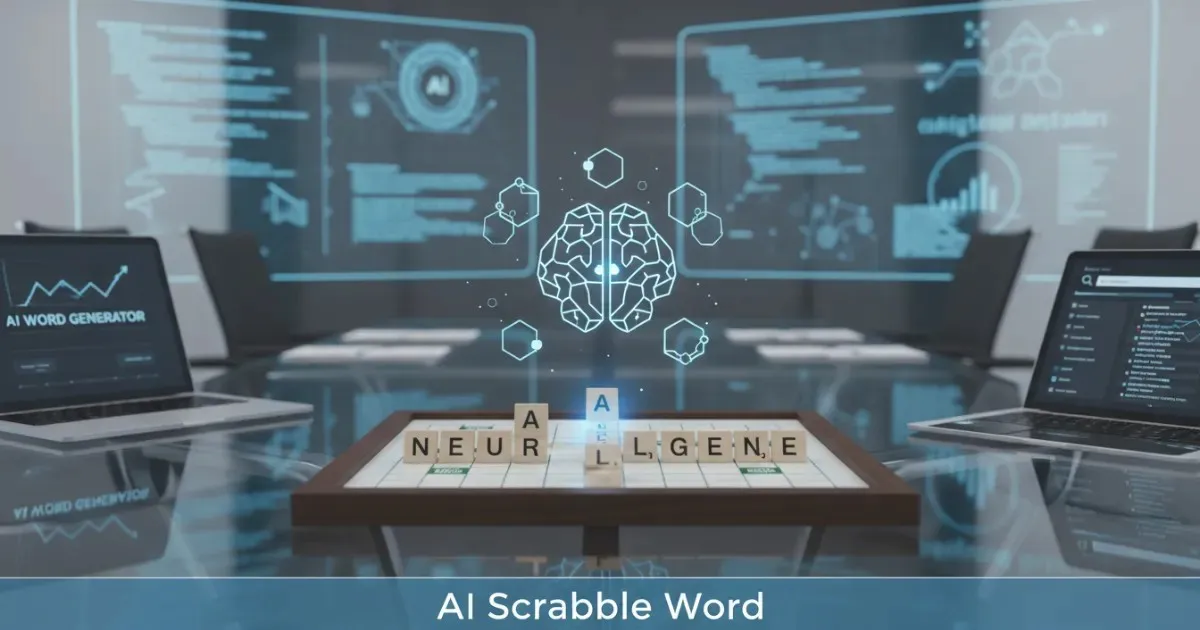
AI Scrabble Word
Introduction
Scrabble has remained one of the world's most popular word games for decades. Whether played casually with friends or in professional tournaments, success depends on vocabulary, strategic thinking, board positioning, and letter management. As artificial intelligence continues transforming industries, it is also changing how players learn and improve at Scrabble.
Today, AI Scrabble Word tools help players discover valid words, analyse game boards, recommend the highest-scoring moves, improve vocabulary, and practice more effectively than traditional dictionaries ever could. These intelligent systems don't simply list words—they evaluate thousands or even millions of possible combinations within seconds while considering board bonuses, remaining tiles, and strategic positioning.
Whether you're a beginner trying to understand two-letter words or an advanced player seeking tournament-level strategies, AI-powered Scrabble assistants provide valuable insights without replacing the skill and creativity required to master the game.
This guide explores everything you need to know about AI Scrabble Word tools, including how they work, their advantages, popular features, ethical considerations, and how artificial intelligence is shaping the future of word games.
What Is an AI Scrabble Word?
An AI Scrabble Word refers to a word suggestion or recommendation generated using artificial intelligence based on the letters available to a player and the current Scrabble board.
Unlike traditional word lists, AI analyses multiple factors simultaneously, including:
Available rack letters
Existing board layout
Premium squares
Remaining tiles
Opponent opportunities
Expected future scores
Dictionary validation
Instead of merely generating all possible words, AI identifies the most strategic move.
For example, suppose your letters are:
A E I N R T S
A conventional word finder may produce hundreds of possible words such as:
RETAINS
STAINER
RETINAS
ANTIERS
STAIN
TRAIN
RETAIN
An AI Scrabble engine goes several steps further by determining:
Which word earns the highest score
Which move blocks an opponent
Which move preserves valuable letters
Which move creates future opportunities
Which move offers the highest probability of winning
This strategic layer is what distinguishes AI from traditional word generators.
What Is an AI Scrabble Word Generator?
An AI Scrabble Word Generator is an intelligent software application that suggests legal Scrabble words using machine learning, natural language processing (NLP), optimisation algorithms, and official Scrabble dictionaries.
Instead of functioning as a static dictionary, these tools can:
Find valid words instantly
Evaluate move quality
Rank possible plays
Predict future board states
Suggest optimal strategies
Analyse previous games
Help players improve over time
Many modern Scrabble apps incorporate AI to provide personalised recommendations and practice sessions tailored to each player's skill level.
Why AI Matters in Scrabble
Many people assume Scrabble is simply about knowing big words.
In reality, high-level Scrabble depends on several skills:
Traditional Skill | AI Enhancement |
Vocabulary | Suggests additional valid words |
Pattern recognition | Finds hidden combinations |
Scoring | Calculates maximum points |
Strategy | Recommends stronger plays |
Tile management | Preserves valuable letters |
Endgame planning | Simulates future turns |
Artificial intelligence accelerates decision-making without removing the strategic depth of the game.
How AI Helps Find Scrabble Words
AI-powered Scrabble systems combine several technologies to generate intelligent recommendations.
1. Dictionary Validation
Every suggested word is checked against official Scrabble dictionaries such as:
TWL
CSW
SOWPODS
Collins Dictionary
This ensures only legal tournament words are recommended.
2. Letter Combination Analysis
AI evaluates every possible arrangement of available letters.
For example:
Letters:
L A T E R S
Possible words include:
ALERTS
SALTER
STALER
LASTER
RATELS
TALERS
The AI ranks these based on the current board rather than alphabetical order.
3. Board Analysis
Unlike ordinary word finders, AI examines:
Existing words
Triple word squares
Double letter squares
Premium positions
Blocking opportunities
Cross-check restrictions
This significantly improves move quality.
4. Probability Calculations
Modern AI estimates:
Remaining letters in the tile bag
Opponent's likely rack
Expected future scores
Risk versus reward
Win probability
These calculations help players make stronger long-term decisions rather than simply chasing immediate points.
5. Strategic Optimisation
Sometimes the highest-scoring move is not the best move.
AI may instead recommend:
Saving an S
Keeping common prefixes
Retaining balanced vowels
Avoiding dangerous openings
Limiting opponent access to premium squares
This makes AI an effective strategic coach.
Technologies Behind AI Scrabble Word Tools
Several artificial intelligence technologies work together to power modern Scrabble assistants.
Machine Learning
Machine learning enables systems to improve move recommendations by analysing millions of previous games.
It learns:
Winning patterns
Common mistakes
High-value openings
Endgame strategies
Rack management
As more data becomes available, recommendations become increasingly accurate.
Natural Language Processing (NLP)
Natural Language Processing helps AI understand language structure.
It recognises:
Prefixes
Suffixes
Root words
Inflections
Word frequency
Morphological relationships
This improves the generation of legal word combinations, a capability closely tied to advances in large language models.
Search Algorithms
AI explores enormous numbers of possible plays using optimisation algorithms.
Instead of randomly checking combinations, intelligent search dramatically reduces computation time while still identifying optimal moves.
Decision Trees
Decision-tree models compare:
Immediate score
Future opportunities
Defensive positioning
Remaining rack balance
The result is a recommendation that balances short-term and long-term success.
Reinforcement Learning
Some advanced Scrabble AI systems use reinforcement learning.
The model:
Plays millions of games against itself.
Learns from victories and losses.
Adjusts its strategy.
Improves continuously.
This approach has produced AI capable of outperforming many expert human players.
Benefits of Using AI Scrabble Word Tools
AI-powered Scrabble assistants offer significant advantages for players at every level.
Faster Word Discovery
Instead of manually searching through dictionaries, AI generates legal words in seconds.
Better Vocabulary Building
Repeated exposure to uncommon words expands your vocabulary naturally over time.
Improved Strategy
AI teaches board control, tile management, and defensive play rather than focusing solely on vocabulary.
Higher Scores
Optimised recommendations often uncover premium-square opportunities that players might overlook.
Learning Through Practice
Many AI platforms explain why a move is strong, helping players improve instead of simply copying suggestions.
Best Features to Look for in an AI Scrabble Word Tool
Not all AI-powered Scrabble tools offer the same capabilities. Some simply generate valid words from a set of letters, while others analyse the entire game board, calculate probabilities, and suggest strategic moves. Choosing the right tool can significantly improve both your gameplay and learning experience.
Here are the key features to consider:
1. Official Dictionary Support
A reliable AI Scrabble tool should support recognised dictionaries such as:
Collins Scrabble Words (CSW)
NASPA Word List (NWL)
SOWPODS
Tournament Word List (TWL)
This ensures every suggested word is valid for the version of Scrabble you are playing.
2. Board Recognition
The most advanced tools allow players to:
Upload screenshots
Scan a physical Scrabble board
Detect existing words automatically
Identify premium scoring squares
Analyse all legal moves
AI-powered image recognition eliminates the need to enter every tile manually.
3. Move Optimisation
Rather than simply listing words, AI should rank them based on:
Highest score
Best long-term strategy
Rack balance
Defensive positioning
Endgame potential
This strategic analysis helps players improve rather than simply score points on the current turn.
4. Vocabulary Learning
Many AI tools include learning modes that:
Explain word meanings
Show pronunciation
Provide example sentences
Highlight commonly used tournament words
Recommend daily practice lists
This transforms gameplay into a continuous learning experience.
5. Difficulty Levels
Whether you are a beginner or an expert, AI should adapt to your skill level by offering:
Easy suggestions
Intermediate strategies
Advanced tournament moves
Expert simulations
Adaptive learning makes the experience engaging and educational.
6. Real-Time Analysis
Modern AI can instantly evaluate:
Current board position
Remaining tiles
Possible opponent moves
Winning probabilities
Optimal next plays
Real-time feedback enables players to make informed decisions quickly.
Best AI Scrabble Word Tools
Several AI-powered tools are available online, each with its own strengths.
Tool | Best For | AI Features |
WordFinder | Casual players | Word generation, dictionary support |
Scrabble Word Finder | Beginners | Rack solving, scoring |
Quackle | Competitive players | AI simulations, move analysis |
Aerolith | Vocabulary practice | Study lists, anagrams |
Lexulous AI | Online gameplay | AI opponents, hints |
Zyzzyva | Tournament preparation | Dictionary search, probability analysis |
Each tool caters to different skill levels, from casual gaming to professional tournament preparation.
AI Scrabble Word vs Traditional Scrabble Dictionary
Before AI became widely available, Scrabble players relied on printed dictionaries and personal vocabulary. While these resources remain valuable, they have several limitations.
Feature | Traditional Dictionary | AI Scrabble Tool |
Search Speed | Slow | Instant |
Board Analysis | No | Yes |
Best Move Suggestions | No | Yes |
Rack Optimisation | No | Yes |
Learning Feedback | Limited | Extensive |
Probability Analysis | No | Yes |
Endgame Planning | No | Yes |
AI complements traditional learning by providing context and strategic insights rather than just word definitions.
How AI Improves Scrabble Strategy
Winning Scrabble requires much more than knowing long words. AI helps players develop strategic thinking in several ways.
Rack Management
Strong players maintain a balanced rack of vowels and consonants.
For example:
Poor Rack
Q X V U
Balanced Rack
A E N R S T
AI recommends moves that leave useful letters for future turns instead of simply chasing immediate points.
Board Control
The highest-scoring move isn't always the smartest.
AI evaluates:
Opening premium squares
Blocking triple-word opportunities
Limiting opponent scoring
Creating future hooks
Professional players often sacrifice a few points to gain long-term positional advantages.
Tile Tracking
Experienced Scrabble players monitor remaining tiles.
AI automatically tracks:
Blank tiles
High-value letters
Remaining vowels
Remaining consonants
Probability of drawing specific letters
This information improves decision-making throughout the game.
Endgame Analysis
As the tile bag empties, strategy becomes increasingly important.
AI calculates:
Guaranteed wins
Safe defensive plays
Exact remaining tiles
Optimal finishing moves
These advanced calculations are difficult for humans to perform quickly.
AI Scrabble Word for Beginners
New players often feel overwhelmed by unfamiliar words and complex strategies. AI makes learning much easier.
Beginners can use AI to:
Learn common two-letter words
Discover high-scoring short words
Improve spelling
Understand board bonuses
Practise anagrams
Build vocabulary gradually
Over time, these skills become second nature.
AI Scrabble Word for Competitive Players
Tournament players use AI differently.
Instead of relying on hints during games, they analyse completed matches to identify missed opportunities and improve future performance.
Professional training often includes:
Reviewing game logs
Studying AI recommendations
Memorising high-frequency words
Practising difficult racks
Simulating tournament scenarios
AI acts as a coach, highlighting strategic errors and suggesting stronger alternatives.
Real-World Applications of AI in Word Games
The technology behind AI Scrabble tools extends beyond Scrabble itself.
Educational Platforms
Schools use AI-powered word games to improve:
Vocabulary
Reading comprehension
Spelling
Language fluency
Critical thinking
Interactive feedback keeps students engaged while reinforcing learning.
Mobile Gaming
Many mobile word games now incorporate AI to:
Adjust difficulty
Recommend challenges
Match players of similar skill
Personalise learning experiences
This creates a more enjoyable and balanced gaming environment.
Language Learning
AI-assisted word games help learners acquire new vocabulary by presenting words in context, explaining meanings, and reinforcing retention through repeated play.
Cognitive Training
Researchers have explored word games as a way to support mental agility. AI can personalise exercises that challenge memory, pattern recognition, and problem-solving, making them useful for lifelong learning and cognitive fitness.
Advanced AI Scrabble Strategies
Artificial intelligence has transformed Scrabble from a vocabulary-based game into one that can be analysed through data, probability, and strategic planning. While beginners use AI to discover valid words, experienced players rely on AI to refine advanced tactics that improve their chances of winning over the course of an entire game.
1. Rack Leave Optimisation
One of the most important concepts in competitive Scrabble is rack leave—the letters you keep after making a play. AI evaluates not only the score of the current move but also how strong the remaining letters are for future turns.
For example, keeping a balanced combination of vowels and consonants often leads to better scoring opportunities in subsequent rounds. AI can recommend a slightly lower-scoring move if it leaves a more flexible rack, increasing your expected score over several turns.
2. Tile Tracking
Advanced AI systems track every tile that has been played and calculate which letters remain in the bag. This information helps players estimate the likelihood of drawing valuable tiles or anticipate what their opponent may hold.
Tile tracking enables players to:
Predict remaining high-value letters such as Q, Z, X, and J.
Estimate the chance of drawing blanks.
Plan endgame strategies more effectively.
Reduce uncertainty when choosing between multiple plays.
3. Board Control
A high-scoring move is not always the best move. AI evaluates how each play changes the board and whether it creates opportunities for the opponent.
Strategic board control includes:
Closing access to Triple Word Score squares.
Avoiding openings that enable high-scoring parallel plays.
Restricting premium scoring lanes.
Creating safe scoring opportunities for future turns.
This defensive approach often separates experienced players from beginners.
4. Parallel Word Creation
Professional Scrabble players maximise points by creating several words in one move. AI analyses every legal placement to identify opportunities where multiple intersecting words can be formed simultaneously.
Advantages include:
Higher cumulative scores.
Better utilisation of premium squares.
Increased efficiency with shorter words.
Improved rack management.
5. Probability-Based Decision Making
Modern AI estimates the expected value of different moves rather than focusing solely on immediate points.
It considers:
Remaining tiles.
Future rack potential.
Opponent's likely responses.
Average score over several turns.
Winning probability.
This approach mirrors techniques used in chess engines and other strategic AI systems.
6. Endgame Optimisation
When the tile bag becomes empty, every move has significant consequences. AI evaluates all possible move sequences until the end of the game.
Endgame analysis includes:
Forced wins.
Optimal tile exchanges.
Score maximisation.
Defensive blocking.
Exact move calculation.
Competitive Scrabble software often performs exhaustive endgame searches that would be impractical for humans to calculate manually.
Common Mistakes Players Make
Even experienced Scrabble players frequently make strategic errors. AI analysis helps identify these weaknesses and improve overall performance.
Chasing High Scores Every Turn
Many players automatically choose the highest-scoring move. However, this can expose premium squares or leave an unbalanced rack.
Instead, AI often recommends slightly lower-scoring moves that create stronger long-term advantages.
Ignoring Rack Balance
Keeping too many vowels or consonants reduces future flexibility.
Examples of poor racks include:
A A A I U
B C D G H
Balanced racks increase the likelihood of forming high-scoring words.
Forgetting Two-Letter Words
Professional Scrabble relies heavily on short words.
Examples include:
AX
JO
XI
ZA
QI
OE
AI encourages players to memorise these words because they frequently unlock premium scoring opportunities.
Opening Triple Word Squares
Careless plays sometimes leave premium squares available for opponents.
AI evaluates defensive positioning and identifies safer alternatives that minimise risk.
Poor Blank Tile Usage
Blank tiles are among the most valuable resources in Scrabble.
Common mistakes include:
Using blanks for short words.
Wasting blanks early in the game.
Missing opportunities to create bingo plays.
AI typically reserves blank tiles for maximum strategic value.
Ignoring Bingos
A bingo—using all seven tiles in one move—earns a substantial bonus. Many players overlook bingo opportunities because they focus on shorter, obvious words.
AI rapidly searches millions of letter combinations to uncover hidden seven- and eight-letter plays.
Neglecting Endgame Planning
Towards the end of the game, players often continue making moves based only on immediate score.
AI instead considers:
Remaining tiles.
Opponent's rack.
Final score adjustments.
Winning percentage.
Ethical Considerations of Using AI During Games
Artificial intelligence is a valuable learning resource, but its use raises ethical questions, especially in competitive environments.
Practising vs Cheating
Using AI after a game to review mistakes is widely accepted and helps players improve.
Using AI to receive move suggestions during a live competitive match, however, is generally considered unfair and may violate the rules of online platforms or tournaments.
Fair Play
Many online Scrabble communities prohibit:
Real-time AI assistance.
Automated move generation.
External word-finding software during ranked games.
Multiple accounts or automated gameplay.
Violating these rules can result in penalties or account suspension.
Educational Benefits
AI has significant educational value when used responsibly.
Players can:
Learn new vocabulary.
Understand strategic concepts.
Analyse completed games.
Build confidence through practice.
Viewed as a study tool rather than a live assistant, AI enhances learning without undermining fair competition.
Transparency in Competitive Play
Tournament organisers increasingly use software and statistical analysis to detect suspicious gameplay patterns. Maintaining transparency and adhering to competition rules helps preserve trust within the Scrabble community.
AI in Online and Tournament Scrabble
Artificial intelligence has become an important part of both casual online play and professional Scrabble training.
Online Scrabble Platforms
Many online platforms integrate AI for features such as:
Hint systems.
Solo practice against computer opponents.
Difficulty adjustment.
Performance statistics.
Post-game analysis.
These tools help players improve while keeping casual games engaging.
Tournament Preparation
Competitive players often use AI outside tournaments to:
Review completed games.
Study missed opportunities.
Practise difficult racks.
Memorise high-frequency words.
Test alternative strategies.
This analytical approach has become a standard part of high-level preparation.
AI as a Training Partner
Unlike human practice partners, AI is always available and provides consistent feedback.
Benefits include:
Unlimited practice games.
Objective move evaluation.
Instant scoring analysis.
Personalised recommendations.
Continuous skill development.
Future Trends in AI-Powered Word Games
Artificial intelligence continues to reshape how people play and learn word games. Several emerging trends are likely to define the next generation of AI-powered Scrabble experiences.
Personalised Learning
Future AI systems will adapt to individual players by analysing strengths and weaknesses.
They may recommend:
Custom vocabulary lists.
Daily practice sessions.
Targeted strategy exercises.
Progressive difficulty levels.
Voice-Assisted Gameplay
Advances in speech recognition may enable players to:
Speak moves aloud.
Receive verbal coaching.
Practise pronunciation.
Interact hands-free with AI assistants.
Augmented Reality (AR)
AR could overlay digital information onto physical Scrabble boards, helping players learn after games by highlighting missed opportunities, analysing moves, and visualising alternative plays without disrupting live competition.
Smarter Computer Opponents
Future AI opponents may emulate different playing styles, such as:
Aggressive scorers.
Defensive strategists.
Vocabulary-focused players.
Beginner-friendly tutors.
This variety would make practice sessions more realistic and engaging.
Multilingual Word Games
AI is making multilingual Scrabble more accessible by supporting multiple dictionaries and languages, allowing players to improve vocabulary across different linguistic contexts.
Deeper Analytics
Future platforms may provide dashboards that track:
Average score per move.
Bingo frequency.
Rack balance efficiency.
Mistake categories.
Long-term improvement trends.
These insights can help players measure progress and identify areas for development.
Conclusion
Artificial intelligence has significantly enhanced the way people play, study, and enjoy Scrabble. Modern AI Scrabble Word tools go far beyond simple word generation by analysing board positions, evaluating long-term strategy, tracking tiles, and recommending moves that maximise both immediate and future scoring opportunities.
For beginners, AI serves as a patient tutor that builds vocabulary, teaches board awareness, and explains strategic concepts. For experienced and tournament players, it functions as a sophisticated analytical partner, revealing missed opportunities, improving rack management, and supporting in-depth post-game review.
At the same time, responsible use of AI remains essential. Using AI as a learning resource or for post-game analysis promotes skill development, while relying on it during live competitive play may conflict with the rules of online platforms and tournaments. Respecting these boundaries helps preserve fair competition and the enjoyment of the game.
Looking ahead, advances in machine learning, natural language processing, augmented reality, and personalised coaching are likely to make AI-powered word games even more engaging and educational. Whether your goal is to improve your vocabulary, achieve higher scores, or compete at an advanced level, AI can be a valuable companion when used ethically and thoughtfully.
Ultimately, AI does not replace the creativity, judgement, and excitement that make Scrabble such an enduring game. Instead, it provides powerful insights and learning opportunities that help players of all abilities continue to grow and enjoy the challenge of every match.
Frequently Asked Questions (FAQs)
An AI Scrabble Word solver is a computational tool that uses data structures like DAWGs (Directed Acyclic Word Graphs) to rapidly scan a dictionary and identify the highest-scoring or most strategically advantageous word placement on a Scrabble board.
Advanced Scrabble AI uses statistical tools, primarily Monte Carlo simulations. By running thousands of mock games with the remaining unseen tiles, the AI predicts the most probable moves an opponent can make and adjusts its own strategy accordingly.
Rack Equity is the mathematical value an AI assigns to the letters remaining on its rack after a move. The algorithm may choose a lower-scoring word if it leaves highly versatile letters (like E, S, or R) for the next turn, maximizing long-term point potential.
It is incredibly difficult but possible. Because Scrabble involves an element of luck (the tiles drawn), a human champion drawing perfectly could beat an AI. However, over a statistically significant number of games, a top-tier heuristic AI will consistently defeat human world champions.
ChatGPT is a Generative Pre-trained Transformer focused on predicting linguistic sequences for conversational output. Scrabble AI is a heuristic search engine focused on mathematical constraint satisfaction on a 2D spatial grid. LLMs struggle with Scrabble's strict structural rules, whereas Scrabble AI masters them flawlessly.
Yes. The spatial reasoning, pathfinding, and optimization algorithms used in game AI are heavily adapted for business use cases, including supply chain routing, scheduling optimization, and rapid database search querying.
Yes. The spatial reasoning, pathfinding, and optimization algorithms used in game AI are heavily adapted for business use cases, including supply chain routing, scheduling optimization, and rapid database search querying.
Due to the need for high-speed memory management and rapid data traversal, C++ and Rust are highly preferred for the core engine, often paired with Python for machine learning integration and API development.

Yash Singh is the Chief Marketing Officer at Vegavid Technology, a leading AI-driven technology company specializing in AI agents, Generative AI, Blockchain, and intelligent automation solutions. With over a decade of experience in digital transformation and emerging technologies, Yash has played a key role in helping businesses adopt advanced AI solutions that enhance operational efficiency, automate workflows, and deliver personalized customer experiences across industries including fintech, healthcare, gaming, ecommerce, and enterprise technology. An alumnus of Indian Institute of Technology Bombay, Yash combines strong technical expertise with strategic marketing leadership to drive innovation in AI-powered applications, autonomous AI agents, Retrieval-Augmented Generation (RAG), Natural Language Processing (NLP), Large Language Models (LLMs), machine learning systems, conversational AI, and enterprise automation platforms. His expertise spans AI model integration, intelligent workflow automation, prompt engineering, smart data processing, and scalable AI infrastructure development, enabling organizations to accelerate digital transformation and business growth. Passionate about the future of intelligent systems, Yash actively shares insights on AI agents, Generative AI, LLM-powered applications, blockchain ecosystems, and next-generation digital strategies. He is committed to helping businesses embrace AI-first transformation while guiding teams to build impactful, industry-specific solutions that shape the future of innovation and intelligent technology.






Leave a Reply