

Who Is an AI Voice Agent Developer?
An AI voice agent developer is the engineer responsible for building software that can listen to a spoken request, understand what's being asked, decide what to do about it, and reply in a natural voice—all within the space of a couple of seconds. As businesses increasingly invest in AI voice agent development services, these developers play a critical role in creating secure, scalable, and production-ready voice solutions tailored to enterprise needs. It's a role that didn't really exist in its current form a few years ago. Speech recognition engineers, chatbot developers, and backend integration specialists used to be three separate jobs. Now, thanks to the convergence of large language models, faster speech-to-text engines, and more natural text-to-speech synthesis, those three skill sets have merged into a single, in-demand profile.
Understanding who this person actually is — what they know, what they build, and how they differ from adjacent roles like conversational AI engineers or traditional software developers — matters increasingly to businesses trying to hire for, or outsource, their first voice AI project.
Who is an AI voice agent developer?
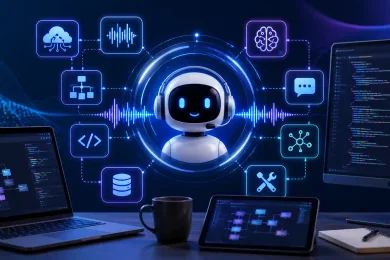
An AI voice agent developer is a software engineer who specializes in building systems that carry on spoken conversations with users and take real action based on what's said — booking an appointment, checking an order, answering a billing question, or routing a call to the right department. They sit at the intersection of four disciplines: speech engineering (turning audio into text and back again), natural language processing (figuring out intent from that text), backend integration (connecting to the systems that actually complete a task), and increasingly, large language model orchestration (using an LLM as the reasoning engine that ties it all together), a discipline that maps closely onto the broader field of AI agent architecture.
What separates this role from a general software developer is the nature of the input. A voice agent developer's code has to make sense of speech that's unscripted, sometimes interrupted, occasionally mumbled, and never quite the same way twice. A developer who's used to deterministic inputs — a form field, an API request with a fixed schema — has to adjust to building for genuine ambiguity as a default condition, not an edge case, which is part of why the difference between AI voice agents and traditional IVR systems runs so much deeper than swapping a phone tree for a microphone.
Who is an AI voice agent developer, really?
Strip away the job title and the answer is more specific than "someone who builds chatbots with a microphone." In practice, this person is usually one of a few overlapping profiles:
A backend or full-stack developer who moved into voice. Many voice agent developers started as general software engineers and picked up ASR/TTS integration, prompt engineering, and telephony work as voice AI projects came their way. Their strength is usually the plumbing — API integrations, latency optimization, and system reliability.
An NLP or machine learning engineer who added speech to their toolkit. These developers often came from text-based conversational AI or intent classification work and extended into the audio layer once voice became the more in-demand modality.
A conversation designer who learned to code the flows they used to only diagram. Less common, but growing — someone who understands dialogue structure and turn-taking deeply, and has picked up enough engineering to implement those flows directly rather than handing them to a developer.
A specialist at an AI development agency who builds voice agents across multiple client industries rather than for a single product, and as a result has seen a wider range of failure modes than an in-house developer typically encounters.
None of these paths is the "correct" one. What defines the role isn't the background someone arrived from, but whether they can own the full pipeline — from the moment audio hits a microphone to the moment a business system confirms a completed task.
How an AI voice agent developer's work actually unfolds
Developing an AI voice agent is a structured process that goes far beyond writing code or integrating APIs. From designing natural conversations to deploying and continuously optimizing the system, developers ensure every stage delivers fast, accurate, and reliable voice experiences for real-world users.
1. Starting with the conversation, not the code
Before any integration work begins, the developer maps out how a conversation should behave: what happens when the caller gives a clear answer, an ambiguous one, or no answer at all. This planning stage borrows heavily from conversational AI architecture, and a developer who skips it tends to end up with a voice agent that handles the happy path fine and falls apart the moment a caller deviates from it.
2. Building the recognition and understanding layer
Once the flow is mapped, the developer wires up automatic speech recognition to convert spoken audio into text, then builds the natural language understanding layer — often backed by an LLM — that extracts intent and key details from that transcript. This is where accents, background noise, and phone line audio quality create real problems that a clean demo environment never reveals, which is why so much of the underlying discipline traces back to how automatic speech recognition systems and the neural networks behind modern speech recognition were trained in the first place.
3. Reasoning about what to do next
With the intent established, dialogue management logic decides what the agent should say or do, taking the full conversation history into account rather than just reacting to the last thing said, which depends heavily on well-built AI agent memory systems that carry earlier context forward across the call. Developers spend a large share of their time here — writing and refining prompts, setting up retrieval so the agent's answers are grounded in real business data through the same mechanisms behind how retrieval-augmented generation improves the accuracy of generative AI models, and building guardrails that prevent the model from confidently answering something it doesn't actually know.
4. Speaking back and closing the loop
The response gets converted to speech through a TTS engine, tuned for pacing and voice quality, with interruption handling built in so the agent stops talking if the caller starts speaking again — a stage best understood by looking at the practical difference between speech-to-text and text-to-speech AI. Then — critically — the developer connects the whole system to whatever backend actually needs to be touched: a CRM, a scheduling system, a payment processor, a telephony platform. A voice agent that can chat convincingly but can't actually reschedule the appointment isn't solving the business problem it was built for.
What distinguishes this role from adjacent ones
Although AI voice agent development shares technologies with chatbot development and conversational AI, it introduces unique engineering challenges. Voice agent developers must optimize for real-time speech processing, natural conversations, low latency, and seamless integrations to deliver human-like voice experiences.
Versus a conversational AI / chatbot developer. Text-based chatbot development doesn't have to account for latency in the same way — a few extra seconds of "typing" indicator is invisible, but a few extra seconds of silence on a phone call feels broken. Voice agent developers also have to handle interruption, tone, and pacing in ways text-based systems never need to, a gap that becomes clearer when comparing the difference between AI voice agents and chatbots feature by feature.
Versus a traditional backend developer. The inputs aren't structured. There's no schema validation for a spoken sentence. The developer has to build tolerance for ambiguity directly into the system's logic rather than rejecting malformed input.
Versus a voice UX or conversation designer. Designers plan how a conversation should feel and branch; developers implement that plan in working code, integrate it with real data sources, and keep it running reliably at scale. In smaller teams, one person does both, but the skill sets are genuinely distinct.
Versus a data scientist or ML researcher. Voice agent developers are almost always working with pre-trained ASR, TTS, and LLM components rather than training models from scratch. Their expertise is in integration, prompt design, and system architecture — applied engineering, not model research.
Versus a human contact center agent. The comparison isn't purely technical either — businesses evaluating a voice agent build usually end up weighing the practical difference between AI voice agents and human agents in terms of consistency, cost, and where judgment calls still genuinely need a person on the line.
Core skills that define the profile
Building intelligent AI voice agents requires expertise across multiple disciplines, from speech processing and language understanding to backend integrations and conversation design. A successful AI voice agent developer combines these technical skills to create reliable, scalable, and natural voice experiences.
Speech and audio engineering fundamentals — comfort with ASR/TTS APIs, streaming audio formats, and the latency trade-offs involved in real-time processing, informed by a working sense of the AI speech models currently available and the frameworks built around them.
LLM and prompt engineering — since most production voice agents use an LLM for reasoning, developers need to write prompts and retrieval logic that keep responses accurate and on-task, built on a solid grasp of how large language models actually work.
API and systems integration — connecting the agent to CRMs, scheduling tools, payment gateways, and telephony infrastructure like SIP trunks or contact center software, typically through dedicated AI agent API integration services and broader efforts to integrate AI agents with CRM and ERP systems.
Conversation design literacy — enough understanding of turn-taking, disambiguation, and graceful failure handling to implement flows correctly, even without a dedicated designer on the team.
Testing discipline specific to spoken conversation — building transcript review tools and structured test suites, since voice interactions fail in ways text interactions don't (mishearing, cross-talk, dropped audio).
Security and compliance fluency — particularly for developers working in healthcare, finance, or insurance, where handling voice data means understanding what can be logged, stored, or passed to third-party APIs under HIPAA, PCI, or GDPR, and building toward layered AI voice agent security and specifically GDPR-compliant AI voice agents where European callers are involved.
The tools and infrastructure this developer works with daily
The day-to-day toolkit for this role sits at an unusual boundary — part audio engineering, part language modeling, part telephony operations. On the recognition side, developers rarely train acoustic models from zero; they select from an ecosystem of streaming ASR options and lean on published guidance for how to build a speech recognition model from scratch mainly to understand what a managed API is doing internally, not to replace it outright. On the telephony side, most production systems now run on purpose-built platforms for embedded voice AI and leading solutions for embedding voice AI in telephony, since building SIP handling and call routing from raw sockets is rarely a good use of a developer's time on a modern project.
Multilingual deployments add another layer of tooling entirely. Developers extending an agent beyond a single language typically start from established approaches to handling accents and multilingual speech in AI models, since a model that performs well on one accent can quietly underperform on another if it isn't specifically evaluated for it, and the direction the industry is heading with multilingual AI voice agents shapes how much of this work gets built in-house versus bought as a managed capability.
Where this person tends to work
AI voice agent developers are in demand across startups, enterprises, and specialized AI firms as businesses increasingly adopt conversational AI solutions. They typically work in environments focused on building, deploying, and continuously improving intelligent voice applications for a wide range of industries.
In-house at product or software companies building a voice feature into an existing app or platform, often working closely with a product manager and a single conversation designer.
At specialized AI development agencies and consultancies that build voice agent development services across multiple client industries — a pattern common at firms offering AI agentic development as one of several agent modalities, where the same underlying architecture gets adapted to healthcare scheduling one month and retail support the next.
Inside contact center and CX teams modernizing legacy IVR systems, often working alongside teams already running AI agents for customer service across chat and email, extending that same infrastructure into voice.
As independent contractors or freelancers, particularly for smaller businesses that need a single voice agent built and don't have ongoing headcount to justify a full-time hire.
The types of voice agent developers you'll actually encounter
As AI voice technology evolves, the role of a voice agent developer has become increasingly specialized. Different developers focus on specific areas of the voice AI stack, combining their expertise to build intelligent, scalable, and production-ready conversational systems.
1. Conversational logic / NLU specialists — focused on intent recognition, dialogue state management, and prompt engineering. Their main concern is accuracy: does the agent actually understand what's being asked.
2. Speech and audio specialists — focused on ASR/TTS tuning, latency, and voice naturalness. Their main concern is how the agent sounds and how fast it responds.
3. Integration engineers — focused on the backend connections that let the agent complete real tasks: booking systems, CRMs, payment processing, telephony routing.
4. Full-stack voice agent developers — comfortable across all three, most common at smaller teams and agencies where one person owns the pipeline end to end.
Most people who hold the title today started in one lane and expanded into the others as project demands required it — very few come in already fluent across audio engineering, NLP, and backend integration simultaneously.
What makes someone good at this job
Technical range matters, but so does a particular kind of patience with imperfect systems. Voice AI fails in messier, less predictable ways than most software: a caller in a moving car, a bad phone connection, a regional accent the ASR model wasn't tuned for, a caller who says "no, that's wrong" halfway through a booking confirmation. The developers who do this work well tend to be the ones who treat those failures as expected input, not exceptions, and build fallback logic and human escalation paths as a first-class part of the design rather than an afterthought bolted on before launch.
They're also, almost without exception, the ones paying attention to how quickly the underlying tools change. ASR accuracy, TTS naturalness, and LLM function-calling capability have all improved meaningfully over short periods, and developers who stay current with shifts in the AI voice agent market tend to avoid getting locked into a platform choice that made sense a year ago but no longer holds up on cost or accuracy today. Many also keep a close eye on how AI agent performance is evaluated more broadly, since the metrics that matter for a voice deployment — resolution rate, escalation frequency, average handling time — often borrow directly from evaluation frameworks built for other categories of autonomous agent.
Use cases that define what this person actually builds
AI voice agent developers create solutions that automate real-world business conversations and streamline customer interactions. Their work spans industries such as customer support, healthcare, sales, and finance, helping organizations improve efficiency while delivering faster, more personalized experiences.
Customer support automation — handling account questions, order status, and troubleshooting, with clean handoff to a human when the conversation exceeds what the agent can resolve, an application covered across a wide range of AI agent use cases in customer service and reflected in how voice AI is changing customer service metrics across the board.
Appointment scheduling and healthcare intake — managing booking, rescheduling, and reminder calls at a volume human staff can't sustain, with measurable benefits of AI voice agents in healthcare settings specifically.
Sales and lead qualification calls — capturing structured information from unstructured conversation, whether inbound or through AI voice for outbound sales, an area closely tied to AI voice agents built for lead generation.
IVR replacement — letting callers say what they need instead of navigating a phone tree.
Outbound calling programs — developers enabling agents to make outbound calls also have to solve for the reality that a large share of dials hit voicemail rather than a live caller, which is why outbound voice AI voicemail detection is treated as its own dedicated engineering problem rather than an edge case.
Multilingual and after-hours coverage — extending service hours and language support without proportionally growing headcount.
Challenges this role has to navigate
Building production-ready AI voice agents involves overcoming technical, operational, and compliance challenges that don't exist in traditional software development. Developers must balance speed, accuracy, security, and user experience to ensure voice agents perform reliably in real-world scenarios.
Balancing speed against accuracy. Every additional processing step — a more thorough intent check, a longer retrieval query — adds latency, and callers notice both a slow response and a wrong one.
Handling real-world audio, not demo audio. Background noise, accents, and phone line compression all degrade transcription accuracy in ways that only show up once a system is handling live calls, a problem developers building an AI phone call agent that manages background noise confront directly rather than in a quiet studio recording.
Keeping an LLM-backed agent honest. Language models can produce fluent, confident answers that are simply wrong. Developers build retrieval grounding and guardrails specifically to prevent this, drawing on the same principles behind responsible AI in voice systems.
Compliance from day one. In regulated industries, data handling can't be retrofitted after a security review — developers need to understand what's being logged and where it's stored before the first test call happens, a concern closely tied to the broader push toward ethical AI voice development as regulation catches up with deployment.
Defending against synthetic and spoofed audio. As voice becomes an authentication surface as much as a communication one, developers increasingly have to guard against voice spoofing attacks and build in deepfake detection, with finance-facing deployments in particular layering on dedicated AI voice agent fraud prevention strategies.
These aren't hypothetical concerns either — most developers who've shipped more than one production system can point to a recognizable set of AI voice agent developer challenges that come up on nearly every project, regardless of industry, which is part of why so much of this knowledge circulates openly rather than staying locked inside any one team.
Best practices this developer follows
Successful AI voice agent developers follow proven engineering practices that prioritize reliability, security, and user experience from the start. These best practices help create scalable voice solutions that deliver accurate conversations, seamless integrations, and continuous performance improvements.
Building human escalation into the flow from the start, rather than treating it as a fallback added after launch.
Reviewing real call transcripts on an ongoing basis to catch failure patterns that only appear with genuine caller variety.
Designing explicitly for interruption, so the agent can stop talking and listen when a caller talks over it.
Testing across a deliberately varied set of accents and audio conditions, not just clean studio recordings.
Rolling out gradually, routing a percentage of live calls through the new agent and comparing outcomes before a full switch — an approach covered in more detail in guidance on choosing a voice AI agent platform for enterprise deployments.
How to tell whether you've found the right developer
Not everyone who lists voice AI experience has actually carried a system through to production and kept it healthy afterward. Businesses vetting candidates or agencies get better signal by asking about specific outcomes — resolution rates, escalation frequency, what broke in the first month — than by watching a scripted demo call. A structured list of questions to ask before hiring an AI voice agent development company tends to expose this gap quickly, since candidates who've only built demos usually struggle with specifics on monitoring, compliance, or failure handling.
It's also worth understanding the general reasons businesses hire a dedicated AI voice agent development company rather than assigning the work to a generalist internal team, since this specific mix of audio engineering, LLM orchestration, and telephony integration rarely exists fully in-house. Working through a broader AI voice agent development company checklist, alongside a shortlist drawn from a list of top AI voice agent development companies, gives a much clearer basis for comparison than pricing alone, and a step-by-step approach to choosing the right AI voice agent development company can shorten that evaluation considerably.
What this expertise costs a business
Budgeting for this role, whether hired directly or brought in through an agency, is complicated by how usage-based the underlying costs are. Beyond salary or project fees, ongoing per-minute charges for ASR, LLM tokens, and TTS generation scale with call volume, which makes traffic forecasting a real part of the budgeting exercise rather than an afterthought. A closer look at the factors affecting AI voice agent development cost tends to surface line items — multilingual coverage, legacy integration work, compliance auditing — that rarely appear in a first-pass estimate.
Businesses sizing up a first project often start from a general estimate of the cost to build an AI voice agent from scratch and adjust from there, but it's worth budgeting separately for the hidden costs in AI voice agent development that tend to show up only after launch, since ongoing monitoring, retraining, and compliance review rarely get priced into the initial scope.
How someone becomes an AI voice agent developer
There's no single accredited path into this role yet, which is part of why the profile still looks so varied. Most people arrive by one of two routes: they're a software or ML engineer who picks up speech and conversation design skills on the job, or they're a conversation/UX designer who picks up enough engineering to implement their own designs. A background in machine learning development helps for developers who need to fine-tune intent classifiers or adapt acoustic models rather than relying entirely on off-the-shelf APIs, and increasingly, developers building outbound or engagement-focused voice agents are also drawing on ideas from AI voice in marketing — personalized voice branding, multilingual scripting — that sit slightly outside the traditional engineering skill set but shape how a well-built agent actually sounds and performs.
What tends to separate someone who's genuinely capable of shipping a production voice agent from someone who can only demo one is exposure to real call volume. Prompt engineering and API integration can be learned relatively quickly; knowing how a system behaves when three hundred real callers with three hundred different accents, moods, and half-finished sentences hit it in a single afternoon is something that's mostly learned by having already been burned by it once.
Conclusion
An AI voice agent developer is, at core, the person who takes on the hardest part of voice AI: making an inherently messy input — spoken, ambiguous, real-time conversation — behave predictably enough to run in production. They're not defined by a single technical background so much as by the range they've built across speech engineering, language understanding, backend integration, and conversation design, and by a working familiarity with exactly how these systems fail once real callers get involved.
As more businesses move away from generic chatbot builders and static IVR menus toward voice agents that actually complete tasks — often built through dedicated conversational AI voice agent development services — this is the person doing the unglamorous work of making that shift hold up under real call volume, not just in a pitch meeting, but on the two-hundredth call of a Tuesday afternoon.
FAQs
An AI voice agent developer is a software engineer who builds intelligent voice systems that understand spoken language, process customer intent, integrate with business applications, and automate real-world tasks using AI.
Core skills include speech processing, ASR/TTS integration, LLM and prompt engineering, API integrations, conversation design, testing, and security compliance for production-ready voice AI solutions.
They work at software companies, AI development agencies, enterprises modernizing customer support, contact centers, and as independent consultants building custom AI voice solutions.
AI voice agents are widely used for customer support automation, appointment scheduling, sales qualification, IVR replacement, and multilingual after-hours customer service.
Experienced developers build scalable, secure, and production-ready voice AI systems that improve customer experiences, integrate with enterprise software, and ensure long-term performance and reliability.
Tags

Yash Singh is the Chief Marketing Officer at Vegavid Technology, a leading AI-driven technology company specializing in AI agents, Generative AI, Blockchain, and intelligent automation solutions. With over a decade of experience in digital transformation and emerging technologies, Yash has played a key role in helping businesses adopt advanced AI solutions that enhance operational efficiency, automate workflows, and deliver personalized customer experiences across industries including fintech, healthcare, gaming, ecommerce, and enterprise technology. An alumnus of Indian Institute of Technology Bombay, Yash combines strong technical expertise with strategic marketing leadership to drive innovation in AI-powered applications, autonomous AI agents, Retrieval-Augmented Generation (RAG), Natural Language Processing (NLP), Large Language Models (LLMs), machine learning systems, conversational AI, and enterprise automation platforms. His expertise spans AI model integration, intelligent workflow automation, prompt engineering, smart data processing, and scalable AI infrastructure development, enabling organizations to accelerate digital transformation and business growth. Passionate about the future of intelligent systems, Yash actively shares insights on AI agents, Generative AI, LLM-powered applications, blockchain ecosystems, and next-generation digital strategies. He is committed to helping businesses embrace AI-first transformation while guiding teams to build impactful, industry-specific solutions that shape the future of innovation and intelligent technology.



Leave a Reply