
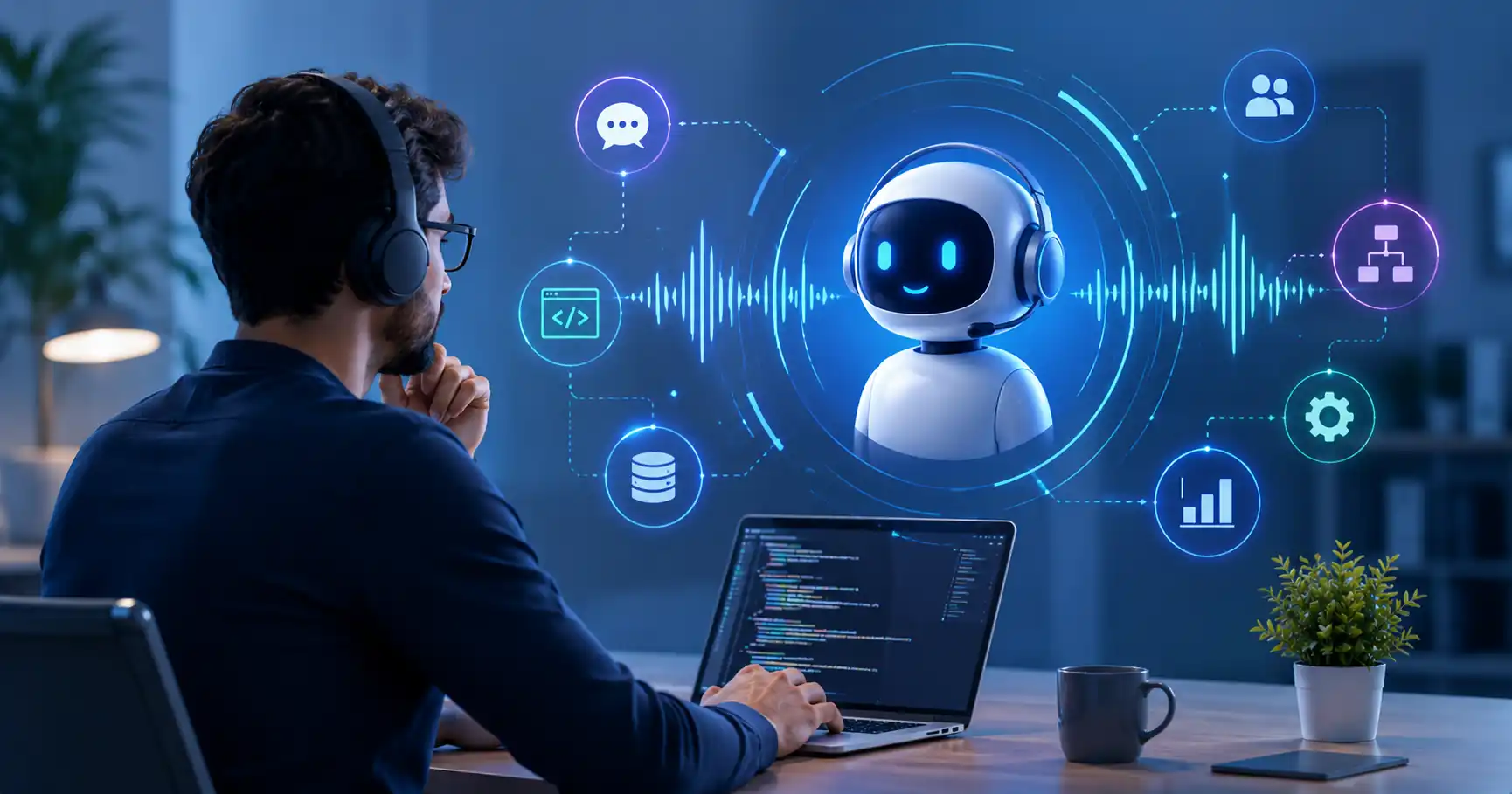
What Does an AI Voice Agent Developer Do?
An AI voice agent developer builds the software systems that let machines understand spoken language, reason about what a caller needs, and respond in a natural voice — all in real time. Where a traditional developer might write code that waits for a button click or a form submission, a voice agent developer writes code that has to make sense of an open-ended sentence spoken by a stranger, decide what to do about it, and reply before the silence gets awkward.
This role sits at the intersection of several disciplines that used to live in separate teams: speech engineering, conversational design, backend integration, and increasingly, large language model orchestration. As businesses replace legacy IVR menus and overworked call centers with always-on voice assistants, the developers who can actually build these systems — not just demo them — have become one of the more specialized and in-demand roles in applied AI.
Who is an AI voice agent developer?
An AI voice agent developer is an engineer who designs, builds, tests, and maintains software that carries on spoken conversations with users and takes action based on what's said. The job goes well beyond wiring a speech-to-text API to a chatbot. It involves architecting a full pipeline — audio capture, automatic speech recognition (ASR), natural language understanding, dialogue management, response generation, text-to-speech (TTS) synthesis, and telephony or app integration — so that the whole loop runs with low enough latency that the conversation feels human, following the same underlying AI agent architecture principles that shape autonomous systems more broadly.
Unlike developers who build one-off scripts or static web features, voice agent developers work with systems that must handle ambiguity constantly. A caller might interrupt mid-sentence, mumble a date, change their mind halfway through a request, or ask something the agent was never explicitly trained to answer. Part of the job is deciding, in code, how the system should behave in each of those moments — a challenge that becomes clearer once you look at the practical difference between AI voice agents and traditional IVR systems, since the old menu-driven model never had to reason about ambiguity at all.
What does an AI voice agent developer do day to day?
On any given day, an AI voice agent developer is likely to be working across a mix of the following:
Designing conversation flows. Before writing a line of integration code, developers map out how a conversation should branch — what happens if the caller says yes, no, "I don't know," or asks an unrelated question. This is often done in collaboration with a conversation designer, and increasingly follows established patterns of conversational AI architecture, but the developer is the one who turns that flow into working logic.
Integrating speech recognition and synthesis. They connect ASR engines that convert spoken audio into text and TTS engines that convert generated responses back into natural-sounding speech, tuning both for accuracy, latency, and voice quality, often referencing the practical difference between speech-to-text and text-to-speech AI when deciding where to invest tuning time.
Building and prompting the reasoning layer. Most modern voice agents route transcribed speech through a large language model to interpret intent and generate a response. Developers write and refine the prompts, guardrails, and retrieval logic that keep the model on-task and factually grounded.
Wiring up backend systems. A voice agent that can't check an order status or book an appointment isn't very useful. Developers build the API connections into CRMs, scheduling systems, payment processors, and telephony platforms, typically through dedicated AI agent API integration services, so the agent can actually complete the tasks callers ask for.
Testing under real-world conditions. Background noise, accents, interruptions, and dropped calls all break naive implementations. Developers run structured test suites and live pilot calls to find where the system fails before customers do.
Monitoring and iterating post-launch. Once live, developers track call transcripts, resolution rates, and failure points, then adjust prompts, retraining data, or escalation rules accordingly, guided by the same principles behind how AI agent performance is evaluated in other autonomous systems.
In short, the developer's job is to turn a product idea — "let customers reschedule appointments by phone without waiting on hold" — into a working, monitored, production-grade voice system.
How AI voice agent developers build a working voice pipeline
A voice agent isn't one model; it's a chain of components, and the developer's core skill is making that chain work together without adding noticeable delay.
1. Capturing and transcribing speech
The pipeline starts with audio capture, whether through a phone line, a web widget, or a mobile app. That audio is streamed to an ASR engine, which converts it into text. Developers have to account for real-world audio conditions — background noise, phone line compression, regional accents, and overlapping speech — since a transcription error early in the pipeline cascades into every step that follows. This is why so much of the groundwork for the role traces back to the fundamentals of automatic speech recognition systems and the neural networks that power modern speech recognition.
2. Understanding intent and managing dialogue
Once there's a transcript, the system needs to figure out what the caller actually wants. Developers configure natural language understanding layers, often backed by an LLM, to extract intent and relevant details (a date, an account number, a product name) from what can be a messy, half-finished sentence. Dialogue management logic then decides what the agent should say or do next, factoring in the conversation history, not just the last thing said — a task made considerably easier by well-designed AI agent memory systems that carry context forward across turns.
3. Generating and speaking the response
The agent's reply is generated, checked against guardrails to prevent off-topic or incorrect answers, and then converted to speech through a TTS engine. Developers tune voice selection, pacing, and pronunciation so the output doesn't sound robotic, and they build in interruption handling so the system can stop talking if the caller starts speaking again. Grounding those replies in accurate business data typically leans on the same techniques behind how retrieval-augmented generation improves the accuracy of generative AI models, since an ungrounded LLM will happily generate a fluent, wrong answer.
4. Connecting to the business systems that matter
None of this is useful in isolation. Developers integrate the voice agent with CRMs, scheduling tools, payment gateways, and telephony infrastructure so the agent can look up an account, confirm a booking, or transfer a call to a human when needed. This is often the most time-consuming part of the build, since every business runs a different combination of legacy and modern systems, and it's usually where broader work to integrate AI agents with CRM and ERP systems ends up overlapping directly with the voice pipeline itself.
Core technical skills an AI voice agent developer needs
Because the role spans several disciplines, the skill set looks different from a typical backend or frontend developer's:
Speech and audio processing fundamentals — familiarity with ASR/TTS APIs, audio streaming formats, and latency optimization, drawing on a working knowledge of the AI speech models and frameworks currently in production use.
NLP and LLM engineering — prompt design, retrieval-augmented generation, and intent classification, since most production voice agents lean on an LLM for reasoning and benefit from understanding how large language models actually work under the hood.
API integration and backend engineering — comfort connecting to CRMs, telephony platforms (like SIP trunks or contact center software), and internal databases, often building on established solutions for embedding voice AI in telephony rather than building call routing from scratch.
Conversation design sensibility — even if a dedicated designer exists, the developer needs to understand turn-taking, disambiguation, and graceful failure handling to implement flows correctly.
Testing and observability practices — building logging, transcript review tools, and automated test suites specific to spoken conversation, which behaves very differently from text chat.
Security and compliance awareness — particularly for voice agents handling payment details or health information, where HIPAA- or PCI-level data handling has to be built in rather than bolted on, alongside layered AI voice agent security practices and, for European deployments, GDPR-compliant AI voice agent design from the outset.
Types of AI voice agent developers
As the field has matured, the role has started splitting into recognizable specializations, similar to how "web developer" eventually split into frontend, backend, and full-stack roles:
1. Conversational AI / NLU engineers Focus on intent recognition, dialogue state management, and LLM prompt engineering. Their main concern is making sure the agent understands what's being asked and responds accurately.
2. Speech and audio engineers Specialize in ASR/TTS tuning, audio pipeline latency, and voice quality — the layer that determines how natural and responsive the agent sounds, often drawing directly on advances in deep learning applied to speech recognition.
3. Integration and backend engineers Handle the connective tissue between the voice agent and business systems — CRM lookups, appointment booking, payment processing, and telephony routing.
4. Full-stack voice agent developers Work across all of the above, common at smaller teams or agencies building custom voice agent development services for clients across industries, where one person often owns the whole pipeline from prototype to production.
5. Localization and multilingual specialists Focus specifically on handling accents and multilingual speech in AI models, tuning ASR and TTS coverage across languages and dialects rather than assuming a single default voice and accent will work everywhere a business operates. As global deployments grow, this specialization is increasingly shaped by the direction multilingual AI voice agents are heading as a category.
Most working developers in this space started in one lane — often NLP or backend engineering — and expanded into the others as voice AI projects demanded it.
The tools and frameworks AI voice agent developers rely on
The day-to-day toolkit looks different from most software roles because so much of it sits at the boundary between audio engineering and language modeling. On the speech side, developers work with streaming AI speech models chosen specifically for their ability to emit partial transcripts and partial audio rather than waiting for a complete utterance, since that streaming behavior is what keeps a live call from feeling laggy. Developers building recognition from the ground up, rather than relying entirely on a managed API, often reference practical guidance on how to build a speech recognition model from scratch to understand what a vendor's black-box API is actually doing under the hood.
On the orchestration side, most teams now build on frameworks that manage LLM tool-calling, conversation state, and memory rather than hand-rolling that logic themselves, which keeps the reasoning layer consistent across a growing agent codebase. Telephony connectivity, meanwhile, is rarely built from raw SIP handling anymore; developers lean on purpose-built platforms for embedded voice AI that already handle call routing, recording, and failover, freeing the developer to focus on the conversational logic rather than reinventing telephony infrastructure from zero.
Where AI voice agent developers add business value
The work isn't abstract; it maps directly onto measurable business outcomes:
Customer support automation — handling account inquiries, order status checks, and troubleshooting without hold times, with clean handoff to a human agent when needed, an application covered extensively across AI agent use cases in customer service.
Appointment scheduling — particularly in healthcare and services businesses, where voice agents manage booking, rescheduling, and reminder calls at a scale human staff can't match.
Sales and lead qualification — conducting outbound or inbound qualification calls, capturing structured data from unstructured conversation, an area where AI voice agents built for lead generation and AI voice for outbound sales increasingly overlap.
Legacy IVR replacement — swapping "press 1 for billing" menus for a system that lets callers just say what they need.
Outbound calling at scale — developers building systems that can make outbound calls autonomously also have to solve for voicemail detection, since a large share of outbound dials land on voicemail rather than a live person, an edge case covered specifically in work on outbound voice AI voicemail detection.
Multilingual and after-hours coverage — extending support hours and language coverage without proportionally scaling headcount.
Developers building these systems increasingly work from platforms like Vegavid's AI agentic development offerings, where voice is one channel among several an autonomous agent can operate across, or from more narrowly scoped AI agents for customer service built specifically around support workflows, and dedicated conversational AI voice agent development services for teams that need the full pipeline built end to end.
Benefits of hiring a dedicated AI voice agent developer
Faster, more reliable deployments. A developer who has already solved latency, interruption handling, and ASR tuning problems on prior projects avoids the trial-and-error that stretches a first voice AI build from weeks into months.
Better handling of edge cases. Real callers don't talk like documentation examples. Experienced developers build in fallback logic, clarifying questions, and human escalation paths that generic no-code voice bot builders often skip.
Tighter integration with existing systems. Off-the-shelf voice bot tools frequently stop at basic Q&A. A developer can wire the agent into the CRM, scheduling system, and payment processor a business already runs on, closing the loop on actual task completion.
Ongoing optimization. Voice agents need tuning after launch as real call patterns emerge. A developer who understands the full stack can iterate on prompts, retrain intent models, and adjust conversation flows based on live transcript review rather than guesswork.
How businesses can tell a developer is the right fit
Not every developer who lists "voice AI" on a resume has actually shipped a production system that survives real call volume. Businesses evaluating candidates or agencies tend to get better signal by asking about specific past latency numbers, escalation rates, and failure modes than by watching a polished demo call. A structured set of questions to ask before hiring an AI voice agent development company tends to surface this gap quickly, since a team that has only built demos usually struggles to answer specifics about production monitoring or compliance handling.
It also helps to understand the general reasons businesses hire a dedicated AI voice agent development company rather than assigning the project to a generalist engineering team, since the specialized skill set — audio engineering, LLM orchestration, telephony integration — rarely lives entirely within a typical in-house team. Reviewing a broader AI voice agent development company checklist alongside a shortlist of top AI voice agent development companies gives a business a much clearer basis for comparison than pricing alone.
Challenges AI voice agent developers navigate
Latency versus accuracy trade-offs. Every extra processing step — a more thorough intent check, a longer retrieval query — adds milliseconds. Developers have to balance response speed against getting the answer right, since callers notice both a wrong answer and an awkward pause.
Noisy, real-world audio. Phone lines, background noise, and accents all degrade transcription accuracy in ways that clean demo environments don't reveal, a problem developers specifically account for when building an AI phone call agent that has to handle background noise. Developers often discover the real failure modes only once a system handles live call volume.
Multilingual and accent coverage. Supporting multiple languages or regional accents well enough to be usable in production takes real tuning, not just switching a model's language parameter.
Compliance and data handling. Voice agents in healthcare, finance, or insurance settings need HIPAA-, PCI-, or GDPR-conscious data handling built into the pipeline from day one, not added after a security review flags a gap. The developer's understanding of what data can be logged, stored, or passed to third-party APIs matters as much as the conversational logic itself, and it increasingly extends to actively defending against voice spoofing attacks and building in deepfake detection for agents handling sensitive transactions, with dedicated AI voice agent fraud prevention strategies layered on top for finance-facing deployments.
Preventing confident wrong answers. LLM-backed agents can produce fluent, confident-sounding responses that are simply incorrect. Developers build retrieval grounding and guardrails to keep the agent tethered to verified information rather than plausible-sounding invention.
Even experienced teams run into a recognizable, recurring set of AI voice agent developer challenges across projects, which is one reason so much of the field's best practice knowledge gets shared openly rather than treated as proprietary — the failure modes tend to repeat across industries far more than the successes do.
Best practices AI voice agent developers follow
Building in human escalation paths. No voice agent should trap a frustrated caller in a loop. Developers build clear triggers — repeated failed attempts, explicit requests for a human, sensitive topics — that hand the call off smoothly.
Logging and reviewing real transcripts. Rather than relying solely on pre-launch testing, developers set up ongoing transcript review to catch failure patterns that only show up with real caller variety, then feed those findings back into prompt and flow adjustments.
Designing for interruption. Callers talk over agents constantly. Developers build in barge-in handling so the system can stop speaking and listen when interrupted, rather than talking over the caller obliviously.
Testing across accents and audio conditions. Before launch, developers run test calls across a deliberately varied set of voices, background noise levels, and connection qualities rather than testing only in ideal studio conditions.
Keeping guardrails close to the source of truth. Grounding responses in verified business data — order records, policy documents, scheduling availability — rather than letting the model improvise reduces the risk of confidently wrong answers reaching a customer.
Planning for gradual rollout. Rather than switching an entire call line over at once, developers often route a percentage of calls through the new voice agent initially, comparing outcomes against the existing process before scaling up — a practice increasingly documented in guidance on choosing a voice AI agent platform for enterprise deployments.
What it costs to bring an AI voice agent developer onto a project
Budgeting for this work is harder than for typical software projects because so much of the cost is usage-based rather than fixed. Beyond the developer's time, ongoing per-minute charges for ASR, LLM tokens, and TTS generation scale directly with call volume, which means a business has to forecast traffic reasonably accurately before committing to a build. A closer look at the factors affecting AI voice agent development cost tends to surface line items — multilingual support, legacy system integration, compliance auditing — that rarely show up in an initial estimate but materially change the final number.
Businesses comparing a custom build against an off-the-shelf platform often start from a baseline estimate of the cost to build an AI voice agent from scratch, then adjust for the specific integrations their business needs. It's also worth budgeting explicitly for the kind of hidden costs in AI voice agent development that tend to surface only after launch — ongoing monitoring, retraining, and compliance reviews chief among them — rather than treating the initial build as the full cost of ownership.
How developers keep pace with a fast-moving field
The tooling underneath voice agents changes quickly — new ASR models, cheaper TTS options, and better LLM function-calling support arrive on a near-monthly cycle. Developers working in this space stay close to shifts in the AI voice agent market, since a platform choice that made sense a year ago may no longer be the most cost-effective or accurate option today. Many also track developments in responsible AI practices for voice systems, given how much personal and sometimes biometric data a voice interaction can involve, alongside broader conversations about ethical AI voice development as regulation catches up to the technology.
Staying current also means understanding where a voice agent stops and a related category begins. It's worth developers being able to articulate the difference between AI voice agents and chatbots clearly to non-technical stakeholders, along with the more subtle difference between AI voice agents and conversational AI more broadly, since these distinctions shape what a business should reasonably expect a given system to do — and where a human agent still needs to stay in the loop.
Developers building customer-facing voice experiences also increasingly draw on techniques from adjacent fields — a background in machine learning development helps when fine-tuning intent classifiers or building custom acoustic models, rather than relying entirely on off-the-shelf APIs. And as voice agents extend beyond support calls into outbound engagement, ideas from AI voice in marketing — personalized voice branding, multilingual campaigns, dynamic scripting — are starting to shape how developers approach conversation design, not just backend architecture.
Conclusion
An AI voice agent developer's job is to make a genuinely difficult technical problem — real-time, spoken, ambiguous conversation — disappear into something that feels effortless for the person on the other end of the call. That means owning the full pipeline: speech recognition, language understanding, response generation, speech synthesis, and every integration point that lets the agent actually resolve what the caller needed, not just chat about it.
It's a role that rewards range over specialization, at least early on — developers who understand audio engineering, LLM behavior, backend integration, and conversation design well enough to move between them tend to ship voice agents that hold up under real call volume rather than just in a demo. As more businesses move away from static IVR systems and generic chatbot builders toward custom, task-completing voice agents built through dedicated AI voice agent development services, that range is exactly what's in short supply.
Ready to build an enterprise-grade AI voice agent?
FAQs
An AI voice agent developer designs, builds, and maintains intelligent voice systems that understand spoken language, process customer intent, and complete real-world tasks using technologies like ASR, LLMs, NLP, and TTS.
AI voice agent developers need expertise in speech recognition, natural language processing, LLM engineering, API integrations, conversation design, backend development, and security compliance.
Industries such as customer support, healthcare, finance, sales, telecommunications, and eCommerce hire AI voice agent developers to build intelligent voice assistants that automate customer interactions and business workflows.
They overcome challenges such as speech recognition accuracy, low-latency conversations, multilingual support, backend integrations, compliance requirements, and preventing AI hallucinations.
Dedicated AI voice agent developers build scalable, production-ready solutions that integrate with existing systems, improve customer experiences, reduce operational costs, and continuously optimize AI performance.
Tags

Yash Singh is the Chief Marketing Officer at Vegavid Technology, a leading AI-driven technology company specializing in AI agents, Generative AI, Blockchain, and intelligent automation solutions. With over a decade of experience in digital transformation and emerging technologies, Yash has played a key role in helping businesses adopt advanced AI solutions that enhance operational efficiency, automate workflows, and deliver personalized customer experiences across industries including fintech, healthcare, gaming, ecommerce, and enterprise technology. An alumnus of Indian Institute of Technology Bombay, Yash combines strong technical expertise with strategic marketing leadership to drive innovation in AI-powered applications, autonomous AI agents, Retrieval-Augmented Generation (RAG), Natural Language Processing (NLP), Large Language Models (LLMs), machine learning systems, conversational AI, and enterprise automation platforms. His expertise spans AI model integration, intelligent workflow automation, prompt engineering, smart data processing, and scalable AI infrastructure development, enabling organizations to accelerate digital transformation and business growth. Passionate about the future of intelligent systems, Yash actively shares insights on AI agents, Generative AI, LLM-powered applications, blockchain ecosystems, and next-generation digital strategies. He is committed to helping businesses embrace AI-first transformation while guiding teams to build impactful, industry-specific solutions that shape the future of innovation and intelligent technology.









Leave a Reply