
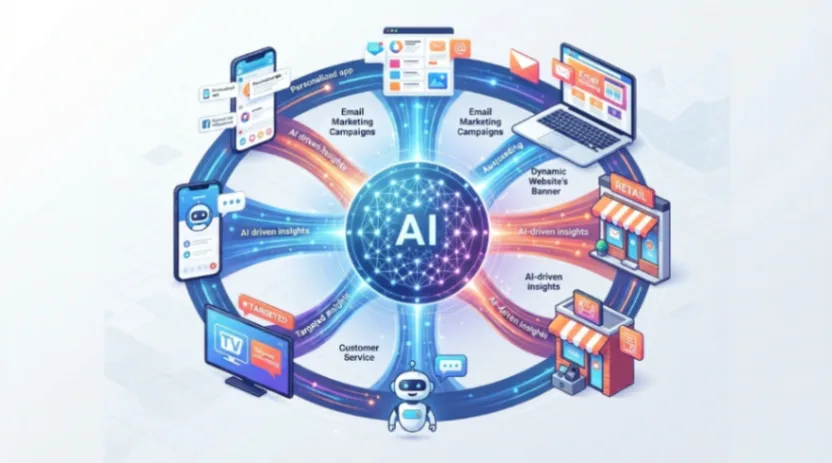
Agentic AI in Omnichannel Marketing: A Complete Guide
The era of rule-based marketing automation is officially behind us. As we navigate the digital landscape of 2026, the complexity of consumer behavior has far outpaced the capabilities of static "if-this-then-that" workflows. Consumers no longer follow linear paths; they move seamlessly between social media, websites, mobile apps, email, messaging platforms, smart devices, e-commerce marketplaces, and physical retail stores in unpredictable ways.
To address this growing complexity, forward-thinking enterprises have moved beyond traditional Generative AI—which primarily creates content on demand—and are embracing Agentic AI to power intelligent omnichannel experiences.
Agentic AI systems do not simply execute predefined marketing workflows; they perceive customer intent, reason through contextual data, formulate strategies, and autonomously execute actions to achieve high-level business objectives. As organizations accelerate this transformation, many are partnering with an Agentic AI development company to design and deploy intelligent AI agents that seamlessly integrate with CRM platforms, customer data platforms (CDPs), marketing automation tools, analytics systems, and advertising networks. These enterprise-grade AI agents enable businesses to orchestrate highly personalized, real-time customer journeys across every touchpoint while continuously optimizing campaign performance, engagement, and conversions.
By seamlessly connecting customer data, marketing content, enterprise applications, and communication channels, Agentic AI is redefining what it means to deliver truly omnichannel experiences. Rather than treating each marketing channel independently, autonomous AI agents coordinate interactions across the entire customer journey, ensuring consistent messaging, personalized engagement, and intelligent decision-making that drives stronger customer relationships and higher business growth.
What is Agentic AI in Omnichannel Marketing?
Agentic AI in omnichannel marketing refers to the use of goal-oriented, autonomous artificial intelligence agents that can independently plan, execute, and optimize marketing campaigns across multiple platforms. Unlike traditional automation that requires human-defined rules, Agentic AI continuously analyzes real-time customer data, decides the next best action, generates tailored content, and delivers it through the most effective channel to achieve a specific KPI, such as conversion or retention.
In a practical context, if a brand sets a goal to "increase customer retention by 15% this quarter," an Agentic AI system will autonomously identify at-risk customers, draft personalized recovery emails, trigger timely SMS offers, adjust digital ad targeting, and measure the results—modifying its strategy in real-time without requiring human micro-management.
Why It Matters: The Strategic Importance in 2026
The shift toward Agentic AI is not merely a technological upgrade; it is a fundamental restructuring of marketing operations. As we progress through 2026, the volume of data and the sheer number of interaction channels make manual campaign orchestration physically impossible for human teams.
Here is why Agentic AI is the defining marketing advantage of the current decade:
The Death of the Linear Customer Journey
Modern consumers expect a unified experience regardless of where they interact with a brand. A user might discover a product via an influencer in a virtual metaverse space, research it on a mobile app, read reviews on a desktop browser, and finally purchase it in a physical store. Agentic AI is the only technology capable of tracking this fragmented journey in real-time and adjusting messaging contextually at every step.
Overcoming Content and Data Silos
For years, marketers struggled with siloed tools—one platform for email, another for social, a different one for ad buying. Agentic AI operates as a unified intelligence layer. By leveraging robust AI Agent Infrastructure Solutions, these systems pull data from Customer Data Platforms (CDPs) and cross-reference it with inventory, pricing, and historical behavior to make holistic decisions.
From Reactive to Proactive Engagement
Traditional marketing reacts to what a customer did (e.g., sending an abandoned cart email 24 hours after a cart is left). Agentic AI acts on what a customer will do. Utilizing predictive analytics, AI agents anticipate needs before they arise, deploying preemptive marketing strategies that intercept the customer exactly when their intent is highest.
Unprecedented Scalability of Personalization
Achieving 1:1 personalization at a scale of millions of users was once a pipe dream. Today, a sophisticated Generative AI Development Company can build Agentic systems that spawn micro-agents for individual user segments, ensuring that every piece of copy, every image, and every promotional offer is mathematically optimized for the individual receiving it.
How It Works: The Technical Architecture
To understand how Agentic AI powers omnichannel marketing, one must look under the hood. The system is fundamentally different from a standard Large Language Models (LLM). It is a composite system often referred to as a Multi-Agent System (MAS), where specialized AI agents work in concert.
The Four Pillars of Agentic Marketing Workflows
The Perception Layer (Data Ingestion): The AI system acts as a central nervous system, continuously absorbing real-time data streams. This includes website telemetry, CRM data, social media sentiment, transaction history, and even macroeconomic indicators. The AI agents perceive the current state of the market and the individual user's context simultaneously.
The Reasoning Engine (Cognitive Processing): Once data is ingested, specialized "Strategist Agents" evaluate the information against business objectives. They ask: What is the likelihood this user will churn? What is their preferred communication channel? What incentive will drive conversion without sacrificing margin? The reasoning engine models multiple potential outcomes and selects the optimal path.
The Execution Layer (Action & Generation): After a strategy is formulated, "Execution Agents" take over. If the strategy dictates a personalized email and a retargeting ad, a Generative AI agent drafts the copy, while a design agent fetches the right imagery—often pulling from a centralized repository where brands Choose Right Digital Asset Management System integration. Another agent interfaces with marketing APIs to deploy the content across platforms.
The Feedback and Learning Loop (Optimization): Agentic AI is inherently self-improving. The system monitors the open rates, click-throughs, and conversions resulting from its actions. If an SMS campaign underperforms, the agent updates its internal knowledge base, adjusting future strategies to favor different channels or messaging tones.
The Multi-Agent Collaboration Model
In a 2026 enterprise setup, you rarely have a single AI doing everything. Instead, you have a collaborative environment:
The Orchestrator Agent: Oversees the entire campaign and manages budget allocation.
The Copywriter Agent: Specializes in crafting high-converting text tailored to channel constraints (e.g., short punchy copy for push notifications, long-form for email).
The Analytical Agent: Constantly crunches A/B test data and feeds insights back to the Orchestrator.
The Compliance Agent: Ensures no generated content violates brand guidelines or privacy regulations like GDPR.
Key Features of Agentic AI in Marketing
When evaluating solutions from a top-tier AI Agent Development Company, expect the following core features that define true Agentic AI:
Goal-Oriented Autonomy: You provide the KPI (e.g., "$50 CPA for new signups"); the AI designs and executes the multi-channel steps to achieve it.
Cross-Channel Memory: The AI remembers that a user clicked an email link on Tuesday, allowing it to reference that specific interaction in a WhatsApp message on Thursday.
Dynamic Budget Reallocation: Agents autonomously shift ad spend in real-time from underperforming channels to high-converting ones.
Self-Prompting Capabilities: The system doesn't wait for a human marketer to prompt it for ideas; it analyzes data anomalies and proposes or initiates campaigns independently.
Real-Time Creative Generation: On-the-fly rendering of personalized images, videos, and text based on the user's immediate context.
Semantic Understanding of Brand Voice: AI Agents maintain strict adherence to brand guidelines, ensuring all autonomously generated content sounds like it came from the same human team.
Business Benefits and Tangible ROI
The integration of Agentic AI yields dramatic improvements across the entire marketing funnel. The ROI is not just found in reduced labor costs, but in the exponential scaling of revenue-generating activities.
1. Drastic Reduction in Customer Acquisition Cost (CAC)
Because AI agents optimize bidding, targeting, and creative assets simultaneously and continuously, wasted ad spend is minimized. By catching users at the exact moment of high intent across the correct channel, CAC can often be reduced by 30% to 50%.
2. Maximized Customer Lifetime Value (CLV)
Agentic systems excel at post-purchase journeys. By autonomously sending personalized product recommendations, usage tips, and timely replenishment reminders via the customer's preferred channel, brands see a significant boost in repeat purchase rates and overall CLV.
3. Infinite Scalability
A human marketing team can manually A/B test perhaps 10 variations of a campaign per week. An Agentic AI system can create, deploy, test, and learn from 10,000 variations an hour. This scalability ensures that every micro-segment of your audience receives a tailored experience.
4. Agility and Speed to Market
When a market trend emerges, a human team might take days to strategize, design, and launch a campaign. Agentic AI can detect a trending topic on social media, generate a relevant marketing campaign, and deploy it across all channels within minutes, capturing momentary viral traffic.
5. Enhanced Human Creativity
By delegating the repetitive tasks of campaign orchestration, data analysis, and multivariate testing to AI agents, human marketing teams are freed to focus on high-level brand strategy, emotional storytelling, and building authentic community relationships.
Industry Use Cases for Agentic Omnichannel Marketing
Agentic AI is highly adaptable and is currently transforming various sectors in distinct ways.
Retail and E-Commerce
AI agents for retail track inventory levels, user browsing history, and seasonal trends. If an agent notices a user has looked at winter coats on a mobile app but hasn't purchased, it can autonomously check if the user's size is in stock, generate a personalized discount code, and send an SMS—all while updating digital billboard ads near the user's geographic location.
Healthcare and Wellness
The healthcare sector requires immense care regarding privacy and timing. AI agents are used to manage patient journeys seamlessly. For instance, exploring the Benefits Digital Marketing For Doctors, we see AI agents autonomously orchestrating appointment reminders via SMS, sending post-visit care instructions via email, and providing educational content through a secure patient portal, ensuring HIPAA compliance at every step.
Web3 and Decentralized Finance (DeFi)
The Web3 ecosystem operates in a highly dynamic environment where market sentiment, community engagement, and blockchain activity change rapidly. Agentic AI enables autonomous AI agents to monitor on-chain transactions, analyze social sentiment across platforms such as Discord, X (formerly Twitter), Telegram, and community forums, and identify emerging trends in real time. These AI agents can automatically generate educational content, personalize community engagement, optimize campaign strategies, detect potential reputation risks, and coordinate token marketing initiatives across multiple digital channels. By combining blockchain analytics with real-time customer insights, Agentic AI helps Web3 organizations deliver highly personalized, data-driven marketing campaigns while strengthening community trust and accelerating ecosystem growth.
B2B Software and SaaS
B2B buying journeys involve multiple decision-makers, long sales cycles, and interactions across numerous digital touchpoints. Agentic AI enables autonomous AI agents to analyze prospect behavior, identify buying intent, and orchestrate personalized engagement strategies throughout the customer journey. AI agents can dynamically generate tailored content for different stakeholders, recommend relevant case studies, schedule product demonstrations, optimize email sequences, qualify leads, and coordinate outreach across CRM platforms, marketing automation systems, and sales channels. By continuously learning from customer interactions and campaign performance, Agentic AI improves lead nurturing, shortens sales cycles, enhances account-based marketing (ABM) strategies, and helps B2B organizations deliver more relevant, data-driven customer experiences across every stage of the buying process.
Real-World Example: "The Abandoned Cart Recovery"
To truly grasp the power of Agentic AI, let's walk through a realistic, step-by-step example of a modern omnichannel recovery campaign.
The Scenario: Sarah is shopping for a high-end espresso machine on an electronics retailer's website via her laptop. She adds a $1,200 machine to her cart but abandons it to attend a meeting.
Traditional Automation Response: Hour 24: Sarah receives a generic "You left something in your cart!" email. She ignores it. End of sequence.
Agentic AI Response (The 2026 Approach):
Minute 15: The Orchestrator Agent registers the cart abandonment. It analyzes Sarah's profile and notes she has a high LTV but is highly price-sensitive and prefers mobile interactions.
Hour 2: The Agent directs a targeted, visually appealing ad for the specific espresso machine to her Instagram feed, dynamically generating ad copy that highlights the machine's durability.
Hour 24: The Agent detects Sarah hovered over the Instagram ad but didn't click. The Reasoning Engine decides an incentive is needed.
Hour 25: An Execution Agent sends a personalized Push Notification via the retailer's mobile app: "Hi Sarah, we know you'd love the Barista Pro. Here is a complimentary 1-year warranty upgrade if you complete your purchase today."
Hour 48: Sarah clicks the push notification but closes the app. The AI agent, cross-referencing inventory, notes there are only 3 units left in her local physical store.
Hour 50: The AI sends an SMS: "Sarah, the Barista Pro is almost sold out online, but we held one at the Downtown store for you. Reply 'HOLD' to reserve it."
Result: Sarah replies "HOLD", walks into the store, and completes the purchase.
Throughout this entire multi-day, multi-channel negotiation, no human marketer intervened. The Agentic AI orchestrated the entire flow dynamically based on Sarah's real-time behavioral cues.
Comparison: Traditional Automation vs. Agentic AI
To highlight the paradigm shift, below is a clear comparison of how traditional marketing automation stacks up against modern Agentic AI workflows.
Feature / Capability | Traditional Marketing Automation (Pre-2024) | Agentic AI Omnichannel Marketing (2026) |
|---|---|---|
Operational Paradigm | Rule-based ("If/Then" triggers). | Goal-oriented (Autonomous strategy generation). |
Channel Integration | Connected but siloed (Linear workflows). | Fully fluid (Dynamic cross-channel memory). |
Content Creation | Requires humans to write and design variants. | AI generates personalized copy/assets in real-time. |
Adaptability | Static. Fails if user behavior breaks the rules. | Dynamic. Adapts instantly to unpredictable behavior. |
Optimization | Manual A/B testing (Human intervention required). | Continuous self-learning and autonomous budget shifting. |
Scale of Personalization | Segment-based (e.g., "Women aged 25-34"). | Hyper-individualized (Segment of ONE). |
Table: Evolutionary differences between legacy marketing tools and intelligent agentic systems.
Implementing Agentic AI: A Strategic Blueprint
Transitioning to an Agentic AI model requires strategic planning, solid infrastructure, and the right talent. If your enterprise is looking to Hire AI Engineers or partner with a specialized agency, follow this blueprint.
Step 1: Unify Your Data Architecture
AI agents are only as intelligent as the data they access. Before deploying agents, ensure you have a robust Customer Data Platform (CDP) that aggregates data from CRM, web analytics, POS systems, and social channels into a single, clean repository.
Step 2: Define Clear Guardrails and KPIs
Agents need boundaries. You must explicitly define what the agents cannot do (e.g., "Do not offer discounts greater than 20%," "Do not send more than one SMS per 48 hours"). Similarly, define the precise KPIs (CPA, LTV, ROAS) the agents should optimize for.
Step 3: Start with a Pilot "Micro-Agent"
Do not attempt to automate your entire marketing department overnight. Start small. Deploy a specific agent for a specific task—for example, an agent dedicated solely to re-engaging churned email subscribers. Monitor its performance, refine its prompts, and build trust in the technology.
Step 4: Expand to Multi-Agent Orchestration
Once comfortable, introduce more agents into the ecosystem. Have your social media agent collaborate with your email agent. Utilize a premier AI Development Company in Germany or your local region to build custom orchestration layers that allow these agents to communicate flawlessly.
Step 5: Continuous Human Oversight (Human-in-the-Loop)
Even the most advanced autonomous AI systems require human governance. Marketing leaders should focus on reviewing the strategic insights generated by the AI, ensuring brand alignment, and making high-level directional pivots based on the AI's data.
Challenges and Limitations
Despite its revolutionary capabilities, Agentic AI in 2026 is not without its hurdles. Organizations must proactively address these challenges to ensure successful deployment.
The Hallucination Risk: While significantly reduced since the early days of LLMs, AI agents can still misinterpret data or generate off-brand messaging. Strict human-in-the-loop (HITL) review protocols and narrow agent framing are essential to mitigate this.
Data Privacy and Compliance: With global data privacy laws tightening, autonomous agents must be programmed with absolute compliance. If an agent autonomously decides to scrape prohibited data or message a user who opted out, the brand faces severe legal consequences. Compliance agents must act as strict gatekeepers.
Brand Voice Dilution: Ensuring that thousands of dynamically generated messages maintain a cohesive, human-sounding brand voice requires extensive fine-tuning of the AI models on your specific brand guidelines.
Integration Complexity: Legacy enterprise tech stacks often resist the fluid API integrations that Agentic AI requires. Upgrading core infrastructure to support real-time, bi-directional data flow is a significant initial investment.
Future Trends: What's Next for Marketing AI?
As we look toward 2027 and beyond, the trajectory of Agentic AI suggests even more profound integrations.
Predictive Emotional AI: Agents will move beyond behavioral data to analyze emotional states in real-time (via sentiment analysis of voice, text, and interaction speed), tailoring marketing approaches based on whether a user is frustrated, excited, or hesitant.
Autonomous B2B Negotiations: We will see agents negotiating contract terms, pricing, and enterprise software trials directly with procurement agents of other companies, removing human bottlenecks in B2B sales.
Edge AI Execution: To reduce latency and enhance privacy, more agentic processing will happen on the "edge" (directly on the user's mobile device or smart wearable), allowing for instantaneous, hyper-localized marketing interactions without sending personal data back to centralized servers.
Metaverse and Spatial Web Integration: As AR and VR mature, marketing agents will manifest as digital concierges, guiding avatars through immersive brand experiences and seamlessly syncing these interactions with physical world marketing campaigns.
Conclusion
Agentic AI has fundamentally transformed the landscape of omnichannel marketing by replacing static, rule-based automation with intelligent, autonomous systems capable of reasoning, planning, and optimizing customer interactions in real time. Unlike traditional marketing automation that simply reacts to predefined triggers, Agentic AI continuously analyzes customer behavior, predicts intent, and proactively delivers the right message through the most effective channel at the optimal moment. Modern enterprises are increasingly leveraging Multi-Agent Systems (MAS), where specialized AI agents collaborate to manage campaign strategy, content creation, customer segmentation, analytics, and performance optimization, enabling highly coordinated marketing operations.
This collaborative intelligence allows brands to achieve true hyper-personalization at scale, delivering tailored experiences to millions of individual customers while continuously learning and improving from every interaction. Rather than replacing marketing professionals, Agentic AI empowers them to focus on strategic planning, creative innovation, and long-term brand growth while autonomous AI agents handle execution, optimization, and routine decision-making. However, successful implementation depends on a unified and high-quality customer data foundation, including Customer Data Platforms (CDPs), CRM systems, and real-time analytics that provide AI agents with accurate contextual insights. As of 2026, adopting Agentic AI for omnichannel marketing is no longer an experimental initiative—it has become a strategic necessity for organizations seeking to deliver exceptional customer experiences, maximize marketing performance, and maintain a competitive advantage in an increasingly AI-driven digital economy.
Ready to transform your business?
FAQs
Agentic AI uses autonomous AI agents to plan, execute, and optimize personalized marketing campaigns across multiple channels using real-time customer data.
It unifies customer interactions across email, social media, websites, mobile apps, and CRM systems while optimizing engagement and campaign performance automatically.
Key benefits include personalized customer experiences, improved campaign performance, automated marketing workflows, higher conversions, and increased customer retention.
Retail, eCommerce, healthcare, finance, SaaS, hospitality, Web3, and enterprise businesses can leverage Agentic AI to enhance customer engagement across channels.
Yes. With secure integrations, governance, and real-time analytics, Agentic AI helps enterprises automate omnichannel campaigns and improve marketing ROI.
Tags

Yash Singh is the Chief Marketing Officer at Vegavid Technology, a leading AI-driven technology company specializing in AI agents, Generative AI, Blockchain, and intelligent automation solutions. With over a decade of experience in digital transformation and emerging technologies, Yash has played a key role in helping businesses adopt advanced AI solutions that enhance operational efficiency, automate workflows, and deliver personalized customer experiences across industries including fintech, healthcare, gaming, ecommerce, and enterprise technology. An alumnus of Indian Institute of Technology Bombay, Yash combines strong technical expertise with strategic marketing leadership to drive innovation in AI-powered applications, autonomous AI agents, Retrieval-Augmented Generation (RAG), Natural Language Processing (NLP), Large Language Models (LLMs), machine learning systems, conversational AI, and enterprise automation platforms. His expertise spans AI model integration, intelligent workflow automation, prompt engineering, smart data processing, and scalable AI infrastructure development, enabling organizations to accelerate digital transformation and business growth. Passionate about the future of intelligent systems, Yash actively shares insights on AI agents, Generative AI, LLM-powered applications, blockchain ecosystems, and next-generation digital strategies. He is committed to helping businesses embrace AI-first transformation while guiding teams to build impactful, industry-specific solutions that shape the future of innovation and intelligent technology.






Leave a Reply