
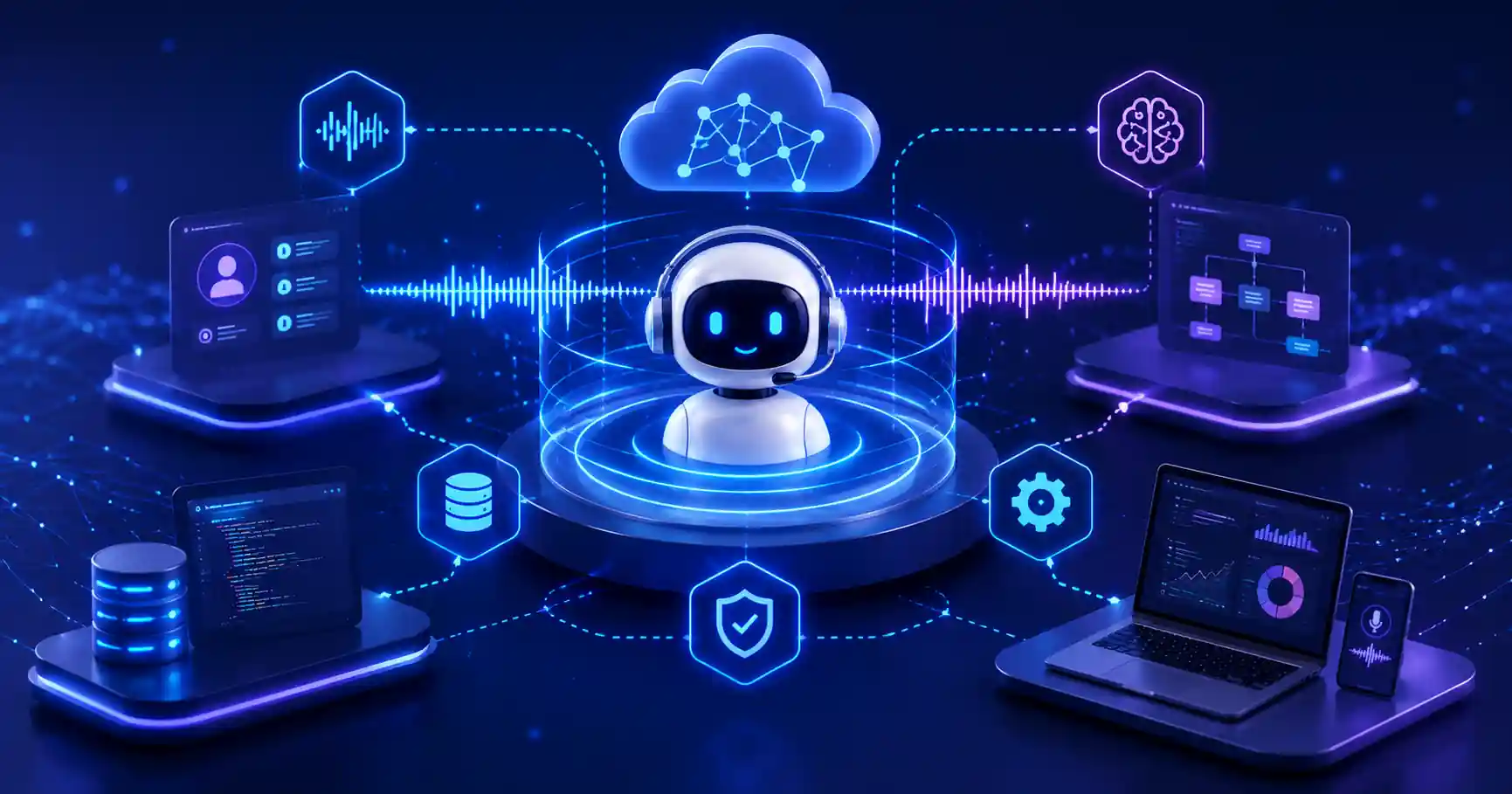
Best AI Voice Agent Platforms for Enterprise Applications
Enterprise call centers are no longer experimenting with AI voice on the side; they are actively shifting inbound support, outbound campaigns, scheduling, and call routing into AI voice agent systems as a primary channel strategy, a shift visible across the wider set of AI use cases in the contact center. The gap between platforms that succeed and platforms that stall out after a pilot is rarely about which vendor has the most natural-sounding voice. It is about how the system behaves once it moves beyond a controlled demo and meets real call volume, real accents, real background noise, and real edge cases that a scripted test call never surfaces. This guide explains how enterprise voice agent platforms work, profiles the strongest options on the market today, and outlines the use cases, benefits, risks, and best practices enterprise buyers should weigh before committing to one.
What is an AI voice agents?
An AI voice agent is a software system that uses speech recognition, natural language understanding, and speech synthesis to carry out full spoken conversations with customers or employees on behalf of an enterprise. Unlike older interactive voice response (IVR) systems, which route callers through rigid, pre-recorded menu trees — a gap covered in more depth when comparing the difference between AI voice agents and IVR — modern voice agents are built on large language models (LLMs) and can understand open-ended speech, hold context across a multi-turn conversation, call external tools and APIs mid-call, and take real actions in business systems — booking an appointment, processing a refund, updating a CRM record, or escalating to a human agent — all while the caller is still on the line.
Enterprises are adopting voice agents because the phone channel, despite decades of predictions about its decline, remains one of the highest-volume and highest-cost channels in customer service, sales, and operations. Industry benchmarking in 2026 shows platforms such as PolyAI reporting containment rates of 80–87% for enterprise deployments, and Retell AI reporting reductions in call handling costs of roughly 80% in some healthcare deployments alongside contact center containment rates near 85%. These figures illustrate why voice automation has moved from experimental pilot projects to a core line item in enterprise technology budgets, part of the broader AI voice agent market growth reshaping how enterprises budget for the phone channel.
The category sits at the intersection of two disciplines: conversational AI, which most people associate with text-based chatbots, and telephony infrastructure, the carrier-grade systems that route and connect phone calls reliably at scale — a distinction worth understanding through the practical difference between voice AI and conversational AI. A platform that only nails one side of that equation — natural-sounding conversation without dependable infrastructure, or rock-solid telephony without genuinely conversational AI — tends to fail once it leaves a controlled pilot and meets real call volume.
How AI voice agent platforms work
Enterprise voice agent platforms are built from a pipeline of interlocking components, and the quality of an enterprise deployment depends on how well these components work together rather than on any single piece in isolation.
1. Speech-to-text (transcription)
Every call begins with automatic speech recognition, which converts the caller's audio into text in near real time. Accuracy here matters enormously: a transcription error early in a call can cascade into a wrong answer, a wrong department transfer, or a wrong record update later in the conversation. Enterprise-grade platforms tune recognition models for accents, background noise, industry vocabulary (medical terms, product SKUs, financial terminology), and telephony audio quality, which is lower-fidelity than the audio used to train most general-purpose speech models.
2. Natural language understanding and reasoning
Once the caller's words are transcribed, an LLM interprets intent, tracks context across turns, and decides what to do next. This is the same reasoning core found in text-based AI agents, adapted for the constraints of live speech, and reflects the growing role of LLMs in the future of AI voice agents: it must produce a next step in a fraction of a second, handle interruptions gracefully, and recover cleanly when it mishears something, rather than pausing to "think" the way a text chatbot can.
3. Tool calling and system integration
The defining feature that separates a voice agent from a voicebot is the ability to call tools mid-conversation. While talking to a customer, the agent can query a CRM for account status, check a scheduling system for open appointment slots, verify a policy number against a database, or trigger a workflow in an order management system — and then speak the result back to the caller without any perceptible dead air, the same pattern behind efforts to integrate AI agents with CRM and ERP systems for hyper-automation. Platforms differentiate heavily on how deep and how fast these integrations are. Salesforce's Agentforce Voice, for example, connects natively to Salesforce data, letting the agent reference live customer records and update cases or sales workflows during the call itself, which removes the latency and error risk of bolting a voice layer onto a separate CRM through custom middleware.
4. Text-to-speech (voice synthesis)
The agent's response is converted back into audio using a synthetic voice. Enterprises increasingly expect natural prosody, appropriate pacing, and even sentiment-aware tone shifts — a voice that slows down and softens when a customer sounds frustrated. Some platforms also offer voice cloning so a brand can maintain one consistent "voice" across every regional support center and language.
5. Latency and interruption handling
Because this entire pipeline — listen, understand, decide, call tools, speak — has to happen while a human is waiting on the line, latency is one of the most important architectural metrics in the category. Delays of even a second or two make a conversation feel unnatural and increase the odds a caller hangs up or asks for a human. Leading platforms now target response latencies in the 500–800 millisecond range and build in interruption handling, sometimes called "barge-in," so the agent can stop speaking immediately if the caller starts talking.
Best AI Voice Agent Platforms for Enterprise Applications
No single platform is the right answer for every enterprise; the best fit depends on whether an organization wants a fully managed solution, a developer-first toolkit to build custom voice flows, or a voice layer added onto a CRM or contact center suite it already runs. The following platforms represent the strongest options across those different buying profiles in 2026.
1. Retell AI
Retell AI is positioned as an enterprise-grade voice platform built for organizations that want full control over their voice infrastructure. It offers an LLM-powered agent architecture with latency in the range of 600 milliseconds, a no-code drag-and-drop builder for less technical teams alongside full API access for engineering teams, and compliance features aimed at regulated industries such as healthcare. Enterprise customers have reported substantial reductions in call handling costs and high containment rates in contact center deployments, reflecting how AI voice agent developers build real-time voice assistants at this level of reliability. Retell is best suited to operations and engineering teams that need production-ready phone automation without a lengthy custom build, and to large enterprises that want carrier-grade reliability paired with deep telephony and data integrations.
2. Vapi
Vapi is a developer-first platform aimed at teams that want granular control over their entire voice stack — telephony provider, underlying language model, and conversation orchestration logic. Rather than offering a fixed, opinionated product, Vapi exposes the building blocks so engineering teams can assemble a bespoke voice agent, choose the specific models that power transcription, reasoning, and speech synthesis, and fine-tune latency at each stage of the pipeline. This flexibility makes Vapi a strong choice for enterprises with in-house AI or platform engineering teams that need to integrate voice into proprietary systems or highly specific workflows, though it generally requires more engineering investment than a managed platform, a tradeoff worth weighing against the common challenges AI voice agent developers face when building from raw components.
3. PolyAI
PolyAI focuses specifically on complex, multilingual enterprise deployments and is frequently cited as one of the strongest options for large organizations that need voice automation to work reliably across languages, accents, and regulatory environments. Reported containment rates for enterprise clients in the 80–87% range make it one of the higher-performing platforms on resolution quality, an important metric for contact centers trying to reduce escalations to human agents.
4. Synthflow
Synthflow takes a no-code approach, targeting teams that want to launch call automation quickly without heavy engineering involvement. It performs well for straightforward inbound and outbound use cases such as appointment scheduling and basic support inquiries, and supports more than 50 languages. Because it trades away some of the deep customization available in developer-first platforms, Synthflow tends to be a better fit for initial deployments and simpler workflows than for the most complex, high-stakes enterprise scenarios — the same tradeoff smaller teams weigh when comparing which AI voice agent is best for small businesses, where limitations in multi-turn context handling can become more apparent as conversations grow more complicated.
5. Salesforce Agentforce Voice
For enterprises already standardized on Salesforce, Agentforce Voice offers a voice agent that is natively wired into Salesforce data. Because the agent can read and write directly to live customer records during a call — updating a case, progressing a sales opportunity, or checking order status — it avoids the integration overhead that independent voice platforms face when connecting to a CRM through external connectors. The tradeoff is that organizations get the most value when their operations are already deeply aligned with Salesforce infrastructure.
6. Amazon Connect with Amazon Lex
Amazon's contact center offering pairs its cloud telephony platform, Amazon Connect, with Amazon Lex for conversational AI, and integrates tightly with the rest of AWS. This makes it a natural fit for AWS-centric organizations that want a scalable, pay-as-you-go voice automation layer without adopting an entirely new vendor ecosystem, and that have variable call volumes where elastic, usage-based pricing is an advantage.
7. Google Cloud Contact Center AI (CCAI)
Google's CCAI platform leans on Google's broader AI infrastructure and natural language capabilities, and is often selected by security-conscious enterprises in regulated industries that want the backing of a hyperscaler's compliance and data-governance posture — the same posture expected of any genuinely GDPR-compliant AI voice agent — alongside strong multilingual and speech-recognition performance.
8. Five9 and NICE
Five9 and NICE represent a different category of buyer: established, full-featured contact center platforms that have layered AI voice capabilities onto existing workforce engagement and omnichannel infrastructure. Five9 is generally the stronger fit for organizations that are already Five9 customers and want to extend into AI voice without a platform migration. NICE brings comprehensive workforce optimization and analytics capabilities alongside its voice AI features, making it attractive to organizations that prioritize quality management and agent coaching.
9. Cognigy
Cognigy is frequently ranked among the strongest enterprise-first options for organizations that need a highly programmable conversational AI platform with granular control over dialogue design, integration logic, and deployment across both voice and chat channels from a single platform.
10. Ringly.io
Ringly.io is a fully managed, usage-billed voice platform built specifically for Shopify and direct-to-consumer e-commerce brands. It is not a general enterprise contact center replacement, but for retail and DTC operations it offers a done-for-you alternative to the build-it-yourself model of platforms like Vapi and Retell, with reported resolution rates around 73% for e-commerce support calls and support for roughly 40 languages.
Use cases of AI voice agents in the enterprise
Enterprise AI voice agents are transforming how organizations manage customer service, internal operations, and employee support through natural, real-time conversations. They automate repetitive voice interactions, improve operational efficiency, and deliver consistent experiences across multiple business functions.
Customer support and contact centers: The largest current use case is deflecting and resolving routine inbound calls — order status, account questions, password resets, appointment changes — so human agents can focus on complex or emotionally sensitive interactions. Enterprise deployments report containment rates as high as 80–87% for well-configured agents handling routine inquiries, and increasingly rely on how an AI contact center determines caller intent to route the conversation correctly from the first few seconds.
Appointment scheduling and healthcare intake: Voice agents are widely used to confirm insurance details, screen basic symptoms, check appointment availability, and handle warm transfers to clinical staff, a role covered in more depth among the top AI voice agents for patient appointment scheduling services, reducing administrative burden on front-desk and scheduling teams while keeping response times consistent around the clock.
Sales and lead qualification: Outbound voice agents can run initial qualification calls, follow up on missed inbound leads, and hand off qualified prospects to human sales representatives with a CRM-linked summary of the conversation already attached to the record.
Financial services and secure transactions: Because many banking and insurance interactions require identity verification and precise handling of sensitive data, voice agents in this space are typically built with strict compliance and workflow controls, the same standard behind dedicated AI voice agent deployments in banking and finance, and are often deployed by platforms with regulated-industry certifications rather than general-purpose tools.
Retail and e-commerce order management: DTC and retail brands use voice agents to handle order tracking, returns, and basic product questions, often as a natural extension of an existing customer service stack such as Shopify.
After-hours and overflow coverage: Many organizations deploy voice agents specifically to catch call volume outside business hours or during demand spikes, maintaining consistent service levels without adding shift coverage.
Benefits of enterprise AI voice agents
Enterprise AI voice agents help organizations automate customer interactions, improve service availability, and streamline business operations at scale. By delivering fast, personalized, and consistent voice experiences, they reduce operational costs while enhancing customer satisfaction and productivity.
1. Lower operational cost at scale
By automating repetitive call volume, catching calls that would otherwise be missed, and reducing the administrative time agents spend updating records after each call, voice agents let enterprises handle more call volume without proportionally increasing headcount. Reported cost reductions in some healthcare deployments have reached roughly 80% for call handling costs, a number worth weighing against the realistic AI automation costs enterprises should budget for at deployment.
2. Consistent service levels
Voice agents do not experience fatigue, do not vary in tone from shift to shift, and can maintain service levels during peak periods or after hours without additional staffing, which is particularly valuable for organizations with unpredictable call volume.
3. Faster resolution and reduced average handle time
Because voice agents can query systems and execute actions during the call itself rather than placing a caller on hold, well-architected deployments reduce average handle time and increase first-call resolution, directly affecting both customer satisfaction and cost per call.
4. Data capture and downstream automation
Every voice interaction produces a structured record — transcripts, extracted intents, outcomes — that can feed directly into CRM systems, analytics dashboards, and quality management tools, part of a broader effort to use AI to optimize a CRM, giving enterprises visibility into call center performance that manual note-taking never provided.
5. Multilingual reach without proportional staffing
Modern voice platforms increasingly support dozens to over a hundred languages, letting enterprises offer consistent multilingual support without building out language-specific staffing in every region.
Risks and limitations
While enterprise voice agents offer significant operational benefits, they also introduce challenges related to accuracy, security, compliance, and complex system integrations. Understanding these limitations early helps organizations implement appropriate safeguards and build reliable, production-ready voice AI solutions.
1. Latency and conversational breakdown under real load
A voice agent that performs well in a controlled demo can behave very differently once it is handling real concurrent call volume. Some platforms maintain call quality but degrade under concurrency; others integrate well with CRM and telephony systems but introduce latency that breaks the natural flow of conversation. Enterprises should treat performance under production-level concurrency, not polished demo performance, as the real test of a platform.
2. Context loss in multi-turn conversations
Simpler or no-code platforms can perform well on short, linear interactions like scheduling but show weaker context handling as conversations become longer or more complex, which makes them a poor fit for high-stakes, multi-step enterprise workflows even though they may be attractive for their ease of setup.
3. Escalation handling
Complex or emotionally charged issues generally still require a human agent, and resolution rates for well-configured platforms — commonly cited in the 60–70% range for routine inquiries, with some enterprise platforms reporting higher — reflect that voice agents are best deployed as a first line of automation rather than a full replacement for human support staff.
4. Data privacy and compliance exposure
Voice agents that read from and write to CRM, healthcare, or financial systems during live calls introduce real data-security considerations, since a mishandled integration could expose sensitive records or execute an incorrect transaction without human review. Regulated industries in particular should prioritize platforms with explicit compliance certifications and audit logging rather than adding those capabilities as an afterthought.
5. Vendor lock-in and integration debt
Platforms tightly coupled to a single CRM or cloud ecosystem, such as a voice layer built natively into one CRM's data model, deliver strong integration but can make it harder to migrate later or to run a multi-vendor strategy, which is worth weighing against the near-term convenience of native integration and the ongoing infrastructure costs of AI voice agent systems a locked-in architecture can carry over time.
Best practices for selecting and deploying enterprise voice agents
Choosing the right enterprise voice agent requires balancing scalability, security, integration capabilities, and user experience with your business objectives. Following proven deployment practices helps ensure reliable performance, regulatory compliance, and long-term ROI from your AI voice solution.
1. Test under real concurrency, not demo conditions
Because performance architecture — latency, interruption handling, and behavior under concurrent call load — is as important as how natural the voice sounds, enterprises should pilot platforms with production-representative call volume before committing to a full rollout, rather than relying on a scripted demo call.
2. Match the platform to the buying profile
Enterprises with strong in-house engineering resources and highly specific requirements are generally better served by developer-first, API-driven platforms that allow granular control over the model stack. Enterprises that want to move quickly with limited engineering investment are better served by managed or no-code platforms, accepting some tradeoff in customization — a decision worth grounding in the right questions to ask before hiring an AI voice agent development company.
3. Prioritize native data integration for complex workflows
Platforms that connect directly to the systems of record a voice agent needs to reference — CRM, scheduling, claims, order management — tend to outperform standalone voice tools bolted on through external connectors, because native integration reduces both latency and the risk of errors mid-call, a principle explained further in how an AI agent uses CRM data to respond mid-conversation.
4. Keep humans in the loop for high-stakes actions
Just as with text-based AI agents, voice agents that can take consequential actions — processing payments, changing account details, handling healthcare information — should be designed with clear escalation paths to human agents and, where appropriate, human confirmation before high-impact actions are finalized, echoing the same boundary covered when comparing the difference between AI voice agents and human agents.
5. Monitor containment and resolution rates by use case, not in aggregate
Because resolution rates vary significantly by scenario — routine inquiries resolve far more often than complex or emotional issues — enterprises should track performance metrics segmented by call type, and use that data to continually refine which categories of calls are fully automated versus routed to human agents, a discipline reflected in the current set of top AI voice agent trends.
6. Plan for multilingual and accessibility requirements up front
Given that language support quality varies meaningfully across platforms even when a vendor advertises broad language coverage, enterprises with multilingual customer bases should test voice quality and comprehension with native speakers for every language that matters to their business, rather than assuming broad language claims translate evenly across all of them.
Conclusion
There is no universal "best" AI voice agent platform for enterprise applications — only the platform that best matches an organization's engineering resources, existing systems of record, compliance requirements, and the specific mix of call types it needs to automate. Enterprises that invest the time to pilot candidates under realistic call volume, weigh native integration depth against flexibility, and set clear escalation rules for human agents will get substantially more value from voice automation than those that select a platform on voice quality alone and one that will only matter more as the future of conversational AI voice agents continues to unfold.
Ready to transform your customer service with enterprise AI voice agents?
FAQs
An enterprise AI voice agent is an AI-powered system that understands spoken language, holds natural conversations, integrates with enterprise applications, and performs real business tasks such as scheduling appointments, updating CRM records, and resolving customer inquiries.
Leading enterprise AI voice agent platforms include Retell AI, Vapi, PolyAI, Synthflow, Salesforce Agentforce Voice, Amazon Connect, Google Cloud CCAI, NICE, Cognigy, and Ringly.io.
Enterprise AI voice agents reduce operational costs, improve customer service availability, automate repetitive voice interactions, accelerate issue resolution, and provide multilingual support while integrating with business systems.
Organizations should evaluate latency, security, regulatory compliance, system integrations, context retention, escalation workflows, and vendor lock-in before deploying enterprise AI voice agents.
Successful deployments require testing under real-world conditions, selecting platforms that align with business goals, integrating with enterprise systems, maintaining human oversight for critical tasks, and continuously monitoring performance.
Tags

Yash Singh is the Chief Marketing Officer at Vegavid Technology, a leading AI-driven technology company specializing in AI agents, Generative AI, Blockchain, and intelligent automation solutions. With over a decade of experience in digital transformation and emerging technologies, Yash has played a key role in helping businesses adopt advanced AI solutions that enhance operational efficiency, automate workflows, and deliver personalized customer experiences across industries including fintech, healthcare, gaming, ecommerce, and enterprise technology. An alumnus of Indian Institute of Technology Bombay, Yash combines strong technical expertise with strategic marketing leadership to drive innovation in AI-powered applications, autonomous AI agents, Retrieval-Augmented Generation (RAG), Natural Language Processing (NLP), Large Language Models (LLMs), machine learning systems, conversational AI, and enterprise automation platforms. His expertise spans AI model integration, intelligent workflow automation, prompt engineering, smart data processing, and scalable AI infrastructure development, enabling organizations to accelerate digital transformation and business growth. Passionate about the future of intelligent systems, Yash actively shares insights on AI agents, Generative AI, LLM-powered applications, blockchain ecosystems, and next-generation digital strategies. He is committed to helping businesses embrace AI-first transformation while guiding teams to build impactful, industry-specific solutions that shape the future of innovation and intelligent technology.





Leave a Reply