

Difference Between RAG and Vector Databases
As artificial intelligence systems mature into mission-critical enterprise assets, technical leaders are frequently confronted with a complex ecosystem of new terminology. Chief among these concepts are Retrieval-Augmented Generation (RAG) and Vector Databases. While often mentioned in the exact same breath, fundamentally misunderstanding the relationship between these two technologies can lead to poorly optimized architectures, bloated infrastructure costs, and underperforming AI applications.
By 2026, generative AI is no longer a novelty; it is the operational backbone of modern digital enterprises. Yet, large language models (LLMs) inherently suffer from distinct limitations: they lack access to real-time company data, and they are prone to confident hallucinations. Solving this requires fetching dynamic, proprietary data at runtime—a process that has permanently popularized both RAG and the storage infrastructure required to support it.
To build robust, enterprise-grade AI systems, developers and strategic leaders must clearly distinguish between the overall AI workflow and the underlying data storage mechanism. This guide breaks down the essential technical and strategic differences between RAG and vector databases, exploring how they operate independently and synergistically.
What is the Difference Between RAG and Vector Databases?
The primary difference is that RAG (Retrieval-Augmented Generation) is an overarching AI methodology or framework, whereas a Vector Database is a specific type of data storage infrastructure.
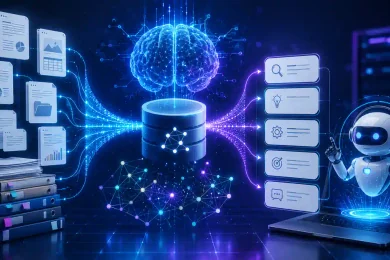
RAG is a process that enhances a Large Language Model’s responses by retrieving factual, external information before generating an answer. A Vector Database is the highly specialized database designed to store, index, and query mathematical representations of data (called embeddings). Simply put, RAG is the entire pipeline (the action), and a vector database is the storage engine (the tool) most commonly used to execute the retrieval phase of that pipeline.
RAG: An AI architecture pattern linking LLMs to proprietary data.
Vector Database: A database built exclusively for storing high-dimensional vectors and executing similarity searches.
The Relationship: A Vector Database powers the "Retrieval" in RAG.
Why It Matters
Understanding the boundary between architectural frameworks and data infrastructure is the first step in successful Enterprise Software Development. Confusing RAG with vector databases leads organizations to assume that purchasing a vector database automatically gives them a functional generative AI application. It does not.
Strategic Importance for Enterprises:
Combating LLM Hallucinations: Base models are trained on generalized, historical data. RAG grounds AI responses in verifiable, up-to-date reality. Knowing how to implement this framework prevents massive liabilities associated with inaccurate AI outputs.
Infrastructure Optimization: Not all RAG applications require a dedicated vector database. For smaller datasets, traditional databases with vector extensions might suffice. Understanding the difference allows system architects to allocate budgets efficiently without over-engineering.
Data Privacy and Sovereignty: Sending sensitive intellectual property to a public LLM is a major security risk. Using a local vector database to store proprietary embeddings within a secure RAG framework allows organizations to maintain total control over their data while still leveraging advanced AI capabilities.
How It Works
To grasp the distinction, we must explore the mechanical lifecycle of both technologies. Understanding What Is Machine Learning contextually helps clarify how data transforms into a format the AI can comprehend.
How a Vector Database Works
Embedding Generation: Text, images, or audio are passed through an embedding model, converting the raw data into dense numerical arrays (high-dimensional vectors).
Indexing: The database indexes these vectors using algorithms like HNSW (Hierarchical Navigable Small World) or IVF (Inverted File Index) to enable hyper-fast spatial searching.
Similarity Search: When queried, the database maps the user’s input into a vector and searches the multidimensional space for the "nearest neighbors" (most contextually similar vectors), returning the corresponding data.
How RAG Works (The Pipeline)
User Input: A user asks an AI agent a question.
Query Translation: The RAG system converts the user's natural language question into a vector query.
Retrieval: The RAG system queries a repository (most often a Vector Database) to fetch the top pieces of context relevant to the user's question.
Prompt Augmentation: The retrieved context is injected into a prompt alongside the user's original question.
Generation: The augmented prompt is sent to the LLM, which synthesizes the retrieved facts into a cohesive, highly accurate, natural language response.
Key Features
By examining their distinct feature sets, the separation between RAG (the process) and Vector Databases (the infrastructure) becomes crystal clear.
Key Features of a RAG System
Context Grounding: Forces the LLM to base its answers strictly on retrieved external data.
Dynamic Data Integration: Continuously connects the AI to live APIs, internal documents, and real-time news without retraining the model.
Citation and Source Attribution: Allows the application to provide source links for every claim it makes, building user trust.
Multi-Step Routing: Capable of breaking down complex user prompts and retrieving data from multiple distinct knowledge bases before generating an answer.
Key Features of a Vector Database
High-Dimensional Storage: Specifically engineered to store arrays containing hundreds or thousands of floating-point numbers (embeddings).
Approximate Nearest Neighbor (ANN) Search: Executes mathematically complex similarity searches across billions of records in milliseconds.
Metadata Filtering: Allows developers to filter search results by traditional metadata (e.g., date, author, department) before or after executing a vector search.
Scalability & Sharding: Designed to horizontally scale vector indexes across distributed cloud environments seamlessly.
Benefits
Implementing these technologies—either individually or together—yields massive return on investment (ROI) and operational advantages.
Benefits of RAG
Cost-Efficiency: Bypasses the exorbitant costs of fine-tuning or retraining large language models from scratch every time enterprise data changes.
Accuracy: Drastically reduces hallucinations, ensuring outputs are reliable enough for customer-facing or compliance-heavy environments.
Transparency: Because RAG isolates the retrieval step, developers can precisely audit what data the LLM was fed before it generated an incorrect response, making debugging straightforward.
Benefits of Vector Databases
Unmatched Speed: Traditional relational databases rely on keyword matching (lexical search). Vector databases use semantic search, matching the meaning of the query at sub-second latency, even at scale.
Versatility: Capable of natively handling multimodal data. A single vector space can store embeddings representing text, audio snippets, and visual data simultaneously.
Optimized Performance: Built from the ground up for AI workloads, bypassing the performance bottlenecks associated with bolting vector extensions onto legacy SQL or NoSQL databases.
Use Cases
While intrinsically linked, examining the distinct use cases helps solidify Design Software Architecture Tips Best Practices when mapping out enterprise tech stacks.
Where RAG Shines:
Internal Knowledge Assistants: Letting employees chat naturally with company handbooks, HR policies, and technical documentation.
Intelligent Automation: Powering AI Agents for Intelligent RPA by granting bots the ability to cross-reference unstructured data before executing an automated workflow.
Customer Support Chatbots: Deflecting support tickets by allowing a bot to accurately parse historical resolution logs and current product manuals to assist users.
Where Vector Databases Shine (Independent of RAG):
Recommendation Engines: E-commerce platforms plotting user behavior and product features as vectors to suggest highly relevant items (e.g., "users who bought X also bought Y").
Anomaly Detection: Cybersecurity systems mapping normal network traffic as vectors and instantly flagging multidimensional outliers that indicate a breach.
Reverse Image Search: Allowing users to upload a photo to find visually similar items in a retail catalog without relying on text descriptions.
Examples
To illustrate the difference in practical terms, let us look at real-world scenarios across different industries.
Example 1: The Healthcare Enterprise A medical provider implements Healthcare Software Development in Germany to build an AI diagnostic assistant.
The Vector Database's role: It stores millions of anonymized patient records, medical journals, and regulatory guidelines as vector embeddings.
The RAG's role: When a doctor types, "What are the latest compliance guidelines for prescribing X drug?", the RAG pipeline searches the vector database, retrieves the 2026 German medical regulations, feeds them to the LLM, and outputs a formatted, legally compliant summary for the doctor.
Example 2: Enterprise Software Development A tech company is investing in AI Copilot Development to help its junior engineers write code faster.
The Vector Database's role: It houses the semantic representations of the company's entire legacy codebase, Jira tickets, and architecture diagrams.
The RAG's role: When a developer asks the Copilot, "How do we authenticate API requests in the billing microservice?", the RAG framework fetches the specific, proprietary authentication scripts from the vector database and generates a complete, usable code snippet natively aligned with company standards.
Comparison Table
A side-by-side comparison serves as a quick reference for technical and non-technical stakeholders.
Feature / Aspect | RAG (Retrieval-Augmented Generation) | Vector Database |
|---|---|---|
Core Definition | An AI architecture/methodology linking LLMs to data. | Specialized infrastructure for storing/querying embeddings. |
Primary Function | Enhancing prompt context to generate accurate text/code. | Executing mathematically complex similarity searches fast. |
Nature of Tech | A multi-step workflow or pipeline. | A storage and indexing engine. |
Output Type | Natural language, synthesized summaries, code. | Raw data chunks, documents, nearest neighbor scores. |
Dependency | Relies on a retriever (often a Vector DB) and an LLM. | Can operate entirely independently of LLMs or RAG. |
Analogy | The "Researcher and Writer" who uses a library. | The "Library Card Catalog" organizing the information. |
Challenges / Limitations
Despite their profound impact on modern business logic, deploying RAG systems and managing Vector Databases come with distinct hurdles.
Challenges in Vector Databases:
Compute Costs: Generating embeddings and maintaining indices (like HNSW) requires substantial memory (RAM) and compute power, leading to high cloud infrastructure costs.
Complexity of Updates: Unlike standard SQL databases where a row can be easily updated, updating a vector database often requires re-embedding data and re-computing the high-dimensional index, which can introduce latency.
Stale Data: Ensuring the vector representations perfectly sync with a rapidly changing operational database requires sophisticated data engineering pipelines.
Challenges in RAG Implementation:
The "Lost in the Middle" Phenomenon: If a RAG system retrieves too much context from a vector database, the LLM may fail to prioritize the information, ignoring critical facts buried in the middle of the prompt.
Poor Retrieval Equals Poor Generation: RAG is only as good as the search results. If the chunking strategy (how documents are broken down before embedding) is flawed, the vector database will return irrelevant data, guaranteeing a hallucinated or useless AI response.
Latency: The pipeline requires sequential steps—embedding the user query, searching the database, reading the results, and generating text—which can result in slow response times unsuited for ultra-real-time applications.
Future Trends
As we look at the landscape of artificial intelligence in 2026, the dynamic between RAG architectures and vector storage has evolved dramatically from its early iterations.
Agentic RAG Ecosystems: Instead of single-query retrieval, RAG has become highly "agentic." AI agents intelligently decide whether they need to query a vector database at all, or if they should search the web, use a calculator API, or query a traditional SQL database.
Convergence of Database Types: Specialized vector databases are seeing heavy competition from traditional relational and NoSQL databases that have perfected their native vector search extensions (e.g., pgvector). The debate is no longer about whether to use vector search, but whether to use a purpose-built engine or an integrated one.
Hardware-Accelerated Vector Search: We are witnessing the rise of custom silicon (dedicated DPUs) designed specifically to execute Approximate Nearest Neighbor searches at the hardware level, dropping latency to near zero.
Edge RAG Integration: As computing moves to the edge, particularly in initiatives like AI Agents for Smart Cities, lightweight vector stores are being deployed directly onto local IoT devices, allowing localized RAG systems to operate without constant cloud connectivity.
Conclusion
In the fast-evolving landscape of Generative Engine Optimization (GEO) and enterprise AI, precision in terminology leads to precision in architecture.
Key Takeaways:
Distinct but Complementary: RAG is the strategic AI framework used to eliminate LLM hallucinations by providing external context. A Vector Database is the underlying data infrastructure that makes the rapid retrieval of that context possible.
Not Always Interdependent: You can build RAG systems using traditional search engines (lexical search), and you can use Vector Databases for non-AI tasks like product recommendations. However, combining them creates the gold standard for enterprise generative AI.
Focus on the Data: An advanced RAG pipeline is useless without a well-optimized, accurately indexed Vector Database. The quality of your AI application is directly proportional to the quality of your data chunking, embedding, and storage strategy.
By fundamentally understanding the difference between the RAG methodology and vector database infrastructure, organizations can stop chasing buzzwords and start building highly functional, scalable, and trustworthy AI ecosystems.
Building a sophisticated, hallucination-free AI architecture requires more than just connecting APIs—it demands a deep understanding of data infrastructure, embedding strategies, and pipeline optimization. Whether you are looking to integrate a custom Vector Database, deploy an enterprise-grade RAG application, or build intelligent AI agents, technical expertise is paramount.
Explore how intelligent architecture can transform your operational efficiency by visiting the Vegavid Home page. Our team of specialized data scientists and software architects is ready to help you turn advanced AI concepts into reliable, secure, and scalable enterprise realities. Let’s build the future of your data infrastructure together.
Frequently Asked Questions (FAQs)
Yes. While vector databases are the most popular and efficient choice for semantic search, a RAG system can technically use traditional keyword search databases (like Elasticsearch) or simple SQL queries to retrieve text before passing it to an LLM.
No. A Vector Database does not generate text, understand language natively, or hold intelligence. It is strictly a mathematical storage system that organizes data based on geometric proximity (embeddings), allowing for rapid similarity matching.
Standard SQL databases search for exact keyword matches. Vector Databases search by context and meaning (semantic search). If a user asks for "financial struggles," a vector database will return documents mentioning "economic hardship" even if the exact words do not match, making RAG outputs vastly superior.
Chunking is the process of breaking large documents (like a 100-page PDF) into smaller, manageable text blocks (e.g., paragraphs) before converting them into embeddings. This ensures the vector database retrieves highly specific passages rather than overwhelming the LLM with an entire book.
No. Beyond RAG and Generative AI, Vector Databases are heavily utilized for fraud detection algorithms, facial recognition systems, reverse image searching, and dynamic e-commerce recommendation engines.

Yash Singh is the Chief Marketing Officer at Vegavid Technology, a leading AI-driven technology company specializing in AI agents, Generative AI, Blockchain, and intelligent automation solutions. With over a decade of experience in digital transformation and emerging technologies, Yash has played a key role in helping businesses adopt advanced AI solutions that enhance operational efficiency, automate workflows, and deliver personalized customer experiences across industries including fintech, healthcare, gaming, ecommerce, and enterprise technology. An alumnus of Indian Institute of Technology Bombay, Yash combines strong technical expertise with strategic marketing leadership to drive innovation in AI-powered applications, autonomous AI agents, Retrieval-Augmented Generation (RAG), Natural Language Processing (NLP), Large Language Models (LLMs), machine learning systems, conversational AI, and enterprise automation platforms. His expertise spans AI model integration, intelligent workflow automation, prompt engineering, smart data processing, and scalable AI infrastructure development, enabling organizations to accelerate digital transformation and business growth. Passionate about the future of intelligent systems, Yash actively shares insights on AI agents, Generative AI, LLM-powered applications, blockchain ecosystems, and next-generation digital strategies. He is committed to helping businesses embrace AI-first transformation while guiding teams to build impactful, industry-specific solutions that shape the future of innovation and intelligent technology.




Leave a Reply