
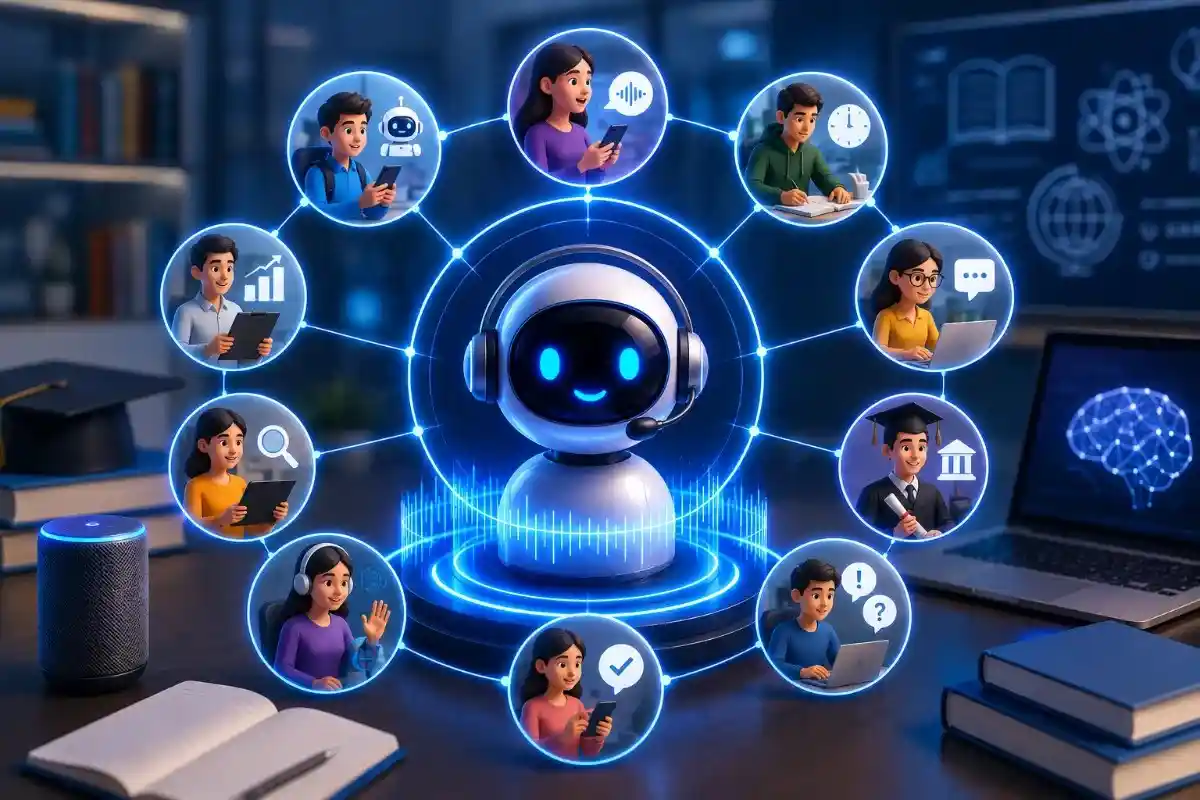
Top 10 AI Voice Agent Use Cases in Education
Introduction
Education has always relied on conversation. Teachers explain, students ask, parents follow up, and administrators answer the same questions dozens of times a day. That repetitive, high-volume communication is exactly where voice-based automation earns its place. Over the past two years, schools, universities, and edtech companies have started building and deploying voice-driven assistants that can answer admissions queries, remind students about assignments, and even walk a learner through a practice quiz over the phone. This shift is part of a broader wave of AI In Education that is changing how institutions communicate at scale. This article walks through what these systems are, how they function, why they matter for modern institutions, the practical benefits they bring, the real use cases already in production, and the trends shaping where this technology goes next. Along the way, we will also look at the tools and companies, including specialists like Vegavid, that help institutions bring these systems to life.
What Are AI Voice Agents in Education?
An AI voice agent in an educational setting is a software system that can hold a spoken conversation with a student, parent, or staff member and complete a task without a human operator on the other end of the line. Unlike a static interactive voice response system that forces callers through rigid menus, a modern voice agent understands natural spoken language, follows context across multiple turns of dialogue, and can pull real information from a student information system, learning management system, or admissions database while the call is happening.
These systems combine several technical layers: automatic speech recognition to convert spoken words into text, a language model to understand intent and generate a reply, and text-to-speech synthesis to turn that reply back into natural-sounding audio. In education specifically, this means a caller can ask about a fee deadline, a class schedule, or a scholarship requirement and receive an accurate, personalized answer in seconds. Because the technology understands accents, interruptions, and follow-up questions, it feels closer to speaking with a knowledgeable staff member than to navigating an automated phone tree. This is the foundation of what most people now describe when they refer to voice-based automation for schools and universities, and it is quickly becoming a standard expectation rather than a novelty for institutions that handle large volumes of calls and messages every day.
How Do AI Voice Agents Work in Education?
Understanding the mechanics helps institutions decide where these systems fit best. A voice agent generally moves through four connected stages during a single interaction, and each stage has to work reliably for the conversation to feel natural rather than robotic.
Speech Recognition and Language Understanding
The moment a student or parent starts speaking, the system converts audio into text using automatic speech recognition tuned for varied accents and background noise common in classrooms, hostels, or busy homes. Engines such as Deepgram and AssemblyAI are commonly used for this layer because they hold up well against noisy phone lines and mixed accents. A language model then parses that text to figure out intent, whether the caller wants to check attendance, reschedule a parent-teacher meeting, or ask about a course prerequisite.
Contextual Reasoning and Data Retrieval
Once intent is identified, the agent queries connected systems such as a student database, calendar, or fee ledger to pull the exact information needed. Institutions with existing cloud commitments often route this reasoning layer through Google Dialogflow or Amazon Lex, since both integrate cleanly with data already sitting in those ecosystems. This is where thoughtful AI Voice Agent Development becomes essential, since the quality of these integrations determines whether the answer given is accurate and current rather than generic.
Response Generation and Voice Synthesis
The system composes a reply in natural language and converts it into speech using a synthetic voice designed to sound warm and clear rather than mechanical, with providers like ElevenLabs frequently supplying this natural-sounding voice layer. Tone, pacing, and pronunciation are tuned specifically for the education context, where callers range from young students to older parents who may be less comfortable with technology.
Escalation and Human Handoff
Well-designed agents recognize when a query is too sensitive or complex, such as a disciplinary matter or a mental health concern, and transfer the caller to a staff member with full context already logged, so nothing has to be repeated. This handoff typically runs over standard telephony infrastructure such as Twilio, which keeps the transfer seamless from the caller's point of view.
Why Are AI Voice Agents Important for Education?
Educational institutions operate on tight staff-to-student ratios, and front-office teams are frequently overwhelmed during admissions season, exam periods, or the start of a new term. A single university admissions office can receive thousands of repetitive calls in a matter of weeks, and most of those calls ask variations of the same handful of questions. Voice agents absorb this repetitive load without getting tired, distracted, or inconsistent, freeing human staff to focus on situations that genuinely require judgment, empathy, or specialized knowledge.
There is also a growing expectation, driven by consumer experiences with banks and retailers, that institutions should be reachable at any hour and should respond instantly rather than asking someone to wait for office hours. Parents working full-time jobs often cannot call during a school's narrow open hours, and international students dealing with time zone differences need support that does not sleep. Partnering with the right provider for AI Voice Agent Development Services allows an institution to meet this expectation without hiring an overnight call center, which is often financially out of reach for schools and mid-sized universities. Beyond convenience, there is a retention argument too: a prospective student who gets a fast, accurate answer during the admissions process is measurably more likely to complete enrollment than one who is left on hold or forgotten in an email queue. For these reasons, voice automation has moved from an experimental add-on to a genuine operational necessity for institutions serious about service quality.
Benefits of AI Voice Agents in Education
The value of voice automation in education becomes clearer when broken into specific, measurable advantages rather than abstract claims. Below are ten practical benefits institutions are already realizing.
Round-the-Clock Availability for Students and Parents
A voice agent does not observe office hours. Whether a parent calls at ten at night to confirm a fee due date or a student checks an exam time slot early on a Sunday morning, the system answers immediately with accurate, current information pulled directly from the institution's records, and enterprise phone platforms like Bland are built specifically to keep this kind of always-on line running reliably at scale.
Consistent and Accurate Information Every Time
Human staff, especially newer employees, occasionally give slightly different answers to the same question depending on who picks up the phone. A properly configured voice agent references the same underlying data source every time, which removes the inconsistency that often causes confusion and repeat calls.
Significant Reduction in Administrative Workload
Front-desk and admissions staff spend a large share of their day answering routine questions about deadlines, documents, and requirements. Automating these repetitive interactions lets staff redirect their time toward counseling, follow-ups, and tasks that genuinely need a human touch.
Faster Response Times During Peak Periods
Admissions season, result announcements, and registration windows create call volume spikes that overwhelm even well-staffed offices. Voice agents scale instantly to handle hundreds of simultaneous conversations, so no caller is stuck waiting in a queue during the busiest weeks of the year.
Lower Operating Costs Compared to Expanding Call Center Staff
Hiring and training additional support staff for seasonal spikes is expensive and often results in underused capacity during quieter months. A voice agent handles the same seasonal surges at a fraction of the ongoing cost, since it scales up and down without recruitment or payroll overhead, and no-code builders such as Synthflow let smaller institutions get this kind of coverage running without a large engineering budget.
Improved Accessibility for Non-Native Speakers and Diverse Learners
Multilingual voice agents can converse in a caller's preferred language, which matters enormously for institutions serving international students or communities where English is not the first language spoken at home. Platforms such as Kore.ai and Yellow.ai are frequently chosen for this reason, since both are built to handle high volumes of multilingual conversation. This reduces miscommunication and makes support genuinely inclusive.
Better Data Collection and Institutional Insight
Every conversation generates a transcript and structured data about what students and parents are actually asking. Institutions can analyze these patterns to spot recurring pain points, such as confusing fee structures or unclear scheduling, and fix the root cause rather than repeatedly answering the same complaint.
Reduced Student Drop-Off During Enrollment
Prospective students frequently abandon an application when they cannot get a quick answer to a simple question about cost, eligibility, or deadlines. Immediate, accurate voice support at this critical decision point keeps applicants engaged and measurably improves completion rates.
Personalized Academic Support at Scale
Voice agents connected to a learning management system can remind an individual student about a specific missing assignment, an upcoming quiz, or a weak area identified in recent test performance, delivering the kind of individual attention that would otherwise require far more staff time than most institutions can spare.
Stronger Continuity During Emergencies or Closures
During weather closures, health emergencies, or sudden schedule changes, voice agents can proactively call or receive calls from thousands of families simultaneously with consistent, accurate updates, something that would be nearly impossible for a small administrative team to manage manually within the same timeframe.
Top 10 Use Cases of AI Voice Agents in Education
Following are the Use Cases of AI Voice Agents in Education:
Institutions worldwide are already deploying voice automation across a wide range of practical scenarios. The following ten represent the most common and highest-impact use cases seen in schools, colleges, universities, and edtech platforms today.
1. Admissions Inquiry Handling
Prospective students and parents call with questions about eligibility, program structure, tuition, and application deadlines. A voice agent answers these instantly, captures lead details, and routes genuinely complex cases to a counselor, which shortens the admissions cycle considerably. Developer-focused platforms like Retell AI and Vapi are commonly used to build this kind of high-volume admissions line, since both support the low-latency, always-on conversation these offices need during peak season.
2. Fee Payment Reminders and Collection Support
Automated outbound calls remind families about upcoming due dates, outstanding balances, or installment options, and can even guide a caller through a payment link or connect them to the finance office if further help is needed.
3. Attendance and Absence Verification
When a student is marked absent, a voice agent can automatically call the registered guardian to confirm the reason, log the response, and flag patterns of repeated absence for counselor follow-up, closing a communication gap that many schools currently handle through slow manual calls.
4. Exam Schedule and Result Notifications
Instead of students refreshing a portal repeatedly, a voice agent can proactively call or answer inbound queries about exam dates, hall ticket status, and result availability, reducing pressure on academic offices during the most stressful weeks of the term. Larger examination boards sometimes build this kind of notification system on top of IBM watsonx Assistant, which fits well with existing enterprise data systems.
5. Tutoring and Homework Support Lines
Some edtech platforms now offer a voice line where a student can ask a subject-specific question aloud and receive a spoken explanation, particularly useful for younger learners or students without easy access to a keyboard or screen. Cloud providers such as Microsoft Azure AI are often used to power this kind of tutoring pipeline, since they bundle speech and language services together for edtech teams building at scale.
6. Career Counseling and Course Recommendation
Voice agents trained on program catalogs can walk a student through their interests and academic background over a conversation, suggesting relevant majors, electives, or certification tracks, effectively extending the reach of a small counseling team. Larger university systems handling this at scale often turn to enterprise-grade platforms like PolyAI, which are built for exactly this kind of structured, high-containment conversation.
7. Alumni and Donor Engagement Calls
Universities use voice agents to reconnect with alumni for event invitations, mentorship programs, or fundraising campaigns, handling the first round of outreach so development staff can focus their time on the most promising conversations. Contact-center platforms such as Cognigy are often used here, since they are designed for exactly this kind of large-scale, structured outbound calling.
8. Library and Resource Assistance
A voice agent can tell a student whether a specific book is available, when it is due back, or how to access a digital resource, removing a routine question that otherwise interrupts library staff throughout the day. Some library systems still rely on foundational speech recognition technology from providers like Nuance for this kind of catalog lookup.
9. Hostel and Facility Management Queries
Boarding students and their families often call about room allotment, mess timings, or maintenance requests. Voice agents handle these operational questions directly, logging maintenance tickets automatically when needed. Tools like EliseAI and Structurely, originally built for real estate leasing offices, are increasingly adapted for exactly this kind of housing and accommodation query.
10. Parent-Teacher Meeting Scheduling
Rather than exchanging several emails or missed calls, a voice agent can check teacher availability, propose time slots to a parent, and confirm a meeting, all within a single short phone conversation, and this remains one of the most requested AI Voice Agent Use Cases in Education among mid-sized schools trying to modernize parent communication without adding administrative headcount.
Choosing the Right Technology Partner
Institutions rarely build every layer of a voice system from scratch, and picking between the many available platforms is rarely a purely technical decision. It depends on budget, existing systems, in-house technical capacity, and the specific mix of use cases an institution wants to cover. This is exactly where working with an experienced AI Voice Agent Development Company adds value, since selecting, configuring, and integrating the right combination of underlying technology is a specialized skill in itself. Firms such as Vegavid work directly with schools, universities, and edtech platforms to assess existing communication gaps, choose the appropriate underlying technology, and build a conversational flow that actually reflects how students and parents ask questions, rather than a generic script copied from an unrelated industry. This kind of tailored Conversational AI Voice Agent Development Services approach tends to produce far better adoption than dropping in an out-of-the-box tool without customization.
Future Trends in AI Voice Agents in Education
The technology underlying educational voice agents is evolving quickly, and several clear directions are already shaping what institutions can expect over the next few years.
Deeper Integration with Learning Management Systems
Future voice agents will pull live data directly from grading, attendance, and assignment platforms, allowing a single call to answer questions that currently require checking three separate systems.
More Natural, Emotionally Aware Conversation
Advances in voice synthesis are making agents sound calmer and more empathetic, particularly important when discussing sensitive topics like poor grades, disciplinary issues, or financial hardship with a worried parent.
Proactive Outreach Rather Than Reactive Answering
Instead of only responding to inbound calls, agents will increasingly initiate contact, such as calling a student who has missed several classes in a row before the pattern becomes a serious problem.
Multilingual and Dialect-Specific Support Expansion
As institutions serve increasingly diverse populations, voice agents will support a wider range of regional dialects and languages with far greater accuracy than current systems allow.
Voice-Based Formative Assessment
Some platforms are beginning to let students answer practice questions verbally, with the agent evaluating spoken responses for comprehension, which particularly benefits younger learners and students with reading difficulties.
Tighter Data Privacy and Compliance Standards
As voice agents handle more sensitive student information, expect stricter regional compliance requirements and more transparent consent processes built directly into how these systems are designed and deployed.
On-Device and Low-Latency Processing
Improvements in edge computing will allow certain voice processing to happen closer to the caller, reducing lag and making conversations feel noticeably more responsive, especially in regions with inconsistent internet infrastructure.
Integration with Campus IoT and Smart Facilities
Voice agents will increasingly connect with smart classroom and hostel systems, letting a student report a maintenance issue or check facility availability through the same conversational interface used for academic queries.
Blended Human-AI Support Models
Rather than fully replacing staff, institutions will formalize workflows where agents handle first-line queries and seamlessly escalate to trained staff with full conversation context, becoming the standard operating model rather than an experimental pilot.
Wider Adoption Among Smaller Institutions
As no-code and mid-market tools mature, smaller schools and regional colleges that previously could not afford custom automation will gain access to capable voice agents, meaningfully narrowing the service gap between large, well-funded universities and smaller institutions.
Conclusion
Voice automation has moved well past the experimental stage in education. From handling admissions questions at two in the morning to reminding a family about a fee deadline or checking a student back into class after an absence, these systems are already reducing administrative strain while improving the experience for students, parents, and staff alike. The institutions seeing the strongest results are not simply buying software off a shelf; they are thoughtfully mapping their specific communication gaps and building conversational flows around real student and parent behavior. Working with a capable AI Agent Development Company, such as Vegavid, to design, integrate, and continuously refine these systems tends to make the difference between a voice agent that gets ignored after a few weeks and one that becomes a genuinely trusted part of how an institution communicates. If your school, college, or edtech platform is ready to explore how a well-designed voice agent could reduce administrative load and improve response times, it is worth starting the conversation with a team that understands both the technology and the realities of education. Reach out to an experienced AI Development Company like Vegavid to discuss where voice automation could make the biggest difference for your institution today.
Ready to transform your business?
FAQs
AI voice agents are conversational AI systems that help schools, universities, and edtech platforms automate interactions such as admissions inquiries, fee reminders, and student support services.
AI voice agents provide instant responses, personalized reminders, academic support, and proactive communication, helping students stay informed and engaged throughout their learning journey.
Yes, AI voice agents can integrate with Learning Management Systems (LMS), Student Information Systems (SIS), CRM platforms, and payment gateways to deliver personalized assistance.
Yes, modern AI voice solutions are scalable and cost-effective, making them suitable for schools, colleges, universities, and edtech startups of all sizes.
Common use cases include admissions support, attendance verification, fee payment reminders, exam notifications, parent-teacher meeting scheduling, and tutoring assistance.
Tags

Yash Singh is the Chief Marketing Officer at Vegavid Technology, a leading AI-driven technology company specializing in AI agents, Generative AI, Blockchain, and intelligent automation solutions. With over a decade of experience in digital transformation and emerging technologies, Yash has played a key role in helping businesses adopt advanced AI solutions that enhance operational efficiency, automate workflows, and deliver personalized customer experiences across industries including fintech, healthcare, gaming, ecommerce, and enterprise technology. An alumnus of Indian Institute of Technology Bombay, Yash combines strong technical expertise with strategic marketing leadership to drive innovation in AI-powered applications, autonomous AI agents, Retrieval-Augmented Generation (RAG), Natural Language Processing (NLP), Large Language Models (LLMs), machine learning systems, conversational AI, and enterprise automation platforms. His expertise spans AI model integration, intelligent workflow automation, prompt engineering, smart data processing, and scalable AI infrastructure development, enabling organizations to accelerate digital transformation and business growth. Passionate about the future of intelligent systems, Yash actively shares insights on AI agents, Generative AI, LLM-powered applications, blockchain ecosystems, and next-generation digital strategies. He is committed to helping businesses embrace AI-first transformation while guiding teams to build impactful, industry-specific solutions that shape the future of innovation and intelligent technology.



Leave a Reply