
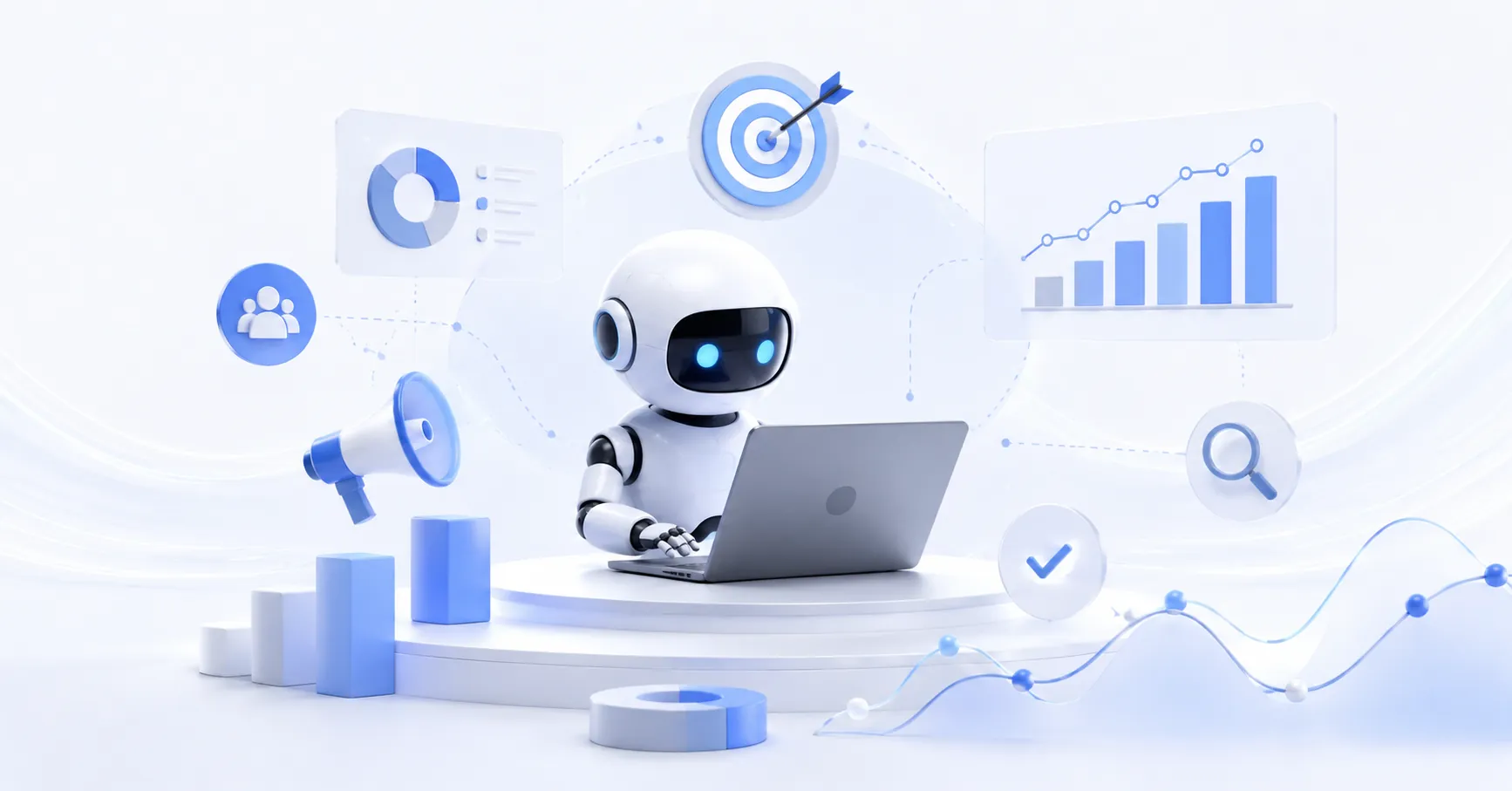
Agentic AI in Dynamic Campaign Optimization: A Complete Guide
The era of manual media buying and reactive A/B testing is officially obsolete. As we navigate the digital advertising landscape of 2026, the velocity of consumer behavior demands a technological response that human operators simply cannot match. Enter Agentic AI in Dynamic Campaign Optimization (DCO)—a paradigm shift that transforms artificial intelligence from a passive analytical tool into an active, autonomous marketing executive.
For years, generative AI served as an intelligent assistant, drafting ad copy or generating banner images based on human prompts. While valuable, this still required human operators to build campaigns, configure budgets, monitor analytics, and manually optimize performance. Today, Agentic AI bridges the gap between insight and execution. These intelligent systems continuously analyze campaign performance, reason through complex variables, and autonomously optimize targeting, bidding, creative assets, and budget allocation to achieve predefined business objectives. To successfully implement these advanced capabilities, many organizations partner with an Agentic AI development company that specializes in building enterprise-grade AI agents capable of integrating with advertising platforms, CRM systems, customer data platforms (CDPs), and analytics tools for intelligent campaign automation.
Whether you are a Chief Marketing Officer looking to maximize Return on Ad Spend (ROAS), a data scientist building next-generation advertising solutions, or a media buyer adapting to the autonomous marketing revolution, understanding Agentic AI is no longer optional. It has become the foundational technology for dynamic campaign optimization, enabling businesses to improve marketing performance, accelerate decision-making, and drive sustainable digital growth in an increasingly competitive marketplace.
What is Agentic AI in Dynamic Campaign Optimization?
Agentic AI in Dynamic Campaign Optimization (DCO) refers to the use of autonomous AI, goal-oriented artificial intelligence systems that independently plan, execute, and adjust marketing campaigns in real time. Unlike traditional AI that merely suggests content or follows rigid "if/then" rules, agentic AI actively analyzes live performance data, reallocates budgets, modifies ad creatives, and refines audience targeting without human intervention to maximize return on investment (ROI).
Agentic AI transforms dynamic campaign optimization by introducing agency—the ability for software to autonomously execute complete marketing workflows, make financial bidding decisions, and assemble personalized creatives based on high-level goals rather than step-by-step human prompts.
Why It Matters: The Strategic Importance
The transition from programmatic advertising to agentic advertising represents one of the most significant leaps in marketing technology. But why is this transition critical for businesses today?
The Death of Manual A/B Testing
Traditionally, marketers would launch Campaign A and Campaign B, wait weeks for statistical significance, and manually shift budgets to the winner. In 2026, consumer attention spans and market trends shift in hours, not weeks. Agentic AI conducts micro-experiments continuously, testing thousands of variables (copy, imagery, CTA, bidding strategy, placement) in real-time. It eliminates the latency between gaining an insight and acting upon it.
Hyper-Personalization at Scale
Modern consumers demand relevance. Delivering a generic ad to a broad demographic results in wasted ad spend and high Customer Acquisition Costs (CAC). Agentic AI utilizes real-time contextual signals—such as local weather, time of day, browsing history, and immediate search intent—to assemble bespoke ads dynamically for individual users.
Operational Efficiency and Scalability
Managing cross-channel campaigns across Google, Meta, TikTok, LinkedIn, and emerging Web3 platforms requires massive operational overhead. By deploying autonomous AI agents for business operations, enterprises can scale their marketing efforts infinitely without linearly scaling their headcount. The AI handles the execution, allowing human marketers to focus on high-level strategy, brand storytelling, and ethical oversight.
Overcoming Signal Loss in a Cookieless World
With third-party cookies completely phased out and data privacy regulations stricter than ever, deterministic targeting has given way to probabilistic modeling. Agentic AI excels at taking sparse, first-party data signals and using advanced predictive models to infer user intent, ensuring campaigns remain highly targeted even in privacy-first environments.
How It Works: The Technical Architecture
To understand how agentic AI optimizes campaigns dynamically, we must look under the hood at its architecture. An autonomous AI agent operates on a continuous feedback loop known as the Perception-Reasoning-Action framework.
Step 1: Perception (Data Ingestion)
The agent continuously monitors data streams. This includes connecting via APIs to Customer Data Platforms (CDPs), Demand-Side Platforms (DSPs), and CRM systems. The AI perceives live metrics such as Click-Through Rates (CTR), Conversion Rates (CVR), Cost Per Click (CPC), and competitor bidding behaviors.
Furthermore, when optimizing display and video ads, the system might rely on leveraging an advanced image processing solution to visually "understand" which specific elements of a video ad (e.g., a specific actor, color palette, or product angle) are driving engagement.
Step 2: Reasoning (The Cognitive Core)
Once the data is ingested, the agent uses Large Language Models (LLMs) and predictive machine learning models to reason. It asks itself questions based on its predefined goal (e.g., "Maximize conversions while keeping CAC below $20").
Is Audience Segment A fatigued by this creative?
Is the CPC on LinkedIn currently too high compared to the historical ROAS?
Based on the weather in Chicago, should I swap the creative to highlight winter wear?
The reasoning engine employs techniques like Chain-of-Thought (CoT) prompting to evaluate the long-term impact of a budget shift before making it.
Step 3: Action (Autonomous Execution)
Once a decision is reached, the agentic system takes action. Using API integrations, it can:
Increase or decrease bids on specific keywords.
Pause underperforming ad sets.
Trigger a generative AI module to create a brand-new variation of ad copy.
Push the new creative directly into the live ad network.
This entire loop—Perception, Reasoning, Action—happens thousands of times a minute, far exceeding human cognitive limits. Building this complex infrastructure often requires organizations to seek expertise by partnering with a specialized AI agent development company capable of architecting secure, autonomous workflows.
Key Features of Agentic AI in DCO
Agentic AI systems possess distinct capabilities that separate them from standard automation tools. Here are the core features defining these platforms in 2026:
Goal-Oriented Autonomy: You set the destination (e.g., "Drive 5,000 webinar signups at $15 CPA"), and the agent determines the route, navigating budget allocation and creative assembly independently.
Dynamic Creative Assembly: Agents can pull assets from a centralized brand repository—headlines, backgrounds, product shots—and assemble them on the fly based on the viewer’s real-time context.
Cross-Channel Orchestration: An agent does not view platforms in silos. If it notices TikTok is currently yielding cheaper conversions than Instagram, it will autonomously route budget from Meta to ByteDance in real-time.
Self-Correction and Reinforcement Learning: The agent learns from its mistakes. If an action (e.g., raising bids by 20%) results in lower ROAS, the reinforcement learning algorithm updates its policy to avoid that action in similar future contexts.
Generative Native Integration: By utilizing AI agents for content creation, the DCO system doesn't just shuffle existing ads; it writes new copy, generates new background imagery, and tests them instantly.
Benefits and Tangible ROI
The adoption of agentic AI in dynamic campaign optimization delivers measurable, transformative benefits for enterprise marketing teams.
1. Drastic Reduction in Customer Acquisition Cost (CAC)
Because the AI is constantly optimizing bids down to the micro-cent and shutting off wasted spend instantly, businesses typically see a 25% to 40% reduction in overall CAC. The agent never "sleeps" and leaves an underperforming campaign running over the weekend.
2. Exponential Increase in ROAS
By delivering the exact right message, in the right format, at the right time, conversion rates naturally spike. Agentic systems excel at identifying micro-segments of highly profitable audiences that human media buyers might overlook due to their small size.
3. Mitigation of Ad Fatigue
Ad fatigue occurs when an audience sees the same creative too many times, causing CTRs to plummet. Agentic AI combats this by monitoring frequency caps and autonomously swapping out creatives, color schemes, and copy before fatigue sets in, extending the lifecycle of a campaign indefinitely.
4. Elimination of Human Error and Bias
Human media buyers often hold biases (e.g., "Our audience doesn't use platform X" or "This image looks better"). Agentic AI operates strictly on mathematical probabilities and live data, eliminating emotional decision-making from budget allocation.
Real-World Use Cases
How is agentic AI being applied across different verticals today?
E-Commerce: High-Velocity Flash Sales
During peak retail events like Black Friday, inventory levels and competitor pricing change by the minute. Businesses are increasingly leveraging AI agents for ecommerce to continuously monitor inventory databases, customer demand, pricing trends, and campaign performance in real time. If a specific SKU (e.g., red sneakers) is selling out too quickly, the agent autonomously pauses ads for that product, reallocates the advertising budget to overstocked items, rewrites ad copy to highlight new promotions, and optimizes targeting to maximize revenue while minimizing wasted ad spend.
Financial Services: Compliance-Driven Personalization
In banking and insurance, marketing campaigns must comply with strict regulatory requirements while remaining highly personalized. Organizations are adopting AI agents for finance to monitor market conditions, customer behavior, and compliance policies while optimizing campaigns in real time. Using a Retrieval-Augmented Generation (RAG) framework, these AI agents dynamically generate compliant marketing content, personalize customer communications, and adjust campaign strategies based on changes in interest rates or market conditions, ensuring every message aligns with legal regulations, internal governance policies, and brand safety standards before execution.
Travel and Hospitality: Context-Aware Targeting
A travel company's agentic AI monitors weather APIs. When a blizzard hits New York, the agent instantly generates and deploys video ads across social media targeting New Yorkers, promoting discounted flights to sunny destinations like Miami, dynamically pulling live pricing into the ad creative.
B2B SaaS: Account-Based Marketing (ABM)
For B2B software companies, agentic AI tracks intent signals from target accounts. If multiple employees from a target enterprise visit the SaaS pricing page, the agent autonomously triggers a highly personalized, aggressive ad campaign across LinkedIn targeting key decision-makers at that specific company.
Specific Examples: The Agent in Action
To truly grasp the power of agentic AI, let us walk through a step-by-step hypothetical scenario of an autonomous agent managing a campaign in 2026.
Scenario: A Direct-to-Consumer (DTC) Fitness Apparel Brand
08:00 AM: The human CMO sets the goal: "Achieve 10,000 sales of the new summer collection at a target CPA of $25 with a total budget of $250,000."
08:05 AM: The agent launches 50 variations of creatives across Google, Meta, and TikTok, allocating a small test budget to each.
11:30 AM: The agent perceives that Video Ad B is performing exceptionally well with women aged 25-34 on TikTok, but failing on Meta.
11:31 AM: Autonomous Action: The agent pauses Video Ad B on Meta, quadruples the budget for it on TikTok, and uses generative AI to spawn 5 new variations of Video Ad B (changing the hook and CTA) to test further.
02:00 PM: The agent detects that a competitor has launched a flash sale, causing CPCs on Google Search to spike, destroying the ROAS.
02:02 PM: Autonomous Action: The agent scales down Google Search bidding to preserve the budget, routing the saved capital into programmatic display ads where inventory is currently cheaper.
05:00 PM: The agent emails a daily digest to the CMO in plain English, explaining the budget shifts made, the reasoning behind them, and the resulting drop in CPA from $28 to $22.
Comparison: The Evolution of Campaign Optimization
To highlight the leap forward, the table below compares traditional programmatic advertising, GenAI-assisted optimization, and Agentic AI optimization.
Feature / Capability | Traditional Programmatic DCO (Pre-2023) | GenAI-Assisted DCO (2023-2024) | Agentic AI DCO (2025-2026) |
|---|---|---|---|
Creative Generation | Manual assembly of human-made assets | AI generates copy/images, humans assemble | AI generates, assembles, and deploys autonomously |
Decision Making | Rules-based (If X happens, do Y) | Suggestive (AI suggests Y, human approves) | Autonomous (AI decides and executes Y) |
Budget Reallocation | Manual or basic algorithmic pacing | Manual based on AI predictive insights | Instant, autonomous cross-channel shifting |
Speed of Optimization | Days to Weeks (Statistical significance) | Hours to Days | Real-time (Milliseconds to Minutes) |
Human Role | Operator / Button-pusher | Editor / Approver | Strategist / Goal-setter / Auditor |
Challenges and Limitations
Despite its revolutionary capabilities, agentic AI in DCO is not without hurdles. Organizations must navigate several technical and strategic challenges to utilize this technology effectively.
The Black Box Problem and Brand Safety
Giving an AI the autonomy to write copy and spend money introduces risk. What if the agent generates a culturally insensitive ad in an attempt to drive "high engagement"? What if it overbids on a low-quality ad placement? To combat this, organizations must invest heavily in guardrails, such as establishing a strict LLM policy that restricts the agent's action space and forces it to cross-reference all outputs against a strict brand safety database.
API Rate Limits and Latency
Agentic AI relies on continuous communication with external platforms (Meta, Google, DSPs). However, these platforms impose strict AI API rate limits. If an agent tries to update bids 10,000 times a minute, it will be blocked. Engineers must design agents that optimize their API calls efficiently, bundling updates to avoid hitting these thresholds.
Data Drift and Model Decay
Consumer behavior is not static. A machine learning model trained on data from Q1 may become completely irrelevant by Q3 due to cultural shifts, economic changes, or new trends. Agentic systems require constant monitoring for "data drift" to ensure their underlying reasoning engines remain accurate.
The "Cold Start" Problem
Agentic AI needs data to make informed decisions. When launching a brand-new campaign for a new product with zero historical data, the agent struggles to optimize initially. It requires a "warm-up" period where it must burn through a testing budget to acquire the necessary data signals before it can optimize efficiently.
Best Practices for Implementing Agentic AI in Dynamic Campaign Optimization
Successfully implementing Agentic AI in dynamic campaign optimization requires more than connecting AI models to advertising platforms. Organizations need a strong data foundation, robust governance, and continuous performance monitoring to ensure autonomous campaign optimization delivers sustainable business value.
Define Clear Campaign Objectives: Establish measurable goals such as maximizing Return on Ad Spend (ROAS), reducing Customer Acquisition Cost (CAC), increasing conversions, or improving customer engagement before deploying autonomous AI agents.
Integrate Enterprise Marketing Platforms: Connect AI agents with CRM systems, Customer Data Platforms (CDPs), advertising networks, analytics platforms, content management systems, and marketing automation tools to enable end-to-end campaign orchestration.
Leverage High-Quality First-Party Data: Provide AI agents with accurate, real-time customer data, behavioral insights, and conversion metrics to improve targeting, personalization, and optimization decisions in a privacy-first environment.
Implement Human-in-the-Loop (HITL) Governance: Maintain human oversight for high-budget campaigns, brand-sensitive messaging, compliance requirements, and major strategic decisions while allowing AI agents to autonomously optimize routine campaign activities.
Continuously Monitor Campaign Performance: Track campaign metrics such as ROAS, CTR, conversion rates, audience engagement, creative performance, and budget utilization to identify optimization opportunities and improve AI decision-making.
Strengthen AI Security and Compliance: Establish role-based access controls, audit trails, brand safety policies, and regulatory compliance frameworks to ensure AI agents operate securely and responsibly across all marketing channels.
Future Trends in Agentic AI (Context: 2026 and Beyond)
As we look toward the remainder of 2026 and into the next decade, the landscape of AI in marketing continues to evolve rapidly. What are the key trends defining the next iteration of agentic DCO?
Multi-Agent Systems (Swarm AI)
We are moving away from monolithic, single-agent systems. In 2026, enterprise marketing departments are utilizing Multi-Agent System (MAS). In this setup, an ecosystem of specialized agents works collaboratively. You might have a "Creative Agent," a "Bidding Agent," and an "Analytics Agent." They converse, debate, and reach consensus on strategy in milliseconds before taking action, resulting in vastly superior optimization compared to a single overarching AI.
Zero-Party Data Integrations
With third-party data practically gone, agentic AI is becoming hyper-focused on zero-party data (data customers willingly share). Agents are increasingly integrating with conversational interfaces and chatbots, using the exact phrasing and preferences a user types into a chat window to dynamically generate personalized ad campaigns for that specific user across the web.
Emotion AI and Sentiment Analysis
Advanced agents are no longer just optimizing for clicks; they are optimizing for emotional resonance. By analyzing biometric proxies (dwell time, scroll speed, micro-interactions), agents can infer user sentiment. If an agent detects frustration (e.g., rapid scrolling), it can dynamically alter the ad creative to be softer, more helpful, and less intrusive.
Global Decentralized Ad Networks
As blockchain technology matures, we are seeing the rise of decentralized advertising exchanges. As highlighted by trends from leading tech hubs—such as a top AI development company in UK—agentic AI is uniquely positioned to navigate these decentralized networks, utilizing smart contracts to autonomously negotiate media buys and verify ad delivery without relying on traditional tech monopolies.
Conclusion
The integration of Agentic AI in dynamic campaign optimization marks the end of the manual marketing era and the beginning of autonomous, data-driven campaign management. Unlike traditional marketing automation or generative AI, which primarily provides recommendations or content, Agentic AI continuously analyzes live campaign data, customer behavior, market trends, and competitive insights before autonomously executing optimization strategies in real time. AI agents can dynamically adjust advertising budgets, modify bidding strategies, personalize creatives, optimize audience targeting, and reallocate resources across channels without requiring constant human intervention.
This continuous optimization significantly improves marketing efficiency by reducing Customer Acquisition Costs (CAC), increasing Return on Ad Spend (ROAS), and maximizing campaign performance around the clock. As a result, the role of marketers is evolving from manually managing campaigns to defining strategic objectives, establishing AI governance framework and providing AI agents with high-quality brand guidelines and business goals. Looking ahead, organizations that embrace Multi-Agent Systems (MAS), real-time contextual intelligence, and privacy-first marketing strategies will be better equipped to thrive in a cookieless digital ecosystem. Businesses that delay adopting Agentic AI-powered campaign optimization risk losing their competitive advantage to organizations capable of making intelligent marketing decisions and executing them at machine speed.
FAQs
Agentic AI uses autonomous AI agents to optimize advertising campaigns in real time by adjusting budgets, bids, audience targeting, and creatives to achieve business goals.
It continuously analyzes campaign data, identifies optimization opportunities, reallocates budgets, personalizes ads, and improves conversions with minimal human intervention.
Key benefits include lower customer acquisition costs, higher ROAS, automated campaign management, real-time optimization, and personalized customer experiences.
Retail, eCommerce, finance, SaaS, travel, healthcare, media, and enterprise businesses use Agentic AI to improve advertising performance and marketing efficiency.
Yes. With secure integrations, governance, and AI oversight, Agentic AI enables enterprises to automate campaign optimization while maintaining brand consistency and compliance.
Tags

Yash Singh is the Chief Marketing Officer at Vegavid Technology, a leading AI-driven technology company specializing in AI agents, Generative AI, Blockchain, and intelligent automation solutions. With over a decade of experience in digital transformation and emerging technologies, Yash has played a key role in helping businesses adopt advanced AI solutions that enhance operational efficiency, automate workflows, and deliver personalized customer experiences across industries including fintech, healthcare, gaming, ecommerce, and enterprise technology. An alumnus of Indian Institute of Technology Bombay, Yash combines strong technical expertise with strategic marketing leadership to drive innovation in AI-powered applications, autonomous AI agents, Retrieval-Augmented Generation (RAG), Natural Language Processing (NLP), Large Language Models (LLMs), machine learning systems, conversational AI, and enterprise automation platforms. His expertise spans AI model integration, intelligent workflow automation, prompt engineering, smart data processing, and scalable AI infrastructure development, enabling organizations to accelerate digital transformation and business growth. Passionate about the future of intelligent systems, Yash actively shares insights on AI agents, Generative AI, LLM-powered applications, blockchain ecosystems, and next-generation digital strategies. He is committed to helping businesses embrace AI-first transformation while guiding teams to build impactful, industry-specific solutions that shape the future of innovation and intelligent technology.







Leave a Reply