
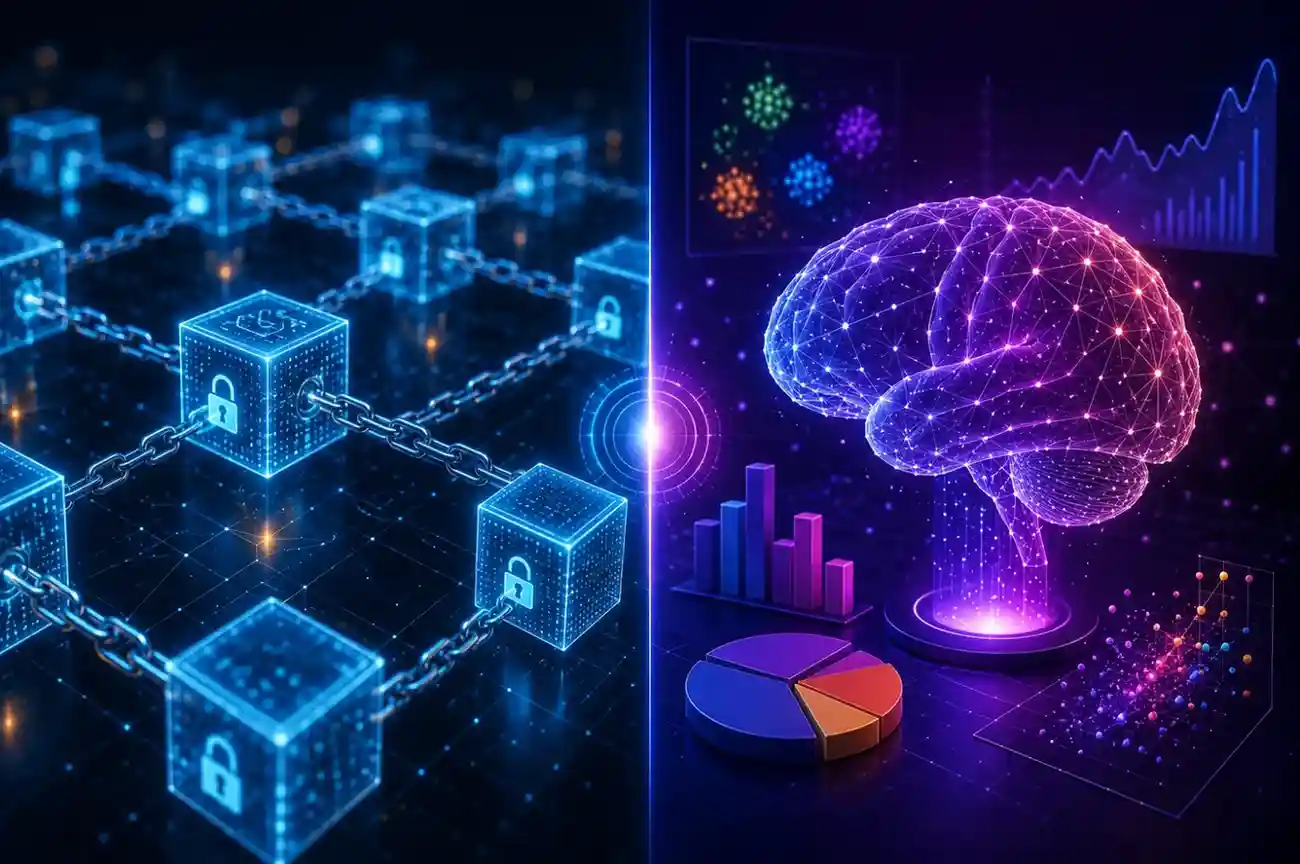
Difference Between Blockchain and Machine Learning: Core Concepts, Use Cases, and Future Applications
Introduction
The digital transformation era is defined by rapid innovation, where advanced technologies are reshaping how businesses operate, compete, and grow. Among these innovations, blockchain and machine learning stand out as two of the most influential forces driving change across industries. Although they are often discussed within the same technological ecosystem, they serve very different purposes and operate on entirely distinct principles.
Understanding the Difference Between Blockchain and Machine Learning is essential for organizations aiming to adopt the right technology for their business objectives. Blockchain focuses on creating secure, decentralized systems for recording and verifying transactions, while machine learning is centered on enabling systems to learn from data and make intelligent predictions.
The growing interest in Blockchain vs Machine Learning highlights a broader need for clarity in how these technologies function, where they excel, and how they can be leveraged effectively. Businesses today are not just choosing between technologies—they are designing ecosystems where multiple innovations work together to create value.
This article provides a comprehensive exploration of both technologies, covering their foundations, use cases, advantages, challenges, and future impact. It also offers practical insights for organizations seeking to implement these technologies strategically. By the end, you will have a clear understanding of how blockchain and machine learning differ and how each can contribute to your digital transformation journey.
What Is Blockchain?
Blockchain is a decentralized digital ledger technology that records, stores, and verifies transactions across a distributed network of computers. Instead of relying on a central authority, blockchain uses consensus mechanisms to validate transactions and maintain a shared, tamper-resistant record of data. Each transaction is grouped into a block, encrypted, and linked to the previous block, creating a secure and immutable chain of records.
The decentralized nature of blockchain ensures that all participants in the network have access to the same version of the ledger, improving transparency and reducing the risk of fraud or unauthorized modifications. Consensus mechanisms such as Proof of Work (PoW) and Proof of Stake (PoS) help verify transactions and maintain the integrity of the blockchain without requiring intermediaries. This architecture makes blockchain highly secure, reliable, and resistant to single points of failure.
Today, blockchain technology is used far beyond cryptocurrencies. It supports applications in industries such as finance, healthcare, supply chain, real estate, manufacturing, and government by enabling secure data sharing, smart contracts, digital identity management, and asset tokenization. As organizations continue to embrace digital transformation, blockchain has become a foundational technology for building transparent, efficient, and decentralized systems.
Key Features of Blockchain
1. Decentralization
Blockchain operates through a distributed network of computers, eliminating the need for a central authority and reducing single points of failure.
2. Immutability
Once data is recorded on the blockchain, it cannot be easily modified or deleted, ensuring the integrity and permanence of transaction records.
3. Transparency
Transactions are recorded on a shared ledger that authorized participants—or the public, depending on the blockchain type—can verify, improving visibility and accountability.
4. Consensus Mechanisms
Blockchain networks use consensus protocols such as Proof of Work (PoW) or Proof of Stake (PoS) to validate transactions and maintain agreement across the network.
5. Smart Contract Support
Many blockchain platforms support smart contracts that automatically execute predefined actions when specific conditions are met, enabling process automation.
Benefits of Blockchain
1. Enhanced Security
Blockchain uses cryptographic techniques and decentralized validation to protect data from unauthorized access, fraud, and tampering.
2. Improved Operational Efficiency
By automating processes and reducing reliance on intermediaries, blockchain streamlines workflows and accelerates transaction processing.
3. Lower Operational Costs
Eliminating intermediaries and automating business processes can reduce administrative expenses and transaction costs.
4. Greater Trust and Accountability
The ability to verify transactions on an immutable ledger increases trust among participants and minimizes disputes.
5. Better Traceability
Blockchain enables organizations to track the origin, movement, and ownership of assets in real time, improving transparency across supply chains and business operations.
Types of Blockchain Networks
1. Public Blockchain
A public blockchain is an open and decentralized network that anyone can join, access, and participate in. It offers high transparency and security, making it suitable for cryptocurrencies and decentralized applications (dApps).
2. Private Blockchain
A private blockchain is a permissioned network controlled by a single organization. Only authorized participants can access the network, making it ideal for enterprises that require greater privacy, security, and control over data.
3. Consortium Blockchain
A consortium blockchain is governed by a group of trusted organizations rather than a single entity. It enables secure collaboration among multiple participants while maintaining controlled access, making it suitable for industries such as banking, healthcare, and supply chain management.
4. Hybrid Blockchain
A hybrid blockchain combines the features of both public and private blockchains. Organizations can keep sensitive data private while allowing selected information to remain publicly accessible, offering flexibility, transparency, and enhanced security.
5. Sidechain
A sidechain is an independent blockchain connected to a main blockchain, allowing digital assets and data to move between networks. Sidechains improve scalability, enable experimentation with new features, and reduce the workload on the primary blockchain.
What Is Machine Learning?
Machine Learning (ML) is a branch of Artificial Intelligence (AI) that enables computers to learn from data and improve their performance without being explicitly programmed for every task. Instead of following fixed instructions, machine learning algorithms analyze large datasets, identify patterns, and make predictions or decisions based on the information they have learned. As more data becomes available, these models can continuously improve their accuracy and performance.
Machine learning works by training algorithms on historical or real-time data to recognize relationships and generate insights. Depending on the type of learning approach, models can classify information, predict future outcomes, detect anomalies, or automate complex decision-making processes. Common machine learning techniques include supervised learning, unsupervised learning, and reinforcement learning, each designed for different types of problems and datasets.
Today, machine learning powers a wide range of real-world applications across industries. It is used in recommendation systems, fraud detection, predictive maintenance, healthcare diagnostics, financial forecasting, autonomous vehicles, customer service, and cybersecurity. By enabling intelligent automation and data-driven decision-making, machine learning has become a key technology driving innovation and digital transformation across businesses worldwide.
Key Features of Machine Learning
1. Data-Driven Learning
Machine learning algorithms learn from historical and real-time data to identify patterns and improve their performance without explicit programming.
2. Pattern Recognition
Machine learning can detect hidden relationships, trends, and anomalies within large datasets, enabling accurate analysis and predictions.
3. Predictive Modeling
ML models use learned patterns to forecast future outcomes, classify information, and support data-driven decision-making.
4. Continuous Improvement
As new data becomes available, machine learning models can be retrained to improve their accuracy and adapt to changing conditions.
5. Multiple Learning Approaches
Machine learning supports various techniques, including supervised learning, unsupervised learning, and reinforcement learning, allowing it to solve a wide range of problems.
Benefits of Machine Learning
1. Improved Decision-Making
Machine Learning analyzes large volumes of data to provide actionable insights, helping organizations make faster and more informed decisions.
2. Increased Operational Efficiency
By automating repetitive tasks and optimizing workflows, machine learning improves productivity while reducing manual effort.
3. Enhanced Customer Experience
ML enables personalized recommendations, intelligent chatbots, and customized services that improve customer engagement and satisfaction.
4. Better Risk and Fraud Detection
Machine learning can identify unusual patterns and suspicious activities in real time, helping businesses reduce fraud and manage risks more effectively.
5. Business Innovation
Machine learning enables organizations to develop intelligent products, optimize business processes, and uncover new growth opportunities through data-driven insights.
Types of Machine Learning Models
1. Supervised Learning
Supervised learning trains models using labeled datasets, where the correct output is already known. It is commonly used for tasks such as classification, regression, spam detection, and price prediction.
2. Unsupervised Learning
Unsupervised learning works with unlabeled data to identify hidden patterns, relationships, or groupings. It is widely used for customer segmentation, anomaly detection, and data clustering.
3. Semi-Supervised Learning
Semi-supervised learning combines a small amount of labeled data with a larger volume of unlabeled data to improve model accuracy while reducing the effort required for data labeling.
4. Reinforcement Learning
Reinforcement learning enables an AI agent to learn by interacting with an environment and receiving rewards or penalties for its actions. It is commonly applied in robotics, autonomous vehicles, gaming, and resource optimization.
5. Deep Learning
Deep learning is an advanced subset of machine learning that uses artificial neural networks with multiple layers to process complex data. It powers applications such as image recognition, speech recognition, natural language processing, and generative AI.
Key Differences Between Blockchain and Machine Learning
Purpose and Functionality
The primary difference between blockchain and machine learning lies in their objectives. Blockchain is designed to provide secure, transparent, and tamper-resistant data management, whereas machine learning focuses on analyzing data, identifying patterns, and making predictions. Blockchain establishes trust in data, while machine learning transforms that data into actionable insights.
Data Usage and Processing
Blockchain stores information in an immutable and structured ledger, ensuring data integrity and traceability. In contrast, machine learning processes large datasets to discover patterns, classify information, and generate predictive models. One secures data, while the other extracts value from it.
Learning Capability
Blockchain follows predefined protocols and consensus mechanisms, meaning it does not learn or adapt over time. Machine learning continuously improves its performance by learning from historical and real-time data, making it suitable for applications that require adaptability and intelligent decision-making.
Centralization vs Intelligence
Blockchain promotes decentralization by distributing data and decision-making across multiple network participants, reducing reliance on a central authority. Machine learning, however, typically depends on centralized computing resources and large datasets to train and deploy intelligent models.
Transparency and Trust
Blockchain offers a transparent and verifiable record of transactions that participants can independently validate. Machine learning models often function as "black boxes," where understanding how a prediction was made can be challenging, reducing transparency in some applications.
Security Approach
Blockchain secures data through cryptography, consensus mechanisms, and immutable records that prevent unauthorized modifications. Machine learning focuses on securing predictive models and data pipelines but is more vulnerable to issues such as biased data, adversarial attacks, and model manipulation.
Automation and Decision-Making
Blockchain automates transactions through smart contracts that execute predefined rules without manual intervention. Machine learning automates decision-making by analyzing data and generating predictions or recommendations based on learned patterns.
This contrast reflects their different approaches to handling data and delivering value.
Use Cases of Blockchain
Financial Transactions
Blockchain has transformed the financial industry by enabling secure and transparent transactions. It reduces the need for intermediaries, lowering costs and improving efficiency.
Banks and financial institutions use blockchain for cross-border payments, fraud detection, and digital asset management.
Supply Chain Transparency
In supply chain management, blockchain provides visibility into the movement of goods, ensuring authenticity and reducing fraud.
Companies can track products from origin to destination, improving accountability and operational efficiency.
Healthcare Data Management
Blockchain is increasingly used in healthcare to secure patient data and improve interoperability between systems.
It ensures that medical records are accurate, accessible, and protected from unauthorized access.
Digital Identity Verification
Blockchain enables secure digital identities, reducing the risk of identity theft and enhancing user privacy.
Organizations can verify identities without relying on centralized databases.
Use Cases of Machine Learning
Predictive Analytics
Machine learning is widely used for Predictive analytics, enabling businesses to forecast trends and make informed decisions.
It analyzes historical data to identify patterns and predict future outcomes.
Customer Personalization
Machine learning enhances customer experiences by delivering personalized recommendations and services.
Businesses use it to improve engagement and increase customer satisfaction.
Fraud Detection
Machine learning models can detect unusual patterns in data, helping organizations identify and prevent fraudulent activities.
This is particularly valuable in the financial sector.
Automation and Efficiency
Machine learning automates repetitive tasks, reducing human effort and increasing productivity.
It allows employees to focus on strategic activities, improving overall efficiency.
Machine Learning Development in Business
Importance of Machine Learning Development
Machine Learning Development has become a critical component of modern business strategies. It enables organizations to harness data for competitive advantage.
Companies use machine learning to optimize operations, improve customer experiences, and drive innovation.
Role of Data in Development
Data plays a central role in machine learning development. High-quality data ensures accurate and reliable models.
Organizations must invest in data infrastructure to support machine learning initiatives.
Implementation Strategies
Successful implementation requires a structured approach, including data collection, model training, and deployment.
Businesses often work with an AI Development Company to streamline this process and ensure effective outcomes.
Real-World Applications
Machine learning is used across industries, from healthcare to finance, demonstrating its versatility and impact.
Companies like Vegavid help organizations implement machine learning solutions tailored to their needs.
Blockchain Development in Business
Importance of Blockchain Development
Blockchain Development is essential for businesses seeking secure and transparent systems.
It enables organizations to build trust and improve operational efficiency.
Enterprise Applications
Blockchain is used in enterprise applications such as supply chain management, financial services, and identity verification.
These applications demonstrate its potential to transform industries.
Development Considerations
Implementing blockchain requires careful planning, including selecting the right network type and ensuring scalability.
Businesses often collaborate with a Blockchain Development Company to build robust solutions.
Strategic Benefits
Blockchain provides long-term benefits, including enhanced security, reduced costs, and improved transparency.
Organizations like Vegavid assist businesses in leveraging these benefits effectively.
Choosing the Right Technology Between Blockchain and Machine Learning
Evaluating Business Needs
The choice between blockchain and machine learning depends on your organization's goals and use cases. If your priority is secure, transparent, and tamper-proof data management, blockchain is the better option. If you want to analyze data, automate processes, and improve decision-making, machine learning is the more suitable technology.
Strategic Decision-Making
Organizations should evaluate factors such as existing infrastructure, data availability, budget, scalability requirements, regulatory compliance, and long-term business objectives before selecting the appropriate technology. A strategic implementation plan helps maximize return on investment.
Hiring the Right Talent
Successful implementation requires professionals with expertise in the chosen technology. Many organizations choose to Hire AI Developers to build and deploy customized machine learning solutions, while blockchain specialists help develop secure decentralized applications and digital asset platforms.
Implementation Challenges
Businesses should prepare for challenges such as implementation costs, technical complexity, integration with existing systems, and scalability. Partnering with experienced technology experts can help streamline deployment, reduce risks, and ensure long-term success.
Blockchain and Machine Learning Together
Complementary Technologies
Blockchain and machine learning are complementary rather than competing technologies. While blockchain provides secure, transparent, and tamper-proof data management, machine learning transforms that data into actionable insights through intelligent analysis and automation.
Practical Applications
Organizations are combining blockchain and machine learning in areas such as fraud detection, predictive maintenance, supply chain optimization, healthcare analytics, and digital identity management. Together, these technologies improve data integrity while enabling smarter decision-making.
Business Benefits
Integrating blockchain with machine learning helps businesses enhance transparency, strengthen data security, automate complex processes, and improve operational efficiency. This combination also supports more accurate analytics by ensuring the reliability of training data.
Future Opportunities
The convergence of blockchain and machine learning will continue to drive innovation across industries, enabling advanced solutions for Web3, smart cities, decentralized finance, and enterprise automation. Companies like Vegavid are exploring these opportunities to develop secure and intelligent digital solutions.
Future Trends in Blockchain and Machine Learning
Advancements in Intelligent Automation
The integration of blockchain and machine learning will enable more secure and intelligent automation across industries. Businesses will increasingly use these technologies to streamline operations, improve decision-making, and reduce manual intervention.
Enterprise Adoption
Organizations across finance, healthcare, manufacturing, logistics, and retail are expected to accelerate the adoption of blockchain and machine learning to enhance security, optimize workflows, and deliver data-driven insights.
Decentralized AI and Web3
The rise of decentralized AI, Web3, and tokenized ecosystems will create new opportunities for combining blockchain with machine learning. These innovations will support transparent AI models, secure data sharing, and collaborative intelligence.
Innovation Opportunities
As blockchain and machine learning continue to evolve, they will drive innovation in areas such as smart cities, predictive supply chains, digital identity, and autonomous systems. Companies like Vegavid are exploring these technologies to develop next-generation enterprise solutions.
Conclusion
Blockchain and machine learning are two powerful technologies that are transforming the digital landscape. While they serve different purposes, their combined potential offers significant opportunities for innovation and growth. Understanding their differences, strengths, and applications is essential for making informed decisions.
Businesses must evaluate their needs carefully and adopt a strategic approach when implementing these technologies. Whether it is enhancing security through blockchain or driving insights with machine learning, the right approach can deliver substantial value.
Organizations like Vegavid demonstrate how thoughtful implementation can bridge the gap between innovation and practical application, helping businesses navigate complex technological landscapes.
Are you ready to explore the potential of AI and transform your business with intelligent, data-driven solutions?
FAQs
Blockchain is a decentralized system designed to securely record and verify transactions, ensuring transparency and immutability. Machine learning, on the other hand, focuses on analyzing data, identifying patterns, and making predictions. While blockchain ensures data trust, machine learning extracts insights and enables intelligent decision-making.
Yes, both technologies can complement each other effectively. Blockchain provides secure and tamper-proof data, which enhances the quality of data used by machine learning models. In return, machine learning can optimize blockchain operations, detect anomalies, and improve efficiency in decentralized systems.
Machine learning is widely used in industries such as healthcare, finance, retail, and manufacturing. It helps in predictive analytics, fraud detection, personalized marketing, and automation. Its ability to process large datasets makes it highly valuable across multiple sectors.
Blockchain is generally more secure than traditional centralized systems because of its decentralized architecture and cryptographic protection. Data stored on a blockchain cannot be altered without network consensus, making it highly resistant to tampering and unauthorized access.
Some common challenges include the need for large and high-quality datasets, high development costs, algorithmic bias, and data privacy concerns. Additionally, businesses require skilled professionals to build and maintain machine learning models effectively.

Yash Singh is the Chief Marketing Officer at Vegavid Technology, a leading AI-driven technology company specializing in AI agents, Generative AI, Blockchain, and intelligent automation solutions. With over a decade of experience in digital transformation and emerging technologies, Yash has played a key role in helping businesses adopt advanced AI solutions that enhance operational efficiency, automate workflows, and deliver personalized customer experiences across industries including fintech, healthcare, gaming, ecommerce, and enterprise technology. An alumnus of Indian Institute of Technology Bombay, Yash combines strong technical expertise with strategic marketing leadership to drive innovation in AI-powered applications, autonomous AI agents, Retrieval-Augmented Generation (RAG), Natural Language Processing (NLP), Large Language Models (LLMs), machine learning systems, conversational AI, and enterprise automation platforms. His expertise spans AI model integration, intelligent workflow automation, prompt engineering, smart data processing, and scalable AI infrastructure development, enabling organizations to accelerate digital transformation and business growth. Passionate about the future of intelligent systems, Yash actively shares insights on AI agents, Generative AI, LLM-powered applications, blockchain ecosystems, and next-generation digital strategies. He is committed to helping businesses embrace AI-first transformation while guiding teams to build impactful, industry-specific solutions that shape the future of innovation and intelligent technology.




Leave a Reply