
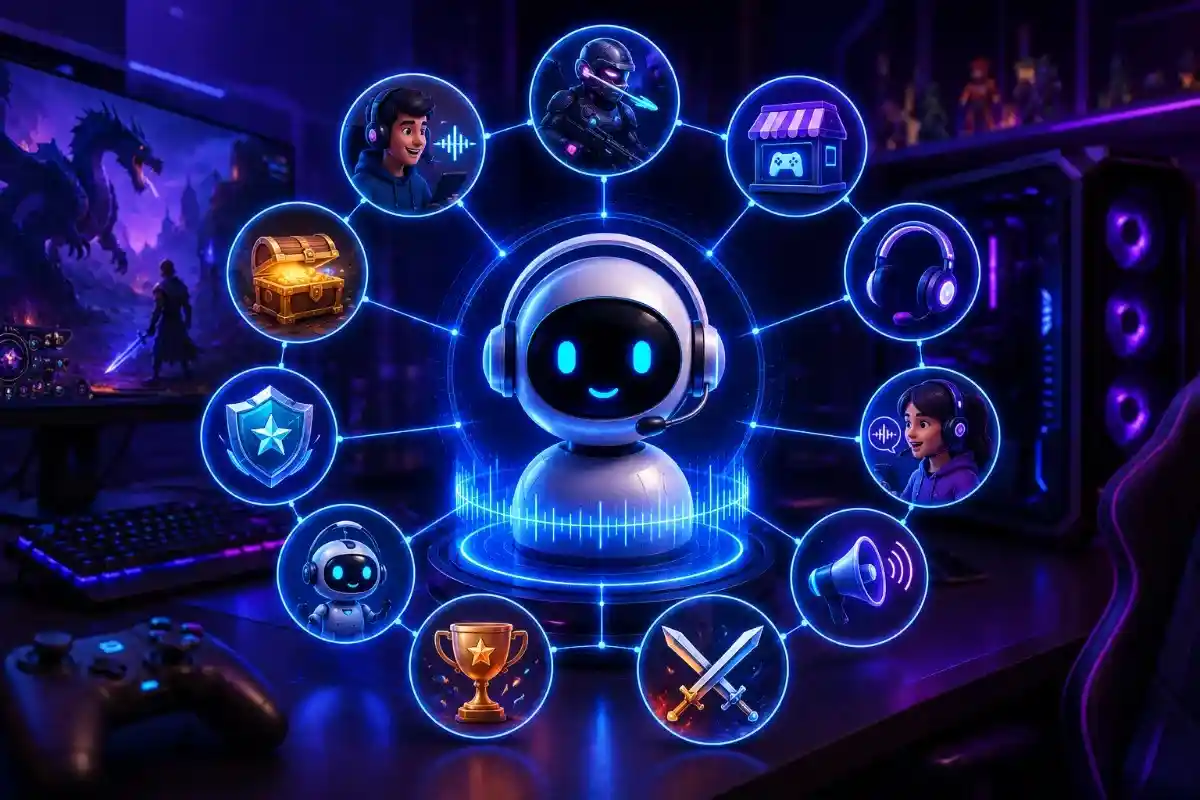
Top 10 Use Cases of AI Voice Agents in Gaming
Introduction
Gaming has always been a conversation between the player and the world on screen, but for most of its history that conversation has run through menus, text boxes, and pre-recorded lines triggered by scripted events. That is changing quickly. Studios are now experimenting with systems that let a player speak naturally to a character, a support line, or a matchmaking assistant and get a real, contextual reply back. This shift is part of a broader wave of AI in gaming that is reshaping everything from non-player character behavior to how publishers handle player support at scale. This article walks through what these systems actually are, how they function inside a game or a support pipeline, why they matter for studios and publishers, the concrete benefits they deliver, the use cases already shipping in real titles, and the trends shaping where the technology goes from here.
What Are AI Voice Agents in Gaming?
An Artificial Intelligence voice agent in a gaming context is a software system that can hold a spoken conversation with a player and respond in a way that feels natural, contextual, and specific to the moment, rather than pulling from a fixed set of pre-recorded lines. Unlike traditional dialogue trees, where a player picks from a short list of preset options, a voice agent listens to what is actually said, interprets intent, and generates a reply that reflects the character's personality, the current game state, and the history of the conversation so far.
These systems combine several technical layers working together in real time: automatic speech recognition that converts a player's spoken words into text, a language model that understands intent and composes a response consistent with a character's backstory or a support agent's script, and text-to-speech synthesis that turns that response back into natural-sounding audio. In a game, this might mean a merchant NPC that remembers a previous trade, or a customer support line that answers a billing question without forcing the player to sit through a phone menu. Because the technology can follow interruptions, tangents, and follow-up questions, it feels far closer to talking with an actual character or a knowledgeable support agent than to navigating a scripted system, and this shift is exactly why so many studios are exploring conversational voice systems across both narrative design and player operations.
How Do AI Voice Agents Work in Gaming?
Understanding the underlying process helps studios decide where voice agents genuinely add value versus where a simpler scripted system is still the better choice. A voice agent generally moves through four connected stages during a single exchange, and each one needs to run with very low latency, since gameplay pacing does not tolerate long pauses in conversation.
Speech Recognition and Intent Detection
The moment a player speaks, whether into a microphone during gameplay or over a support call, the system converts that audio into text using automatic speech recognition tuned for background noise, accents, and the fast, casual phrasing players tend to use. Engines such as Deepgram and AssemblyAI are frequently used for this layer because both are built to hold up under noisy, real-time conditions. A language model then parses the text to identify what the player actually wants, whether that is asking an NPC for directions or reporting a billing issue.
Character or Scenario Reasoning
Once intent is identified, the system pulls in relevant context, such as an NPC's backstory, prior interactions, or the player's account history, so the response stays consistent rather than generic. This is where careful AI Voice Agent Development becomes essential, since the depth of this reasoning layer determines whether a character feels alive or simply repeats variations of the same canned line.
Response Generation and Voice Synthesis
The system composes a reply and converts it into speech using a synthetic voice built to match the character's tone, age, or personality. Providers such as ElevenLabs are widely used for this natural-sounding voice layer, while gaming-specific engines like Convai and NVIDIA ACE combine voice generation with real-time facial animation so the character's expression matches what it is saying.
Escalation and Continuity
Well-designed agents recognize when a conversation needs to shift, such as a support query that requires a human agent or a narrative moment that needs to hand off to a scripted cutscene, and they do this while preserving context so nothing has to be repeated.
Why Are AI Voice Agents Important for Gaming?
Modern games run on live-service economics, and that means publishers now manage millions of concurrent players, constant patch cycles, and support queues that never fully close. A single popular title can generate tens of thousands of player support tickets a week, ranging from account recovery to matchmaking disputes, and most of those questions repeat the same handful of patterns. Voice agents absorb this repetitive load without fatigue or inconsistency, which frees human support staff to focus on genuinely complex escalations, such as fraud investigations or accessibility requests.
There is also a creative argument that matters just as much as the operational one. Players increasingly expect worlds that respond to them rather than worlds built entirely from pre-written branches, and studios that invest in the right AI Voice Agent Development Services can deliver NPCs and companions that genuinely react to what a player says instead of forcing them down a narrow dialogue tree. Beyond immersion, there is a retention angle too: players who get fast, accurate support during a billing dispute or a lost-item issue are considerably more likely to stay engaged with a title than those left waiting on a ticket queue for days. For these reasons, voice automation has moved from an experimental novelty to a genuine competitive differentiator for studios serious about both player experience and operational efficiency, a trend closely tracked in broader AI agent market trends across industries.
Benefits of AI Voice Agents in Gaming
The value of voice automation in gaming becomes clearer when broken into specific, measurable advantages rather than abstract claims. Below are ten practical benefits studios and publishers are already realizing.
Round-the-Clock Player Support Coverage
A voice agent does not observe office hours or time zones. Whether a player in Manila calls at three in the morning about a failed purchase or a player in Brazil needs help mid-match, the system answers immediately, and enterprise phone platforms like Bland are built specifically to keep this kind of always-on support line running reliably at global scale.
More Believable and Reactive Non-Player Characters
NPCs powered by voice agents can respond to what a player actually says rather than cycling through the same handful of canned lines, which makes side quests, companions, and merchants feel meaningfully more alive across repeated playthroughs.
Reduced Support Ticket Backlogs
Front-line support teams spend a large share of their day answering routine questions about account recovery, refunds, and matchmaking issues. Automating these repetitive interactions lets human agents redirect their time toward complex cases and genuine player relationship management.
Faster Response Times During Launch Spikes
Game launches and major content drops create support volume spikes that overwhelm even well-staffed teams. Voice agents scale instantly to handle thousands of simultaneous conversations, so players are not stuck waiting in a queue during the busiest days of a release cycle.
Lower Operating Costs Compared to Scaling Human Support Teams
Hiring and training additional support staff for seasonal launch spikes is expensive and often leaves teams underused during quieter months. No-code builders such as Synthflow let smaller studios stand up this kind of scalable support coverage without a large engineering budget.
Better Accessibility for Global and Multilingual Player Bases
Multilingual voice agents can converse in a player's preferred language, which matters enormously for global titles with players spread across dozens of regions. Platforms such as Kore.ai and Yellow.ai are frequently chosen for this reason, since both are built to handle high volumes of multilingual conversation at scale.
Richer Data on Player Sentiment and Pain Points
Every voice conversation generates a transcript and structured data about what players are actually asking or frustrated by. Studios can analyze these patterns to spot recurring balance complaints or confusing mechanics and address the root cause rather than repeatedly answering the same support ticket.
Improved Onboarding for New Players
A voice-guided tutorial companion can answer a new player's questions in natural language as they explore early game systems, reducing the drop-off that often happens when players feel lost during the first hour of a complex title.
Safer, Healthier Voice Chat Environments
Real-time voice moderation tools such as Modulate's ToxMod analyze live voice channels for harassment and toxic behavior, giving studios a proactive way to protect players without relying solely on manual reports after the fact.
Deeper Personalization at Scale
Voice agents connected to player profiles can remember a player's preferred playstyle, past choices, or in-game relationships, delivering the kind of individualized attention that would otherwise require significantly more writing and support staff than most studios can budget for.
Top 10 Use Cases of AI Voice Agents in Gaming
Following are the Top 10 Use Cases of AI Voice Agents in Gaming:
Studios and platforms worldwide are already deploying voice automation across a wide range of practical scenarios. The following ten represent the most common and highest-impact use cases seen in games and gaming platforms today.
1. Dynamic NPC Dialogue and Companion Characters
Instead of choosing from a preset list of dialogue options, players can speak naturally to a companion or merchant and receive a contextual, in-character response. Platforms such as Inworld AI are widely used to build this kind of persistent, personality-driven NPC dialogue system across open-world and narrative-heavy titles.
2. Interactive Storytelling and Branching Narrative Experiences
Some narrative-focused games use voice-driven characters that adapt emotionally to what a player says, shifting tone and story direction based on the conversation. Tools like Charisma.ai specialize in exactly this kind of emotionally aware, branching interactive storytelling.
3. Real-Time NPC Perception and Action
Beyond simple dialogue, some voice agents allow characters to perceive objects in the game world and act on spoken requests, such as handing over an item a player asks for by name. NVIDIA ACE combines this kind of spatial awareness with real-time voice synthesis and facial animation for exactly this purpose.
4. Player Support and Account Recovery Lines
Voice agents answer routine account recovery, refund, and purchase-related questions instantly, routing genuinely complex cases to a human agent. Enterprise contact-center platforms like PolyAI are commonly used for this kind of high-volume, structured player support conversation.
5. Matchmaking and Lobby Assistance
A voice agent can answer questions about queue times, rank requirements, or party formation while players wait in a lobby, reducing friction during a moment that otherwise has no dedicated support channel.
6. In-Game Purchase and Billing Support
Players calling about a failed transaction or a missing item can get an immediate, accurate answer instead of waiting on a ticket, with telephony infrastructure such as Twilio commonly handling the underlying call routing for this kind of support line.
7. Esports and Tournament Registration Assistance
Voice agents can walk competitors through tournament registration, rule clarifications, and scheduling conflicts, handling the first round of routine questions so organizers can focus on the events themselves.
8. Voice-Driven Tutorials and Onboarding Guides
New players can ask a tutorial companion questions aloud instead of digging through menus, particularly useful for complex strategy or simulation titles with steep learning curves. Developer-focused platforms such as Retell AI and Vapi are often used to build this kind of low-latency, conversational onboarding assistant.
9. Community and Voice Chat Moderation
Live voice channels in multiplayer titles are monitored for harassment and disruptive behavior using dedicated voice moderation systems, helping studios maintain healthier communities without relying purely on player reports.
10. Accessibility Features for Players with Disabilities
Voice-driven navigation and command systems allow players with mobility or vision impairments to control certain game functions or receive spoken descriptions of on-screen information, and this remains one of the fastest-growing AI Voice Agent Use Cases in Gaming among studios building for genuinely inclusive player bases.
Choosing the Right Technology Partner
Studios rarely build every layer of a voice system from scratch, and choosing between the many available platforms is rarely a purely technical decision. It depends on the game engine already in use, budget, in-house technical capacity, and the specific mix of narrative and support use cases a studio wants to cover. Cloud providers such as Google Dialogflow, Amazon Lex, and Microsoft Azure AI are sometimes used for the support side of this equation when a studio already has infrastructure built on one of these ecosystems.
This is exactly where working with an experienced AI Voice Agent Development Company adds value, since selecting, configuring, and integrating the right combination of narrative and support technology is a specialized skill in itself. Firms such as Vegavid work directly with studios and gaming platforms to assess where a voice agent would genuinely improve the player experience, choose the appropriate underlying technology, and build a conversational flow that reflects how players actually talk rather than a generic script borrowed from an unrelated industry, a related discipline covered in depth in this guide to AI tools for game development. This kind of tailored Conversational AI Voice Agent Development Services approach tends to produce far better player reception than dropping in an out-of-the-box tool without customization.
Future Trends in AI Voice Agents in Gaming
The technology underlying gaming voice agents is evolving quickly, and several clear directions are already shaping what studios can expect over the next few years.
Persistent NPC Memory Across Play Sessions
Future voice agents will remember player interactions across multiple sessions rather than resetting each time, allowing companions and rivals to reference events from weeks earlier in a natural way.
Emotionally Adaptive Dialogue Systems
Advances in voice synthesis and emotion modeling are making characters sound genuinely responsive to a player's tone, adjusting warmth, humor, or tension based on how a conversation unfolds.
Deeper Integration with Game Engines
Voice agent platforms are increasingly building native plugins for Unreal Engine and Unity, reducing the technical overhead studios face when adding conversational NPCs to an existing project.
Real-Time Voice Moderation Becoming Standard
As voice chat becomes central to more multiplayer titles, proactive moderation systems will likely become a default expectation rather than an optional add-on, similar to how text moderation became standard a decade ago.
Retrieval-Augmented NPCs with Deep Lore Knowledge
Characters will increasingly draw on a game's full lore database in real time to answer detailed questions accurately, an approach closely related to the broader rise of retrieval-augmented generation techniques across enterprise AI.
Voice Agents in Web3 and Blockchain-Based Games
As blockchain gaming and player-owned economies continue to grow, voice agents are likely to play a role in guiding players through wallet interactions and marketplace transactions within titles such as those covered in this overview of play-to-earn Web3 games.
Open-Source Agentic Frameworks Entering Game Pipelines
Studios are beginning to experiment with open-source agentic frameworks to orchestrate multiple AI-driven characters within a single scene, coordinating their behavior more efficiently than isolated dialogue systems.
On-Device Processing for Console and VR Titles
Improvements in edge computing will allow more voice processing to happen locally on consoles and VR headsets, reducing latency and making conversations feel noticeably more responsive during fast-paced gameplay.
Cross-Platform Voice Identity for Companions
Players will increasingly expect a companion character's voice and personality to persist across platforms, from console to mobile to cloud streaming, rather than resetting with each device.
Wider Adoption Among Mid-Size and Indie Studios
As no-code and mid-market voice tools mature, smaller studios that previously could not afford custom conversational systems will gain access to capable voice agents, narrowing the gap between AAA productions and independent titles.
Conclusion
Voice automation has moved well past the experimental stage in gaming. From NPCs that respond naturally to what a player actually says, to support lines that resolve a billing issue at any hour, these systems are already improving both the creative and operational sides of how studios run their games. The studios seeing the strongest results are not simply bolting on off-the-shelf software; they are thoughtfully mapping where a voice agent genuinely improves the player experience and building conversational systems around real player behavior. Working with a capable AI Agent Development Company, such as Vegavid, to design, integrate, and continuously refine these systems tends to make the difference between a voice feature players quickly ignore and one that becomes a memorable part of how they experience a game. If your studio or platform is ready to explore how a well-designed voice agent could improve player engagement and support efficiency, it is worth starting the conversation with a team that understands both the technology and the realities of shipping games. Reach out to an experienced AI Development Company like Vegavid to discuss where voice automation could make the biggest difference for your next title today.
Ready to transform your business?
FAQs
AI voice agents are conversational AI systems that enable players to interact naturally with NPCs, support teams, and in-game assistants through voice conversations.
They provide immersive NPC interactions, faster support responses, personalized gameplay experiences, and more engaging tutorials for players.
Yes, AI voice agents can integrate with game engines, customer support systems, voice chat platforms, and player databases through APIs and middleware solutions.
Popular use cases include dynamic NPC conversations, player support, voice-driven tutorials, matchmaking assistance, community moderation, and accessibility features.
Tags

Yash Singh is the Chief Marketing Officer at Vegavid Technology, a leading AI-driven technology company specializing in AI agents, Generative AI, Blockchain, and intelligent automation solutions. With over a decade of experience in digital transformation and emerging technologies, Yash has played a key role in helping businesses adopt advanced AI solutions that enhance operational efficiency, automate workflows, and deliver personalized customer experiences across industries including fintech, healthcare, gaming, ecommerce, and enterprise technology. An alumnus of Indian Institute of Technology Bombay, Yash combines strong technical expertise with strategic marketing leadership to drive innovation in AI-powered applications, autonomous AI agents, Retrieval-Augmented Generation (RAG), Natural Language Processing (NLP), Large Language Models (LLMs), machine learning systems, conversational AI, and enterprise automation platforms. His expertise spans AI model integration, intelligent workflow automation, prompt engineering, smart data processing, and scalable AI infrastructure development, enabling organizations to accelerate digital transformation and business growth. Passionate about the future of intelligent systems, Yash actively shares insights on AI agents, Generative AI, LLM-powered applications, blockchain ecosystems, and next-generation digital strategies. He is committed to helping businesses embrace AI-first transformation while guiding teams to build impactful, industry-specific solutions that shape the future of innovation and intelligent technology.


Leave a Reply